The Short Answer: AHAM Verified purifiers have independently tested CADR ratings. Look for the AHAM seal and match CADR to your room size (CADR ÷ 1.55 = max sq ft). Higher CADR means faster air cleaning but potentially more noise.
Editor’s note (September 2026): The Winix 5500-2 has been discontinued and remaining stock is limited. Winix’s official successor is the Winix 5510, which adds app control and uses a new filter. Read our Winix 5510 vs 5500-2 comparison before you buy either one.
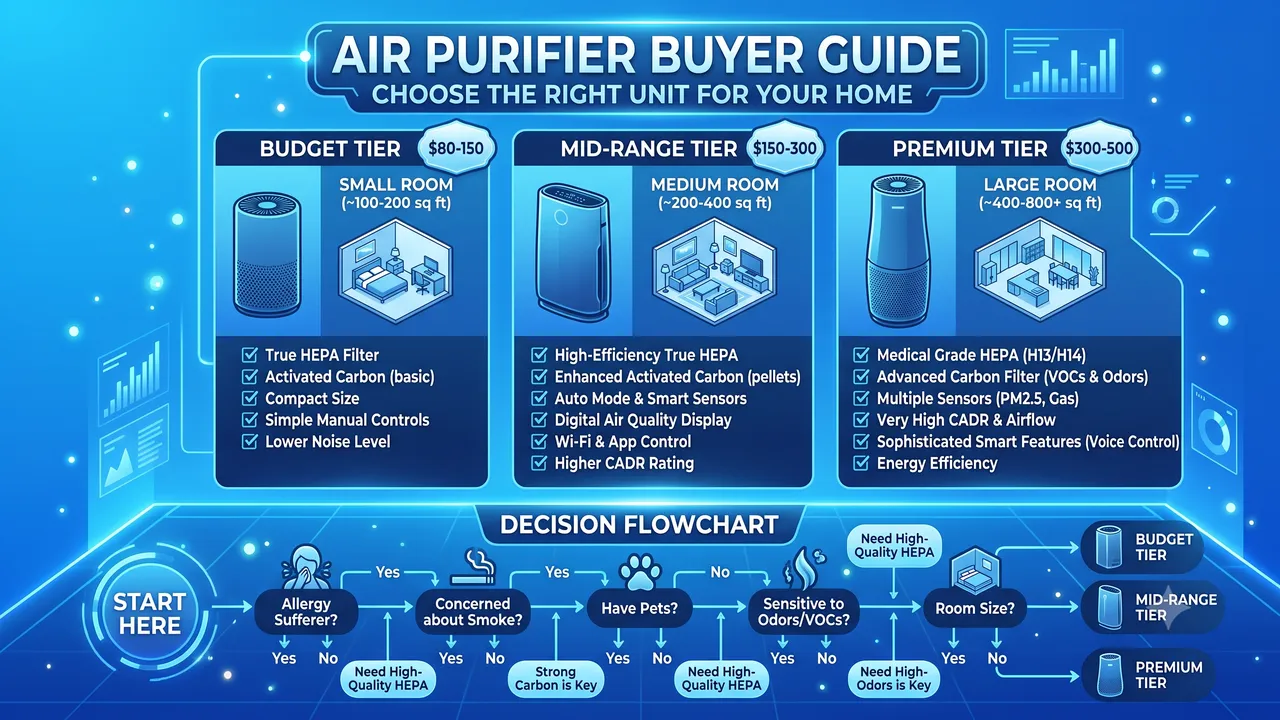
Why Indoor Air Quality Matters
The EPA estimates that indoor air can be 2 to 5 times more polluted than outdoor air, and Americans spend roughly 90% of their time indoors. The World Health Organization attributes approximately 3.8 million premature deaths annually to household air pollution.
Common indoor pollutants include:
- Particulate matter (PM2.5 and PM10) from cooking, candles, and outdoor infiltration
- Volatile organic compounds (VOCs) from paint, furniture, cleaning products, and building materials
- Mold spores thriving in damp bathrooms and basements
- Pet dander and dust mite allergens affecting roughly 30% of the population
- Wildfire smoke, an increasingly common concern, with the 2023 Canadian wildfires affecting air quality across 20+ U.S. states
A good air purifier isn’t a luxury purchase, it’s one of the most direct investments you can make in your long-term respiratory health.
How We Evaluated
We focused on four objective criteria rather than marketing claims:
- Clean Air Delivery Rate (CADR), The AHAM-certified measurement of how quickly a purifier cleans air of smoke, dust, and pollen. Higher is better.
- Filter type and quality, True HEPA (99.97% at 0.3 microns) vs. HEPA-type claims, plus activated carbon weight for VOC/gas filtration
- Room coverage, Based on 4.8 air changes per hour (ACH), not the exaggerated claims some manufacturers use
- Operating cost, Filter replacement costs per year plus energy consumption at typical usage
The Best Air Purifiers for 2026
Best Overall: Coway Airmega AP-1512HH
Coway’s AP-1512HH has been Wirecutter’s top pick for years and remains the best combination of performance, price, and operating cost. Its CADR ratings are 246 (smoke), 240 (dust), and 233 (pollen), placing it in the top tier for mid-size purifiers.
- Room size: Up to 361 sq ft (4.8 ACH) or 874 sq ft (2 ACH)
- Filter type: True HEPA + activated carbon sheet + washable pre-filter
- Annual filter cost: Approximately $50-60
- Noise: 24-53 dB (quieter than a refrigerator on low)
- Energy: ENERGY STAR certified, roughly $30-40/year to run 24/7
- Price: $189-229
The real standout feature is the air quality indicator that changes color based on real-time particle detection. It also has an Eco mode that turns the fan off when air is clean for 30+ minutes, saving energy without sacrificing performance.
Best for Large Rooms: Blueair Blue Pure 211i Max
For spaces over 500 square feet, the Blueair 211i Max delivers impressive performance. Blueair’s HEPASilent technology combines electrostatic and mechanical filtration, achieving high CADR with lower noise and energy consumption than pure mechanical HEPA.
- CADR: 410 (smoke), 380 (dust), 380 (pollen)
- Room size: Up to 635 sq ft (4.8 ACH) or 1,524 sq ft (2 ACH)
- Filter type: HEPASilent (electrostatic + mechanical) + activated carbon
- Annual filter cost: Approximately $70-80
- Noise: 23-52 dB
- Price: $339
The 211i Max connects to Blueair’s app for remote control and air quality monitoring, though the auto mode works well enough that you’ll rarely need the app. The fabric pre-filter comes in multiple colors, a small touch that makes a big difference in living spaces.
Best Budget: Levoit Core 300
For under $100, the Levoit Core 300 offers genuine True HEPA filtration in a compact package. It’s ideal for bedrooms, home offices, and nurseries.
- CADR: 141 (smoke), 140 (dust), 145 (pollen)
- Room size: Up to 219 sq ft (4.8 ACH) or 547 sq ft (2 ACH)
- Filter type: True HEPA + activated carbon pellet filter
- Annual filter cost: Approximately $35-40
- Noise: 24-50 dB
- Price: $89-99
For the price, the Core 300 punches well above its weight. The replacement filters are widely available and affordable, and Levoit offers specialized versions: a toxin-absorber filter with extra carbon for VOCs, and a pet allergy filter with additional pre-filtration.
Best for Allergies: Winix 5500-2
The Winix 5500-2 is the most feature-rich purifier in the mid-range, with a true HEPA filter, washable activated carbon filter, and Winix’s proprietary PlasmaWave technology (which creates hydroxyls that neutralize bacteria and viruses, an ionization method that produces no harmful ozone, unlike older ionizers).
- CADR: 243 (smoke), 246 (dust), 232 (pollen)
- Room size: Up to 360 sq ft (4.8 ACH)
- Filter type: True HEPA + washable AOC carbon + PlasmaWave
- Annual filter cost: Approximately $55-65
- Noise: 27-57 dB
- Price: $159-199
The carbon filter is washable rather than disposable, which reduces long-term costs. Unlike many competitors, the Winix includes a remote control, useful if the purifier sits across the room. PlasmaWave can be turned off with a button if you prefer mechanical filtration only.
Best Premium: IQAir HealthPro Plus
The IQAir HealthPro Plus sits in a different league entirely. It’s used in hospitals and cleanrooms worldwide and was deployed extensively during the SARS outbreak in Hong Kong hospitals. The HyperHEPA filter captures particles down to 0.003 microns, 100 times smaller than the True HEPA standard.
- CADR: Not AHAM rated (IQAir uses their own testing methodology)
- Room size: Up to 1,125 sq ft (2 ACH) or 450 sq ft (5 ACH)
- Filter type: HyperHEPA + 5 lbs V5-Cell activated carbon + pre-filter
- Annual filter cost: Approximately $200-280
- Noise: 22-57 dB (quietest in class on low)
- Price: $899
The V5-Cell gas filter contains 5 pounds of activated carbon and impregnated alumina, far more than any consumer purifier. This makes the HealthPro Plus the best option for people with Multiple Chemical Sensitivity (MCS), those living in areas with heavy industrial pollution, or anyone wanting the absolute best filtration possible.
Best Design: Molekule Air Pro
Molekule takes a fundamentally different approach with PECO (Photo Electrochemical Oxidation) technology, which they claim destroys pollutants at a molecular level rather than just trapping them. Independent testing has shown mixed results, but the design is unmatched and for people in smaller spaces who prioritize aesthetics, it’s compelling.
- Room size: Up to 1,000 sq ft (manufacturer claim; independent tests suggest ~250-350 sq ft effective)
- Filter type: PECO + pre-filter
- Annual filter cost: Approximately $140-180
- Noise: 30-60 dB
- Price: $799
Important caveat: Consumer Reports and independent labs have found Molekule’s performance inconsistent compared to traditional HEPA purifiers. We include it for design-conscious buyers, but for pure filtration performance at this price, IQAir or multiple Coway units offer objectively better air cleaning.
Comparison Table
| Model | CADR (Smoke/Dust/Pollen) | Room Size (4.8 ACH) | Annual Filter Cost | Price |
|---|---|---|---|---|
| Coway AP-1512HH | 246/240/233 | 361 sq ft | $50-60 | $189-229 |
| Blueair 211i Max | 410/380/380 | 635 sq ft | $70-80 | $339 |
| Levoit Core 300 | 141/140/145 | 219 sq ft | $35-40 | $89-99 |
| Winix 5500-2 | 243/246/232 | 360 sq ft | $55-65 | $159-199 |
| IQAir HealthPro Plus | Not AHAM rated | 450 sq ft | $200-280 | $899 |
| Molekule Air Pro | Not AHAM rated | ~300 sq ft | $140-180 | $799 |
How to Pick the Right Size
The most common mistake is buying an undersized purifier. Here’s the formula:
- Measure your room in square feet (length × width)
- A purifier’s “recommended room size” on the box usually assumes 2 ACH (air changes per hour)
- For allergies, asthma, or wildfire smoke, you want 4.8 ACH, which means the effective room size is roughly 40% of the manufacturer’s 2 ACH rating
Example: If a purifier claims “covers 500 sq ft”, that’s at 2 ACH. At 4.8 ACH, it effectively covers about 200 sq ft. For a 12’ × 15’ bedroom (180 sq ft), that’s perfect. For a 20’ × 30’ living room (600 sq ft), you’d need multiple units or a much larger model.
The Bottom Line
For most people in apartments or standard-size rooms, the Coway AP-1512HH is the right answer. It balances performance, cost, and reliability better than anything else on the market. If you have a large open-plan space, step up to the Blueair 211i Max. For bedrooms and nurseries on a budget, the Levoit Core 300 is unbeatable at its price point.
And if money is no object and you want medical-grade filtration at home, the IQAir HealthPro Plus is in a class of its own.
Related Articles
- How to Choose an Air Purifier: CADR, ACH, and HEPA Explained
- Air Purifier Filter Replacement Guide: Costs and Schedules
The Warranty Reality Check
Manufacturer warranties look reassuring on paper, 1 to 5 years depending on the model, but what they actually cover is narrower than most buyers assume. Coway’s warranty, for example, covers defects in materials and workmanship. It does not cover: filter replacements (obviously), damage from power surges, cosmetic wear, or failure caused by using third-party filters. Read the warranty terms before purchasing. They’re usually available as a PDF on the manufacturer’s website, buried in the “Support” section.
The more practical question: how responsive is the company when something goes wrong? Based on owner reports across forums and review sites: Coway’s U.S. support is responsive but slow (2-3 business days for email, limited phone hours). Blueair is faster but more likely to refer you to the retailer for initial troubleshooting. Winix has mixed reviews, some owners get prompt replacements, others get the runaround. Levoit, being newer and aggressively growing, has the most variable support experience.
For the best protection, buy from a retailer with a solid return policy. Amazon’s 30-day return window is standard. Some Costco and Sam’s Club locations carry air purifiers with their legendary return policies, worth checking if you’re a member.
The CADR Number You’re Probably Ignoring
Everyone looks at the overall CADR score, but the individual CADR values, smoke, dust, and pollen, tell different stories. If you live in a wildfire-prone area, the Smoke CADR is the only number that matters. If you have pets, look at Dust CADR. If seasonal allergies are your concern, Pollen CADR.
The Coway AP-1512HH’s CADR of 246 (smoke) and 240 (dust) are well-balanced. The Blueair 211i Max at 410 (smoke) is in a different league for wildfire applications. The Levoit Core 300 at 141 (smoke) is perfectly adequate for a bedroom but wholly inadequate for a living room during smoke season.
The rule of thumb from the EPA: your Smoke CADR should be at least equal to your room’s square footage for effective wildfire smoke protection at 5 ACH. A 300 sq ft room needs a 300+ Smoke CADR, period. Most budget purifiers fall well short.
Disclosure: We may earn a commission from qualifying purchases. Our recommendations are based on objective performance data, not advertiser relationships.
Frequently Asked Questions
How long should I run my air purifier each day?
For best results, run your air purifier 24/7 on medium speed. Air purification works by continuously removing particles—turning it off allows them to accumulate again. Modern purifiers use 30-80W on medium (similar to a light bulb), making continuous operation energy-efficient.
Where is the best place to put an air purifier?
Place the purifier 3-5 feet from your breathing zone, near pollution sources, with unobstructed airflow on all sides. Avoid corners, curtains, and furniture that block intake or output. For bedrooms, position near the bed but not blowing directly on you.
How do I know when to replace the filter?
Most purifiers have filter indicator lights. Without indicators, replace HEPA filters every 6-12 months and carbon filters every 3-6 months. Signs of a clogged filter: reduced airflow, visible discoloration, increased noise, or the purifier seeming less effective.
Are air purifiers noisy?
Noise levels vary by model and fan speed. Sleep modes (20-25 dB) are quieter than a whisper. Medium speeds (35-45 dB) are similar to background music. High speeds (50-60 dB) are conversation level. For bedrooms, look for sleep modes under 25 dB.
Do air purifiers use a lot of electricity?
No. Most purifiers use 30-80W on medium and 5-15W on sleep mode. Running 24/7 on medium costs $2-8/month at average US electricity rates. Energy Star models use 15-40% less electricity. The main ongoing cost is filter replacement ($30-120/year).
Browse All Our Air Purifier Guides
By Room Type
- Best Air Purifier for Bedrooms, Quiet operation and sleep-friendly features
- Best Air Purifier for Large Rooms, High CADR for open-plan spaces
- Best Air Purifier for Apartments, Compact designs for small spaces
- Best Air Purifier for Nursery, Safe and quiet for baby rooms
- Best Air Purifier for Home Office, Low noise for focused work
- Best Air Purifier for Kitchen, Cooking odors and grease particles
- Room-by-Room Air Purifier Guide, Placement strategy for every room
By Health Concern
- Best Air Purifier for Allergies, Pollen, dust mites, and pet dander
- Best Air Purifier for Asthma, HEPA filtration for respiratory relief
- Best Air Purifier for COPD, What pulmonologists recommend
- Best Air Purifier for Mold, Spore filtration and humidity control
- Air Purifier for Dust Mite Allergies, Targeted dust mite protection
- Air Purifier for Chemical Sensitivity, VOC and chemical filtration
By Problem
- Best Air Purifier for Smoke, Wildfire and tobacco smoke filtration
- Best Air Purifier for Pets, Dander, odor, and fur management
- Best Air Purifier for Dust, Fine particle removal
- Best Air Purifier for Cat Litter Smell, Ammonia and odor control
- Air Purifier for VOCs and Formaldehyde, Chemical off-gassing protection
Product Reviews
- Levoit Core 400S Review, Smart has and solid performance
- MOOKA Air Purifier Review, Budget brand deep dive
- Coway Airmega 250 Review, Mid-range premium option
- Coway Airmega 400 Review, Large room powerhouse
- Dyson Air Purifier Review, Premium design and bladeless tech
Head-to-Head Comparisons
- Coway vs Levoit, Two top brands compared
- Coway AP-1512HH vs Levoit Core 400S, Classic matchup
- Blueair vs Coway, Premium vs value
- Dyson vs Coway, Design vs performance
- Winix 5500-2 vs Blueair 211, Mid-range showdown
Guides and How-To
- Air Purifier Buying Guide, Everything first-time buyers need
- How to Choose: CADR and ACH Explained, Technical specs demystified
- HEPA Filter Deep Dive, Filter technology explained
- Air Purifier Placement Guide, Where to put it for maximum effect
- Filter Replacement Guide, Costs, schedules, and tips
Tools
- CADR Calculator, Find the right CADR for your room
- Energy Cost Calculator, Calculate running costs
- Room Size Calculator, Measure your space
- Purifier Finder, Get personalized recommendations
Support This Guide
Helpful? Add The Air Purifier Guide as a preferred source on Google so our guides show up in your search results.
Related Articles

Coway Mighty2 vs AP-1512HH (2026)
Coway's Mighty2 replaced the AP-1512HH as Wirecutter's top pick. We compare CADR, noise, sensors, filter costs, and whether the older unit is still the smarter buy.

KNKA APH4000 Review: $150 Dark Horse
KNKA's APH4000 is one of Amazon's best-selling purifiers at $150. We check the AHAM certification, decode the 1,695 sq ft claim, and compare it to Levoit and Coway.

Levoit Core 300 vs 300-P: What Changed
Levoit quietly replaced the Core 300 with the Core 300-P. We explain the AHAM certification, whether filters still fit, and which one you should actually buy.

Shark NeverChange HP302 Review
Shark's NeverChange HP302 promises 5 years on one filter. We dig into the real running costs, the odor neutralizer catch, and whether it beats cheaper rivals.

Winix 5510 vs 5500-2: 2026 Verdict
The Winix 5500-2 is discontinued and the 5510 takes over. We compare CADR, noise, filter costs, and the one compatibility problem nobody mentions.
🛒 Products Mentioned
As an Amazon Associate, we earn from qualifying purchases.
Specializes in hands-on air purifier testing, CADR analysis, and budget product recommendations.
View all articles by Alex →