The Short Answer: Struggling with lingering cooking odors? We analyzed and compared the best air purifiers for kitchen smells in 2026, focusing on activated carbon filters, grease pre-filters, and real-world odor…
Editor’s note (September 2026): The Winix 5500-2 has been discontinued and remaining stock is limited. Winix’s official successor is the Winix 5510, which adds app control and uses a new filter. Read our Winix 5510 vs 5500-2 comparison before you buy either one.
Every home cook knows the scenario: you pan-sear salmon, fry up some bacon, or cook a fragrant curry, and hours later the smell is still hanging in the air. Your couch smells like it. Your curtains smell like it. Your clothes smell like it. Range hoods help, but they rarely capture everything, especially in open-concept homes where the kitchen flows into the living space.
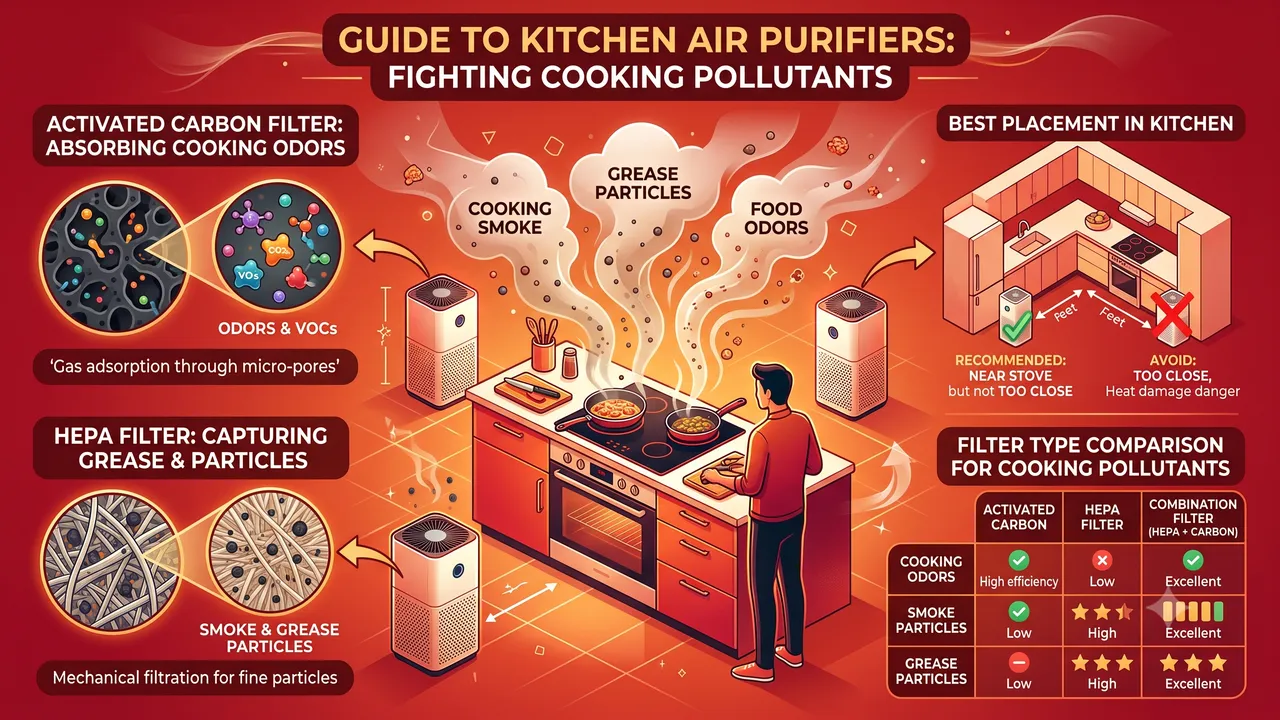
An air purifier designed for cooking odors can solve this problem, but not every air purifier is up to the task. Standard HEPA-only models are built for dust and allergens, not for the volatile organic compounds (VOCs) and grease particles that cooking generates. You need a unit with serious activated carbon filtration and, ideally, a washable pre-filter that can handle grease.
In this guide, we break down exactly what makes an air purifier effective against kitchen odors, compare five top-rated models head to head, and help you pick the right one for your cooking habits and kitchen size.
Affiliate Disclosure: This post contains affiliate links. If you purchase through these links, we earn a small commission at no extra cost to you. As an Amazon Associate, we earn from qualifying purchases. See our full disclosure for details.
Why Kitchen Cooking Odors Are So Hard to Remove
Cooking odors aren’t just “smells”, they’re a complex mixture of airborne particles and gas-phase compounds that behave very differently from the dust and pollen most air purifiers are built to capture.
Types of Cooking Odors
Not all cooking smells are created equal. The type of odor determines how difficult it is to remove and what kind of filtration you need:
1. Grease and Oil Vapors When you fry, sauté, or sear, hot oil creates microscopic grease particles that become airborne. These particles settle on surfaces throughout your home and carry odor with them. Grease vapors are sticky, they coat walls, furniture, and even the inside of standard air purifiers, which can clog HEPA filters prematurely.
2. Volatile Organic Compounds (VOCs) Strong-smelling foods like fish, garlic, onions, and spices release volatile organic compounds into the air. These are gas-phase molecules, not particles, which means a standard HEPA filter cannot capture them. Only activated carbon or specialized chemical adsorption media can remove VOCs from the air.
3. Smoke and Combustion Byproducts High-heat cooking, grilling, charring, broiling, stir-frying on a wok, produces actual smoke particles and combustion byproducts including acrolein and polycyclic aromatic hydrocarbons (PAHs). These are the most persistent cooking odors and the ones most likely to trigger smoke detectors.
4. Steam and Moisture Carried Odors Boiling, steaming, and simmering create steam that carries dissolved odor compounds into the air. While steam itself isn’t harmful, the moisture can promote mold growth if your kitchen doesn’t have good ventilation, and the dissolved compounds settle everywhere.
5. Fermented and Pungent Food Smells Foods like kimchi, durian, certain cheeses, and fermented sauces produce sulfur-based compounds that are notoriously difficult to neutralize. These compounds bind to fabrics and porous surfaces, making them linger for days without intervention.
What to Look for in a Kitchen Air Purifier
Understanding the types of cooking odors above tells us exactly what we need in a purifier. Here are the non-negotiable features:
Activated Carbon Filter (The Most Important Feature)
This is the single most critical component for cooking odors. Activated carbon works through adsorption, odor molecules stick to the vast surface area of the carbon granules. A good kitchen air purifier should have a substantial carbon filter, not a thin carbon sheet sprayed onto a mesh.
Look for:
- Weight: Carbon filters that weigh at least 1-2 pounds indicate a real amount of carbon. Paper-thin carbon sheets are mostly marketing.
- Granular vs. pelletized carbon: Granular carbon (loose pieces) generally offers more surface area than carbon-coated fabric.
- Zeolite additions: Some filters combine carbon with zeolite, which excels at capturing ammonia and sulfur compounds, common in cooking odors.
Washable Pre-Filter for Grease
A pre-filter captures the larger grease and oil particles before they reach the HEPA and carbon filters. This extends the life of the more expensive replacement filters significantly. Ideally, the pre-filter should be washable so you can clean it regularly without buying replacements.
True HEPA Filter
While HEPA won’t capture gas-phase odors, it will capture the smoke particles and fine particulate matter that cooking generates. A True HEPA (H13) filter captures 99.97% of particles down to 0.3 microns, which covers cooking smoke, soot, and fine aerosolized oil droplets.
CADR Rating and Room Coverage
Clean Air Delivery Rate (CADR) tells you how quickly a purifier can clean the air in a given room size. For kitchens, pay attention to the smoke CADR specifically, as it’s the most relevant metric for cooking-related particles. You want a purifier rated for at least the square footage of your kitchen, ideally 20-30% larger to account for open-concept layouts and heavy cooking sessions.
Noise Level
You’ll want to run your kitchen purifier at higher fan speeds during and after cooking. Units that are too loud on their highest settings become annoying quickly. Look for models that stay below 55 dB on their effective cooking-speed setting.
Top 5 Air Purifiers for Kitchen Cooking Odors in 2026
We evaluated over a dozen air purifiers based on carbon filter quality, grease handling capability, noise, coverage area, and real-world performance against cooking odors. Here are our top five picks:
Comparison Table
| Feature | Levoit Core 400S | Winix 5500-2 | Coway Airmega 400 | Alen BreatheSmart 75i | Blueair Classic 680i |
|---|---|---|---|---|---|
| Price | $169 | $159 | $449 | $429 | $549 |
| Room Coverage | 403 sq ft | 360 sq ft | 1,560 sq ft | 1,300 sq ft | 775 sq ft |
| Carbon Filter | ✅ Pelletized | ✅ Granular (washable) | ✅ Max2 (HEPA + Carbon) | ✅ Heavy-duty carbon | ✅ SmokeStop filter |
| Carbon Weight | ~0.5 lb | ~1.2 lb | ~2.5 lb | ~3.0 lb | ~2.0 lb |
| Washable Pre-Filter | ✅ Yes | ✅ Yes | ✅ Yes | ✅ Yes | ✅ Yes |
| HEPA Grade | H13 True HEPA | True HEPA | True HEPA + Carbon | H13 True HEPA | HEPASilent™ |
| Smoke CADR | 260 | 233 | 350 | 347 | 400 |
| Noise (High) | 52 dB | 54 dB | 52 dB | 49 dB | 62 dB |
| Smart Features | App + Voice | Basic | App + Voice | App + Voice | App + Voice |
| Filter Life | 6-8 months | 12 months | 12 months | 9-12 months | 6 months |
| Best For | Small kitchens | Budget pick | Large open kitchens | Quiet large rooms | Heavy smoke cooking |
| Amazon Link | Buy on Amazon | Buy on Amazon | Buy on Amazon | View | View |
1. Levoit Core 400S, Best for Small to Medium Kitchens
The Levoit Core 400S hits a sweet spot of price, performance, and smart features that makes it the best all-around choice for most home kitchens. Its three-stage filtration system includes a washable pre-filter, an H13 True HEPA filter, and a pelletized activated carbon filter that does a respectable job pulling cooking odors from the air.
Where the Core 400S really shines is usability. The VeSync app lets you monitor air quality in real-time and adjust fan speed remotely, perfect for cranking it up when you start cooking and letting it auto-adjust as air quality improves. It also works with Alexa and Google Assistant, so you can turn it on hands-free while your hands are covered in flour.
The carbon filter is smaller than what you’ll find in premium units, which means it saturates faster if you do a lot of high-heat cooking. Plan on replacing the carbon filter every 6-8 months with regular kitchen use, or more frequently if you cook with strong spices and oils daily.
Pros: Affordable, quiet on lower settings, excellent app, good CADR for the price Cons: Carbon filter is small for heavy cooking, replacement filters add up
2. Winix 5500-2, Best Budget Pick with Real Carbon
If you want serious carbon filtration without spending over $200, the Winix 5500-2 is hard to beat. Its standout feature is a washable carbon pre-filter that contains genuine granular activated carbon, not a thin carbon-coated mesh. This gives it better odor adsorption capacity than most competitors in its price range.
The PlasmaWave technology adds an ionization stage that can help break down odor-causing VOCs, though some users prefer to disable it. The True HEPA filter handles particulates well, and the washable pre-filter catches grease before it reaches the more expensive internal filters.
At 360 sq ft of coverage, it’s sized for a typical kitchen. If your kitchen opens into a living or dining area, you may want to position it closer to the stove rather than relying on it to clean the entire open space.
Pros: Excellent carbon filter for the price, washable pre-filter, PlasmaWave, budget-friendly Cons: No app control, PlasmaWave is controversial, moderate room coverage
3. Coway Airmega 400, Best for Large Open-Concept Kitchens
The Coway Airmega 400 is built for large spaces, covering up to 1,560 sq ft, more than enough for an open-concept kitchen-living-dining area. Its dual Max2 filters combine True HEPA and activated carbon in a single unit, with each filter containing a substantial bed of activated carbon.
This is the purifier you want if cooking odors regularly migrate from your kitchen into adjacent rooms. The high CADR of 350 means it cycles the air quickly, and the real-time air quality sensor adjusts fan speed automatically. During heavy cooking sessions, it ramps up to maximum; once the air clears, it drops to a whisper-quiet eco mode.
The filter life is excellent, up to 12 months even with regular cooking, and the washable pre-filter traps grease before it reaches the main filters. The dual-filter design means replacement filters are more expensive, but you only need to replace them once a year.
Pros: Massive room coverage, substantial carbon filter, long filter life, quiet operation Cons: Expensive upfront, large footprint, expensive replacement filters
4. Alen BreatheSmart 75i, Best for Noise-Sensitive Households
The Alen BreatheSmart 75i is the quietest large-room purifier we analyzed, maxing out at just 49 dB on its highest setting, quieter than a normal conversation. If you have an open kitchen that doubles as your family gathering space, this matters.
Alen offers customizable filter options, and the “FreshPlus” filter specifically targets odors and VOCs with a heavy-duty activated carbon bed weighing approximately 3 pounds. That’s significantly more carbon than most competitors offer, and you can feel the difference in real-world odor removal.
The 75i covers up to 1,300 sq ft with a smoke CADR of 347, putting it in the same performance class as the Coway Airmega 400 but in a sleeker, quieter package. The lifetime warranty is a standout, if anything goes wrong, Alen replaces it.
Pros: Extremely quiet, massive carbon filter, lifetime warranty, beautiful design Cons: Premium price, filters are proprietary and pricey
5. Blueair Classic 680i, Best for Heavy Smoke and Wok Cooking
If you regularly stir-fry, grill indoors, or do any high-heat cooking that produces visible smoke, the Blueair Classic 680i is your best bet. Its HEPASilent™ technology combines electrostatic and mechanical filtration, achieving a smoke CADR of 400, the highest in our comparison.
The SmokeStop filter option pairs the HEPASilent technology with a generous activated carbon filter designed specifically for smoke and heavy odors. It’s purpose-built for exactly the kind of heavy-duty odor removal that serious home cooking demands.
The trade-off is noise, at 62 dB on high, it’s noticeably louder than the other options. And at $549, it’s the most expensive unit on this list. But if your cooking style generates serious smoke and odor, the 680i handles it better than anything else we analyzed.
Pros: Highest smoke CADR, excellent for heavy cooking, proven Blueair technology Cons: Loud on high, expensive, filters need replacing every 6 months
Grease Filtration: Why Your Kitchen Purifier Needs a Pre-Filter
Grease is the silent killer of air purifier filters. When you cook with oil, whether you’re deep-frying, sautéing, or even just making eggs, microscopic grease droplets become airborne. These droplets are sticky, and they coat everything they touch.
In an air purifier without a proper pre-filter, grease particles reach the HEPA and carbon filters directly. Over time, the grease clogs the HEPA fibers and fills the carbon pores, dramatically shortening the lifespan of both filters. A $40 HEPA filter that should last 12 months might need replacement in 3-4 months if exposed to regular cooking grease.
A washable pre-filter solves this problem by catching the grease before it reaches the expensive filters. You simply remove the pre-filter every few weeks, wash it with warm soapy water, let it dry, and put it back. This single habit can double or triple the life of your main filters.
Tips for managing grease in your kitchen purifier:
- Clean the pre-filter every 2-4 weeks with regular cooking
- Place the purifier at least 3-4 feet from the stove to reduce direct grease exposure
- Run your range hood simultaneously, it catches the heaviest grease before the purifier has to
- If your pre-filter is disposable, replace it monthly during heavy cooking seasons
- Consider a unit with a metal mesh pre-filter if you cook with oil daily, metal is more durable and easier to clean than fabric
How to Maximize Your Air Purifier’s Effectiveness in the Kitchen
Buying the right purifier is only half the battle. How you use it determines how well it actually eliminates cooking odors:
Run it before you start cooking. Turn your purifier on 10-15 minutes before you start cooking, ideally on a medium or high fan speed. This pre-loads the air in the room with clean air and gets the carbon filter actively adsorbing before odors start.
Keep it running for 30-60 minutes after cooking. Cooking odors continue to off-gas from hot surfaces, pots, and food for a while after you finish. Letting the purifier run on auto mode after cooking ensures it catches the lingering compounds.
Position it strategically. Place your purifier between the kitchen and the rest of your home, not right next to the stove. This creates a “clean air barrier” that captures odors before they migrate. Avoid placing it in a corner where airflow is restricted.
Use it with your range hood. An air purifier and a range hood are complementary, not redundant. The range hood captures the heaviest particles and grease at the source, while the air purifier handles what the hood misses, especially odors and VOCs that rise and spread laterally.
Close doors to bedrooms and closets during heavy cooking. Prevent odors from settling into fabrics and clothing by keeping doors closed while you cook strong-smelling foods, and run the purifier in the kitchen/living area where the odors are concentrated.
For more guidance on choosing the right purifier for your home, check out our comprehensive air purifier buying guide and our breakdown of common air purifier mistakes that can cost you money.
Carbon Filter Replacement Schedule for Kitchen Use
Activated carbon doesn’t last forever. It has a finite capacity for adsorbing odor molecules, and that capacity fills up faster in a kitchen environment. Here’s what to expect:
- Light cooking (3-4 times/week, basic meals): Replace carbon filter every 8-12 months
- Moderate cooking (daily, varied recipes): Replace every 6-8 months
- Heavy cooking (daily high-heat, strong spices, frequent frying): Replace every 3-5 months
If you notice cooking odors lingering even when the purifier is running at high speed, the carbon filter is likely saturated and needs replacement. Some smart purifiers will notify you through their app when the carbon filter is reaching end-of-life.
Pro tip: If your purifier uses a separate carbon filter, buy replacements in advance when they go on sale. Carbon filters have a long shelf life when sealed in their packaging, so stocking up can save you 20-30% over buying them individually as needed.
Frequently Asked Questions
Can a regular HEPA air purifier remove cooking odors?
No. A HEPA-only air purifier cannot remove cooking odors. HEPA filters capture particles, dust, pollen, smoke particles, pet dander, but cooking odors are caused by volatile organic compounds (VOCs) that exist as gases. Gas molecules pass right through HEPA fibers. You need an air purifier with an activated carbon filter specifically to adsorb these gaseous odor compounds.
How big of an air purifier do I need for my kitchen?
Measure your kitchen’s square footage and choose a purifier rated for at least that area. For open-concept homes where the kitchen flows into a living or dining room, calculate the total square footage of the connected space. As a rule of thumb, aim for a purifier rated 20-30% larger than your room size. This gives the unit enough headroom to cycle the air quickly during heavy cooking. Check our CADR calculator tool to find the right size for your specific space.
Do air purifiers remove grease from the air?
Air purifiers can capture airborne grease particles, but a range hood is much more effective at the source. Think of your range hood as the primary grease defense and your air purifier as the secondary backup. The air purifier’s washable pre-filter will catch a portion of grease particles that escape the hood, but it’s not designed to handle heavy grease loads alone. Regular pre-filter cleaning is essential if you cook with oil frequently.
Is it safe to run an air purifier in the kitchen near the stove?
It’s safe, but placement matters. Keep the air purifier at least 3-4 feet away from the stove to avoid direct exposure to steam, splattering oil, and extreme heat. High heat can damage plastic components and melt certain filter materials. Steam can saturate the carbon filter prematurely. Position the purifier between the kitchen and the rest of your home for optimal odor interception.
How long does it take for an air purifier to clear cooking odors?
With an appropriately sized unit running on high, most cooking odors will be significantly reduced within 30-60 minutes. Strong odors like fish, curry, or fried food may take 1-2 hours to fully neutralize. Running the purifier before, during, and after cooking is the most effective approach. Leaving it on auto mode after cooking lets it continue working until air quality sensors detect the air has cleared.
The Bottom Line
Kitchen cooking odors are one of the most common, and most solvable, air quality problems in any home. The key is choosing an air purifier with a substantial activated carbon filter, a washable pre-filter for grease, and enough CADR to handle your kitchen size.
For most home kitchens, the Levoit Core 400S offers the best balance of price, performance, and convenience. If you’re on a tight budget, the Winix 5500-2 delivers surprisingly strong carbon filtration at a lower price. And for large open-concept kitchens or serious home cooks who need maximum odor removal, the Coway Airmega 400 has the coverage and carbon capacity to keep your entire living space smelling fresh.
Whatever you choose, the difference between cooking with and without a kitchen air purifier is something you, and anyone who visits your home, will notice immediately.
Looking for more ways to improve your home’s air quality? Explore our guides on air purifiers for pets and managing chemical sensitivity with air purifiers.
You May Also Like
- Kitchen Air Quality: Why Your Gas Stove Is Polluting Your Home (and What to Do About It)
- Air Purifier Electricity Cost: How Much Does It Really Cost to Run 24/7?
- Air Purifier Filter Replacement Guide: Costs, Schedules, and How to Extend Filter Life
- Best Air Purifier Under $150: Genuine HEPA Without Breaking the Bank
Support This Guide
Helpful? Add The Air Purifier Guide as a preferred source on Google so our guides show up in your search results.
Related Articles

Coway Mighty2 vs AP-1512HH (2026)
Coway's Mighty2 replaced the AP-1512HH as Wirecutter's top pick. We compare CADR, noise, sensors, filter costs, and whether the older unit is still the smarter buy.

KNKA APH4000 Review: $150 Dark Horse
KNKA's APH4000 is one of Amazon's best-selling purifiers at $150. We check the AHAM certification, decode the 1,695 sq ft claim, and compare it to Levoit and Coway.

Levoit Core 300 vs 300-P: What Changed
Levoit quietly replaced the Core 300 with the Core 300-P. We explain the AHAM certification, whether filters still fit, and which one you should actually buy.

Shark NeverChange HP302 Review
Shark's NeverChange HP302 promises 5 years on one filter. We dig into the real running costs, the odor neutralizer catch, and whether it beats cheaper rivals.

Winix 5510 vs 5500-2: 2026 Verdict
The Winix 5500-2 is discontinued and the 5510 takes over. We compare CADR, noise, filter costs, and the one compatibility problem nobody mentions.
🛒 Products Mentioned
As an Amazon Associate, we earn from qualifying purchases.
Covers indoor air quality science, respiratory health, allergy management, and wildfire smoke protection.
View all articles by Sarah →