The Short Answer: For pet owners, look for washable pre-filters and activated carbon for odors. The Winix 5500-2 ($159) and Coway AP-1512HH ($189) are excellent choices. Clean pre-filters every 2-4 weeks to extend HEPA filter life.
Editor’s note (September 2026): The Winix 5500-2 has been discontinued and remaining stock is limited. Winix’s official successor is the Winix 5510, which adds app control and uses a new filter. Read our Winix 5510 vs 5500-2 comparison before you buy either one.
The phrase “canary in the coal mine” isn’t a metaphor, canaries were literally used in mines because their respiratory systems succumb to toxic gases long before humans notice symptoms. Pet birds (parrots, cockatiels, budgies, canaries, finches) have a unidirectional respiratory system with air sacs extending into their bones. This design makes them exceptionally efficient at extracting oxygen, and exceptionally vulnerable to airborne toxins. For bird owners, choosing an air purifier isn’t about preference; it’s about life-or-death safety.
In this guide, we’ll cover exactly how a bird’s respiratory system works, which air purifier technologies are safe and which are deadly, the best bird-safe models on the market, where to place your purifier relative to the cage, and how to recognize respiratory distress before it’s too late.
Why Birds Are So Vulnerable to Airborne Toxins
A bird’s respiratory system is fundamentally different from a mammal’s. While humans use a bidirectional (tidal) airflow, air goes in and out through the same path, birds use a unidirectional system powered by a network of nine air sacs. Air flows through the lungs in one direction, maximizing gas exchange efficiency. This is why birds can sustain the extreme oxygen demands of flight at high altitudes.
The tradeoff is enormous vulnerability. Toxins that would be partially filtered, diluted, or metabolized by a mammal’s nasal passages and bidirectional lungs pass through a bird’s entire respiratory system with almost no buffering. Additionally, air sacs extend into hollow bird bones, meaning toxins can reach deep into the skeleton. There is very little mucous membrane or ciliary defense compared to mammals.
Key facts about avian respiration:
- Air sacs have no gas exchange function, they act as bellows. Damage to the air sacs reduces ventilation efficiency but doesn’t directly cause hypoxia until it’s severe.
- The parabronchial lungs are where gas exchange occurs. Toxins that damage parabronchial tissue cause rapid, catastrophic respiratory failure.
- Birds have no diaphragm. Ventilation depends on sternal movement and air sac expansion. Anything that restricts movement (pain, swelling, weakness) immediately compromises breathing.
- Metabolic rate is high. Small birds like budgies and canaries process air proportionally faster than large parrots, meaning smaller species reach toxic exposure thresholds sooner.
Teflon/PTFE fumes from overheated non-stick cookware at temperatures above 500°F, merely an irritant to humans, kill birds within minutes, often before the human notices any odor. The same applies to self-cleaning oven fumes, scented candle emissions, and ozone from air purifier ionizers.
Bird Species Sensitivity Guide
Not all bird species react identically to airborne toxins. Smaller species with faster metabolic rates are generally more vulnerable, but there are also species-specific differences in air sac anatomy and parabronchial sensitivity. about common pet bird species:
| Species | Sensitivity Level | Specific Risks | Notes |
|---|---|---|---|
| Canaries | Extreme | Most sensitive of all common pet birds; historically used as gas detectors in mines. Even brief exposure to low-level ozone or PTFE fumes can be fatal. | Require the strictest air quality standards. Any air purifier with ionizer function is unacceptable. |
| Budgies (Parakeets) | Very High | Small body size means rapid toxin absorption. Highly sensitive to aerosolized chemicals including air fresheners and cleaning sprays. | Keep purifier on lowest fan setting near cage to avoid drafts that stress small birds. |
| Cockatiels | Very High | Extremely sensitive to PTFE fumes and scented products. Prone to respiratory infections when air quality is poor. | Benefit enormously from HEPA filtration due to their prolific feather dust production. |
| Finches | Very High | Tiny body mass means very low toxic dose thresholds. Sensitive to volatile organic compounds (VOCs) from new furniture, paint, or flooring. | Should never be in a room with a newly purchased air purifier that hasn’t been off-gassed. |
| African Greys & Large Parrots | High | Larger body mass provides somewhat more resilience, but still far more sensitive than any mammal. Prone to aspergillosis fungal infections from mold spores. | Benefit most from activated carbon filters that remove gaseous pollutants and VOCs. |
Bottom line: Regardless of species, treat every pet bird as if it has the sensitivity of a canary. The margin of error is simply too small to take chances.
Absolute Purifier Safety Rules for Bird Homes
If you share your home with a bird, these rules are non-negotiable:
-
Zero ozone, period. No ionizers. No electrostatic precipitators. No UV-C bulbs accessible to room air. Even “trace” ozone from “ozone-free” ionizers accumulates in a bird’s air sacs. The California Air Resources Board’s ozone limit of 0.050 ppm was set for humans, birds experience harm at far lower concentrations.
-
No PTFE/Teflon-coated components anywhere near the purifier’s air path. Some budget purifiers use Teflon-coated fan motors or wiring insulation. Stick with reputable brands (Coway, Blueair, IQAir) that explicitly confirm PTFE-free construction.
-
OEM filters only. Third-party replacement filters may use adhesives, glues, or activated carbon treated with chemicals that off-gas volatile organic compounds. The $10–15 savings isn’t worth the risk. See our guide on third-party vs. OEM replacement filters for more details.
-
No scented filters or aromatherapy add-ons. Some manufacturers sell “aromatherapy” pre-filters or scent pads. Essential oils, including eucalyptus, tea tree, and lavender, are toxic to birds even in small airborne concentrations. These products are dangerous regardless of being marketed as “natural.”
-
Off-gas new purifiers before introducing them to the bird’s room. Run any new air purifier in a separate room with the door closed for at least 48–72 hours before placing it near your bird’s cage. Manufacturing residue, adhesives, and new-plastic off-gassing can irritate avian respiratory systems.
-
Avoid purifiers with UV-C lamps exposed to room air. While UV-C light kills pathogens inside sealed purifier chambers, some units expose UV bulbs to room air, which can produce trace amounts of ozone. If your purifier has UV-C, ensure the bulb is fully enclosed and inaccessible to room air.
Top 5 Bird-Safe Air Purifiers Compared
After extensive research into avian veterinarian recommendations, bird-owner community feedback, and independent ozone testing results, here are the five safest air purifiers for homes with pet birds:
| Model | CADR (Smoke/Dust/Pollen) | Price | Filter Type | Ozone Output | Noise (Low/High) |
|---|---|---|---|---|---|
| Coway AP-1512HH Mighty | 233 / 246 / 240 | ~$189 | True HEPA + Activated Carbon | Zero (no ionizer) | 24.4 / 53.8 dB |
| Winix 5500-2 | 232 / 243 / 246 | ~$159 | True HEPA + Activated Carbon | PlasmaWave can be disabled | 27.8 / 58 dB |
| IQAir HealthPro Plus | 300+ (independent) | ~$899 | HyperHEPA (H13) + V5-Cell Gas | Zero (no ionizer or UV) | 25 / 59 dB |
| Blueair Blue Pure 211+ | 350 / 350 / 350 | ~$299 | HEPASilent + Particle + Carbon | Undetectable (electrostatic on filter only) | 31 / 56 dB |
| Levoit Core 300S | 187 / 195 / 191 | ~$99 | H13 True HEPA + Activated Carbon | Zero (no ionizer) | 24 / 46 dB |
Detailed Notes for Bird Owners
Coway AP-1512HH Mighty, This is the most widely recommended air purifier in bird-owner communities. It uses 100% mechanical filtration with no ionizer function whatsoever. The activated carbon filter handles odors and light VOCs. Its compact size fits well in most rooms. The only caution: ensure you purchase the genuine Coway model, as some lookalike budget brands may contain ionizer components.
Winix 5500-2, An excellent value option, but you must disable the PlasmaWave feature in the settings. PlasmaWave is an ionization technology that produces trace ozone. Once disabled, the unit operates as a pure mechanical HEPA + carbon purifier. Always double-check that PlasmaWave stays off after power outages, as some units reset to default-on.
IQAir HealthPro Plus, The gold standard if budget isn’t a concern. Its HyperHEPA filter captures particles down to 0.003 microns, far exceeding standard HEPA’s 0.3-micron threshold. The V5-Cell gas-phase filter uses 2.5 kg of activated carbon and alumina for superior VOC and odor removal. Independently tested with zero ozone emissions. Frequently recommended by avian veterinarians.
Blueair Blue Pure 211+, Uses HEPASilent technology, which applies electrostatic charging to the filter media itself (not to room air). Independent third-party testing has confirmed no measurable ozone output. Extremely high CADR makes it ideal for larger rooms. Bird owners have used this model for years without reported issues.
Levoit Core 300S, The most affordable bird-safe option. Uses H13 True HEPA with no ionizer or UV-C. Ultra-quiet on low settings (24 dB), which is beneficial because loud purifier noise can stress some bird species. Best suited for smaller rooms (up to 219 sq ft). See our full Levoit lineup comparison for more options.
Where to Place Your Air Purifier Relative to the Cage
Placement matters enormously for both effectiveness and bird safety. Here are evidence-based guidelines:
Distance and Airflow Direction
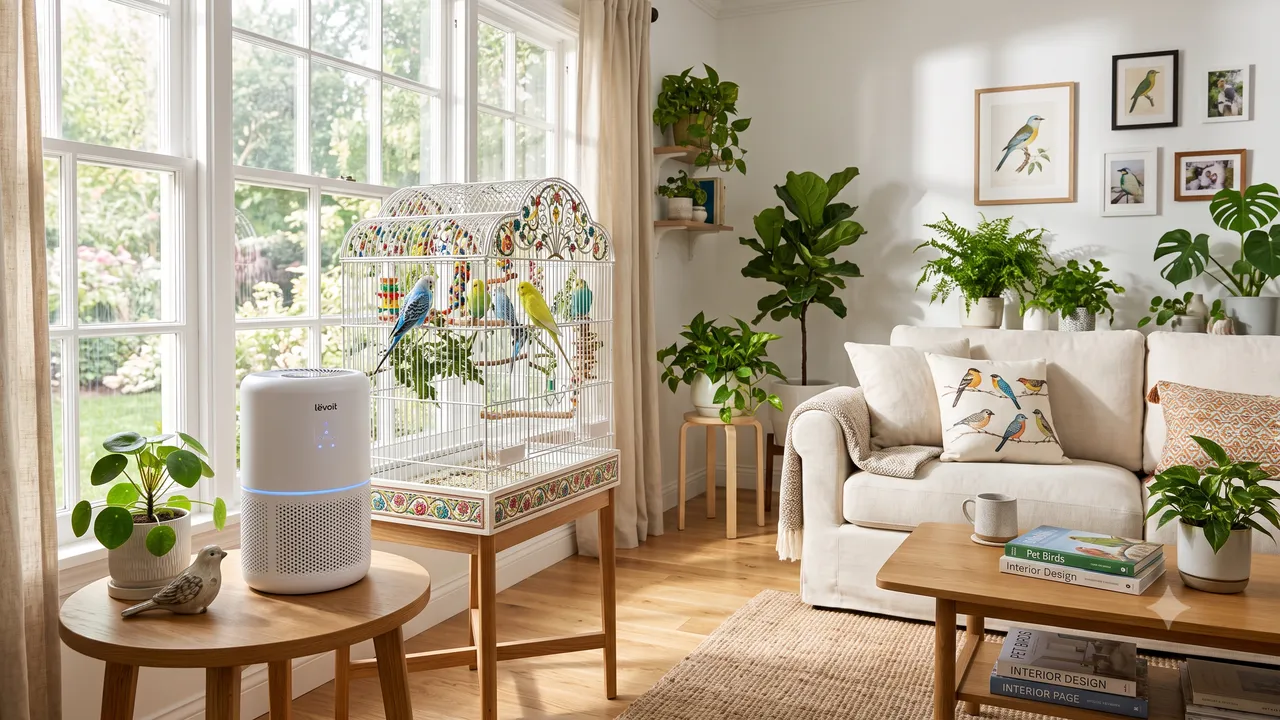
- Minimum 4–6 feet from the cage. Placing the purifier too close creates a direct airflow draft that can chill birds, stress them, and blow feather dust and dander directly at them from turbulence rather than capturing it.
- Position the purifier so clean air flows toward the cage area, not away from it. If your purifier has a directional output (most top-firing units do), point the clean air stream in the bird’s general direction without being directly aimed at the cage.
- Never place the purifier directly above the cage. Downward drafts stress birds and can blow food and water dish contents around.
Height Considerations
- Place the purifier on the floor or a low stand, not on a shelf directly next to the cage. Most air purifiers intake air from the sides or bottom and exhaust from the top. Floor placement maximizes room air circulation and particle capture.
- Bird cages should ideally be at chest height or above (birds feel safer when elevated). This natural height difference actually works in your favor, the purifier captures falling dust and dander before it circulates up to cage level.
Room Layout Tips
- Keep the purifier away from doors and windows where outdoor air bypasses the filtration path. You want the purifier to process the room’s recirculating air, not fight against drafts.
- If your bird’s cage is in a corner, place the purifier in the opposite corner or along the adjacent wall. This creates a circular airflow pattern across the entire room.
- For large rooms over 350 sq ft, consider running two smaller units at opposite ends rather than one large unit. This ensures more uniform air quality and eliminates dead zones where pollutants accumulate near the cage.
The 48-Hour Rule
When you first set up any new air purifier, even a model known to be bird-safe, run it in a separate closed room for 48–72 hours before placing it near your bird. New units off-gas manufacturing residues from plastics, adhesives, and filter media. This simple step prevents unnecessary respiratory irritation.
Signs of Respiratory Distress in Birds: Emergency Guide
Birds instinctively hide illness (in the wild, appearing sick makes you a predator’s target). By the time a bird shows visible respiratory symptoms, the situation is often critical. Learn these warning signs and act immediately:
Early Warning Signs (Act Within Hours)
- Tail bobbing. Watch the tail while the bird is resting. A gentle up-and-down bob with each breath indicates increased respiratory effort. This is often the first visible sign.
- Increased resting respiratory rate. Normal for a budgie is 65–85 breaths per minute at rest. For a cockatiel, 40–50. Count breaths when the bird is calm and compare to its baseline.
- Quiet or reduced vocalization. A normally chatty bird that suddenly goes quiet may be conserving energy for breathing.
- Fluffed feathers at rest. Birds fluff up to conserve heat when their body is fighting stress or illness. Combined with any other sign on this list, fluffing is a red flag.
Emergency Signs (Act Within Minutes)
- Open-mouth breathing or gaping. Birds only breathe through their mouths when they are in severe respiratory distress. This is an emergency.
- Wing spreading away from the body. The bird is trying to maximize airflow to its air sacs. It cannot breathe normally.
- Clicking, wheezing, or crackling sounds when breathing. These sounds indicate fluid in the air sacs or airway obstruction.
- Lethargy and loss of balance. If a bird is so oxygen-deprived that it cannot perch steadily, it needs emergency veterinary care immediately.
- Cyanosis (bluish discoloration of the cere or feet). This indicates critical oxygen deprivation. Death can follow within minutes.
What to Do Immediately
- Move the bird to fresh air immediately. Take it outside or to a well-ventilated room far from any potential toxin source.
- Turn off any air purifier, humidifier, diffuser, or appliance in the room. Do not try to identify the source first, just remove the bird from the environment.
- Keep the bird warm and calm. Place it in a small carrier or box lined with a towel, in a quiet area. Stress increases oxygen demand.
- Call your avian veterinarian immediately. If after hours, contact an emergency veterinary hospital that treats birds. Do not wait to see if symptoms improve.
- Do not administer any medications unless specifically directed by a veterinarian.
Time is everything. Birds can go from first symptoms to death in under 30 minutes when exposed to airborne toxins like PTFE fumes or high ozone concentrations.
Source Control: The Most Important Step
For bird homes, eliminating toxin sources matters more than any filtration technology. An air purifier cannot outpace a source that continuously emits toxins into the air.
- Never use non-stick cookware. Switch entirely to stainless steel, cast iron, or ceramic. This includes Teflon, PTFE, and PFOA-coated pans, bakeware, and cooking utensils. Overheating even a single pan can release lethal fumes.
- No scented candles, air fresheners, essential oil diffusers, or cleaning products with strong fragrances. Plug-in air fresheners and reed diffusers are particularly dangerous because they emit VOCs continuously. For cleaning, use unscented, bird-safe products or simple vinegar-and-water solutions.
- No self-cleaning oven cycles. They burn off residue at 900°F, releasing PTFE fumes lethal to birds. Remove your bird from the home entirely if you must run a self-clean cycle, and ventilate the house for several hours before returning the bird.
- Avoid new furniture, carpet, or paint in the bird’s room. These off-gas formaldehyde and VOCs for weeks to months. If you must renovate, relocate your bird to a different part of the house and ventilate thoroughly.
- Use the air purifier as a complement to eliminating these sources, not as a substitute. Even the best HEPA purifier cannot remove PTFE fumes or high-concentration VOCs fast enough to protect a bird.
For a broader look at reducing household pollutants, see our guide on DIY ways to improve indoor air quality.
Comparing Air Purifier Technologies for Bird Safety
Understanding which technologies are safe and which are dangerous is critical for bird owners. Here’s a breakdown:
| Technology | How It Works | Safe for Birds? | Details |
|---|---|---|---|
| True HEPA Mechanical Filtration | Physical filter captures particles ≥0.3 microns | ✅ Yes | Gold standard for bird homes. No emissions, no ozone. |
| Activated Carbon Filtration | Adsorbs VOCs, odors, and gaseous pollutants | ✅ Yes | Essential for bird homes. Removes cooking fumes and household chemicals. |
| HEPASilent (Blueair) | Electrostatic charge on filter media, not room air | ✅ Yes | No detectable ozone. Proven safe by independent testing. |
| Ionizer (negative ion generator) | Charges particles in room air; some produce ozone as byproduct | ❌ No | Any ozone is too much for birds. Do not use, even on “low” settings. |
| Electrostatic Precipitator | Charges particles and collects on plates; produces ozone | ❌ No | Ozone output varies but is never zero. Not safe for any bird species. |
| UV-C Germicidal | Ultraviolet light destroys pathogens | ⚠️ Caution | Enclosed UV-C is safe. Exposed UV-C bulbs produce trace ozone. |
| PlasmaWave / PCO | Plasma ionization technology | ❌ No | Produces ozone and other reactive species. Disable or avoid entirely. |
| PECO (Molekule) | Photo-electrochemical oxidation | ⚠️ Caution | Limited independent data on ozone output. Conservative choice: avoid. |
For a deep dive into purification technologies, see our complete air purifier technology comparison. For more on the specific dangers of ozone-producing devices, read Ozone Air Purifiers: Dangers and Safety Warnings.
Additional Tips for Bird Owners Using Air Purifiers
- Monitor filter replacement closely. A clogged HEPA filter reduces airflow and can cause the motor to work harder, potentially increasing heat and off-gassing from internal components. Set calendar reminders and replace filters on schedule.
- Run the purifier continuously, not just when you notice odors. Birds are exposed to low-level airborne irritants (cooking fumes, dust, dander) throughout the day. Continuous filtration provides consistent protection. See our guide on how long to run your air purifier for optimization tips.
- Combine with humidity control. Maintaining 40–60% relative humidity supports avian respiratory health and helps HEPA filters capture particles more efficiently. Too-dry air irritates air sacs; too-humid air promotes mold growth.
- Get an air quality monitor. A reliable air quality monitor lets you track PM2.5, VOC, and humidity levels in your bird’s room in real time, giving you early warning before conditions become dangerous.
- Have a backup plan. If you suspect your air purifier is malfunctioning or producing an unusual smell, remove your bird from the room immediately and investigate. Bird respiratory emergencies escalate faster than you expect.
Frequently Asked Questions
Are ionizer air purifiers safe for birds?
No. Ionizer air purifiers, including those marketed as “ozone-free”, are not safe for birds. Ionizers work by electrically charging air molecules, and this process inevitably produces some ozone as a byproduct. While the ozone levels may be below the FDA’s 0.050 ppm limit for human exposure, birds are harmed at concentrations far lower than that. Additionally, ionizers produce ultrafine particles and reactive oxygen species that can damage avian respiratory tissue. Always choose mechanical HEPA filtration only.
Can an air purifier actually kill a bird?
Yes, certain types of air purifiers can kill birds. Ozone generators and ionizers produce ozone, which is directly toxic to avian respiratory systems. High-efficiency ozone output, the kind marketed for “shock treatment” odor removal, can kill a bird in minutes. Even low-level chronic ozone exposure from ionizers can cause cumulative air sac damage that leads to respiratory failure over days or weeks. Additionally, air purifiers containing PTFE-coated components can release toxic fumes if the motor overheats. This is why choosing a verified bird-safe model (mechanical HEPA only, no ionizer, no PTFE) is essential.
Is the Coway AP-1512HH safe for birds?
Yes. The Coway AP-1512HH Mighty is widely considered one of the safest air purifiers for bird-owning households. It uses 100% mechanical filtration (True HEPA + activated carbon pre-filter) with no ionizer function, no UV-C lamp, and no ozone-producing technology. It has been used safely by bird owners for over a decade with no reported avian health issues. The one caveat: ensure you are purchasing the genuine Coway model from an authorized seller, as counterfeit or lookalike units may have different internal components.
How far should an air purifier be from a bird cage?
Place your air purifier at least 4–6 feet from your bird’s cage. The clean air output should flow generally toward the cage area but never blow directly onto or above the cage. Direct airflow drafts can chill birds, cause stress, and blow debris into food and water dishes. The ideal setup is a purifier positioned on the floor in the corner of the room opposite the cage, creating gentle circular air circulation across the entire space.
Do air purifiers help with bird dust and feather dander?
Absolutely, this is one of the primary benefits of running a HEPA air purifier in a room with birds. Species like cockatiels, cockatoos, and African greys produce enormous amounts of feather dust (powder down) as part of their natural grooming process. A True HEPA air purifier captures these fine particles (typically 0.5–10 microns) before they settle on surfaces or are inhaled by household members. For heavy dander producers, choose a high-CADR model and replace the pre-filter frequently, as feather dust clogs filters faster than typical household dust.
Birds are extraordinary companions, but their unique respiratory biology demands that we take air quality seriously, not as a convenience, but as a responsibility. A properly chosen and placed HEPA air purifier, combined with rigorous source control, gives your feathered family member the clean air they need to thrive.
See also: Air Purifier Technology Comparison: HEPA, UV, Ionizer, PECO, Ozone Air Purifiers: Dangers and Safety Warnings, Best Air Purifier for Pets: Dander and Odor Control, Best Air Purifiers 2026: Complete Guide, How to Test If Your Air Purifier Is Working.
Disclosure: This article contains affiliate links. If you purchase through our links, we may earn a small commission at no additional cost to you. We only recommend products we have thoroughly researched and genuinely believe are safe for bird-owning households. Our editorial opinions are our own and are not influenced by affiliate partnerships. See our full disclosure policy for details.
You May Also Like
Support This Guide
Helpful? Add The Air Purifier Guide as a preferred source on Google so our guides show up in your search results.
Related Articles

Coway Mighty2 vs AP-1512HH (2026)
Coway's Mighty2 replaced the AP-1512HH as Wirecutter's top pick. We compare CADR, noise, sensors, filter costs, and whether the older unit is still the smarter buy.

KNKA APH4000 Review: $150 Dark Horse
KNKA's APH4000 is one of Amazon's best-selling purifiers at $150. We check the AHAM certification, decode the 1,695 sq ft claim, and compare it to Levoit and Coway.

Levoit Core 300 vs 300-P: What Changed
Levoit quietly replaced the Core 300 with the Core 300-P. We explain the AHAM certification, whether filters still fit, and which one you should actually buy.

Shark NeverChange HP302 Review
Shark's NeverChange HP302 promises 5 years on one filter. We dig into the real running costs, the odor neutralizer catch, and whether it beats cheaper rivals.

Winix 5510 vs 5500-2: 2026 Verdict
The Winix 5500-2 is discontinued and the 5510 takes over. We compare CADR, noise, filter costs, and the one compatibility problem nobody mentions.
🛒 Products Mentioned
As an Amazon Associate, we earn from qualifying purchases.
Covers indoor air quality science, respiratory health, allergy management, and wildfire smoke protection.
View all articles by Sarah →