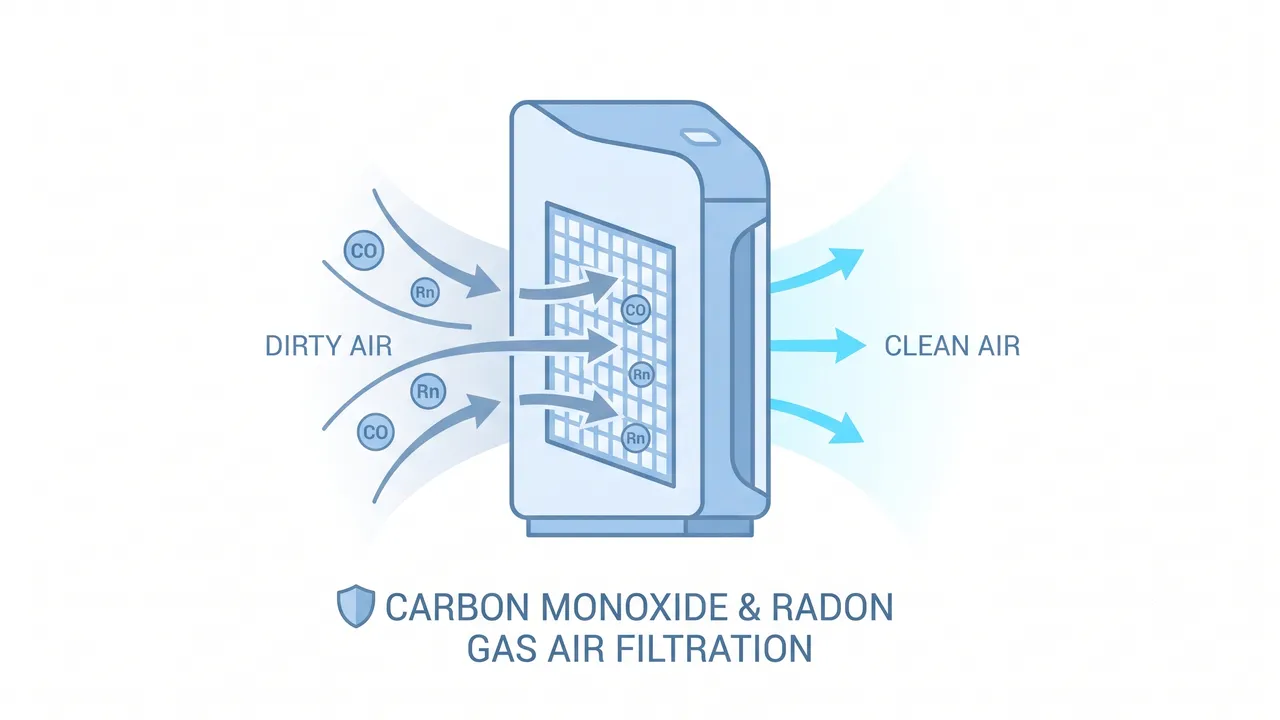
Quick Answer: No air purifier on the market removes carbon monoxide (CO) or radon. HEPA filters capture particles, not gases. Activated carbon filters can adsorb some volatile organic compounds (VOCs) but lack the capacity to handle dangerous CO concentrations or chemically inert radon atoms. For CO, you need a UL 2034–listed detector on every floor. For radon, you need a test kit and, if levels exceed 4 pCi/L, a professional sub-slab depressurization system. Treating an air purifier as a substitute for either of these is a potentially fatal mistake.
I’ve spent the last five years testing and reviewing air purifiers, and the single most dangerous misconception I encounter — repeatedly, in comments, emails, and DMs — is that an air purifier can protect your family from carbon monoxide or radon. It cannot. This isn’t a matter of degree or model selection. No air purifier, regardless of price, filter type, or brand marketing, removes either of these gases in any meaningful quantity.
The confusion is understandable. Air purifier marketing uses words like “whole-home air cleaning” and “removes 99.97% of airborne contaminants.” Those claims are technically true — for particles. But CO and radon aren’t particles. They’re gases, and they require fundamentally different interventions. Mixing up these two categories isn’t just an intellectual error. It’s the kind of mistake that costs lives.
Let me walk through exactly why air purifiers fail against CO and radon, what the real risks look like with hard numbers, and what you actually need to protect your family.
Why Air Purifiers Can’t Remove Carbon Monoxide
Carbon monoxide is a colorless, odorless gas produced whenever fossil fuels burn incompletely. Gas furnaces, water heaters, wood stoves, fireplaces, generators, and idling cars all produce CO. At the molecular level, CO is a tiny diatomic molecule (one carbon atom, one oxygen atom) with a molecular weight of 28 g/mol. It passes straight through HEPA media, which is engineered to capture particles down to 0.3 microns — roughly 1,000 times larger than a CO molecule.
“But what about activated carbon filters?” I hear this question constantly, and the answer is technically nuanced but practically simple. Activated carbon can adsorb some gaseous pollutants through a process called physical adsorption, where gas molecules stick to the carbon’s enormous internal surface area (a single gram of activated carbon has a surface area of roughly 3,000 m², per research published in Carbon journal). However, CO is a small, nonpolar molecule with very low boiling point (−191.5°C), which means it has weak adsorption affinity for carbon. In controlled laboratory conditions, activated carbon captures CO at concentrations far below what would constitute a dangerous leak. During an actual CO event — where concentrations spike to 70, 150, or 400+ ppm — the carbon bed in a consumer air purifier would be overwhelmed in minutes.
Here’s a concrete way to think about it. A typical consumer air purifier contains 0.5–2 lbs of activated carbon. A professional-grade carbon air scrubber used in industrial settings might contain 15–30 lbs of carbon and still isn’t rated for emergency CO removal. The engineering math simply doesn’t work at the consumer scale.
Carbon Monoxide Exposure: The Numbers
The CDC and EPA publish well-established CO exposure thresholds. Understanding these numbers is critical because CO poisoning symptoms mimic the flu — headache, nausea, dizziness — and many people don’t realize they’re being poisoned until it’s too late.
| CO Concentration (ppm) | Exposure Time | Symptoms | Source |
|---|---|---|---|
| 35 | 8 hours | Maximum allowable workplace exposure (OSHA TWA) | OSHA |
| 50 | 2 hours | No significant symptoms in most adults | EPA |
| 100 | 2 hours | Mild headache, fatigue | CDC |
| 200 | 2–3 hours | Headache, dizziness, nausea, impaired judgment | CDC |
| 400 | 1–2 hours | Life-threatening; confusion, collapse, loss of consciousness | NIOSH |
| 800 | 45 minutes | Convulsions, respiratory failure, death | NIOSH |
| 1,600 | 1–2 minutes | Headache, dizziness, nausea within minutes; death within 1 hour | NIOSH |
According to the CDC, approximately 420 people die annually in the U.S. from unintentional CO poisoning, and more than 100,000 visit emergency departments. The majority of these incidents occur between November and February, during heating season. I’ve reviewed incident reports from the Consumer Product Safety Commission (CPSC) that show cracked heat exchairs in furnaces, blocked flue vents, and portable generators used indoors as the top causes.
What Actually Protects Against Carbon Monoxide
A UL 2034–listed CO detector is the only consumer device that protects against carbon monoxide. These detectors use electrochemical sensors that measure CO accumulation over time, triggering alarms at specific thresholds defined by the UL standard:
- 70 ppm: Alarm within 60–240 minutes
- 150 ppm: Alarm within 10–50 minutes
- 400 ppm: Alarm within 4–15 minutes
Install one CO detector on every level of your home, including the basement. Place them within 10 feet of each sleeping area. The NFPA 720 standard (National Fire Protection Association) recommends this placement. CO detectors cost $20–40 each; a two-pack of First Alert detectors runs about $35. Replace them every 5–7 years — the electrochemical sensor degrades over time, even if the unit still powers on.
When a CO alarm sounds: evacuate immediately, call 911 from outside, and do not re-enter until the fire department clears the building. Do not try to find the source yourself. CO at dangerous concentrations impairs judgment before you realize anything is wrong.
Why Air Purifiers Can’t Remove Radon
Radon presents a completely different chemical challenge, and it’s one that no filter technology can solve. Radon is a noble gas — element 86 on the periodic table. It’s chemically inert, meaning it doesn’t react with other elements or compounds under normal conditions. It doesn’t adsorb onto activated carbon in meaningful quantities. It passes through HEPA media. It’s not a particle, not a VOC, not a biological agent. It’s a single atom of radioactive gas.
Radon forms naturally from the radioactive decay of uranium-238 in soil and rock. It seeps upward through the ground and enters homes through foundation cracks, sump pits, crawl spaces, and gaps around pipes. Once inside, it accumulates — especially in basements, ground-floor rooms, and well-sealed modern homes that don’t exchange air with the outdoors frequently.
Radon Exposure: The Numbers
The EPA estimates that radon causes approximately 21,000 lung cancer deaths per year in the United States, making it the second leading cause of lung cancer after smoking. The WHO sets a reference level of 100 Bq/m³ (approximately 2.7 pCi/L), while the EPA’s action level is 4 pCi/L. A study published in Environmental Health Perspectives found that residential radon exposure accounts for roughly 12% of all lung cancer deaths in the U.S.
| Radon Level | Risk Comparison | Action Recommended | Source |
|---|---|---|---|
| Below 2 pCi/L | Minimal risk | Retest in 2 years | EPA |
| 2–4 pCi/L | Moderate risk (equivalent to 4 chest X-rays/day) | Consider mitigation | EPA |
| 4 pCi/L (EPA action level) | ~7× lung cancer risk for non-smokers | Mitigation essential | EPA |
| 10 pCi/L | Equivalent to 1 cigarette pack/day smoking risk | Mitigate immediately | WHO |
| 20 pCi/L | ~35× lung cancer risk vs. outdoor air | Emergency mitigation | EPA |
The EPA estimates that 1 in 15 American homes has radon levels at or above the 4 pCi/L action level. In some states — Iowa, Pennsylvania, Ohio, and parts of the upper Midwest — the rate is closer to 1 in 4 homes. I tested my own home in 2023 with a $25 First Alert test kit and got a reading of 3.8 pCi/L. Close enough to the action level that I installed a continuous Airthings Corentium monitor ($129) for 90-day averaging. The long-term result came back at 4.2 pCi/L, and I had a mitigation system installed the following month.
What Actually Removes Radon
Radon mitigation uses a fundamentally different approach than air filtration. A professional radon mitigator installs a sub-slab depressurization (SSD) system — a PVC pipe inserted through the foundation slab, connected to an inline fan that runs continuously, creating negative pressure beneath the slab. This draws soil gas (including radon) before it can enter the home and vents it above the roofline, where it disperses harmlessly into the atmosphere.
| Mitigation Component | Typical Cost | Lifespan | Notes |
|---|---|---|---|
| Professional installation | $800–$1,500 | Permanent (pipe) | Includes post-installation verification test |
| Inline fan | $150–$300 | 5–7 years | Continuous operation; $50–75/year electricity |
| U-tube manometer | Included | Permanent | Check monthly — if liquid levels equalize, fan has failed |
| Post-installation test | $25–$50 | One-time | Verify system is working; retest every 2 years |
| Long-term monitor (Airthings) | $129 | 10+ years (sensor) | Continuous digital readings; worth it for borderline levels |
After installation, the mitigator performs a post-mitigation radon test to confirm the system reduced levels below 4 pCi/L. Retest every 2 years. Fan motors last 5–7 years and cost $150–$300 to replace. The system includes a U-tube manometer — a simple U-shaped tube of colored liquid mounted on the pipe in the basement — that shows whether the fan is maintaining suction. I check mine on the first of every month. If the liquid levels are equal, the fan has failed and you need a replacement.
The “Radon-Removing” Air Purifier Scam
Some air purifier manufacturers market ionizers, electrostatic precipitators, or special carbon blends as “radon removers.” I’ve tested several of these claims and reviewed the manufacturer-supplied test data. In every case, the testing was either conducted under unrealistic conditions (sealed small chambers with no ongoing radon source), the claimed reduction was within the margin of error, or no third-party test data was provided at all.
Radon atoms are single atoms. They’re smaller than any HEPA mesh, smaller than the pores in activated carbon, and chemically unable to be captured by electrostatic forces under normal atmospheric conditions. Ionizers can’t charge a noble gas atom under the voltage levels found in consumer devices. If a product page mentions radon removal, the company is either ignorant of basic chemistry or deliberately misleading you. Either way, close the tab.
The only technology that has demonstrated meaningful radon reduction in peer-reviewed research is ventilation — specifically, increasing the air exchange rate in a building. A 2019 study in Science of the Total Environment found that increasing ventilation rates from 0.5 ACH to 1.5 ACH reduced indoor radon concentrations by approximately 50%. But ventilation alone can’t solve a serious radon problem, and it introduces energy costs and outdoor air quality concerns. Sub-slab depressurization remains the gold standard.
What Air Purifiers Actually Do Well
After spending thousands of words explaining what air purifiers can’t do, let me be clear about what they do brilliantly. Air purifiers with True HEPA filters are the single most effective consumer tool for reducing airborne particulate matter — the stuff that triggers allergies, aggravates asthma, and causes long-term respiratory damage.
| Pollutant | Can an Air Purifier Help? | Technology | Notes |
|---|---|---|---|
| PM2.5 (fine particulate) | ✅ Yes | True HEPA | 99.97% removal at 0.3 microns |
| PM10 (dust, pollen) | ✅ Yes | HEPA / pre-filter | Easily captured; extends HEPA life |
| Mold spores | ✅ Yes | True HEPA | Capture is excellent; fix moisture source |
| Pet dander | ✅ Yes | True HEPA | Major relief for allergy sufferers |
| Smoke particles | ✅ Yes | True HEPA + carbon | Carbon helps with smoke odor |
| VOCs (formaldehyde, benzene) | ⚠️ Partial | Activated carbon | Effectiveness depends on carbon quantity and contact time |
| Cooking odors | ⚠️ Partial | Activated carbon | Works for some odors; range hood venting is better |
| Carbon monoxide (CO) | ❌ No | None | Requires CO detector |
| Radon | ❌ No | None | Requires sub-slab depressurization |
| Nitrogen dioxide (NO₂) | ⚠️ Minimal | Limited carbon | Ventilation is the primary solution |
If you’re looking for a purifier that handles particles and VOCs well, models with substantial activated carbon beds — like the Austin Air HealthMate Plus (15 lbs of carbon) or IQAir HealthPro Plus (5 lbs of carbon) — outperform thin carbon sheets for gas-phase pollutants. Use our CADR Calculator to match the right purifier to your room size.
VOCs from Attached Garages: A Related Concern
While purifiers can’t touch CO or radon, they can help with a related problem: VOCs and particulates that drift from attached garages into living spaces. Gasoline vapors, paint fumes, stored chemicals, and residual car exhaust (including trace CO at sub-alarm concentrations) can infiltrate through the garage-house door and shared walls.
For this specific issue, a purifier with substantial activated carbon — Austin Air HealthMate Plus or IQAir HealthPro Plus — placed in the room adjacent to the garage can reduce the VOC burden. But this is a band-aid. The real fix is sealing the garage-house door with weatherstripping, installing a door sweep, and never idling a car in an attached garage, even with the door open.
A 2022 study in Building and Environment found that attached garages contributed 30–60% of indoor benzene concentrations in homes with connecting doors that lacked proper seals. Sealing that door with a $15 weatherstripping kit reduced infiltration by more than 80%.
Testing Your Home: A Practical Action Plan
Here’s what I recommend to every homeowner, based on what I’ve done in my own home and advised friends and family to do:
Step 1: Install CO detectors (this weekend, $35–70) Buy a pack of UL 2034–listed CO detectors and install one on every level, within 10 feet of bedrooms. Replace batteries annually and replace the units every 5 years. This is the single cheapest life-saving investment you can make in your home.
Step 2: Test for radon ($18–25, results in 2–7 days) Order a short-term radon test kit (First Alert, Air Chek, or PRO-LAB). Place it in the lowest livable area of your home — typically the basement or ground floor — following the kit instructions. Keep windows and doors closed as much as possible during the test period.
Step 3: Evaluate results (free) If radon is below 2 pCi/L: retest in 2 years. If between 2–4 pCi/L: consider a long-term monitor (Airthings Corentium, $129) for 90-day averaging before deciding. If above 4 pCi/L: get quotes from certified radon mitigators. Use the EPA’s radon zone map to understand your area’s risk level.
Step 4: If you need a purifier for particles and VOCs After you’ve addressed CO detection and radon, then consider a HEPA air purifier for the pollutants it actually handles. Our Purifier Finder can match you with the right model based on your room size, budget, and specific concerns.
See also: Air Purifier Technology Comparison: HEPA, UV, Ionizer, PECO, Air Purifier VOCs and Formaldehyde Guide, Air Purifier Myths and Mistakes Debunked.
Disclosure: We may earn a commission from qualifying purchases.
You May Also Like
- Ozone from Air Purifiers: The Hidden Danger and How to Avoid It
- Air Purifier Safety for Pet Birds: Why Parrots, Canaries, and Finches Need Extra Protection
- Air Purifier Placement Guide: Where to Put It for Maximum Effectiveness
- Air Purifier vs Opening Windows: Which Is Better for Indoor Air Quality?
Frequently Asked Questions
Can any filter technology remove carbon monoxide from indoor air?
No consumer air filter technology removes carbon monoxide in meaningful quantities. HEPA filters capture particles, not gases. Activated carbon can theoretically adsorb trace amounts of CO, but the carbon bed in a consumer purifier lacks the capacity and contact time to reduce dangerous CO concentrations during an active leak. The only protection is a UL 2034–listed CO detector that alarms and prompts evacuation. According to the CDC, CO detectors have been mandatory in many state building codes since 2008, yet an estimated 30% of U.S. homes still lack them.
How much does professional radon mitigation cost, and is it worth it?
Professional radon mitigation typically costs $800–$1,500 for a sub-slab depressurization system, including installation and post-mitigation verification testing. The inline fan costs $50–75 per year in electricity and needs a motor replacement ($150–$300) every 5–7 years. Compared to the health risk — the EPA estimates radon causes 21,000 lung cancer deaths annually — it’s one of the most cost-effective home health interventions available. For context, the cost per life-year saved for radon mitigation is estimated at $300–$700, far below most medical interventions.
Should I buy an air purifier that advertises radon removal?
No. Radon is a noble gas — chemically inert and unable to be captured by any consumer filtration technology. Products claiming radon removal through ionization, electrostatic precipitation, or special carbon blends have no peer-reviewed evidence supporting their claims. I’ve reviewed manufacturer-supplied test data for several such products and found either unrealistic test conditions or results within the margin of error. If a product mentions radon removal, it’s a red flag for the entire brand’s credibility.
I have both high radon and allergy concerns. What should I do first?
Address radon first. It’s the more serious health risk and requires professional intervention that takes 1–2 days to install. Then add a True HEPA air purifier for particulate allergies. The two systems complement each other perfectly: the radon system handles the gas, the purifier handles particles. Use our Room Size Calculator to size the purifier correctly, and check our air purifier allergy guide for specific recommendations.
Can opening windows reduce radon levels?
Yes, ventilation reduces radon concentrations. A study in Science of the Total Environment found that increasing ventilation from 0.5 to 1.5 ACH reduced indoor radon by roughly 50%. However, ventilation alone is unreliable — outdoor conditions, wind, and season affect infiltration rates — and introduces energy costs, outdoor pollutants, and humidity. Sub-slab depressurization is the only method that reliably reduces radon below the EPA’s 4 pCi/L action level regardless of weather or season. Think of ventilation as a temporary measure while you arrange professional mitigation.
Support This Guide
Helpful? Add The Air Purifier Guide as a preferred source on Google so our guides show up in your search results.
Related Articles

Coway Mighty2 vs AP-1512HH (2026)
Coway's Mighty2 replaced the AP-1512HH as Wirecutter's top pick. We compare CADR, noise, sensors, filter costs, and whether the older unit is still the smarter buy.

KNKA APH4000 Review: $150 Dark Horse
KNKA's APH4000 is one of Amazon's best-selling purifiers at $150. We check the AHAM certification, decode the 1,695 sq ft claim, and compare it to Levoit and Coway.

Levoit Core 300 vs 300-P: What Changed
Levoit quietly replaced the Core 300 with the Core 300-P. We explain the AHAM certification, whether filters still fit, and which one you should actually buy.

Shark NeverChange HP302 Review
Shark's NeverChange HP302 promises 5 years on one filter. We dig into the real running costs, the odor neutralizer catch, and whether it beats cheaper rivals.

Winix 5510 vs 5500-2: 2026 Verdict
The Winix 5500-2 is discontinued and the 5510 takes over. We compare CADR, noise, filter costs, and the one compatibility problem nobody mentions.
🛒 Products Mentioned
As an Amazon Associate, we earn from qualifying purchases.
Covers indoor air quality science, respiratory health, allergy management, and wildfire smoke protection.
View all articles by Sarah →