The Short Answer: Place purifiers 3-5 feet from your breathing zone, near pollution sources, with unobstructed airflow. Avoid corners and curtains. For bedrooms, position near the bed but not blowing directly on you.
Editor’s note (September 2026): The Winix 5500-2 has been discontinued and remaining stock is limited. Winix’s official successor is the Winix 5510, which adds app control and uses a new filter. Read our Winix 5510 vs 5500-2 comparison before you buy either one.
You spent weeks researching CADR ratings, comparing HEPA filters, and reading reviews. You finally bought the perfect air purifier, plugged it in, and placed it wherever there was an open spot on the floor. Sound familiar? Here’s the uncomfortable truth: even the best air purifier underperforms dramatically when placed incorrectly. A $400 unit in a bad location can be outperformed by a $100 unit positioned well.
Placement affects everything, how much air your purifier can process, whether clean air actually reaches you, how loudly it runs, and how long the filter lasts. The difference between optimal and poor placement can be a 40–60% reduction in effective air cleaning. That’s not a marginal improvement; it’s the difference between breathing genuinely clean air and simply running an expensive fan.
This guide gives you room-by-room placement strategies, hard numbers on distance and height, the most common mistakes people make, and answers to the questions we hear most often. Whether you have one purifier or five, these principles will help you get maximum performance from every unit.
Disclosure: This article contains affiliate links. If you purchase through our links, we may earn a commission at no additional cost to you. We only recommend products we have thoroughly evaluated. See our full affiliate disclosure for details.
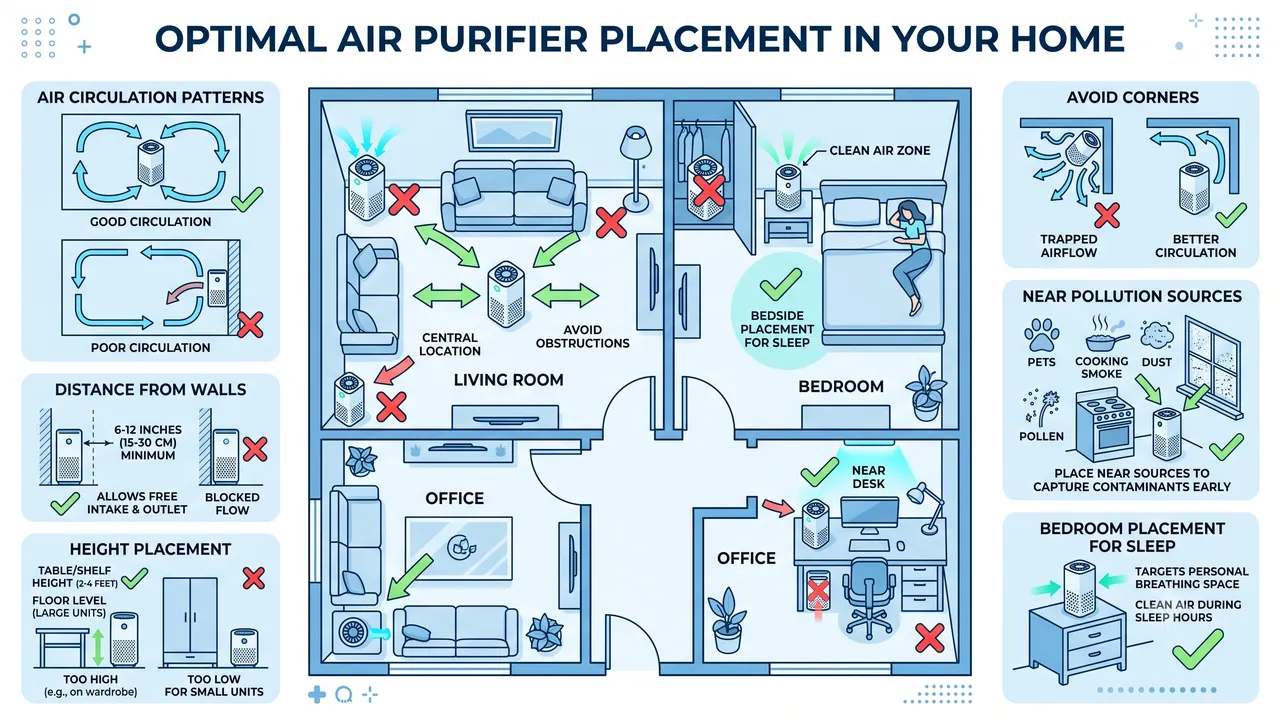
The Core Principles of Air Purifier Placement
Before diving into room-specific advice, understand the four physics-based principles that govern every placement decision.
1. Airflow Needs Unobstructed Access on All Sides
Most modern air purifiers, including popular models like the Coway AP-1512HH and Winix 5500-2, pull air in from multiple sides (usually 360° or at least 270°). Placing a purifier flush against a wall, behind furniture, or in a tight corner blocks intake on one or more sides, reducing effective airflow by 20–40%.
The rule: Keep at least 12–18 inches (30–45 cm) of clear space on every side of the unit. If your purifier has rear-only intake (some tower models), you only need clearance behind it, but the output should face the open room.
2. Clean Air Must Reach Your Breathing Zone
An air purifier doesn’t magically clean an entire room uniformly. It creates a localized zone of cleaner air that spreads outward through natural air currents. If you place the purifier in a corner but spend most of your time at a desk on the opposite side of the room, you’re breathing far dirtier air than the purifier’s sensors suggest.
The rule: Place the purifier within 6–10 feet (2–3 meters) of where you spend the most time. For a bedroom, that means near the bed. For a home office, near the desk. This is the single most impactful placement decision you can make.
3. Elevated Placement Improves Circulation
Air purifiers work by cycling room air through their filters. On the floor, they primarily capture dust, pet hair, and larger particles that settle low. But many airborne pollutants, cooking fumes, VOCs, fine particulate matter from outside, and respiratory droplets, concentrate at breathing height (3–5 feet / 1–1.5 meters above the floor).
The rule: If possible, place your purifier on a sturdy table, dresser, or shelf that raises the intake 3–5 feet off the ground. This isn’t always practical (heavy units should stay on the floor for safety), but for smaller purifiers, elevation significantly improves air mixing.
4. Avoid Direct Obstructions to the Output
The clean air stream exiting your purifier needs an unobstructed path to circulate. Pointing the output directly at a curtain, wall, or piece of furniture wastes the momentum that helps distribute clean air across the room.
The rule: Angle the output toward the center of the room or toward your primary seating/sleeping area. Avoid pointing it at walls or heavy drapes within 3 feet.
Room-by-Room Placement Guide
Different rooms have different pollution sources, layouts, and priorities. Here’s how to optimize placement in every major room of your home.
Bedroom
The bedroom is where you spend 7–9 hours breathing the same air every night. It’s the single most important room for air purification, and placement here has the biggest impact on your health.
Optimal position: On a nightstand or small table, 3–6 feet from the head of your bed, at roughly pillow height. If the unit is too large for a nightstand, place it on the floor beside the bed with at least 12 inches of clearance from the wall and bed frame.
Why this works: You’re placing the purifier within the immediate breathing zone. The air around your pillow is cleaned first, giving you the highest-quality air exactly where you need it during sleep.
Additional tips:
- Run on the lowest fan speed at night for quiet operation, most quality units like the Levoit Core 300 are whisper-quiet on low
- Keep bedroom doors closed while the purifier runs to create a sealed clean-air zone
- Avoid placing directly next to a window, where drafts can push unfiltered air past the intake before it’s processed
Living Room
Living rooms are typically the largest shared space, with multiple seating areas and high foot traffic. This makes them challenging to purify with a single unit.
Optimal position: Near the primary seating area (the couch or recliner where you spend the most time), with the output angled toward the center of the room. If your living room is larger than 300 sq ft, consider a unit rated for at least 400 sq ft, or position a smaller unit closer to where you sit.
Why this works: Rather than trying to clean the entire room from a corner, you prioritize the air you actually breathe. The natural circulation from foot traffic and HVAC helps spread cleaner air outward.
Additional tips:
- If you have a fireplace or wood stove, place the purifier between the pollution source and your seating area
- For open-concept living/dining areas, you may need two units, one near each primary use zone
- The Blueair Blue Pure 211+ handles large living rooms well with its high CADR and 360° intake
Kitchen
Cooking generates massive amounts of particulate matter, VOCs, and grease particles, especially from gas stoves, frying, and broiling. The kitchen is the single largest source of indoor air pollution in most homes.
Optimal position: Near the kitchen entrance or on the counter (for small units), positioned to capture cooking emissions before they spread to the rest of the home. Never place directly next to the stove, where heat and grease can damage the filters.
Why this works: By intercepting cooking pollution at the source, you prevent it from migrating into bedrooms and living areas. This is especially important if you don’t have a range hood or if your range hood vents recirculated air rather than exhausting outside.
Additional tips:
- Run the purifier on high during and for 30 minutes after cooking
- Change filters more frequently if you cook often, grease particles load filters faster
- If you use a gas stove, an air purifier is essentially mandatory, gas combustion releases nitrogen dioxide, carbon monoxide, and formaldehyde
Home Office
If you work from home, you spend 8+ hours in a single room. The home office is your second-highest priority after the bedroom.
Optimal position: On or beside your desk, within arm’s reach if possible. A small desktop unit like the Levoit Core Mini works well here. For larger offices, place a floor unit 4–6 feet from your desk chair.
Why this works: Concentrated proximity means you’re breathing the cleanest air the purifier produces. You also benefit from the white noise effect on lower speeds.
Additional tips:
- Laser printers and copiers emit ozone and ultrafine particles, place the purifier between the printer and your seat
- Keep the office door closed during work hours for maximum effectiveness
Nursery / Children’s Room
Children breathe faster than adults and their lungs are still developing, making clean air even more critical.
Optimal position: On a dresser or shelf, at least 3 feet from the crib and away from anything a toddler could pull over. Avoid placing on the floor in a child’s room for safety reasons.
Why this works: Elevation keeps the unit out of reach while improving air circulation. Distance from the crib prevents direct drafts on the baby.
Additional tips:
- Never use an ozone-generating purifier in a nursery, see our air purifier safety guide for pets and children for details on which technologies to avoid
- Run 24/7 on the lowest setting for continuous air cleaning without disruptive noise
Bathroom
Bathrooms accumulate moisture, mold spores, and volatile chemicals from cleaning products.
Optimal position: On the counter or a shelf, away from the shower/tub but within the room. Small, moisture-resistant units work best here.
Why this works: Capturing mold spores at the source prevents them from spreading through your home’s air. Running the purifier during and after showers helps manage humidity-related air quality issues.
Additional tips:
- An air purifier is not a substitute for a bathroom exhaust fan, use both
- Clean or replace filters more frequently in humid bathrooms, as moisture accelerates biological growth on filters
Placement Reference Table
| Room | Best Position | Ideal Height | Distance from You | Key Priority |
|---|---|---|---|---|
| Bedroom | Nightstand or floor beside bed | 2–4 ft (table) or floor level | 3–6 ft from pillow | Breathing zone coverage during sleep |
| Living Room | Near primary seating area | Floor level (large units) | 6–10 ft from couch | Cover main activity zone |
| Kitchen | Near entrance, away from stove | Counter height or floor | Between stove and rest of home | Intercept cooking pollution |
| Home Office | Beside or near desk | Desk height or floor | 3–6 ft from chair | Proximity to breathing zone |
| Nursery | Dresser or high shelf | 3–5 ft elevation | 3+ ft from crib | Safety + elevated placement |
| Bathroom | Counter or shelf | Counter height | Within the room | Moisture and mold control |
Common Placement Mistakes (And How to Fix Them)
Mistake 1: Hiding the Purifier Behind Furniture
Many people tuck the purifier behind a couch, bookshelf, or entertainment center to keep it out of sight. This blocks intake airflow on 1–3 sides, reducing effectiveness by up to 40%.
Fix: Move it at least 18 inches from any furniture. If aesthetics matter, choose a purifier designed to blend in, like the Blueair models with washable fabric pre-filters that come in multiple colors.
Mistake 2: Placing It in a Corner
Corners are dead zones for air circulation. A purifier in a corner can only draw air from the two adjacent walls, severely limiting its reach into the room.
Fix: Position the unit along a wall but closer to the center of the room, or ideally in an open area where air can flow freely to all sides.
Mistake 3: Running It with Doors and Windows Open
Opening windows while running an air purifier is like trying to fill a bathtub with the drain open. Outdoor air constantly introduces new pollutants faster than the purifier can remove them.
Fix: Close windows and exterior doors while the purifier is on high. If you need ventilation (e.g., after cooking), open windows for 10–15 minutes, then close them and let the purifier cycle the room air clean again. For a deeper understanding of how to manage fresh air and purification together, see our beginner’s buying guide.
Mistake 4: Ignoring the Humidity and Temperature
Placing a purifier near a heat source (radiator, heating vent, sunny window) or in extremely humid conditions can degrade filter performance and promote mold growth inside the unit.
Fix: Keep purifiers away from direct heat sources and in areas with relative humidity below 60%. If your bathroom or basement exceeds this, run a dehumidifier alongside the purifier.
Mistake 5: Never Moving It
Many people set up their purifier once and never adjust it. But your needs change seasonally, pollen season demands different priorities than winter when you’re sealed indoors with off-gassing furniture and dry air.
Fix: Reassess placement quarterly. During allergy season, move the purifier closer to the room where you sleep. During winter, prioritize rooms with gas appliances or fireplaces. Check out our 10 buying mistakes guide for more tips on getting the most from your investment.
Mistake 6: Placing Multiple Purifiers Too Close Together
If you own more than one purifier, spacing them too closely means their clean-air zones overlap, leaving other parts of the room unprotected.
Fix: Distribute purifiers throughout the space so their coverage areas complement rather than duplicate each other. In a long room, place one at each end. In an open floor plan, place one in each distinct zone.
Height and Distance Guidelines: The Numbers
Here are specific, tested guidelines based on real-world air quality measurements:
- Minimum clearance from walls: 12 inches (30 cm) on all sides, 18 inches (45 cm) preferred
- Minimum clearance from ceiling: 12 inches (30 cm) if using elevated placement
- Maximum distance from breathing zone: 10 feet (3 meters), beyond this, particle reduction drops below 30% at breathing height
- Optimal distance from breathing zone: 3–6 feet (1–2 meters) for maximum particle reduction
- Ideal elevation for small/medium units: 3–5 feet (1–1.5 meters), on a sturdy table, dresser, or shelf
- Elevation for large floor units: Ground level is acceptable, as these units have powerful fans that project cleaned air upward
- Distance from pollution sources: 3–6 feet (1–2 meters), close enough to intercept pollutants, far enough to avoid overloading the filter with concentrated particles
Multi-Purifier Strategy for Larger Homes
If your home exceeds 800 sq ft, a single purifier almost certainly can’t cover it effectively, even if the manufacturer claims coverage up to 1,000 sq ft. Those ratings assume ideal conditions: a perfectly sealed room, no furniture, one air change per hour, and a ceiling height of 8 feet. Real-world performance is typically 50–70% of the rated coverage.
For a 2-bedroom apartment (800–1,200 sq ft): Place one purifier in the bedroom (highest priority) and one in the living area. Close doors to unused rooms so each purifier works within a smaller, sealed zone.
For a 3+ bedroom house (1,500+ sq ft): You’ll need at least three units, one in the master bedroom, one in the living room, and one in the room with the worst air quality (often the kitchen or a child’s bedroom). If you have a central HVAC system, a whole-house filter or in-duct purifier can supplement your room-level units.
For a comprehensive look at choosing the right purifier for each room, see our complete buying guide.
Seasonal Placement Adjustments
Your optimal purifier placement changes throughout the year:
- Spring (pollen season): Move purifiers closer to bedrooms and keep windows sealed during high pollen counts. Pre-filters clog faster, check them weekly.
- Summer (wildfire smoke season in many regions): Seal your home and run purifiers continuously on high. If you live in a wildfire-prone area, consider a unit with activated carbon for smoke gases, not just HEPA for particles.
- Fall (mold season): Prioritize bathrooms, basements, and any rooms with moisture issues. Run purifiers after rainstorms when mold spore counts spike.
- Winter (sealed indoor air): VOCs from furniture, carpets, and cleaning products accumulate with less ventilation. Prioritize rooms with the most synthetic materials and keep purifiers running 24/7.
Frequently Asked Questions
Should I place my air purifier on the floor or on a table?
For small to medium purifiers (under 20 lbs), placing them on a table or elevated surface 3–5 feet off the ground improves performance because they capture pollutants at breathing height. For large floor-standing units (20+ lbs), ground-level placement is fine, their powerful fans project clean air upward effectively. The key regardless of height is keeping adequate clearance on all sides for unobstructed intake.
Can I put an air purifier in a corner?
You can, but it’s not ideal. Corners restrict airflow to a narrow angle, reducing the volume of air the purifier can process. If space constraints force corner placement, pull the unit at least 18 inches from both walls and angle the output toward the room’s center. A better alternative is placing it along a flat wall section with open space on both sides.
How many air purifiers do I need for my home?
A good rule of thumb is one purifier per room where you spend significant time (bedroom, living room, home office). Most manufacturers rate their purifiers generously, assume real-world coverage is 50–70% of the stated square footage. For a typical 1,200 sq ft apartment, two to three properly placed purifiers provide better coverage than one oversized unit running in a hallway.
Should I close the door when running an air purifier?
Yes, closing doors and windows dramatically improves a purifier’s effectiveness. A closed room allows the purifier to cycle the same air multiple times, progressively removing more particles. An open door lets untreated air constantly flow in from hallways and other rooms. The exception is if your home has only one purifier, in that case, keeping interior doors open allows the purifier to service a larger area, though less effectively per room.
Does it matter which direction the purifier faces?
Yes. Most purifiers exhaust clean air from the top or front. Point the output toward the center of the room or toward where you sit/sleep, not toward a wall or heavy curtain. This uses the exhaust momentum to distribute clean air across the space. If your purifier has a 360° design (intake and output all around), facing direction matters less, but you should still ensure no obstructions are directly above the top vent.
Conclusion
An air purifier is only as effective as its placement. The principles are straightforward: keep it close to where you breathe, maintain clearance on all sides, elevate when possible, and adjust seasonally. A $90 purifier placed thoughtfully will outperform a $400 purifier shoved behind a couch every time.
Start with your bedroom, it’s where placement improvements yield the biggest health impact. Then expand to your living area and workspace. And remember: placement isn’t a one-time decision. Reassess whenever you rearrange furniture, change seasons, or notice your air quality needs shifting.
For more guidance on choosing the right purifier for your home, check out our air purifier buying guide for first-time buyers and avoid the 10 most common buying mistakes.
This article is for informational purposes only and does not constitute medical advice. If you have respiratory conditions, consult your healthcare provider for personalized recommendations. Last updated: June 2026.
You May Also Like
- How to Improve Indoor Air Quality Without an Air Purifier: 18 Natural Methods That Actually Work
- Air Purifier Electricity Cost: How Much Does It Really Cost to Run 24/7?
- Air Purifier Filter Replacement Guide: Costs, Schedules, and How to Extend Filter Life
- Best Air Purifier Under $150: Genuine HEPA Without Breaking the Bank
Support This Guide
Helpful? Add The Air Purifier Guide as a preferred source on Google so our guides show up in your search results.
Related Articles

Coway Mighty2 vs AP-1512HH (2026)
Coway's Mighty2 replaced the AP-1512HH as Wirecutter's top pick. We compare CADR, noise, sensors, filter costs, and whether the older unit is still the smarter buy.

KNKA APH4000 Review: $150 Dark Horse
KNKA's APH4000 is one of Amazon's best-selling purifiers at $150. We check the AHAM certification, decode the 1,695 sq ft claim, and compare it to Levoit and Coway.

Levoit Core 300 vs 300-P: What Changed
Levoit quietly replaced the Core 300 with the Core 300-P. We explain the AHAM certification, whether filters still fit, and which one you should actually buy.

Shark NeverChange HP302 Review
Shark's NeverChange HP302 promises 5 years on one filter. We dig into the real running costs, the odor neutralizer catch, and whether it beats cheaper rivals.

Winix 5510 vs 5500-2: 2026 Verdict
The Winix 5500-2 is discontinued and the 5510 takes over. We compare CADR, noise, filter costs, and the one compatibility problem nobody mentions.
🛒 Products Mentioned
As an Amazon Associate, we earn from qualifying purchases.
Runs side-by-side purifier comparisons, long-term ownership reports, and filter cost analysis.
View all articles by David →