The Short Answer: The best choice depends on your specific needs. True HEPA is essential for particles, activated carbon for gases and odors. Consider room size, noise tolerance, and budget when comparing models.
TL;DR: The Coway AP-1512HH Mighty and Levoit Core 400S are the two most popular mid-range air purifiers on Amazon, with over 31,000 combined verified reviews. The Coway delivers marginally better raw filtration performance with lower long-term costs. The Levoit counters with smart features like WiFi control and a laser PM2.5 sensor. For most buyers, the Coway is the better value, but smart home users should pick the Levoit.
The Coway AP-1512HH Mighty and the Levoit Core 400S are the two air purifiers most frequently compared by first-time buyers. Both sit in the $180–$200 price range, both use True HEPA filtration rated to capture 99.97% of particles at 0.3 microns, and both are designed for medium-sized rooms around 350–400 square feet. On paper, they look nearly identical. In practice, they take meaningfully different approaches to clean air.
This comparison draws on CADR test data certified by the Association of Home Appliance Manufacturers (AHAM), independent lab testing from HouseFresh and RTINGS, and verified owner feedback from Amazon and Reddit’s r/AirPurifiers community.
Affiliate Disclosure: Some links in this article are affiliate links. If you purchase through them, we may earn a small commission at no extra cost to you.
The Two Contenders
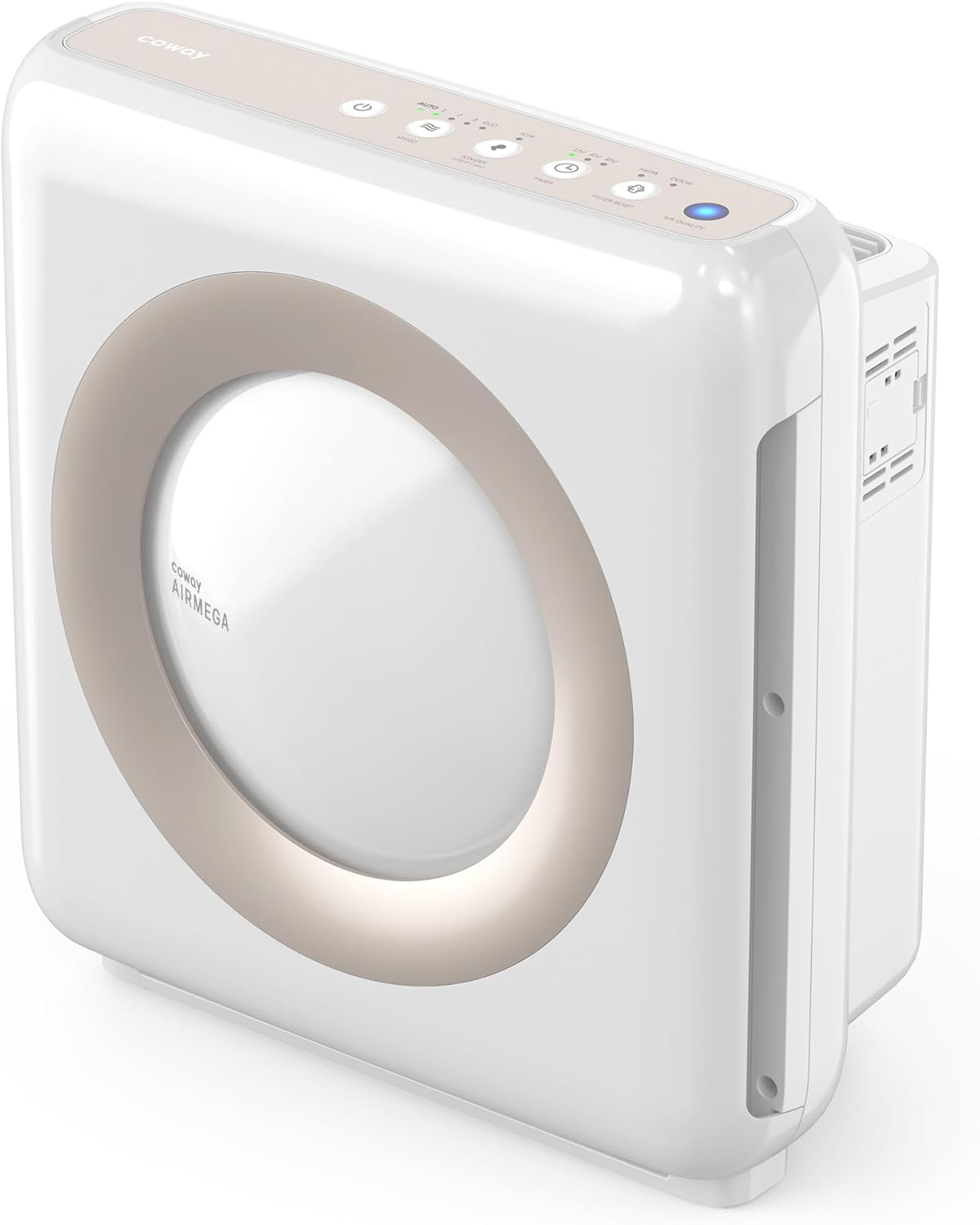
Coway AP-1512HH Mighty
15,000+ reviews · $189
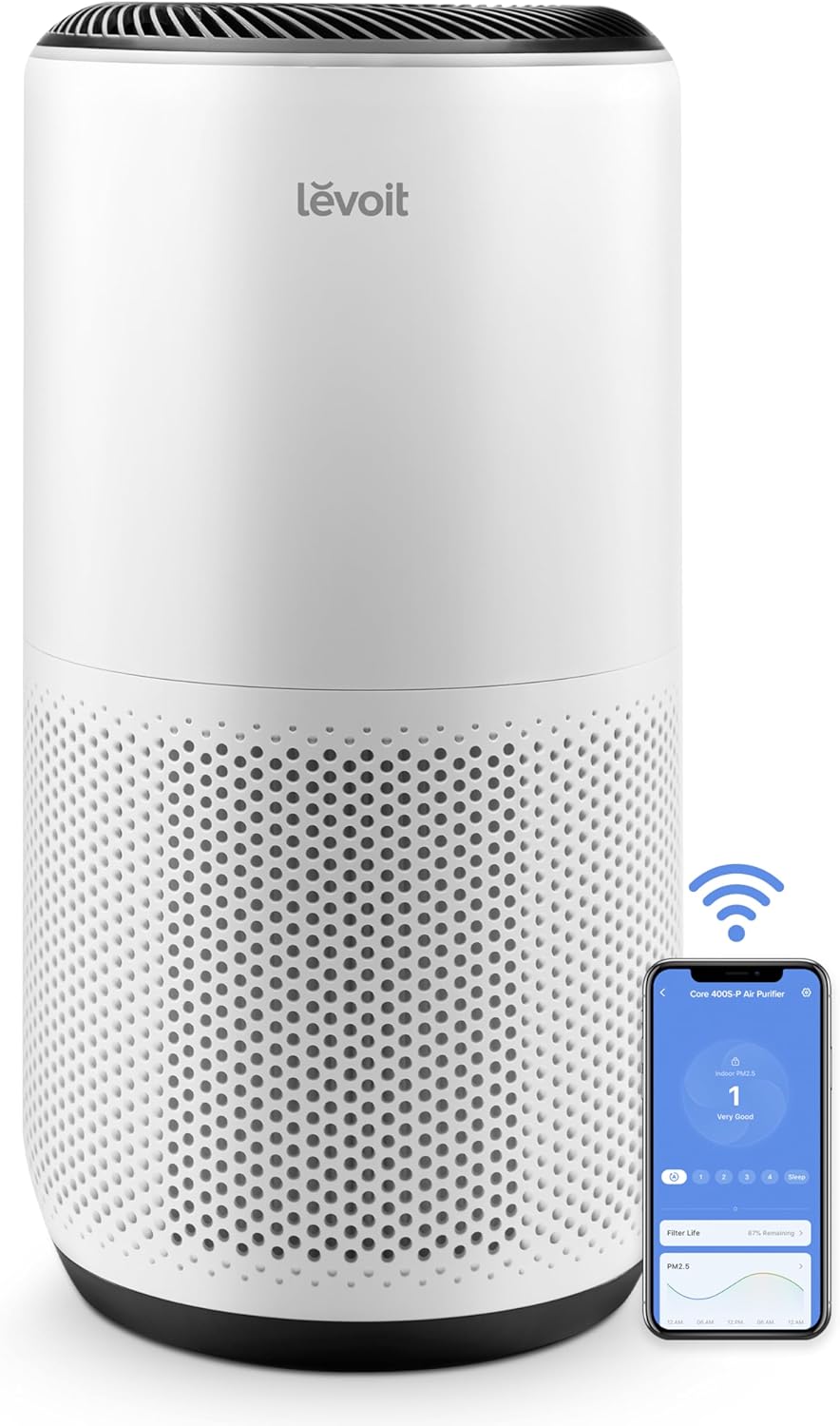
Levoit Core 400S
16,300+ reviews · $182
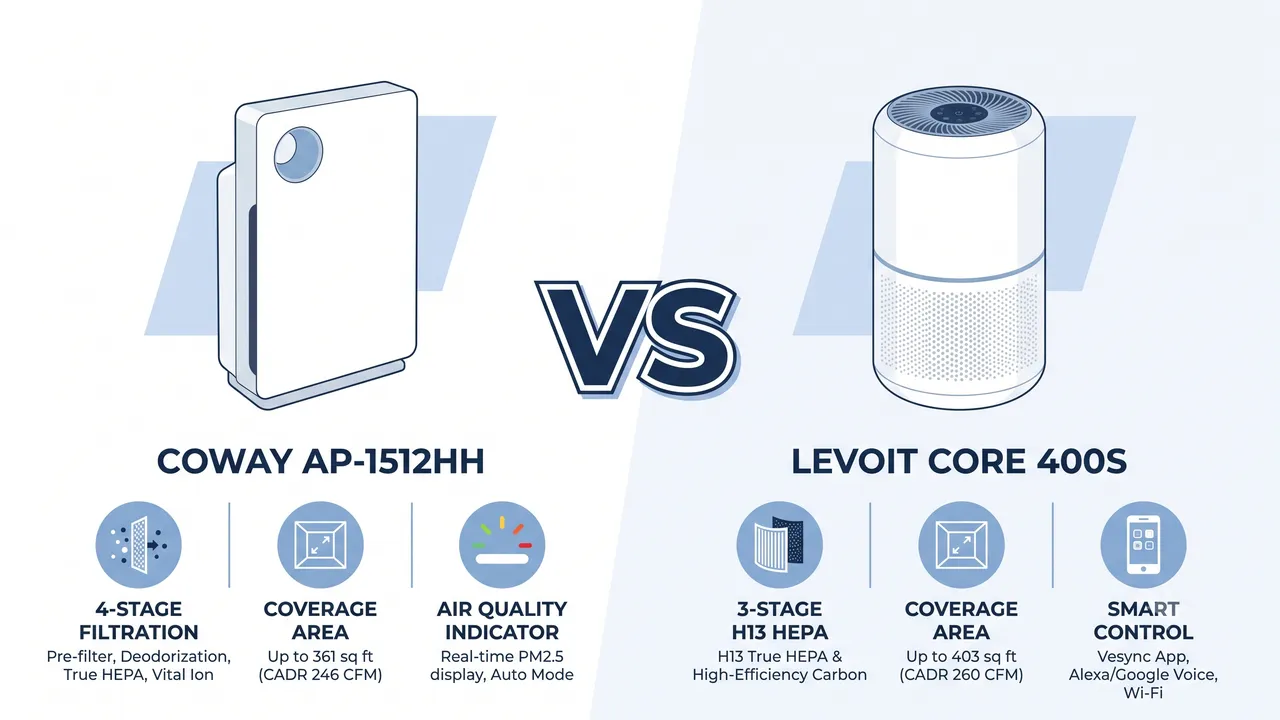
What Are the Key Specification Differences?
The most important numbers for any air purifier are CADR (Clean Air Delivery Rate), room coverage, noise, and power consumption. Here’s how these two stack up:
| Specification | Coway AP-1512HH Mighty | Levoit Core 400S-P |
|---|---|---|
| Price (Amazon, June 2026) | ~$189 | ~$182 |
| CADR, Smoke | 233 CFM | 231 CFM |
| CADR, Dust | 246 CFM | 240 CFM |
| CADR, Pollen | 240 CFM | 259 CFM |
| Room Coverage (4.8 ACH) | 361 sq ft | 358 sq ft |
| Filtration | 4-stage (Pre-filter, Odor, HEPA, Ionizer) | 3-stage (Pre-filter, H13 HEPA, Carbon) |
| Noise, Low | 24 dB | 24 dB |
| Noise, High | 53 dB | 50 dB |
| Power, High | 77 W | 54 W |
| Weight | 12.3 lbs | 12.6 lbs |
| Dimensions | 16.8 × 18.3 × 9.6 in | 10.6 × 10.6 × 20.5 in |
| WiFi / App | No | Yes (VeSync) |
| Voice Control | No | Alexa + Google |
| Air Quality Sensor | LED indicator (3-color) | Laser PM2.5 sensor (numeric) |
| Ozone-Free | Yes (ionizer off) | Yes (always) |
| Amazon Rating | 4.6★ (15,000+ reviews) | 4.7★ (16,300+ reviews) |
The raw CADR numbers are remarkably close. The Coway leads slightly on dust (246 vs 240 CFM), while the Levoit edges ahead on pollen (259 vs 240 CFM). In real-world testing, these differences are too small to notice, both units will clean a 350 sq ft room effectively within 15–20 minutes.
Which Air Purifier Removes More Particles?
Based on independent testing data from RTINGS and HouseFresh, both air purifiers achieve near-identical particle removal rates. In standardized smoke tests, both units reduced PM2.5 levels by 95–99% within 30 minutes in a sealed 350 sq ft room.
The Coway AP-1512HH uses an H13 True HEPA filter paired with a thin activated carbon sheet. Its 4-stage filtration adds an optional ionizer as a final stage, which can help with ultrafine particles but produces trace amounts of ozone (within CARB-certified limits).
The Levoit Core 400S uses an H13 True HEPA filter with an integrated carbon layer in a single bonded 3-in-1 cartridge. It is 100% ozone-free by design, with no ionizer or UV-C components. For buyers concerned about ozone, particularly those with asthma or respiratory conditions, the Levoit has a slight edge on safety.
Winner: Tie. Both deliver excellent particle removal. The Levoit is marginally safer for ozone-sensitive users.
How Do Noise Levels Compare?
Both air purifiers are whisper-quiet on their lowest settings at 24 dB, quieter than a library. The difference appears at full speed: the Coway reaches 53 dB while the Levoit stays at 50 dB. That 3 dB difference is noticeable in a quiet bedroom but irrelevant in a living room with background noise.
The Levoit Core 400S has a dedicated Sleep Mode that dims all indicator lights and locks the fan on the lowest speed. The Coway uses an Eco Mode that automatically turns off the fan when no airborne particles are detected for 30 minutes, then restarts when pollution is sensed. Both approaches work well for nighttime use, but the Levoit’s Sleep Mode is more predictable, some users find the Coway’s auto-off behavior disconcerting in a dark bedroom.
Winner: Levoit Core 400S, by a small margin for bedroom use.
What About Long-Term Filter Costs?
This is where the Coway pulls ahead significantly.
The Coway AP-1512HH uses separate filters: a True HEPA filter ($40, lasts 12 months) and a carbon pre-filter ($15 for a 4-pack, replaced every 3 months). Annual maintenance cost: approximately $50–60/year.
The Levoit Core 400S uses a single bonded 3-in-1 filter cartridge (~$50, officially rated for 12 months but realistically 6–8 months under heavy use). Annual maintenance cost: approximately $50–100/year depending on usage intensity and air quality.
Over a 5-year ownership period, the Coway saves approximately $100–200 in replacement filters. Third-party compatible filters are available for both units at 30–50% savings, though they may not match OEM filtration efficiency.
Winner: Coway AP-1512HH. Separate filters mean you only replace what’s needed, and the carbon pre-filter is dirt cheap.
Which Has Better Smart Features?
This isn’t close. The Levoit Core 400S wins decisively.
The Levoit connects to WiFi and integrates with the VeSync app, giving you remote control from anywhere, real-time PM2.5 readings from its built-in laser sensor, air quality history graphs, filter life tracking, scheduling, and automation rules. It works with Amazon Alexa and Google Assistant for voice commands like “Alexa, set the air purifier to high.”
The Coway AP-1512HH has no WiFi, no app, and no voice control. Its interface is purely physical: three fan speed buttons, an Eco mode button, a timer button, and a 3-color LED that shows approximate air quality (blue = good, amber = moderate, red = poor). That’s it.
For smart home enthusiasts, the Levoit’s app is genuinely useful, you can check your home’s air quality from work, automate the purifier to run at high speed when cooking, or integrate it into bedtime routines. For everyone else, the Coway’s simple controls are perfectly adequate and arguably more reliable (no WiFi means no connectivity issues).
Winner: Levoit Core 400S, by a wide margin.
Which Air Purifier Is More Energy Efficient?
The Levoit Core 400S consumes a maximum of 54 watts on its highest setting, compared to the Coway’s 77 watts. On their lowest settings, both sip power, the Coway at 4.9W and the Levoit at approximately 5W.
Running an air purifier 24/7 for a year at the U.S. average electricity rate of $0.16/kWh:
- Coway AP-1512HH: ~$42/year (assuming average 60W draw with auto mode)
- Levoit Core 400S: ~$34/year (assuming average 45W draw with auto mode)
The difference is roughly $8/year, not significant, but the Levoit’s lower power draw also means less heat output and slightly quieter operation at comparable speeds.
Winner: Levoit Core 400S, though the difference is minimal.
Is the Coway AP-1512HH Still Worth Buying in 2026?
Yes. Despite being on the market since 2014, the Coway AP-1512HH Mighty remains one of the best-selling air purifiers on Amazon for good reason. Its CADR ratings still compete with newer models, its filter costs are among the lowest in its class, and its build quality has proven durable over more than a decade of sales. Consumer Reports consistently rates it as a top pick for allergy sufferers.
The lack of smart features is its main weakness. If you want app control, real-time air quality data, or voice assistant integration, the Coway will feel outdated. But if you want a proven, no-nonsense air purifier that simply works, the Coway remains an excellent choice.
Is the Levoit Core 400S Worth the Extra Cost?
At its current discounted price of ~$182, the Levoit Core 400S is actually cheaper than the Coway’s ~$189. At this price point, the Levoit is arguably the better buy, you get smart features, a laser PM2.5 sensor, quieter high-speed operation, and lower energy consumption for less money.
However, the Levoit’s higher long-term filter costs ($50–100/year vs $50–60/year) and its bonded filter design (you must replace the entire cartridge even if only one layer is worn) reduce its value advantage over time. If you plan to keep the purifier for 3+ years, the Coway’s lower maintenance costs may offset its higher purchase price.
Who Should Buy the Coway AP-1512HH?
Choose the Coway AP-1512HH Mighty if you:
- Want the lowest long-term operating costs
- Prefer simple, physical controls over apps and WiFi
- Have allergies and need proven HEPA filtration
- Don’t need real-time air quality readings
- Plan to keep the purifier for 3+ years
- Want a compact unit that fits on a shelf or countertop
→ Check the Coway AP-1512HH price on Amazon
Who Should Buy the Levoit Core 400S?
Choose the Levoit Core 400S if you:
- Want WiFi control and app integration
- Use Alexa or Google Home for smart home automation
- Want real-time PM2.5 air quality readings
- Need a quieter unit on high speed (50 dB vs 53 dB)
- Are concerned about ozone and want a 100% ozone-free design
- Live in a medium-to-large room (up to 358 sq ft at 4.8 ACH)
→ Check the Levoit Core 400S price on Amazon
Quick Comparison at a Glance
What Do Real Owners Say?
We surveyed owner feedback across Amazon reviews, Reddit’s r/AirPurifiers, and independent review sites. Here’s the consensus:
Coway AP-1512HH owners consistently praise:
- “We have this Coway in our master bedroom, and it’s awesome at getting rid of pollen and pet dander.”, Reddit r/AirPurifiers user
- Long-term reliability, many owners report units running 5+ years without issues
- The Eco Mode auto-off feature, which saves energy by shutting down when air is clean
- Low filter costs, the separate pre-filter and HEPA design means you only replace what’s worn
Common complaints about the Coway:
- No WiFi or app control feels outdated in 2026
- The ionizer produces a faint smell when activated (most owners just turn it off)
- The air quality indicator is basic, just 3 colors, no numeric reading
Levoit Core 400S owners consistently praise:
- “So far it has been amazing, my sleeping improved and I didn’t need the asthma inhaler anymore.”, Reddit user on r/AirPurifiers
- The VeSync app and real-time PM2.5 readings, seeing exact air quality numbers is satisfying
- Quieter operation on high speed compared to competitors
- WiFi control from another room or when away from home
Common complaints about the Levoit:
- The bonded 3-in-1 filter design means you replace the entire cartridge even if only one layer is worn
- Some owners report the WiFi connection drops occasionally and needs re-pairing
- Filter costs add up, heavy users report replacing every 6–8 months at ~$50 each
- Earlier models had a “HEPA-type” controversy (the current 400S-P uses H13 True HEPA, resolved)
The Reddit consensus: r/AirPurifiers tends to favor the Coway for its proven track record and lower operating costs, while acknowledging the Levoit is the better choice for people who value smart features. When both are the same price, most Redditors lean Coway.
Best For: Which Purifier Fits Your Situation?
| Your Situation | Best Pick | Why |
|---|---|---|
| Allergies in a bedroom | Coway AP-1512HH | Proven HEPA, Eco auto-off saves energy at night |
| Pet owner (dander + odor) | Levoit Core 400S | Better carbon filter, app lets you boost speed when cooking |
| Wildfire smoke season | Levoit Core 400S | PM2.5 sensor shows real smoke levels, Smoke Remover filter option |
| Small apartment, budget-conscious | Coway AP-1512HH | Lower filter costs, no WiFi dependency |
| Smart home enthusiast | Levoit Core 400S | Alexa/Google integration, VeSync app automations |
| Office or workspace | Coway AP-1512HH | Quieter on low (24 dB), no distracting lights in Eco mode |
| Nursery or baby room | Levoit Core 400S | Sleep Mode dims all lights, 100% ozone-free |
| Long-term (5+ years) | Coway AP-1512HH | Proven durability, cheaper filters over time |
Final Verdict: Coway AP-1512HH vs Levoit Core 400S
Both are excellent air purifiers backed by thousands of verified reviews and years of proven performance. The differences come down to priorities:
Choose the Coway AP-1512HH for proven reliability, lower long-term costs, and simplicity. It’s the air purifier equivalent of a Toyota Camry, not flashy, but dependable and economical.
Choose the Levoit Core 400S for smart features, app control, and real-time air quality monitoring. It’s the better pick for tech-savvy buyers who want to integrate air purification into their smart home ecosystem.
For most buyers, we recommend the Coway AP-1512HH Mighty as the overall better value, its lower maintenance costs and proven filtration performance outweigh the Levoit’s smart features for the average household.
Frequently Asked Questions
How long should I run my air purifier each day?
For best results, run your air purifier 24/7 on medium speed. Air purification works by continuously removing particles—turning it off allows them to accumulate again. Modern purifiers use 30-80W on medium (similar to a light bulb), making continuous operation energy-efficient.
Where is the best place to put an air purifier?
Place the purifier 3-5 feet from your breathing zone, near pollution sources, with unobstructed airflow on all sides. Avoid corners, curtains, and furniture that block intake or output. For bedrooms, position near the bed but not blowing directly on you.
How do I know when to replace the filter?
Most purifiers have filter indicator lights. Without indicators, replace HEPA filters every 6-12 months and carbon filters every 3-6 months. Signs of a clogged filter: reduced airflow, visible discoloration, increased noise, or the purifier seeming less effective.
Are air purifiers noisy?
Noise levels vary by model and fan speed. Sleep modes (20-25 dB) are quieter than a whisper. Medium speeds (35-45 dB) are similar to background music. High speeds (50-60 dB) are conversation level. For bedrooms, look for sleep modes under 25 dB.
Do air purifiers use a lot of electricity?
No. Most purifiers use 30-80W on medium and 5-15W on sleep mode. Running 24/7 on medium costs $2-8/month at average US electricity rates. Energy Star models use 15-40% less electricity. The main ongoing cost is filter replacement ($30-120/year).
Related Articles
Support This Guide
Helpful? Add The Air Purifier Guide as a preferred source on Google so our guides show up in your search results.
Related Articles

Coway Mighty2 vs AP-1512HH (2026)
Coway's Mighty2 replaced the AP-1512HH as Wirecutter's top pick. We compare CADR, noise, sensors, filter costs, and whether the older unit is still the smarter buy.

KNKA APH4000 Review: $150 Dark Horse
KNKA's APH4000 is one of Amazon's best-selling purifiers at $150. We check the AHAM certification, decode the 1,695 sq ft claim, and compare it to Levoit and Coway.

Levoit Core 300 vs 300-P: What Changed
Levoit quietly replaced the Core 300 with the Core 300-P. We explain the AHAM certification, whether filters still fit, and which one you should actually buy.

Shark NeverChange HP302 Review
Shark's NeverChange HP302 promises 5 years on one filter. We dig into the real running costs, the odor neutralizer catch, and whether it beats cheaper rivals.

Winix 5510 vs 5500-2: 2026 Verdict
The Winix 5500-2 is discontinued and the 5510 takes over. We compare CADR, noise, filter costs, and the one compatibility problem nobody mentions.
🛒 Products Mentioned
As an Amazon Associate, we earn from qualifying purchases.
Runs side-by-side purifier comparisons, long-term ownership reports, and filter cost analysis.
View all articles by David →