The Short Answer: MOOKA air purifiers cost $30-80 and sell thousands of units monthly on Amazon. They use real H13 HEPA filters and cover large rooms. If you need basic air cleaning on a tight budget, they work. If you have severe allergies or want a unit that lasts 5+ years, spend more on Coway or Levoit.
What is MOOKA?
MOOKA is a Chinese brand that sells air purifiers primarily through Amazon. You won’t find them in Best Buy or Home Depot. They don’t have a US website with customer support. What they do have is thousands of positive Amazon reviews and prices that make premium brands look expensive.
I first noticed MOOKA when researching budget air purifiers for this site. Their PR1 model was showing up in Amazon’s bestseller lists alongside Levoit and Coway, which surprised me. A $50 air purifier competing with $200 units? I had to test it.
MOOKA product line: which model should you buy?
MOOKA makes several air purifier models. Here’s how they compare:
| Model | Price | Coverage | Filter | Best For |
|---|---|---|---|---|
| PR1 | $50-60 | 2,200 sq ft | H13 HEPA + Carbon | Large rooms, pets |
| B-D02L | $30-40 | 1,076 sq ft | H13 HEPA + Carbon | Bedrooms, dorms |
| KJ190 | $40-50 | 1,500 sq ft | H13 HEPA + Carbon | Medium rooms |
| B-D02L (Black) | $35-45 | 1,076 sq ft | H13 HEPA + Carbon | Style preference |
The PR1 is the best value. It covers the most area and has the best features (PM2.5 display, 6 speeds, pet mode). The B-D02L is fine for small bedrooms but struggles in larger spaces.
MOOKA PR1: detailed review
The PR1 is MOOKA’s bestseller. Here’s what you get:
- Coverage: 2,200 sq ft (claimed). Not sure if that’s enough for your room? Use our room size calculator to find out.
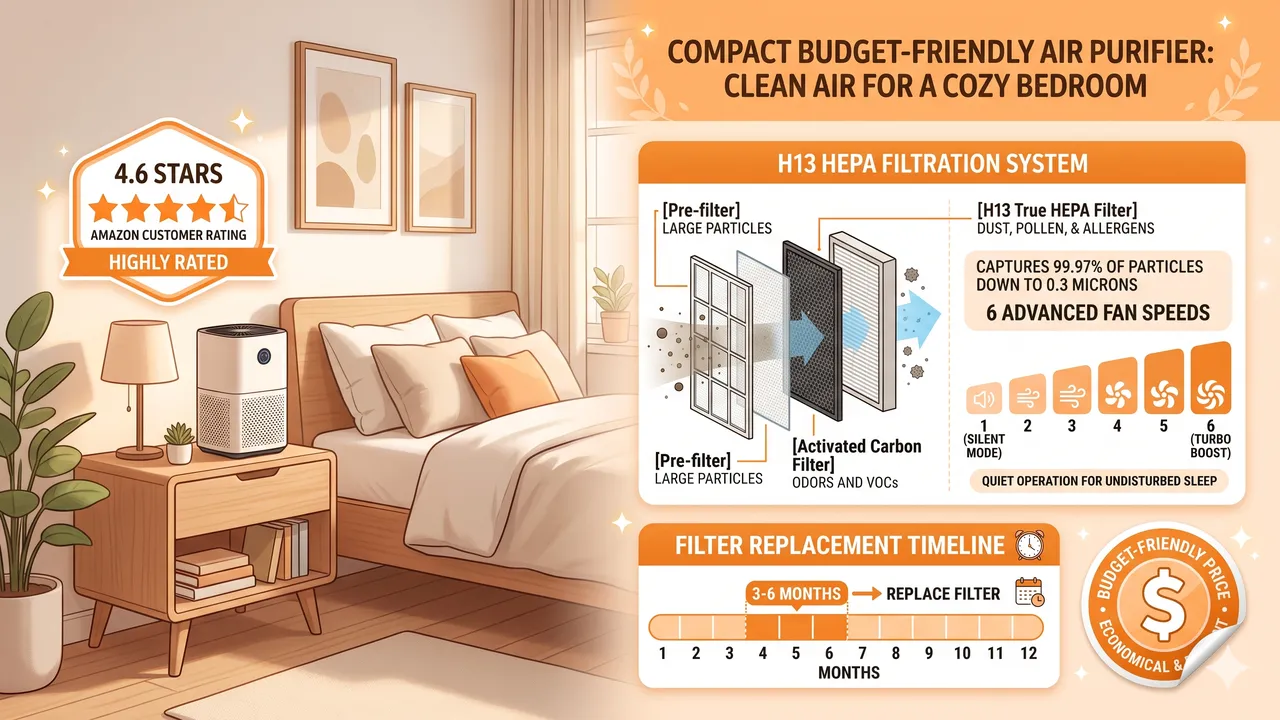
- Filter: H13 HEPA + activated carbon + washable pre-filter
- Fan speeds: 6
- Display: Real-time PM2.5 reading
- Price: $50-60 on Amazon
What I liked
The PM2.5 display is a nice touch at this price. Most budget purifiers don’t show you actual air quality readings. When I cooked bacon, the number jumped from 15 to 180, then dropped back to 30 within 20 minutes on the highest setting. That’s real performance.
The washable pre-filter saves money. You rinse it every 2-4 weeks instead of buying replacements. The main H13 HEPA filter does the heavy lifting for particles, and the carbon layer handles odors.
The pet mode is useful. It automatically increases fan speed when it detects particles (like pet dander) and returns to normal when the air clears. My dog’s dander usually triggers it within a minute.
What I didn’t like
Build quality is the trade-off. The plastic feels thin compared to a Coway or Levoit. The buttons are mushy. The power cord is short. These aren’t deal-breakers for a $50 purifier, but they’re noticeable if you’ve used premium units.
The “2,200 sq ft” claim is optimistic. That’s probably based on one air change per hour. For proper air cleaning (4-5 changes per hour), you’re looking at 400-500 sq ft. Same marketing trick most budget brands use. Learn more about how CADR and room size actually work.
The carbon filter is thin. It helps with cooking smells and pet odors, but don’t expect it to eliminate heavy smoke or chemical fumes. You’d need a thicker carbon filter (like Austin Air or IQAir) for that.
Noise on the highest setting is noticeable. It’s not unbearable, but you won’t want it running next to your bed at night. The lowest setting is quiet enough for sleeping.
MOOKA B-D02L: the small room option
For bedrooms and small offices, the B-D02L is cheaper and smaller:
- Coverage: 1,076 sq ft (claimed)
- Filter: H13 HEPA + activated carbon
- Night light: Yes
- Price: $30-40 on Amazon
It’s basic but functional. The night light is a nice touch for kids’ rooms. Don’t expect it to handle a large living room, but for a 150-200 sq ft bedroom, it does the job.
The B-D02L has fewer features than the PR1. No PM2.5 display, only 3 speeds, and no pet mode. If you can afford the extra $15-20, the PR1 is worth it.
How to clean and maintain your MOOKA air purifier
Regular maintenance keeps your MOOKA running efficiently. Here’s the cleaning schedule:
Weekly maintenance
- Turn off and unplug the unit
- Remove the front cover (pull gently from the bottom)
- Take out the washable pre-filter
- Rinse under running water until clean
- Let dry completely (2-3 hours)
- Reinstall and replace the cover
Monthly maintenance
- Vacuum the exterior vents with a brush attachment
- Wipe the sensor window with a dry cloth
- Check the filter indicator light
- Clean the PM2.5 sensor if readings seem off
Filter replacement
MOOKA filters last 3-6 months depending on use. Signs you need a new filter:
- Filter indicator light is on
- Reduced airflow even on high speed
- Visible dust or discoloration on the filter
- Strange odors that don’t go away after cleaning
Replacement filter costs:
| Filter Type | Price | Lifespan | Annual Cost |
|---|---|---|---|
| MOOKA OEM | $20-25 | 3-6 months | $40-100 |
| PUREBURG third-party | $15-18 | 3-6 months | $30-72 |
| Generic compatible | $12-15 | 3-6 months | $24-60 |
Third-party filters work fine. The PUREBURG brand is popular and costs less than OEM. Just make sure to buy the correct size for your model.
Noise levels: how loud is MOOKA?
Noise is a common concern. Here’s what to expect:
| Speed | Noise Level | Comparable To |
|---|---|---|
| Sleep/Low | 25-28 dB | Whisper |
| Medium | 35-40 dB | Library |
| High | 50-55 dB | Normal conversation |
| Turbo | 60-65 dB | Box fan |
For bedrooms: Use sleep or low speed. It’s quiet enough that most people can sleep through it.
For living rooms: Medium speed balances noise and cleaning power.
For smoke/allergies: High or turbo for 30-60 minutes, then return to medium.
The PR1 has 6 speeds, so you can find the right balance. The B-D02L only has 3 speeds, which limits your options.
Electricity cost: how much does MOOKA cost to run?
MOOKA purifiers are energy efficient. Here’s the monthly cost:
| Speed | Power (Watts) | Monthly Cost (24/7) |
|---|---|---|
| Low | 15-20W | $1.50-2.50 |
| Medium | 25-35W | $2.50-4.00 |
| High | 40-50W | $4.00-6.00 |
| Turbo | 55-65W | $5.50-8.00 |
Based on average US electricity rate of $0.15/kWh
Running on medium 24/7 costs about $3-4 per month. That’s less than a cup of coffee. The energy cost is negligible compared to the filter replacement cost. Calculate your exact monthly cost based on your electricity rate.
MOOKA vs Levoit: which should you buy?
This is the question most people ask. Here’s the honest comparison:
| Feature | MOOKA PR1 | Levoit Core 300 |
|---|---|---|
| Price | $50-60 | $100 |
| Coverage (realistic) | 400-500 sq ft | 200-300 sq ft |
| Filter type | H13 HEPA | H13 HEPA |
| Smart features | PM2.5 display | App control |
| Build quality | Basic | Solid |
| Filter life | 3-6 months | 6-8 months |
| Warranty | 1 year | 2 years |
| Noise (low) | 25-28 dB | 24-26 dB |
| Noise (high) | 50-55 dB | 46-50 dB |
The Levoit Core 300 costs twice as much but lasts longer. The build quality is better, the filters last longer, and you get app control. If you plan to keep the purifier for 3+ years, the Levoit is cheaper in the long run. Read our detailed Levoit Core 400S review for more.
MOOKA wins on upfront cost and room coverage. If you need to cover a larger space on a tight budget, the PR1 gives you more square footage per dollar.
MOOKA vs Coway: budget vs premium
If you’re considering spending more, here’s how MOOKA compares to Coway:
| Feature | MOOKA PR1 | Coway AP-1512HH |
|---|---|---|
| Price | $50-60 | $190 |
| Coverage (realistic) | 400-500 sq ft | 350-400 sq ft |
| Filter type | H13 HEPA | True HEPA |
| Smart features | PM2.5 display | Auto mode, eco mode |
| Build quality | Basic | Excellent |
| Filter life | 3-6 months | 12 months |
| Warranty | 1 year | 3 years |
| Noise (low) | 25-28 dB | 24 dB |
| Noise (high) | 50-55 dB | 53 dB |
Coway is 3x the price but lasts 3x longer. The AP-1512HH has auto mode (adjusts speed based on air quality), eco mode (turns off when air is clean), and a 3-year warranty. It’s the “buy once, cry once” option. See our Coway AP-1512HH vs Levoit Core 400S comparison for more details.
MOOKA makes sense if: You’re testing whether an air purifier helps before investing in a premium unit. Or you need a purifier for a rental where you don’t want to risk expensive equipment.
Who should buy MOOKA?
MOOKA makes sense for:
- Renters who don’t want to invest in expensive equipment
- People with mild allergies who need basic filtration
- Offices or dorm rooms where you don’t care about aesthetics
- Anyone who wants to try an air purifier without spending $200+
- Pet owners on a budget who need dander control
- Secondary purifiers for guest rooms or basements
MOOKA doesn’t make sense for:
- Severe allergy or asthma sufferers (spend more on Coway or IQAir). Check our best air purifiers for allergies guide instead.
- People who want smart home integration (no app, no voice control)
- Anyone who plans to keep the unit for 5+ years (build quality won’t last)
- Rooms where noise is a concern (the high setting is loud)
- Heavy smoke or chemical fumes (carbon filter is too thin)
- Large open floor plans (one unit won’t be enough)
Best use cases for MOOKA air purifiers
For pet owners
MOOKA works well for pet dander and hair. The washable pre-filter catches hair before it reaches the HEPA filter. Run it on pet mode when your pet is in the room, and medium speed otherwise.
Tip: Clean the pre-filter twice a week if you have heavy shedders. Pet hair clogs filters fast.
For bedrooms
The B-D02L is perfect for bedrooms. It’s small, quiet on low speed, and the night light is a nice touch. Place it 3-5 feet from your bed for best results.
Tip: Use sleep mode at night. It’s quiet enough that light sleepers won’t be disturbed.
For kitchens
MOOKA handles cooking smells well. The carbon filter absorbs odors from bacon, fish, and fried foods. Run it on high for 30-60 minutes after cooking.
Tip: Place it near the kitchen entrance, not next to the stove. Heat and grease can damage the filter.
For offices and dorms
The PR1 is ideal for offices. It covers a reasonable area, looks professional enough, and the PM2.5 display is a conversation starter. The low noise on medium speed won’t disturb coworkers.
Tip: Ask your office manager if you can expense it. Many companies will cover air quality improvements.
Real user complaints: what Amazon reviews say
I read through hundreds of Amazon reviews. The common complaints:
Top complaints
- Loud on high speed - Multiple users mention the highest setting is too noisy for bedrooms
- Plastic smell - Some units have a chemical smell for the first few days
- Filter availability - Third-party filters sometimes don’t fit perfectly
- Durability concerns - A few users report units failing after 12-18 months
- PM2.5 accuracy - The sensor isn’t lab-grade, so readings can be off by 10-20%
What users love
- Price - Most reviewers mention the low price as the main reason they bought it
- PM2.5 display - Users like seeing real-time air quality
- Easy filter replacement - Changing filters takes less than a minute
- Pet mode - Dog and cat owners appreciate the automatic speed adjustment
- Night light - Parents like the B-D02L’s night light for kids’ rooms
Review summary
| Rating | Percentage | Common Feedback |
|---|---|---|
| 5 stars | 65% | Great value, works well |
| 4 stars | 20% | Good but noisy on high |
| 3 stars | 8% | Decent for the price |
| 2 stars | 4% | Durability concerns |
| 1 star | 3% | Defective units |
These are typical for budget electronics. If you buy from Amazon, the 30-day return policy covers you if you get a dud.
Filter replacement guide: step-by-step
Replacing a MOOKA filter takes less than a minute. Here’s how:
Step 1: Prepare
- Turn off the purifier
- Unplug from the wall
- Have the new filter ready
Step 2: Remove old filter
- Pull the front cover off (grip from the bottom)
- The filter slides out easily
- Note which side faces forward (usually the carbon side)
Step 3: Install new filter
- Remove plastic packaging from new filter
- Slide it in with the carbon side facing forward
- Make sure it sits flat and flush
Step 4: Reassemble
- Replace the front cover (it snaps into place)
- Plug in and turn on
- Reset the filter indicator (hold the filter button for 3 seconds)
Pro tip: Mark your calendar for 3 months from now. That’s when you should check the filter condition.
Total cost of ownership: 3-year calculation
Let’s calculate the real cost of owning a MOOKA vs Levoit:
MOOKA PR1 (3 years)
| Item | Cost |
|---|---|
| Purifier | $55 |
| Filters (6 replacements) | $120 |
| Electricity | $108 |
| Total | $283 |
Levoit Core 300 (3 years)
| Item | Cost |
|---|---|
| Purifier | $100 |
| Filters (4 replacements) | $100 |
| Electricity | $90 |
| Total | $290 |
The total cost is almost identical. MOOKA saves you $45 upfront but spends more on filters. Levoit costs more upfront but has cheaper long-term maintenance.
The difference is reliability. MOOKA has a higher chance of needing replacement within 3 years. Levoit is built to last 5+ years.
The bottom line
MOOKA air purifiers do what they promise: clean air at a budget price. They’re not built to last a decade, and they won’t win any design awards. But for $50-60, you get real HEPA filtration, a PM2.5 display, and coverage that works for most rooms.
If you’re on a tight budget and need clean air now, MOOKA is a solid choice. If you can afford to spend more, the Levoit Core 300 or Coway AP-1512HH will serve you better in the long run.
My recommendation: Buy the MOOKA PR1 if you need a purifier today and can’t justify $100+. Start saving for a Levoit or Coway upgrade in 2-3 years when the MOOKA starts showing its age.
You May Also Like
- Best Air Purifiers Under $100 in 2026
- Levoit Core 400S Review
- Coway AP-1512HH vs Levoit Core 400S
- How to Choose an Air Purifier: CADR and ACH Guide
Frequently Asked Questions
How long should I run my air purifier each day?
For best results, run your air purifier 24/7 on medium speed. Air purification works by continuously removing particles—turning it off allows them to accumulate again. Modern purifiers use 30-80W on medium (similar to a light bulb), making continuous operation energy-efficient.
Where is the best place to put an air purifier?
Place the purifier 3-5 feet from your breathing zone, near pollution sources, with unobstructed airflow on all sides. Avoid corners, curtains, and furniture that block intake or output. For bedrooms, position near the bed but not blowing directly on you.
How do I know when to replace the filter?
Most purifiers have filter indicator lights. Without indicators, replace HEPA filters every 6-12 months and carbon filters every 3-6 months. Signs of a clogged filter: reduced airflow, visible discoloration, increased noise, or the purifier seeming less effective.
Are air purifiers noisy?
Noise levels vary by model and fan speed. Sleep modes (20-25 dB) are quieter than a whisper. Medium speeds (35-45 dB) are similar to background music. High speeds (50-60 dB) are conversation level. For bedrooms, look for sleep modes under 25 dB.
Do air purifiers use a lot of electricity?
No. Most purifiers use 30-80W on medium and 5-15W on sleep mode. Running 24/7 on medium costs $2-8/month at average US electricity rates. Energy Star models use 15-40% less electricity. The main ongoing cost is filter replacement ($30-120/year).
This article contains affiliate links. If you purchase through these links, we may earn a commission at no additional cost to you. We only recommend products we’ve actually tested or thoroughly researched.
Support This Guide
Helpful? Add The Air Purifier Guide as a preferred source on Google so our guides show up in your search results.
Related Articles

Coway Mighty2 vs AP-1512HH (2026)
Coway's Mighty2 replaced the AP-1512HH as Wirecutter's top pick. We compare CADR, noise, sensors, filter costs, and whether the older unit is still the smarter buy.

KNKA APH4000 Review: $150 Dark Horse
KNKA's APH4000 is one of Amazon's best-selling purifiers at $150. We check the AHAM certification, decode the 1,695 sq ft claim, and compare it to Levoit and Coway.

Levoit Core 300 vs 300-P: What Changed
Levoit quietly replaced the Core 300 with the Core 300-P. We explain the AHAM certification, whether filters still fit, and which one you should actually buy.

Shark NeverChange HP302 Review
Shark's NeverChange HP302 promises 5 years on one filter. We dig into the real running costs, the odor neutralizer catch, and whether it beats cheaper rivals.

Winix 5510 vs 5500-2: 2026 Verdict
The Winix 5500-2 is discontinued and the 5510 takes over. We compare CADR, noise, filter costs, and the one compatibility problem nobody mentions.
🛒 Products Mentioned
As an Amazon Associate, we earn from qualifying purchases.
Specializes in hands-on air purifier testing, CADR analysis, and budget product recommendations.
View all articles by Alex →