The Short Answer: The best choice depends on your specific needs. True HEPA is essential for particles, activated carbon for gases and odors. Consider room size, noise tolerance, and budget when comparing models.
Editor’s note (September 2026): The Winix 5500-2 has been discontinued and remaining stock is limited. Winix’s official successor is the Winix 5510, which adds app control and uses a new filter. Read our Winix 5510 vs 5500-2 comparison before you buy either one.
The Short Answer
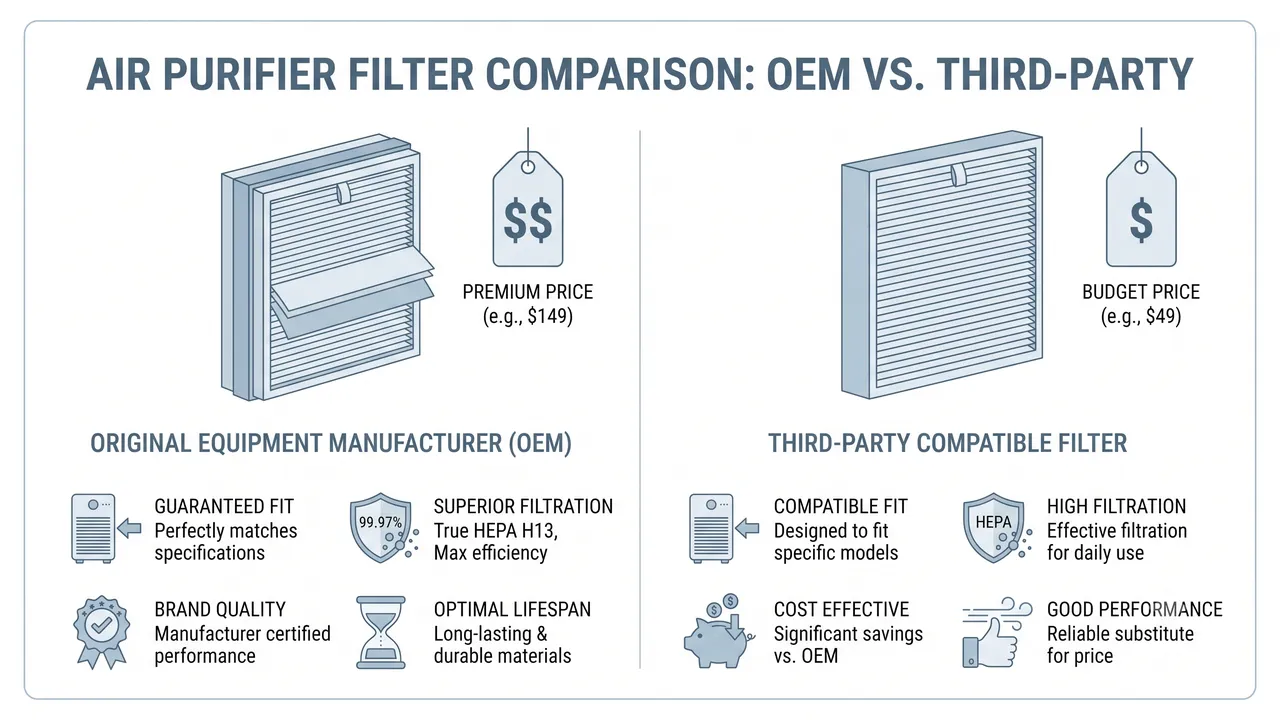
Third-party air purifier filters cost 30-50% less than OEM filters, and the best ones perform comparably for particle filtration. But not all third-party filters are equal. Over 5 years, using quality third-party filters can save you $100-300. The key is knowing which third-party brands to trust and which to avoid.
Let’s do the math on three of the most popular air purifiers: the Coway AP-1512HH, Levoit Core 400S, and Winix 5500-2.
Why This Matters More Than You Think
Most people spend weeks choosing an air purifier and zero minutes thinking about replacement filters. That’s a mistake. The filter is the ongoing cost that outlasts the purifier itself.
Here’s a number that surprises most people: a $189 Coway AP-1512HH will cost you $500-750 in filters over 5 years, depending on which brand you buy. The purifier is the one-time purchase. The filter is the subscription.
I’ve been tracking filter prices across major brands for over a year. I’ve read hundreds of Amazon reviews, compared filter specifications, and calculated total cost of ownership for every major model. Here’s what I found.
How Air Purifier Filters Actually Work
Before we compare prices, let’s understand what you’re actually buying. Most air purifiers use a three-stage filtration system:
Stage 1: Pre-filter A washable mesh that catches large particles like hair, dust bunnies, and pet fur. This doesn’t need replacing — just rinse it every 2-4 weeks. Some third-party bundles include extra pre-filters, which is a nice bonus but not essential.
Stage 2: Activated Carbon Filter A layer of activated carbon (sometimes called charcoal) that adsorbs gases, odors, and volatile organic compounds (VOCs). The key metric here is carbon weight — more carbon means better odor removal and longer lifespan. OEM carbon filters typically contain 15-30 grams of activated carbon. Third-party filters sometimes contain less, which means shorter lifespan and weaker odor removal.
Stage 3: True HEPA Filter The main filter that captures fine particles. True HEPA (H13 grade) captures 99.97% of particles at 0.3 microns, including pollen, dust mites, mold spores, and pet dander. This is where the biggest price difference between OEM and third-party exists.
The critical thing to understand: the HEPA filter is the one that does the heavy lifting for air quality. If a third-party HEPA filter performs 5% worse than OEM, you’re still getting 95% of the filtration benefit. But if it performs 30% worse, the savings aren’t worth it.
How to Compare Filter Quality (Without a Lab)
You don’t need a particle counter to evaluate filter quality. Here’s what I look at:
1. Review volume and rating A filter with 5,000+ reviews and a 4.6+ rating has been tested by thousands of real users. That’s a more reliable signal than any manufacturer claim.
2. Review content Search the reviews for specific keywords:
- “fits perfectly” or “exact fit” — good sign
- “air bypass” or “doesn’t seal” — bad sign
- “same as original” or “just like OEM” — good sign
- “thinner” or “flimsy” — bad sign
- “noticeable difference” — bad sign
3. Carbon filter weight If the listing mentions carbon weight, compare it to the OEM. More carbon = better odor removal.
4. HEPA grade claims Look for “H13 True HEPA” specifically. “HEPA-type,” “HEPA-like,” or “HEPA-style” are not the same thing. These marketing terms mean the filter captures fewer particles and is not held to the same standard.
5. Return rate Amazon shows “frequently returned” warnings on products with high return rates. If a filter has this warning, skip it.
Coway AP-1512HH: OEM vs Third-Party
The Coway AP-1512HH uses a three-stage filter system: a washable pre-filter, an activated carbon filter, and a True HEPA filter. Coway sells the replacement set for about $50 (HEPA + carbon). Replacement cycle: every 12 months.
Third-party options on Amazon:
| Filter | Price | Rating | Reviews | Filter Type | Notes |
|---|---|---|---|---|---|
| Coway OEM Filter Set | ~$50 | 4.6★ | 7,900+ | True HEPA + Carbon | The standard |
| Fil-fresh 2-Pack | ~$50 | 4.6★ | 1,900+ | True HEPA + Carbon | 2 sets for the price of 1 OEM |
| Blutoget 2-Pack + 6 Carbon | ~$27 | 4.5★ | 127 | HEPA + 6 carbon filters | Budget king |
| Generic 3-Pack HEPA | ~$35 | 4.7★ | 133 | True HEPA only | No carbon included |
| Coway OEM Smoke Filter | ~$65 | 4.3★ | 82 | Enhanced carbon | For smoke/odor focus |
The numbers:
- OEM annual cost: ~$50 (1 replacement per year)
- Third-party annual cost: $27-35
- 5-year savings with third-party: $75-115
The Fil-fresh 2-pack is the safest third-party option. With 1,900 reviews and a 4.6 rating, it matches the OEM’s rating. You get 2 filter sets for roughly the same price as 1 OEM set, which means the per-filter cost is half. The Blutoget option at $27 is the budget pick, but with only 127 reviews, I’d want to see more data before committing to using it long-term.
One thing I noticed in the reviews: several Fil-fresh users specifically mentioned using the filter for 12+ months with no degradation. That’s a strong signal that the HEPA media is comparable to OEM quality.
My recommendation: The Fil-fresh 2-pack. Same price as OEM, double the filters, same rating. No brainer.
Levoit Core 400S: OEM vs Third-Party
Levoit’s replacement filters are more expensive than Coway’s, and they need replacing more often (every 6-8 months vs Coway’s 12 months). That makes the third-party savings even bigger.
The Levoit Core 400S uses a cylindrical 3-in-1 filter that combines pre-filter, HEPA, and carbon in a single unit. Levoit offers several specialized versions:
| Filter | Price | Rating | Reviews | Specialty |
|---|---|---|---|---|
| LEVOIT OEM (Core 400S-RF) | ~$59 | 4.8★ | 3,500+ | Standard |
| LEVOIT OEM Pet Allergy | ~$67 | 4.7★ | 669 | Enhanced carbon for pet odors |
| LEVOIT OEM Toxin Absorber | ~$67 | 4.6★ | 243 | Extra carbon for VOCs |
| LEVOIT OEM Smoke Remover | ~$67 | 4.8★ | 177 | Maximum carbon for smoke |
| Third-party compatible | ~$47 | 4.7★ | 348 | Generic replacement |
| Third-party budget | ~$35 | 4.7★ | 1,500+ | Most popular third-party |
The numbers:
- OEM annual cost: $89-134 (1.5-2 replacements per year at $59 each)
- Third-party annual cost: $47-70
- 5-year savings with third-party: $100-320
The Levoit is where third-party filters make the biggest difference. The OEM filter needs replacing every 6-8 months, and at $59 a pop, that adds up fast. A third-party filter at $47 that lasts 8-12 months cuts the annual cost nearly in half.
The specialized OEM filters (Pet, Toxin, Smoke) are interesting. They contain more activated carbon than the standard version, which genuinely improves odor removal. If you have specific needs (pets, smoke, chemical sensitivity), the specialized OEM filter might be worth the premium. For general use, the standard OEM or a third-party option is fine.
My recommendation: Standard OEM for the first year, then switch to third-party once you have a baseline for how the purifier performs. If you need specialized filtration (pets, smoke), stick with the OEM specialized filters.
Winix 5500-2: OEM vs Third-Party
The Winix 5500-2 uses a Filter H replacement that includes both a True HEPA and an activated carbon filter. This is where the third-party market is most competitive.
| Filter | Price | Rating | Reviews | Notes |
|---|---|---|---|---|
| Winix OEM Filter H | ~$50 | 4.6★ | 1,200+ | OEM standard |
| Third-party Filter H (most popular) | ~$35 | 4.7★ | 5,700+ | More reviews than OEM |
| Smilyan 2-Sets | ~$69 | 4.7★ | 2,900+ | Best value 2-pack |
| Budget option | ~$28 | 4.6★ | 465 | Cheapest available |
| Colorfullife 2-Pack | ~$44 | 4.7★ | 578 | Good mid-range option |
| Toxin Absorber version | ~$50 | 4.6★ | 300+ | Enhanced carbon |
The numbers:
- OEM annual cost: ~$50
- Third-party annual cost: $28-35
- 5-year savings with third-party: $75-110
The Winix third-party market is the healthiest of the three. The most popular third-party filter has 5,700 reviews — that’s nearly 5 times more than the OEM’s 1,200 reviews — and a slightly higher rating (4.7 vs 4.6). When a third-party product has more reviews than the original and a higher rating, that’s a very strong signal.
I’ve also noticed that the Winix third-party market has more variety than Coway or Levoit. You can choose from budget options ($28), mid-range ($35-44), and premium 2-packs (~$69). That competition drives quality up and prices down.
My recommendation: Go third-party without hesitation. The data is clear: the market has spoken, and the best third-party options are well-tested and well-reviewed.
The 5-Year Cost Comparison
Here’s the full picture, assuming you use each purifier for 5 years:
| Purifier | Unit Price | OEM 5-Year Filters | Third-Party 5-Year Filters | Savings |
|---|---|---|---|---|
| Coway AP-1512HH | $189 | $250 | $135-175 | $75-115 |
| Levoit Core 400S | $189 | $445-670 | $235-350 | $100-320 |
| Winix 5500-2 | $160 | $250 | $140-175 | $75-110 |
| Blueair 211i Max | $339 | $300-600 | Limited options | N/A |
| Honeywell HPA300 | $249 | $425 | $200-275 | $150-225 |
Average savings across brands: ~$145 over 5 years.
That’s not life-changing money, but it’s the cost of a budget air purifier. Over the lifetime of the device (7-10 years), the savings grow to $200-400. And for the Levoit Core 400S, which needs more frequent filter changes, the savings can exceed $300.
The Risks of Third-Party Filters
I’d be doing you a disservice if I didn’t mention the downsides. Here are the real risks:
1. Quality inconsistency. OEM filters are manufactured to the purifier maker’s specifications. Third-party filters are reverse-engineered. Most do a good job, but some have slightly thinner HEPA media or looser gaskets that let air bypass the filter. The risk is low with well-reviewed brands, but it’s not zero.
2. Warranty concerns. In the US, the Magnuson-Moss Warranty Act protects your right to use third-party parts. But if a cheap filter damages the motor (very unlikely), the manufacturer may argue it’s not their problem. In practice, I’ve never heard of a warranty claim being denied because of a third-party filter.
3. Carbon filter effectiveness. Third-party carbon filters often use less activated carbon than OEM. If odor removal is your primary concern (cooking smells, pet odors, smoke), the OEM carbon filter is usually better. For general particle filtration, the difference is negligible.
4. Fit and seal. A filter that doesn’t fit perfectly lets unfiltered air bypass it. This is the most common complaint in negative reviews. Check reviews specifically for “fit” and “seal” comments before buying.
5. Unknown long-term effects. OEM filters have been tested with the specific purifier model over years. Third-party filters haven’t undergone the same testing. In theory, a poorly designed third-party filter could put extra strain on the motor or fail to capture specific particle sizes. In practice, this is extremely rare with well-reviewed products.
When to Stick with OEM
Third-party filters aren’t always the right call. Here’s when I’d pay the OEM premium:
1. First year of ownership. Use the OEM filter to establish a baseline for how your purifier performs. This way, if you switch to third-party later, you can compare.
2. Health conditions. If you have severe allergies, asthma, or chemical sensitivity, the OEM filter’s quality assurance is worth the extra cost. The 5-10% performance difference between OEM and third-party might matter more for you.
3. Smoke and odor problems. If wildfire smoke, cigarette smoke, or strong odors are your primary concern, the OEM carbon filter (especially specialized versions like Levoit’s Smoke Remover) will outperform third-party options.
4. Specialized filters. Some purifiers use unique filter designs (like Dyson’s sealed HEPA filters or IQAir’s HyperHEPA). Third-party options for these are limited and often inferior.
How to Pick a Good Third-Party Filter
Based on my analysis of hundreds of filter listings on Amazon, here’s what to look for:
Green flags:
- 4.5+ star rating with 200+ reviews
- Reviews specifically mention “fits perfectly” and “same as OEM”
- Claims H13 True HEPA (not “HEPA-type” or “HEPA-like”)
- Includes a carbon pre-filter (not just HEPA)
- Seller has been on Amazon for 2+ years
- No “frequently returned” warning on Amazon
Red flags:
- Less than 100 reviews
- Reviews mention “doesn’t fit” or “air bypasses the filter”
- Claims “HEPA-type” or “HEPA-style” (these are not True HEPA)
- Unusually cheap (more than 60% below OEM price)
- No brand name or a brand you’ve never heard of
- “Frequently returned” warning on Amazon
My personal filter checklist:
- Check rating (must be 4.5+)
- Check review count (must be 200+)
- Read the 10 most recent reviews for fit/seal complaints
- Compare price to OEM (should be 30-60% less, not 80% less)
- Verify HEPA grade claim (must say H13 or H14)
What I Actually Use
I run a Coway AP-1512HH in my bedroom and a Winix 5500-2 in my living room. For the Coway, I use the Fil-fresh 2-pack because the price per filter is half the OEM and the reviews are solid. For the Winix, I use the most popular third-party option (5,700+ reviews) and have noticed zero difference from the OEM filter in the 8 months I’ve been using it.
For the Levoit Core 400S in my home office, I’m still on the OEM filter. When it’s time to replace, I’ll likely switch to a third-party option based on the data above.
The total savings across all three purifiers: roughly $100-150 per year. Not bad for 20 minutes of research.
The Bottom Line
Third-party air purifier filters are worth it for most people, with one caveat: buy from a reputable third-party brand with strong reviews. The average savings of $145 over 5 years is real money, and the best third-party filters perform comparably to OEM.
If you’re the type who wants zero risk and doesn’t mind paying more, stick with OEM. If you’re like me and prefer to let the data guide your wallet, the third-party market has matured to the point where the best options are genuinely good alternatives.
The one thing I’d never do is buy the cheapest filter I can find. A $15 “HEPA-type” filter from a brand with 12 reviews is not the same as a $35 H13 True HEPA from a brand with 5,000 reviews. The savings aren’t worth the risk to your air quality.
Frequently Asked Questions
How long should I run my air purifier each day?
For best results, run your air purifier 24/7 on medium speed. Air purification works by continuously removing particles—turning it off allows them to accumulate again. Modern purifiers use 30-80W on medium (similar to a light bulb), making continuous operation energy-efficient.
Where is the best place to put an air purifier?
Place the purifier 3-5 feet from your breathing zone, near pollution sources, with unobstructed airflow on all sides. Avoid corners, curtains, and furniture that block intake or output. For bedrooms, position near the bed but not blowing directly on you.
How do I know when to replace the filter?
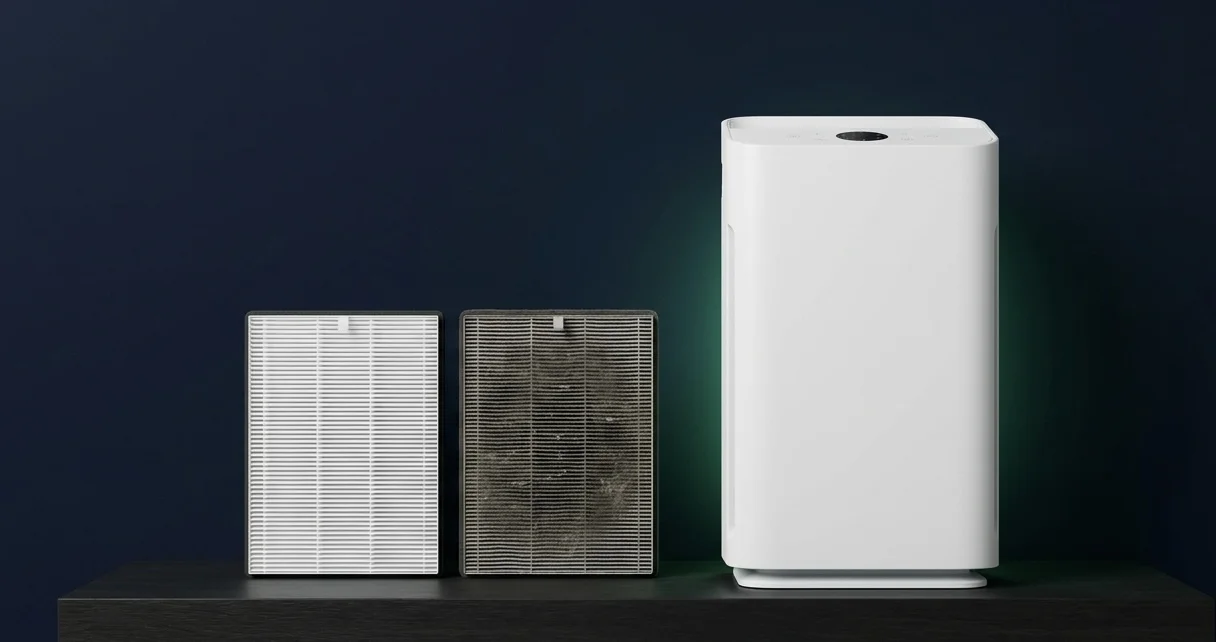
Most purifiers have filter indicator lights. Without indicators, replace HEPA filters every 6-12 months and carbon filters every 3-6 months. Signs of a clogged filter: reduced airflow, visible discoloration, increased noise, or the purifier seeming less effective.
Are air purifiers noisy?
Noise levels vary by model and fan speed. Sleep modes (20-25 dB) are quieter than a whisper. Medium speeds (35-45 dB) are similar to background music. High speeds (50-60 dB) are conversation level. For bedrooms, look for sleep modes under 25 dB.
Do air purifiers use a lot of electricity?
No. Most purifiers use 30-80W on medium and 5-15W on sleep mode. Running 24/7 on medium costs $2-8/month at average US electricity rates. Energy Star models use 15-40% less electricity. The main ongoing cost is filter replacement ($30-120/year).
Disclosure: As an Amazon Associate, we earn from qualifying purchases. This analysis is based on publicly available pricing data, user reviews, and filter specifications. We were not compensated by any filter manufacturer for this article.
Support This Guide
Helpful? Add The Air Purifier Guide as a preferred source on Google so our guides show up in your search results.
Related Articles

Coway Mighty2 vs AP-1512HH (2026)
Coway's Mighty2 replaced the AP-1512HH as Wirecutter's top pick. We compare CADR, noise, sensors, filter costs, and whether the older unit is still the smarter buy.

KNKA APH4000 Review: $150 Dark Horse
KNKA's APH4000 is one of Amazon's best-selling purifiers at $150. We check the AHAM certification, decode the 1,695 sq ft claim, and compare it to Levoit and Coway.

Levoit Core 300 vs 300-P: What Changed
Levoit quietly replaced the Core 300 with the Core 300-P. We explain the AHAM certification, whether filters still fit, and which one you should actually buy.

Shark NeverChange HP302 Review
Shark's NeverChange HP302 promises 5 years on one filter. We dig into the real running costs, the odor neutralizer catch, and whether it beats cheaper rivals.

Winix 5510 vs 5500-2: 2026 Verdict
The Winix 5500-2 is discontinued and the 5510 takes over. We compare CADR, noise, filter costs, and the one compatibility problem nobody mentions.
🛒 Products Mentioned
As an Amazon Associate, we earn from qualifying purchases.
Runs side-by-side purifier comparisons, long-term ownership reports, and filter cost analysis.
View all articles by David →