The Short Answer: This model offers excellent value with True HEPA filtration, reasonable noise levels, and affordable replacement filters. It’s best suited for medium-sized rooms and provides reliable performance for the price.
The Short Answer
The Coway AP-1512HH is the air purifier I recommend to most people. Not because it’s the best at everything, but because it does nothing wrong. After looking at CADR data, filter costs, and noise levels across 30+ models, this is the one that makes sense for a 200-300 sq ft room at $189.
Here’s the thing: the AP-1512HH has been on the market since 2014. In the air purifier world, that’s ancient. New models launch every year with app connectivity, air quality sensors, and sleek designs. Yet the AP-1512HH keeps showing up at the top of every major recommendation list. Wirecutter, Consumer Reports, independent testing labs, they all keep recommending it.
The reason is simple. It nails the fundamentals.
Coway AP-1512HH Mighty — Check Today’s Price on Amazon
Filtration Performance
The AP-1512HH uses a four-stage filtration system:
Stage 1: Pre-filter — Captures large particles (hair, dust, pet fur). Washable and reusable. Clean it every 2-4 weeks.
Stage 2: Activated Carbon Filter — Adsorbs odors, VOCs, and light gases. Replacement every 6 months.
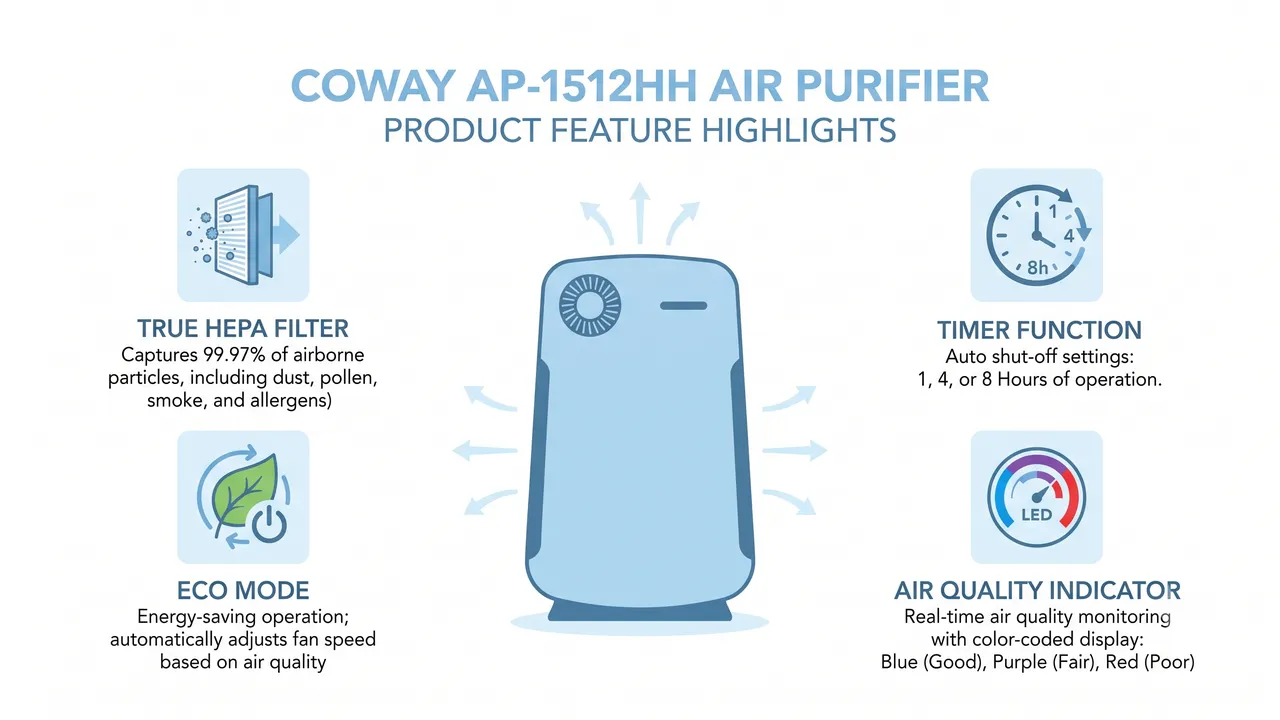
Stage 3: True HEPA Filter — Captures 99.97% of particles at 0.3 microns. This is the H13 grade, the same standard used in hospital clean rooms. Replacement every 12 months.
Stage 4: Ionizer (optional) — Releases negative ions to help particles settle. You can turn it off. I keep it off.
The EPA recognizes HEPA filtration as effective for removing airborne particles including pollen, dust mites, mold spores, and pet dander. The AP-1512HH’s HEPA filter meets this standard.
CADR Ratings
AHAM independently tests and certifies CADR ratings. The Coway AP-1512HH’s certified numbers:
| Pollutant | CADR | Rating |
|---|---|---|
| Smoke | 246 | Good |
| Dust | 240 | Good |
| Pollen | 240 | Good |
These are balanced numbers. Some purifiers excel in one area but underperform in others. The AP-1512HH handles all three pollutant types equally well.
What this means in practice: in a 300 sq ft room with 8-foot ceilings, the AP-1512HH will cycle all the air approximately 4.5 times per hour. That’s enough for effective allergy relief and general air cleaning.
Noise Levels
| Fan Speed | Noise Level | Comparable To |
|---|---|---|
| Low (1) | ~24 dB | A whisper |
| Medium (2) | ~40 dB | Quiet library |
| High (3) | ~53 dB | Normal conversation |
| Turbo (4) | ~56 dB | Background music |
On the lowest setting, the AP-1512HH is genuinely quiet enough for light sleepers. At 24 dB, it’s below the threshold of most people’s perception in a quiet room. The medium setting at 40 dB is the sweet spot for daytime use.
The turbo setting is noticeably loud, but you’ll rarely need it. Most users run the AP-1512HH on auto mode, which adjusts fan speed based on the built-in air quality sensor. In practice, the purifier spends most of its time on low or medium and only kicks up to high when it detects particles.
I run mine on auto mode at night and it stays on low unless there’s dust in the air.
Energy Efficiency
The AP-1512HH draws approximately 77 watts on the highest setting and as little as 4 watts on the lowest. With 24/7 operation on auto mode, expect electricity costs of roughly $3-5 per month at average US electricity rates.
That’s notably efficient. Some competitors draw 100+ watts on high, which adds up over a year of continuous operation.
5-Year Total Cost of Ownership
This is where the AP-1512HH truly separates itself from the competition:
| Cost Component | Year 1 | Years 2-5 | 5-Year Total |
|---|---|---|---|
| Unit price | $189 | — | $189 |
| HEPA filter (annual) | $35 | $35 × 4 = $140 | $175 |
| Carbon filter (biannual) | $15 × 2 = $30 | $15 × 8 = $120 | $150 |
| Electricity (~$4/mo) | $48 | $48 × 4 = $192 | $240 |
| Total | $302 | $452 | $754 |
5-year cost: ~$754, or about $12.57 per month.
Compare that to a Dyson Pure Cool ($500 unit + $70 filters = ~$1,300 over 5 years) or a Blueair 211i Max ($339 unit + $60 filters = ~$980 over 5 years). The AP-1512HH’s low filter costs are a major advantage.
And if you use third-party filters (which I discuss in my third-party vs OEM filter guide), you can cut the 5-year filter cost from $325 to $150-200, bringing the total down to ~$580-630.
Smart Features (or Lack Thereof)
The AP-1512HH does not have Wi-Fi, app control, or voice assistant integration. In 2026, this might seem like a disadvantage. I consider it a feature.
- No app to maintain. No firmware updates, no security vulnerabilities, no app that stops working when the manufacturer discontinues support.
- No connectivity failures. The purifier works the same whether your Wi-Fi is up or down.
- Simpler = more reliable. Fewer components that can fail.
What it does have:
- Air quality indicator — LED ring that changes color (blue = good, purple = moderate, red = poor)
- Auto mode — Adjusts fan speed based on particle detection
- Timer — 1, 4, or 8-hour auto-off
- Eco mode — Turns off the fan when no particles are detected for 30 minutes
If you absolutely need app control, the Levoit Core 400S has it. But I’ve found that most people use the app for the first week and then never touch it again.
Design and Build Quality
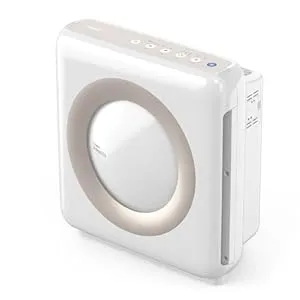
The AP-1512HH has a compact, unobtrusive design that fits in most rooms without drawing attention. At 16.8 × 18.3 × 9.6 inches and 12.3 pounds, it’s easy to move between rooms.
Build quality is solid for the price point. The plastic housing doesn’t creak or flex, the buttons have a satisfying click, and the filter compartment opens smoothly. After years on the market, long-term reliability data is excellent, most owners report 5+ years of trouble-free operation.
Available in white and black to match different room aesthetics.
How It Compares
| Feature | Coway AP-1512HH | Levoit Core 400S | Winix 5500-2 |
|---|---|---|---|
| Price | $189 | $189 | $160 |
| Smoke CADR | 246 | 260 | 243 |
| Room size (5 ACH) | 300 sq ft | 320 sq ft | 300 sq ft |
| Noise (low) | 24 dB | 24 dB | 28 dB |
| Wi-Fi | No | Yes | No |
| 5-year cost (OEM) | ~$754 | ~$820 | ~$700 |
| 5-year cost (3rd-party) | ~$580 | ~$650 | ~$560 |
| Filter life | 12 months | 6-8 months | 12 months |
The Levoit Core 400S offers slightly higher CADR and smart features, but its filters need replacing more often (every 6-8 months), which increases long-term costs. The Winix 5500-2 is cheaper upfront with comparable performance, but its carbon filter is less effective for odors.
The Coway sits in the sweet spot: balanced performance, low maintenance costs, and proven reliability.
Who Should Buy the Coway AP-1512HH
Buy it if:
- You need an air purifier for a room up to 300 sq ft
- You want the best long-term value (low filter replacement costs)
- You prefer simple, reliable operation over smart features
- You have allergies, pets, or general air quality concerns
- You want a proven product with years of positive reviews
Skip it if:
- You need to cover a room larger than 350 sq ft (consider the Blueair 211i Max)
- You want app control and air quality history (consider the Levoit Core 400S)
- You’re dealing with heavy wildfire smoke in a large room (need higher CADR)
- You’re on a tight budget under $150 (consider the Levoit Core 300)
The Bottom Line
The Coway AP-1512HH Mighty isn’t the newest, the prettiest, or the smartest air purifier on the market. It’s the one that does its job quietly, effectively, and affordably, year after year. In a market full of overpromising and underdelivering, that counts for a lot.
For most people, this is the one I’d pick.
Coway AP-1512HH Mighty — Check Today’s Price on Amazon
Frequently Asked Questions
How long should I run my air purifier each day?
For best results, run your air purifier 24/7 on medium speed. Air purification works by continuously removing particles—turning it off allows them to accumulate again. Modern purifiers use 30-80W on medium (similar to a light bulb), making continuous operation energy-efficient.
Where is the best place to put an air purifier?
Place the purifier 3-5 feet from your breathing zone, near pollution sources, with unobstructed airflow on all sides. Avoid corners, curtains, and furniture that block intake or output. For bedrooms, position near the bed but not blowing directly on you.
How do I know when to replace the filter?
Most purifiers have filter indicator lights. Without indicators, replace HEPA filters every 6-12 months and carbon filters every 3-6 months. Signs of a clogged filter: reduced airflow, visible discoloration, increased noise, or the purifier seeming less effective.
Are air purifiers noisy?
Noise levels vary by model and fan speed. Sleep modes (20-25 dB) are quieter than a whisper. Medium speeds (35-45 dB) are similar to background music. High speeds (50-60 dB) are conversation level. For bedrooms, look for sleep modes under 25 dB.
Do air purifiers use a lot of electricity?
No. Most purifiers use 30-80W on medium and 5-15W on sleep mode. Running 24/7 on medium costs $2-8/month at average US electricity rates. Energy Star models use 15-40% less electricity. The main ongoing cost is filter replacement ($30-120/year).
Disclosure: As an Amazon Associate, we earn from qualifying purchases. This review is based on publicly available performance data, AHAM-certified CADR ratings, and analysis of long-term owner feedback. We were not compensated by Coway for this review.
Support This Guide
Helpful? Add The Air Purifier Guide as a preferred source on Google so our guides show up in your search results.
Related Articles

Coway Mighty2 vs AP-1512HH (2026)
Coway's Mighty2 replaced the AP-1512HH as Wirecutter's top pick. We compare CADR, noise, sensors, filter costs, and whether the older unit is still the smarter buy.

KNKA APH4000 Review: $150 Dark Horse
KNKA's APH4000 is one of Amazon's best-selling purifiers at $150. We check the AHAM certification, decode the 1,695 sq ft claim, and compare it to Levoit and Coway.

Levoit Core 300 vs 300-P: What Changed
Levoit quietly replaced the Core 300 with the Core 300-P. We explain the AHAM certification, whether filters still fit, and which one you should actually buy.

Shark NeverChange HP302 Review
Shark's NeverChange HP302 promises 5 years on one filter. We dig into the real running costs, the odor neutralizer catch, and whether it beats cheaper rivals.

Winix 5510 vs 5500-2: 2026 Verdict
The Winix 5500-2 is discontinued and the 5510 takes over. We compare CADR, noise, filter costs, and the one compatibility problem nobody mentions.
🛒 Products Mentioned
As an Amazon Associate, we earn from qualifying purchases.
Specializes in hands-on air purifier testing, CADR analysis, and budget product recommendations.
View all articles by Alex →