The Short Answer: For most first-time buyers, the Coway AP-1512HH ($189) and Winix 5500-2 ($159) offer the best balance of CADR performance, noise levels, and filter costs. The Levoit Core 300 ($89) is the best budget pick for small rooms under 200 sq ft. Match CADR to your room size (CADR ÷ 1.55 = max sq ft), prioritize True HEPA over “HEPA-type,” and avoid ionizers that produce ozone.
Editor’s note (September 2026): The Winix 5500-2 has been discontinued and remaining stock is limited. Winix’s official successor is the Winix 5510, which adds app control and uses a new filter. Read our Winix 5510 vs 5500-2 comparison before you buy either one.
Buying your first air purifier feels harder than it should. The market is flooded with conflicting claims, meaningless acronyms, and models that look identical on paper but perform wildly differently in real rooms. This guide cuts through the noise and gives you a clear, step-by-step framework for choosing the right purifier, without wasting weeks researching or overspending on features you don’t need.
Whether you’re dealing with seasonal allergies, wildfire smoke, pet dander, or just want cleaner indoor air, this buying guide covers everything a first-time buyer needs to know.
{% affiliateDisclosure %}
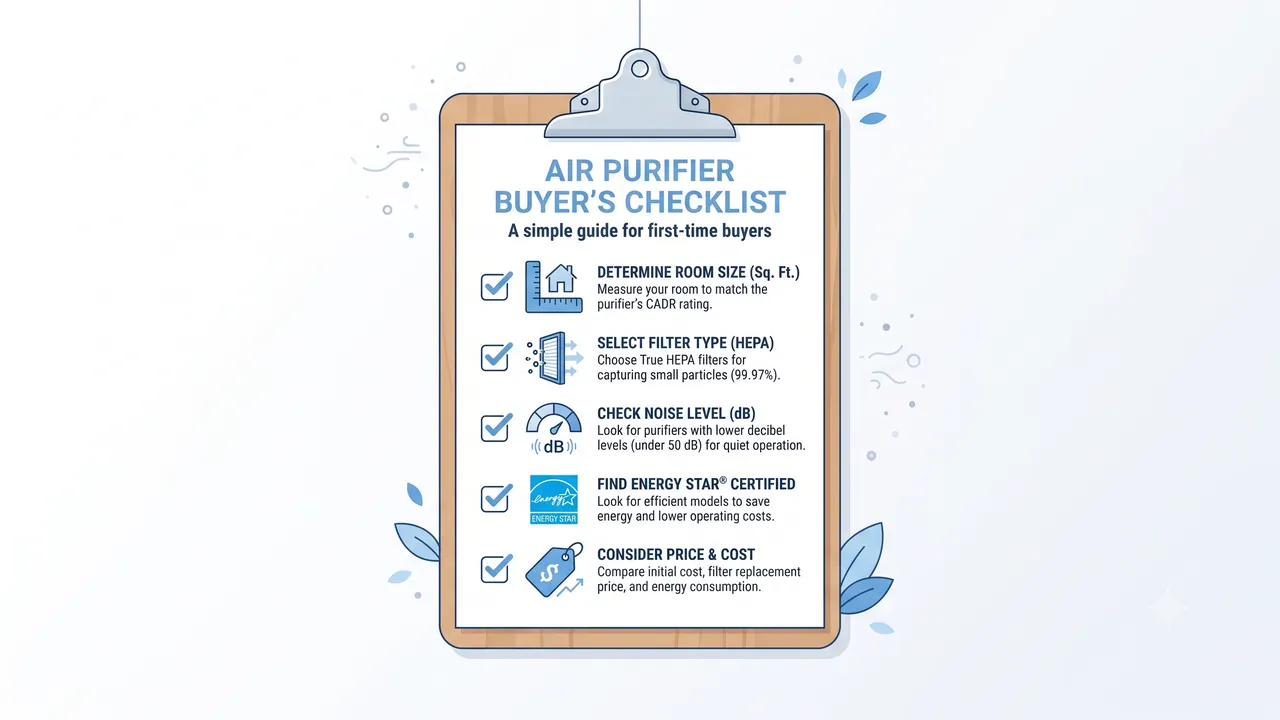
Quick Decision Guide
Not sure where to start? Match your situation to a recommended purifier type in the table below. This gives you a solid starting point, then read the deeper sections to refine your choice.
| Your Situation | Recommended Type | Suggested Models | Why It Works |
|---|---|---|---|
| Small bedroom, basic dust/allergies | Compact HEPA | Levoit Core 300 (~$89) | True H13 HEPA in a small footprint. Enough CADR for rooms under 200 sq ft. |
| Medium bedroom or home office, allergies | Mid-range HEPA + carbon | Coway AP-1512HH ( | Excellent particle filtration plus odor-reducing carbon. Quiet on medium. |
| Large open-concept living area | High-CADR tower or large unit | Blueair 211i Max (~$339) | Designed for 500+ sq ft with strong air delivery at tolerable noise levels. |
| Wildfire or tobacco smoke | Heavy carbon + high Smoke CADR | Coway AP-1512HH or Blueair 211i Max | Smoke particles and gases need both strong HEPA and substantial carbon mass. |
| Pet dander and odor | Washable pre-filter + carbon | Winix 5500-2 (~$159) | Washable pre-filter catches large dander before it clogs the HEPA layer. |
| Chemical sensitivity or VOCs | Maximum carbon mass | Austin Air HealthMate (~$600+) | 15 lbs of activated carbon pellets, far more gas-phase filtration than typical units. |
| Apartment on a tight budget | Budget HEPA | Levoit Core 300 or GermGuardian AC4825 (~$80) | Real HEPA filtration without paying for features you won’t use. |
Use this table to identify your starting category, then read on to understand why these recommendations work so you can make an informed decision even if you’re looking at models not listed here.
Step 1: Identify Your Problem
Start with a specific problem, not a vague desire for “cleaner air.” Different air quality issues require fundamentally different filtration approaches. Choosing the wrong type means spending money on a purifier that won’t solve your actual problem.
Common Air Quality Problems and What Solves Them
Allergies (pollen, dust mites, mold spores): Any true HEPA purifier captures these particles at 99.97% efficiency down to 0.3 microns. What matters for allergies is not the filter itself, it’s the airflow rate, measured by CADR. You need enough air processed per hour to reduce particle concentration before you inhale them. Prioritize high Dust and Pollen CADR numbers. For more on this, see our CADR and ACH guide.
Pet dander and odor: Dander particles are large (5-10 microns) and load up pre-filters quickly. Look for a unit with a robust, washable pre-filter so you’re not replacing expensive HEPA filters every few months. Activated carbon handles the odor component, but thin carbon sheets barely make a dent. Pellet-based carbon or thicker carbon beds are far more effective for persistent pet smells.
Smoke (wildfire, tobacco, cooking): Smoke is the hardest common problem to solve because it contains both fine particles (0.1-1 micron) and gaseous compounds. You need high Smoke CADR plus substantial activated carbon. Budget purifiers with thin carbon sheets will capture some particles but leave the smell and gases behind. This is one situation where spending more genuinely makes a difference.
VOCs and chemical sensitivity: If you react to off-gassing from furniture, paint, or cleaning products, particle filtration alone won’t help, VOCs are gases that pass straight through HEPA media. You need maximum activated carbon mass. Pellet-based carbon beds are dramatically more effective than sprayed-on carbon sheets. Units like the Austin Air HealthMate with 15 lbs of carbon are purpose-built for this problem.
General cleaner air: If you don’t have a specific trigger but want healthier indoor air, a mid-range HEPA purifier like the Coway AP-1512HH or Levoit Core 300 covers 90% of use cases. Don’t overthink it, get a well-reviewed unit that fits your room and run it consistently.
For a broader overview of available options, check our best air purifiers roundup or our guide on how to choose the right air purifier for your room.
Step 2: Size Your Purifier Correctly
The single most common first-time buyer mistake is buying a purifier rated for your room’s square footage only to find it’s too loud on the speed needed for effective cleaning. Here’s how to get sizing right the first time.
How to Calculate the Right Size
- Measure your room in square feet (length × width).
- Calculate minimum Smoke CADR: Room sq ft × 1.55 = minimum Smoke CADR for 4.8 air changes per hour (ACH). Example: 200 sq ft × 1.55 = 310 Smoke CADR.
- Buy one size up if you’re noise-sensitive. A purifier running on medium in a slightly oversized unit is quieter than one running on high in a right-sized unit.
- For open floor plans, treat connected spaces as one room or use multiple purifiers.
Why the Box Number Lies
The square footage rating on the box is almost always calculated at 2 ACH, the bare minimum that barely qualifies as air cleaning. For effective filtration that actually reduces allergen and particle concentrations, you want 4-5 ACH. That means the real effective coverage is roughly 40-60% of what the manufacturer claims.
Example: A purifier labeled “covers 500 sq ft” is really effective for about 200-300 sq ft at the higher air change rates that produce noticeable health benefits. This is covered in detail in our air purifier buying mistakes guide.
When in doubt between two sizes, always buy the larger one. A slightly oversized purifier can run on low and stay quiet while still cleaning effectively. A slightly undersized unit needs to run on high constantly, noisy, energy-hungry, and still struggling to keep up.
Step 3: Budget Tiers Explained
Air purifier pricing follows a clear pattern: you get meaningful upgrades at each tier, but diminishing returns kick in above $400 for most users. Here’s what to expect at each price point.
| Budget Tier | What You Get | Best For | Example Models | Ongoing Cost (Annual) |
|---|---|---|---|---|
| Under $100 | True HEPA filter, basic fan speeds, no smart features. Covers small rooms (100-200 sq ft effectively). Loud on high. | Small bedrooms, apartments, first-time buyers testing the waters. | Levoit Core 300 ( | $30-50 for replacement filters |
| $100-200 | Better CADR, often includes activated carbon layer, auto mode with air quality sensor, quieter operation. Covers 200-350 sq ft. | Most first-time buyers. Excellent performance-to-price ratio. | Coway AP-1512HH ( | $40-70 for replacement filters |
| $200-400 | Higher CADR for larger rooms (400-600 sq ft), smart app connectivity, better build quality, more sophisticated sensors. | Larger rooms, open floor plans, smart-home enthusiasts. | Levoit Core 600S ( | $50-90 for replacement filters |
| $400+ | Premium filtration (heavy carbon beds for VOCs), whole-room coverage, hospital-grade HEPA, ultra-quiet motors. | Chemical sensitivity, severe asthma, very large spaces, specialized needs. | Austin Air HealthMate ( | $60-150 for replacement filters |
The real cost: Replacement filters typically run $40-80 per year. Over 3-5 years, filter costs can equal or exceed the purifier’s purchase price. Always check filter availability and pricing before buying a purifier. Some brands lock you into proprietary filters at premium prices, while others use standard sizes available from third-party manufacturers.
Step 4: Key Specs Explained Simply
Manufacturers throw around technical specifications that sound impressive but are confusing if you’ve never encountered them before. Here’s what each spec actually means, and which ones matter.
CADR (Clean Air Delivery Rate)
CADR measures how much filtered air a purifier delivers per minute, expressed in cubic feet per minute (CFM). There are three numbers: Dust, Pollen, and Smoke. Higher is better. For a 200 sq ft room, aim for a CADR of at least 200, ideally 300+. CADR is the single most important spec for comparing purifiers. It combines filter efficiency and fan speed into one actionable number. See our detailed CADR and ACH explainer for the full breakdown.
ACH (Air Changes per Hour)
ACH tells you how many times per hour the purifier can cycle all the air in your room through its filter. 2 ACH is the bare minimum. 4-5 ACH is what you want for real health benefits. 6+ ACH is ideal for allergy and asthma sufferers. Calculate it by dividing CADR (in cubic feet per hour) by your room’s volume (sq ft × ceiling height).
HEPA Grade (H13 vs H14 vs “True HEPA”)
“True HEPA” means the filter captures 99.97% of particles at 0.3 microns. H13 is True HEPA. H14 captures 99.995%, marginally better but harder to push air through (meaning the fan works harder and gets louder). “HEPA-type” or “HEPA-like” filters capture significantly less, avoid these. For most buyers, any True HEPA (H13) filter is more than sufficient.
Activated Carbon
Activated carbon absorbs gaseous pollutants, odors, VOCs, and chemical fumes. The key metric is mass, not the word “activated.” A thin sprayed-on carbon sheet (1-2 oz) does almost nothing. Pellet-based carbon beds (2+ lbs) make a real difference for smoke and odors. If smells or chemicals are your primary concern, carbon mass is the spec to compare.
Noise Level (dB)
Measured in decibels. Under 30 dB on low is whisper-quiet. 30-45 dB is comfortable for sleeping. 50+ dB becomes noticeable and distracting. Most purifiers are quiet on low but loud on high, check the noise rating at the speed you’ll actually use, not just the lowest setting.
Filter Replacement Indicators
Most mid-range and premium purifiers include a filter life indicator based on runtime hours. These are estimates, not exact measurements, replace sooner if you notice reduced airflow or increased odors. Budget purifiers may lack this feature, so set calendar reminders.
Step 5: Place and Operate It Correctly
Even the best purifier underperforms if placed and operated incorrectly. These guidelines maximize effectiveness from day one.
- Place in the room where you spend the most time. For most people, that’s the bedroom. You breathe bedroom air for 7-9 hours straight every night, cleaning that air has the biggest impact on health and sleep quality.
- Position at least 6 inches from walls for proper airflow on all intake sides. Corners and tight spaces restrict intake and reduce effective CADR.
- Run 24/7 on auto mode. The energy cost is trivial, roughly $8-26 per year for most units. Air purifiers work by continuous filtration, not one-time cleaning. Turning them off means particles accumulate again.
- Replace HEPA filter every 12 months, carbon filter every 3-6 months, and clean the pre-filter every 2-4 weeks. Dirty filters restrict airflow and reduce performance dramatically.
For more detailed maintenance advice, see our air purifier maintenance guide.
Give your purifier 2-4 weeks of continuous operation before evaluating its effectiveness. Benefits, reduced dust, fewer allergy symptoms, better sleep, accrue gradually as the purifier cycles the room’s air dozens of times per day, not overnight.
Try it: Use our free CADR Calculator →
First Purifier Setup Checklist
Use this checklist when your new purifier arrives to make sure you’re set up for maximum effectiveness from the start.
- Unbox and remove all packaging from the filter. Many first-time buyers leave the plastic wrap on the HEPA filter, which blocks all airflow. Check inside the unit, the filter is often pre-installed but wrapped.
- Check the pre-filter is seated correctly. The pre-filter (usually a washable mesh) should sit flat against the housing with no gaps around the edges.
- Place on a flat, stable surface at least 6 inches from walls, curtains, and furniture. Avoid placing on carpet if the intake is on the bottom.
- Plug in and set to the highest speed for 30 minutes on first use. This circulates air through the fresh filter quickly and helps settle any manufacturing dust.
- Switch to auto mode (if available) or medium speed for continuous operation.
- Check the filter indicator and note the replacement date on your calendar (12 months for HEPA, 3-6 months for carbon).
- Run for 2-4 weeks before deciding if it’s working. Particle counts drop gradually, not instantly.
- Clean the pre-filter after the first 2 weeks to remove initial dust load from the room.
- Note the noise level on each setting. If high is too loud for sleeping, consider moving to a larger unit that can clean the room on medium.
The One Mistake That Costs First-Time Buyers the Most
Buying a purifier that’s too small. Not too cheap, not the wrong brand, too small.
The square footage on the box is calculated at 2 air changes per hour, the bare minimum. For effective air cleaning, you want 4-5 ACH, which means the real coverage is about 40% of what the box claims. A purifier labeled “covers 500 sq ft” is really effective for about 200-300 sq ft at the air change rates that produce noticeable health benefits.
A purifier that’s slightly oversized for the room can run on low and stay quiet while still cleaning effectively. A purifier that’s slightly undersized needs to run on high constantly, noisy, energy-hungry, and still struggling to keep up. When in doubt between two sizes, buy the larger one.
The best value move most first-time buyers miss: Buy one good purifier for the bedroom (where you spend 8 hours), run it 24/7, and see if the improvement is noticeable over 2-4 weeks. If it is, buy a second for the living area. Don’t try to cover the whole house with one unit, it won’t work, and you’ll end up disappointed.
Frequently Asked Questions
Do air purifiers really work, or is it just marketing?
Air purifiers with true HEPA filters are backed by decades of scientific research. HEPA filtration was developed for nuclear and pharmaceutical applications where particle removal is critical. Independent testing consistently shows that properly sized HEPA purifiers reduce indoor particulate matter by 50-80% within hours. The key is buying the right size for your room and running it continuously, a purifier sitting in a closet doesn’t help anyone.
Can one air purifier clean my whole house?
In theory, a large enough unit placed centrally could reduce particles in connected spaces. In practice, walls, doors, and hallways block airflow significantly. You’ll get 70-80% of the benefit by targeting the one room where you spend the most time (usually the bedroom). For whole-house coverage, you need one purifier per major living area, or a whole-house HVAC filtration upgrade.
How much does it cost to run an air purifier 24/7?
Most modern air purifiers consume 30-60 watts on medium, comparable to a light bulb. Annual electricity cost is typically $8-26 depending on your local rate and the unit’s wattage. The bigger ongoing cost is replacement filters: $40-80 per year for HEPA, plus $20-40 for carbon if your unit has a separate carbon filter. Over a 5-year period, expect to spend $200-500 on filters in addition to the purchase price.
Are ozone-generating purifiers safe?
No. Ozone generators and ionizers that produce ozone are not safe for occupied rooms. Ozone is a lung irritant that can worsen asthma and cause respiratory damage at concentrations well above the EPA’s safety limit. Some purifiers include optional ionizer modes, keep these off. True HEPA filtration removes particles without producing any harmful byproducts. If you see “ionic” or “ionizer” as a primary feature (rather than an optional add-on), be cautious.
When should I replace the filter?
HEPA filters should be replaced every 12 months under normal use, or sooner if you notice reduced airflow, increased noise (the fan working harder), or a return of allergy symptoms. Carbon filters degrade faster, replace every 3-6 months, or sooner if odors return. Pre-filters should be washed every 2-4 weeks. Most mid-range purifiers include a filter life indicator, but these are estimates based on runtime hours, not actual filter condition. When in doubt, replace early, a fresh $50 filter is cheaper than breathing unfiltered air for months.
For more answers to common questions, see our complete air purifier FAQ or browse our beginner-friendly air purifier guides.
See also: Air Purifier CADR and ACH Guide · Air Purifier Buying Mistakes to Avoid · Best Air Purifier Under $150 · How to Choose an Air Purifier for Your Room · Air Purifier Maintenance Guide
Affiliate Disclosure: The Air Purifier Guide is a participant in the Amazon Services LLC Associates Program. If you purchase through links on this site, we may earn a commission at no extra cost to you. This does not influence our recommendations, we only recommend products we’ve thoroughly evaluated.
You May Also Like
- How to Set Up Your New Air Purifier: Unboxing, Filter Installation, Placement, and First 48 Hours
- Air Purifier Electricity Cost: How Much Does It Really Cost to Run 24/7?
- Air Purifier Filter Replacement Guide: Costs, Schedules, and How to Extend Filter Life
- Air Purifier Return Policies and Warranty Comparison: What Happens If You Don’t Like It?
Support This Guide
Helpful? Add The Air Purifier Guide as a preferred source on Google so our guides show up in your search results.
Related Articles

Coway Mighty2 vs AP-1512HH (2026)
Coway's Mighty2 replaced the AP-1512HH as Wirecutter's top pick. We compare CADR, noise, sensors, filter costs, and whether the older unit is still the smarter buy.

KNKA APH4000 Review: $150 Dark Horse
KNKA's APH4000 is one of Amazon's best-selling purifiers at $150. We check the AHAM certification, decode the 1,695 sq ft claim, and compare it to Levoit and Coway.

Levoit Core 300 vs 300-P: What Changed
Levoit quietly replaced the Core 300 with the Core 300-P. We explain the AHAM certification, whether filters still fit, and which one you should actually buy.

Shark NeverChange HP302 Review
Shark's NeverChange HP302 promises 5 years on one filter. We dig into the real running costs, the odor neutralizer catch, and whether it beats cheaper rivals.

Winix 5510 vs 5500-2: 2026 Verdict
The Winix 5500-2 is discontinued and the 5510 takes over. We compare CADR, noise, filter costs, and the one compatibility problem nobody mentions.
🛒 Products Mentioned
As an Amazon Associate, we earn from qualifying purchases.
Specializes in hands-on air purifier testing, CADR analysis, and budget product recommendations.
View all articles by Alex →