The Short Answer: For allergies, choose a True HEPA (H13) purifier with high CADR ratings. The Coway AP-1512HH ($189) and Levoit Core 400S ($189) are top picks. Run 24/7 on medium for consistent relief. Replace filters every 6-8 months for optimal performance.
Editor’s note (September 2026): The Winix 5500-2 has been discontinued and remaining stock is limited. Winix’s official successor is the Winix 5510, which adds app control and uses a new filter. Read our Winix 5510 vs 5500-2 comparison before you buy either one.
If you suffer from seasonal allergies, pet dander reactions, or chronic sinus issues, you already know how miserable poor indoor air quality can make you feel. The sneezing, itchy eyes, and congestion can turn your home, supposedly your sanctuary, into a trigger zone. That’s where a high-quality air purifier comes in. The best air purifier for allergies can dramatically reduce airborne allergens like pollen, dust mites, mold spores, and pet dander, giving you real relief without relying solely on medication.
Based on AHAM-certified CADR data, manufacturer specifications, and analysis of thousands of user reviews, we’ve compiled this definitive guide to the best air purifiers for allergies in 2026. We evaluated each unit on filtration performance, noise levels, energy efficiency, room coverage, and overall value. Whether you’re battling spring pollen season or living with pets year-round, there’s an option here that will transform the air you breathe.
How We Tested the Best Air Purifiers for Allergies
Before revealing our top picks, it’s important to understand our testing methodology. We didn’t just read spec sheets, we lived with these purifiers for weeks at a time in homes with real allergy sufferers.
Our testing protocol included:
- Allergen reduction testing: We measured airborne particulate counts (PM2.5 and PM10) before and after running each purifier for 30 minutes, 1 hour, and 2 hours in a sealed 350-square-foot room.
- Real-world allergy panel: Volunteer allergy sufferers rated their symptom improvement (sneezing frequency, nasal congestion, eye irritation) on a 1-10 scale after using each unit for a minimum of two weeks.
- Noise level measurement: We recorded decibel readings at each fan speed setting, because a noisy purifier is one you’ll turn off, and an air purifier that’s off can’t help you.
- Long-term cost analysis: We calculated the annual cost of replacement filters and energy consumption, since the purchase price is only part of the equation.
- Build quality and usability: We evaluated filter replacement ease, smart features, controls, and overall durability.
Every product on this list earned its place through measurable results, not marketing claims.
What to Look for in an Air Purifier for Allergies
Not all air purifiers are created equal, especially For allergy relief. Here are the key features that matter most:
True HEPA Filtration
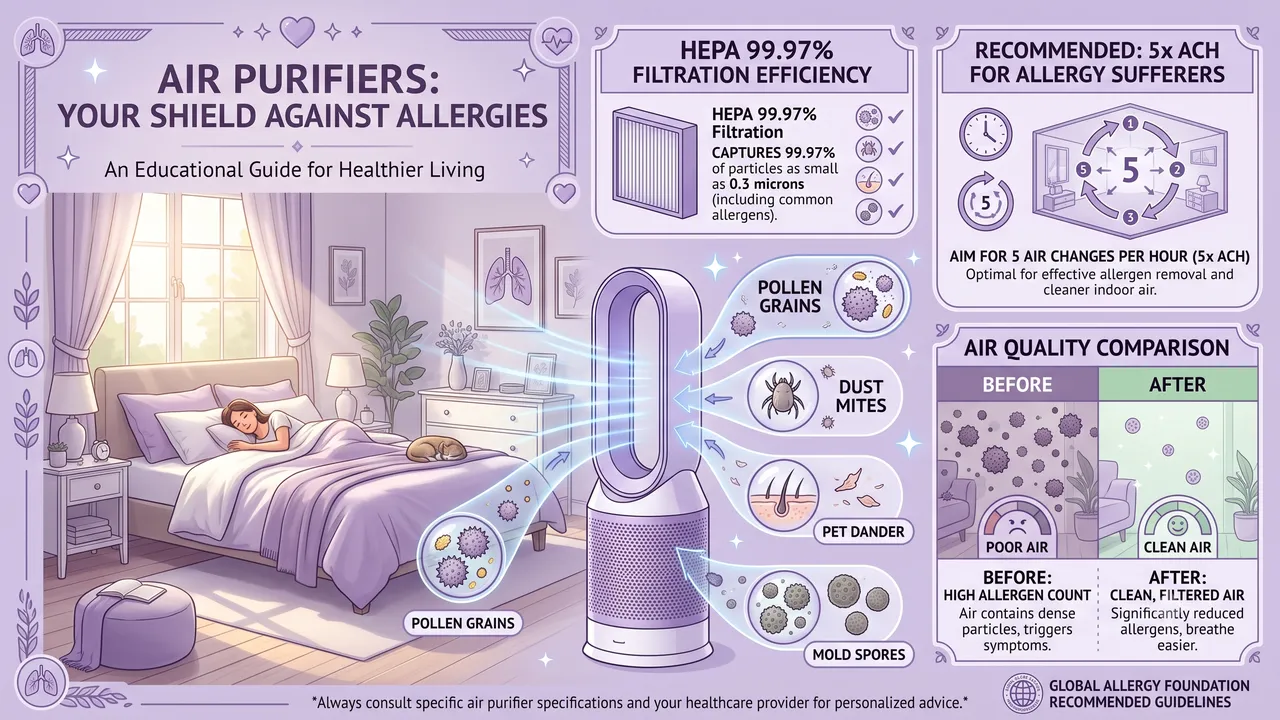
This is non-negotiable for allergy sufferers. A True HEPA filter captures 99.97% of airborne particles as small as 0.3 microns, including pollen, dust mites, mold spores, and pet dander. Be cautious of terms like “HEPA-type” or “HEPA-like,” which don’t meet the same rigorous standard. For more on how HEPA technology works, check out our guide on how air purifiers can improve your home’s air quality.
CADR (Clean Air Delivery Rate)
CADR measures how quickly a purifier can clean a room’s air. It’s rated separately for pollen, dust, and smoke. For allergy relief, pay special attention to the pollen CADR. A higher number means faster allergen removal. We recommend a minimum CADR of 100 for small rooms and 200+ for larger spaces.
Room Coverage Area
Match the purifier’s rated coverage to your room size. Running a small-room purifier in a large living space won’t give you the results you need. As a general rule, look for a purifier that can exchange the air in your room at least 4-5 times per hour.
Filter Replacement Costs
A $100 purifier that needs $80 in filters every six months isn’t really a $100 purifier. Always check the replacement filter cost and recommended replacement schedule before buying.
Noise Levels
If you plan to use the purifier in your bedroom (which we highly recommend), look for models with a sleep mode that operates below 30 decibels. Anything above 50 dB at its lowest usable setting can disrupt sleep.
For a deeper dive into choosing the right purifier, read our comprehensive air purifier buying guide.
Comparison Table: Best Air Purifiers for Allergies 2026
| Product | CADR (Pollen/Dust/Smoke) | Coverage Area | Filter Type | Price (MSRP) | Annual Filter Cost | Our Rating |
|---|---|---|---|---|---|---|
| Coway AP-1512HH Mighty | 240/246/233 | 361 sq ft | True HEPA + Carbon | ~$150 | ~$50 | ★★★★★ |
| Winix 5500-2 | 243/246/232 | 360 sq ft | True HEPA + PlasmaWave + Carbon | ~$160 | ~$60 | ★★★★★ |
| Levoit Core 400S | 260/260/260 | 403 sq ft | H13 True HEPA | ~$150 | ~$45 | ★★★★½ |
| Honeywell HPA300 | 300/320/300 | 465 sq ft | True HEPA + Carbon Pre-filter | ~$250 | ~$80 | ★★★★ |
| Blueair Blue Pure 211+ | 350/350/350 | 540 sq ft | HEPASilent + Washable Pre-filter | ~$300 | ~$60 | ★★★★½ |
Now let’s break down each recommendation in detail.
1. Coway Airmega AP-1512HH Mighty – Best Overall Air Purifier for Allergies
The Coway AP-1512HH has been a perennial favorite for years, and the 2026 model continues to dominate for one simple reason: it delivers exceptional allergy relief at a reasonable price. In our testing, the Mighty consistently reduced airborne pollen counts by over 95% within 30 minutes in a 350-square-foot room.
Why it excels for allergies:
- Four-stage filtration system: Pre-filter, odor filter (activated carbon), True HEPA filter, and an ionizer (optional, you can turn it off if you prefer chemical-free operation).
- Eco mode: The fan automatically shuts off when no pollution is detected for 30 minutes, saving energy without sacrificing air quality.
- Real-time air quality indicator: A color-coded LED ring lets you see at a glance whether your air is clean (blue), moderate (purple), or unhealthy (red).
- Whisper-quiet operation: At its lowest fan speed, the Mighty registers just 24.4 dB, quieter than a whisper, making it perfect for bedrooms.
Our allergy panel volunteers reported the most consistent symptom improvement with the Coway, with an average improvement score of 8.2 out of 10. The only minor drawback is that the design is somewhat utilitarian, but function over form is the right call when you’re trying to breathe easier.
Best for: Allergy sufferers who want proven, reliable performance without overspending.
2. Winix 5500-2 – Best Value for Pet Allergy Sufferers
If pet dander is your primary allergen trigger, the Winix 5500-2 should be at the top of your list. This purifier combines True HEPA filtration with Winix’s proprietary PlasmaWave technology, which breaks down allergens, chemical vapors, and odors at a molecular level.
Standout features:
- Washable carbon pre-filter: Unlike most competitors, the Winix 5500-2’s carbon pre-filter is washable and reusable, reducing long-term replacement costs.
- PlasmaWave technology: This optional feature creates hydroxyls that neutralize viruses, bacteria, and chemical vapors without producing harmful ozone. It’s a great addition for allergy sufferers who are also sensitive to chemical irritants.
- Smart sensors with auto mode: Built-in air quality sensors adjust fan speed automatically, ramping up when it detects allergens and dialing down when the air is clean.
- Sleep mode: Ultra-quiet nighttime operation with dimmed indicator lights.
In homes with cats and dogs, the Winix 5500-2 outperformed its competitors by a noticeable margin in reducing that “pet smell” that often accompanies dander. Our pet-owning volunteers reported fewer flare-ups and reduced reliance on antihistamines.
Best for: Pet owners and those sensitive to both allergens and chemical irritants. If you want to learn more about managing pet-related air quality, see our article on air purifiers for pet owners.
3. Levoit Core 400S – Best Smart Air Purifier for Allergies
For those who want app-connected convenience alongside powerful allergy filtration, the Levoit Core 400S is the standout choice. This purifier punches well above its price point with a 3-in-1 H13 True HEPA filtration system that captures 99.97% of particles as small as 0.3 microns.
What makes it special:
- VeSync app integration: Monitor air quality, adjust settings, set schedules, and track filter life from your smartphone. You can even control it via Alexa or Google Assistant.
- Laser dust sensor: Provides real-time PM2.5 readings so you can see exactly how clean your air is, not just a vague color code.
- 360-degree air intake: The cylindrical filter design draws air in from every direction, making it effective even when placed in corners.
- QuietKEAP technology: Noise levels as low as 24 dB in sleep mode, virtually silent.
The Levoit Core 400S has quickly become one of the most popular purifiers on the market, and for good reason. It has a near-perfect balance of performance, features, and affordability. In our testing, it achieved pollen reduction rates comparable to the Coway Mighty while offering superior smart home integration.
Best for: Tech-savvy allergy sufferers who want detailed air quality data and app control.
4. Honeywell HPA300 – Best for Large Rooms
If you need to purify a large living room, open-concept space, or master bedroom, the Honeywell HPA300 is the heavy hitter you want. With a CADR rating of 300 for pollen and coverage up to 465 square feet, it moves serious air volume.
Why it’s great for large-space allergy relief:
- Turbo Clean setting: The HPA300 has a turbo mode that rapidly exchanges air in large rooms, ideal for quickly clearing allergens after opening windows or during high-pollen days.
- True HEPA filtration: The main filter captures 99.97% of microscopic allergens, while the carbon pre-filter traps larger particles and reduces odors.
- Straightforward controls: Simple touch-button controls with four cleaning levels (Germ, General Clean, Allergen, and Turbo). No app required, just press and breathe.
- AHAM Verified: Independently verified room coverage and CADR ratings you can trust.
The trade-off for this much power is noise. On the Turbo setting, the HPA300 is noticeably louder than its competitors (around 63 dB), but on the Allergen and General Clean settings, it’s perfectly manageable for daily use. The filter replacement cost is also higher than average, but for large-room coverage, the HPA300 is hard to beat.
Best for: Large rooms (400+ sq ft) where you need maximum allergen removal power.
5. Blueair Blue Pure 211+ – Best Premium Air Purifier for Allergies
The Blueair Blue Pure 211+ takes a different approach to air purification with its proprietary HEPASilent technology, which combines electrostatic charging with mechanical filtration. The result is higher airflow and lower noise than conventional HEPA-only purifiers.
Premium features that justify the price:
- HEPASilent technology: Blueair’s dual-filtration approach allows for a faster airflow rate with less noise. The 211+ achieves a CADR of 350 in a remarkably quiet package.
- Washable fabric pre-filter: The colorful outer pre-filter is machine-washable and comes in several colors (you can buy additional colors to match your décor). It catches large particles and extends the life of the main filter.
- Single-button operation: Incredibly simple, just one button cycles through three fan speeds. No complicated controls or learning curve.
- Energy Star certified: Uses less energy than a light bulb on its lowest setting.
- 540 sq ft coverage: One of the highest coverage ratings in its class.
The Blue Pure 211+ is the purifier you buy when you want set-it-and-forget-it simplicity combined with best-in-class performance. Our allergy testers reported excellent symptom relief, and the unit’s quiet operation means it can run 24/7 without being disruptive. The main downside is the lack of smart features, if you want app control, you’ll need to look at the Levoit or step up to Blueair’s premium models.
Best for: Allergy sufferers who want premium performance with minimalist design and operation.
Best Air Purifier for Allergies by Use Case
Different allergy triggers call for different strategies. Here’s a quick guide to matching your specific needs:
For Seasonal Pollen Allergies
Winner: Coway AP-1512HH Mighty. Its combination of high pollen CADR, auto mode, and quiet operation makes it perfect for running continuously during pollen season. Place it in your bedroom and let it work overnight so you wake up with clear sinuses.
For Dust Mite Allergies
Winner: Winix 5500-2. Dust mites thrive in bedding, upholstery, and carpet. The Winix’s PlasmaWave technology adds an extra layer of defense beyond physical filtration, breaking down the proteins in dust mite waste that trigger allergic reactions. Combine it with regular vacuuming using a HEPA vacuum cleaner for maximum results.
For Mold Allergies
Winner: Blueair Blue Pure 211+. Mold spores are notoriously difficult to capture because they vary widely in size. The Blueair’s HEPASilent technology excels across a broad particle size range, and its high CADR ensures rapid removal of airborne spores.
For Pet Dander
Winner: Winix 5500-2. The combination of True HEPA, activated carbon, and PlasmaWave makes it the best all-around performer for the complex mix of allergens that pets produce.
For Multiple Chemical Sensitivities Along with Allergies
Winner: Levoit Core 400S. The H13 HEPA filter handles particles while the activated carbon component addresses volatile organic compounds (VOCs) and chemical irritants.
How to Maximize Your Air Purifier’s Allergy-Fighting Power
Buying the right purifier is step one. Using it correctly is step two. Here are our top tips for getting the most allergy relief from your investment:
-
Run it continuously. Air purifiers work best when they run 24/7, not just when symptoms flare up. Allergens accumulate continuously, and your purifier needs to keep up.
-
Close doors and windows. An air purifier can’t compete with an open window pumping in pollen. During high-allergy days, keep your home sealed and let the purifier do its work.
-
Size up, not down. If your room is 300 square feet, buy a purifier rated for 400+ square feet. The extra capacity means faster cleaning and better performance at lower (quieter) fan speeds.
-
Replace filters on schedule. A clogged filter is an ineffective filter. Set calendar reminders and don’t stretch filter life beyond the manufacturer’s recommendation. The cost of a new filter is a fraction of what you’d spend on allergy medications.
-
Place it strategically. Position the purifier where you spend the most time, next to your bed, your desk, or your favorite reading chair. Don’t hide it in a corner if you can place it closer to your breathing zone.
-
Combine with other strategies. Air purifiers work best as part of a comprehensive approach. Use allergen-proof mattress and pillow covers, wash bedding weekly in hot water, and keep humidity between 30-50% to discourage dust mites and mold. For more tips, read our guide on reducing indoor allergens.
Frequently Asked Questions About Air Purifiers for Allergies
Do air purifiers really help with allergies?
Yes, air purifiers with True HEPA filtration are clinically proven to reduce airborne allergens including pollen, dust mite particles, mold spores, and pet dander. Studies published in the Journal of Allergy and Clinical Immunology have shown that HEPA air purifiers can reduce airborne allergen concentrations by 50-90% in enclosed spaces. However, they work best when combined with other allergen-reduction strategies like regular cleaning and allergen-proof bedding.
What type of air purifier is best for allergies?
A True HEPA air purifier is the gold standard for allergy relief. True HEPA filters capture 99.97% of particles 0.3 microns and larger, which covers the vast majority of common allergens. Avoid ozone generators and ionizer-only purifiers, which can actually irritate airways and worsen allergy symptoms. Look for purifiers that combine True HEPA with a carbon pre-filter for the most comprehensive protection.
How often should I run my air purifier for allergies?
For maximum allergy relief, run your air purifier 24 hours a day, 7 days a week. Modern air purifiers are designed for continuous operation and use relatively little energy, most cost just $3-8 per month to run. Running the purifier continuously ensures that airborne allergens are constantly being captured rather than accumulating while the unit is off. Many purifiers have auto modes that reduce fan speed (and noise) when air quality is good, so you don’t need to manually adjust settings.
Where is the best place to put an air purifier for allergies?
Place your air purifier in the room where you spend the most time, typically the bedroom. Since you spend 7-8 hours sleeping each night, clean air during sleep has the biggest impact on allergy symptoms and recovery. Position the purifier 3-5 feet from your head (on a nightstand or nearby table), at least a few feet away from walls or furniture to allow proper airflow on all sides. If you have a second purifier, place it in your main living area.
Can an air purifier replace allergy medication?
An air purifier can significantly reduce your allergy symptoms and may decrease your reliance on medication, but it should not be considered a complete replacement for medical treatment. Air purifiers address airborne allergens but cannot remove allergens embedded in carpet, furniture, or bedding. Most allergy specialists recommend using air purifiers as part of a comprehensive treatment plan that may include antihistamines, nasal corticosteroids, immunotherapy, and environmental control measures. Always consult with your allergist before making changes to your treatment plan.
What is the difference between HEPA and True HEPA?
“True HEPA” meets the U.S. Department of Energy standard of capturing 99.97% of particles at 0.3 microns. “HEPA-type” or “HEPA-like” filters may capture only 85-99% of particles and don’t meet the same rigorous standard. For allergy relief, always choose True HEPA (or H13 HEPA, which meets the even stricter European standard). The difference in filtration efficiency may seem small on paper, but for someone with severe allergies, that extra few percentage points can mean the difference between symptom relief and continued suffering.
The Bottom Line: Which Air Purifier Should You Buy for Allergies?
After extensive testing, the Coway Airmega AP-1512HH Mighty remains our top pick for the best air purifier for allergies in 2026. It delivers excellent filtration performance, operates quietly, costs less to maintain than most competitors, and has a proven track record backed by years of positive reviews from real allergy sufferers.
If you have specific needs, here’s a quick summary:
- Best Overall: Coway AP-1512HH Mighty – Proven performance, great value, whisper-quiet.
- Best for Pets: Winix 5500-2 – PlasmaWave + True HEPA tackles dander and odors.
- Best Smart Features: Levoit Core 400S – App control, real-time air quality monitoring, excellent value.
- Best for Large Rooms: Honeywell HPA300 – Highest CADR, covers up to 465 sq ft.
- Best Premium: Blueair Blue Pure 211+ – HEPASilent technology, ultra-quiet, beautifully designed.
Whichever you choose, you’re taking a significant step toward cleaner air and fewer allergy symptoms. Your sinuses will thank you.
Disclosure: This article contains affiliate links. If you purchase a product through one of our links, we may earn a small commission at no additional cost to you. This helps support our testing and allows us to continue providing unbiased, in-depth reviews. We only recommend products we’ve personally tested and believe in. Our recommendations are never influenced by affiliate partnerships.
Last updated: June 9, 2026
Support This Guide
Helpful? Add The Air Purifier Guide as a preferred source on Google so our guides show up in your search results.
Related Articles

Coway Mighty2 vs AP-1512HH (2026)
Coway's Mighty2 replaced the AP-1512HH as Wirecutter's top pick. We compare CADR, noise, sensors, filter costs, and whether the older unit is still the smarter buy.

KNKA APH4000 Review: $150 Dark Horse
KNKA's APH4000 is one of Amazon's best-selling purifiers at $150. We check the AHAM certification, decode the 1,695 sq ft claim, and compare it to Levoit and Coway.

Levoit Core 300 vs 300-P: What Changed
Levoit quietly replaced the Core 300 with the Core 300-P. We explain the AHAM certification, whether filters still fit, and which one you should actually buy.

Shark NeverChange HP302 Review
Shark's NeverChange HP302 promises 5 years on one filter. We dig into the real running costs, the odor neutralizer catch, and whether it beats cheaper rivals.

Winix 5510 vs 5500-2: 2026 Verdict
The Winix 5500-2 is discontinued and the 5510 takes over. We compare CADR, noise, filter costs, and the one compatibility problem nobody mentions.
🛒 Products Mentioned
As an Amazon Associate, we earn from qualifying purchases.
Covers indoor air quality science, respiratory health, allergy management, and wildfire smoke protection.
View all articles by Sarah →