The Short Answer: Learn 18 proven, natural ways to improve indoor air quality without buying an air purifier. From houseplants and ventilation strategies to source control and humidity management, these methods help…
You walk into your home after a long day, close the door, and assume the air inside is cleaner than the air outside. In most cases, you’re wrong. According to the U.S. Environmental Protection Agency, indoor air can be two to five times more polluted than outdoor air, sometimes even ten times worse. The good news? You don’t necessarily need to spend hundreds of dollars on an air purifier to start breathing better.
There are plenty of natural, low-cost, and highly effective strategies for improving indoor air quality. Some involve changing daily habits. Others require small investments in houseplants, cleaning tools, or ventilation upgrades. All of them can meaningfully reduce the pollutants floating around your living space.
This guide covers 18 proven methods organized into five categories: source control, ventilation, natural filtration, humidity management, and lifestyle adjustments. We’ll also discuss when these methods aren’t enough and an air purifier actually becomes necessary, because honesty matters more than selling you solutions you don’t need.
Source Control: Remove Pollutants Before They Spread
The single most effective strategy for cleaner indoor air is eliminating pollution sources entirely. Air purifiers react to pollutants; source control prevents them from existing in the first place.
1. Switch to Low-VOC or Zero-VOC Paints and Finishes
Volatile organic compounds (VOCs) off-gas from conventional paints, stains, varnishes, and adhesives for months or even years after application. Formaldehyde, benzene, toluene, and xylene are among the most common VOCs found in household paints. When you repaint a room or refinish furniture, choose products labeled “Zero-VOC” or “Low-VOC” by the EPA’s Safer Choice program or Green Seal certification. The performance difference is negligible, but the air quality improvement is significant.
2. Replace Synthetic Cleaning Products with Natural Alternatives
Most conventional cleaning sprays release dozens of VOCs into the air with every use. A 2018 study published in the American Journal of Respiratory and Critical Care Medicine found that regular use of chemical cleaning products caused lung function decline equivalent to smoking 20 cigarettes a day over the same period. Replace them with simple alternatives: white vinegar for glass and surfaces, baking soda for scrubbing, castile soap for general cleaning, and hydrogen peroxide for disinfection. If you prefer commercial products, look for EPA Safer Choice labels.
3. Eliminate Synthetic Fragrances
Air fresheners, scented candles, plug-in diffusers, and dryer sheets are among the worst offenders for indoor air quality. They release phthalates, formaldehyde, and other synthetic chemicals that accumulate in enclosed spaces. Stop using them entirely. If you miss pleasant scents, use an essential oil diffuser with pure oils, simmer cinnamon and citrus peels on the stove, or simply open a window. Fresh air is the best air freshener.
4. Remove or Reduce Carpeting
Carpets are enormous reservoirs of dust, allergens, pet dander, mold spores, and chemical residues. Even regular vacuuming only removes surface-level debris, deep within the fibers, years of accumulated pollutants hide. If full carpet removal isn’t feasible, have carpets professionally deep-cleaned at least twice a year and vacuum with a HEPA-filtered vacuum at least twice per week. For a lasting solution, consider replacing carpet with hard flooring (hardwood, tile, or laminate) and using washable area rugs.
5. Choose Solid Wood Furniture Over Particleboard
Pressed-wood products, particleboard, MDF (medium-density fiberboard), and plywood, are bound with urea-formaldehyde resins that off-gas continuously. In a room with multiple pieces of particleboard furniture, formaldehyde levels can remain elevated for years. Opt for solid wood, metal, or glass furniture when possible. If you must keep pressed-wood items, seal exposed edges with low-VOC polyurethane or shellac to reduce emissions.
6. Store Chemicals Outside Living Spaces
Paint thinners, pesticides, gasoline cans, and harsh cleaning chemicals should never be stored inside your main living areas. Move them to a detached garage, sealed outdoor shed, or at minimum a well-ventilated utility closet with a weather-stripped door. Even sealed containers slowly leak vapors over time.
Ventilation Strategies: Fresh Air Is Your Best Friend
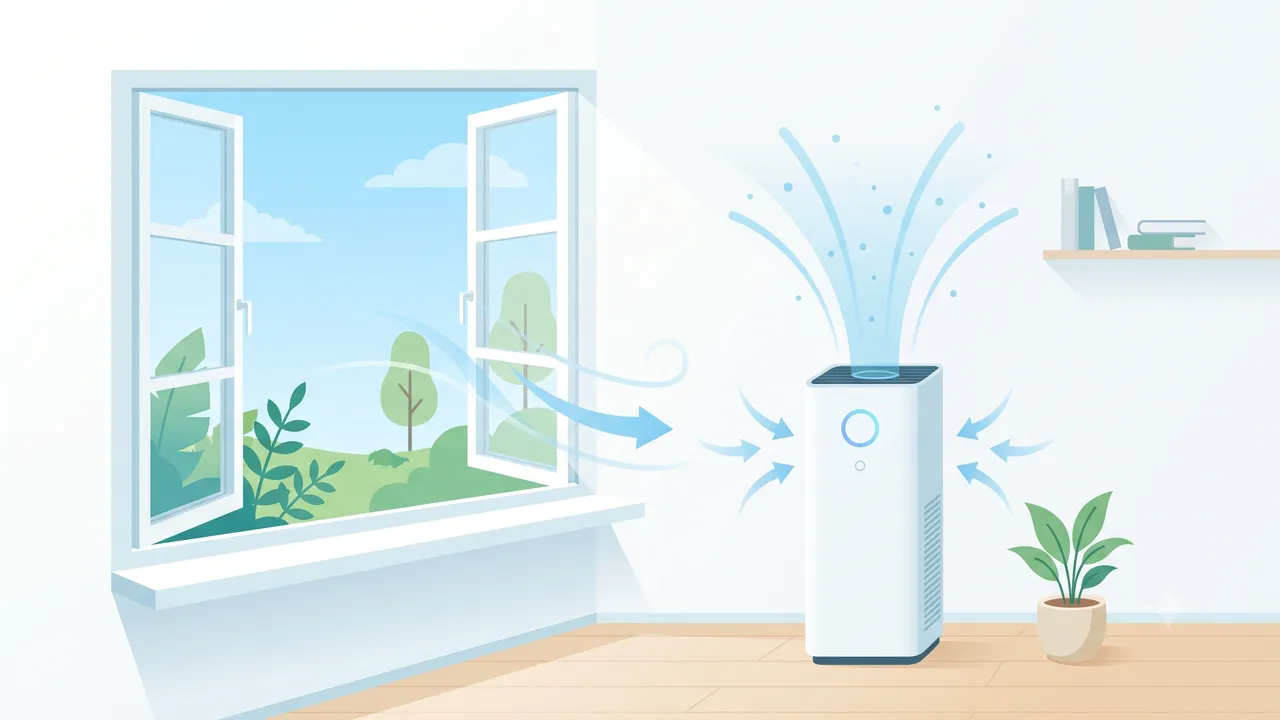
Proper ventilation dilutes indoor pollutants by bringing in fresh outdoor air. The key is knowing when and how to ventilate effectively.
7. Cross-Ventilate Daily
Open windows on opposite sides of your home for 15 to 30 minutes each day, ideally in the morning when outdoor air tends to be cleaner. This creates a cross-breeze that flushes out stale, polluted air and replaces it with fresh air. Even in winter, brief ventilation periods help, the temporary temperature drop is worth the air quality improvement. If you live in an area with high outdoor pollution (near highways, industrial zones, or during wildfire season), check local air quality indexes before opening windows using a tool like AirNow.gov.
8. Use Exhaust Fans Strategically
Your kitchen range hood and bathroom exhaust fans are powerful air quality tools that most people underuse. Turn on the range hood every time you cook, not just when something smells smoky. Gas stoves in particular release nitrogen dioxide, carbon monoxide, and formaldehyde during combustion. Run the hood fan on high during cooking and for 10 to 15 minutes afterward. In bathrooms, run the exhaust fan during and for 20 minutes after every shower to prevent mold growth and humidity buildup.
9. Install a Whole-House Fan or Attic Ventilator
A whole-house fan pulls fresh air in through open windows and pushes stale air out through the attic. It’s far cheaper to operate than air conditioning and can completely exchange the air in your home within minutes. Modern whole-house fans are quiet, energy-efficient, and cost a fraction of what a high-end air purifier runs. They work best in climates with cool evenings and mornings.
10. Create Passive Ventilation Pathways
If your home feels stuffy even with windows open, check for blocked airflow. Interior doors, heavy curtains, and furniture placed against vents can all obstruct natural air circulation. Keep doors between rooms open during the day. Move furniture at least a few inches away from vents and registers. Consider installing transfer grilles above doors in stuffy rooms to allow air to flow freely between spaces.
Natural Filtration: Houseplants and Living Systems
While houseplants alone can’t replace mechanical filtration, they do contribute to air quality through a process called phytoremediation, absorbing certain pollutants through their leaves and roots.
11. Add Air-Purifying Houseplants
NASA’s famous Clean Air Study identified several houseplants that effectively remove common indoor pollutants like formaldehyde, benzene, trichloroethylene, and xylene. The following table highlights the best options:
| Plant | Key Pollutants Removed | Care Level | Light Needs | Pet-Safe? |
|---|---|---|---|---|
| Snake Plant (Sansevieria) | Formaldehyde, benzene, xylene | Very Easy | Low to bright indirect | Toxic to cats/dogs |
| Pothos (Epipremnum aureum) | Formaldehyde, benzene, xylene | Easy | Low to moderate indirect | Toxic to cats/dogs |
| Spider Plant (Chlorophytum) | Formaldehyde, xylene, carbon monoxide | Easy | Bright indirect | Yes |
| Peace Lily (Spathiphyllum) | Benzene, formaldehyde, trichloroethylene | Moderate | Low to moderate indirect | Toxic to cats/dogs |
| Boston Fern (Nephrolepis) | Formaldehyde, xylene | Moderate | Indirect, humid | Yes |
| Rubber Plant (Ficus elastica) | Formaldehyde, carbon monoxide | Easy | Moderate indirect | Toxic to cats/dogs |
| Bamboo Palm (Chamaedorea) | Formaldehyde, benzene, trichloroethylene | Moderate | Indirect, moderate | Yes |
| English Ivy (Hedera helix) | Benzene, formaldehyde, mold spores | Easy | Moderate indirect | Toxic to cats/dogs |
| Dracaena varieties | Benzene, formaldehyde, trichloroethylene | Easy | Indirect | Toxic to cats/dogs |
| Areca Palm (Dypsis lutescens) | Formaldehyde, xylene, toluene | Moderate | Bright indirect | Yes |
For meaningful impact, aim for at least one plant per 100 square feet of living space. Group several plants together in rooms where you spend the most time.
12. Maintain a Salt Lamp or Beeswax Candle (With Realistic Expectations)
Himalayan salt lamps and beeswax candles are often marketed as air purifiers. The reality is more nuanced. Beeswax candles do produce negative ions when burned, which can theoretically bind to airborne pollutants and cause them to settle. However, the effect is minimal compared to proper ventilation. Salt lamps have no scientifically proven air-purifying benefit. Use them for ambiance if you enjoy them, but don’t rely on them as air quality solutions.
Humidity Management: The Overlooked Factor
Humidity levels have a massive impact on indoor air quality. Too high, and you get mold, dust mites, and bacterial growth. Too low, and you get irritated airways, increased susceptibility to respiratory infections, and more airborne dust.
13. Maintain Indoor Humidity Between 30% and 50%
This is the sweet spot recommended by the EPA and the American Society of Heating, Refrigerating and Air-Conditioning Engineers (ASHRAE). Below 30%, mucous membranes dry out and become vulnerable to infection. Above 50%, mold colonies begin thriving and dust mite populations explode. Use a simple digital hygrometer (most cost under $15) to monitor humidity levels in different rooms.
14. Fix Leaks and Moisture Sources Immediately
A slow pipe leak behind a wall, a damp basement, or condensation on single-pane windows can create persistent mold problems that no amount of air purifying will solve. Inspect under sinks, around toilets, behind appliances, and in basement or crawl spaces regularly. Address any water intrusion within 24 to 48 hours to prevent mold colonization. Use a dehumidifier in naturally damp areas like basements, keeping humidity below 50%.
15. Dry Laundry Outside or in a Ventilated Space
Drying wet clothes indoors releases a surprising amount of moisture into the air, a single load can add several pints of water vapor to your living space. This is one of the most common causes of elevated indoor humidity and subsequent mold growth in apartments. Dry clothes outside whenever possible, or use a dryer vented to the outdoors.
Lifestyle Adjustments: Daily Habits That Matter
16. Vacuum with a HEPA-Filtered Vacuum Regularly
Standard vacuums often do more harm than good, they suck up large particles but exhaust fine particulate matter (PM2.5) back into the air through their exhaust. A vacuum with a sealed HEPA filtration system captures 99.97% of particles down to 0.3 microns. Vacuum all floors, upholstered furniture, and mattresses at least twice a week. If you have pets, daily vacuuming in high-traffic areas makes a noticeable difference.
17. Wash Bedding Weekly in Hot Water
Your bed is a thriving ecosystem of dust mites, dead skin cells, and accumulated allergens. Wash all sheets, pillowcases, and blankets in water at least 130°F (54°C) weekly to kill dust mites and remove allergens. Encase mattresses and pillows in allergen-proof covers. Replace pillows every one to two years.
18. Implement a No-Shoes Policy Indoors
Shoes track in pesticides, lead dust, bacteria, fecal matter, allergens, and countless other pollutants from the outdoors. A study from the University of Arizona found an average of 421,000 units of bacteria on the outside of shoes. Place a shoe rack or basket by the entrance and provide house slippers for guests. This single habit can dramatically reduce the amount of particulate matter and chemical contamination on your floors.
When You Actually Need an Air Purifier
Natural methods are powerful, but they have limits. You should strongly consider investing in an air purifier if:
-
You or a family member has asthma, allergies, or a respiratory condition. HEPA air purifiers remove 99.97% of airborne allergens, including pollen, pet dander, dust mite fragments, and mold spores. Natural methods help but can’t match this level of filtration. See our Air Purifier Buying Guide for First-Time Buyers for help choosing the right model.
-
You live in an area with high outdoor pollution. If you’re near a highway, industrial area, or in a region prone to wildfires, opening windows for ventilation may introduce more pollutants than it removes. A purifier with activated carbon and HEPA filtration handles both particulates and gases.
-
You have pets. While regular cleaning helps, a HEPA air purifier captures pet dander and hair that settles in places you can’t easily clean. Check our guide to air purifiers safe for birds and pets if you have feathered or furry family members.
-
Someone in your home has chemical sensitivities (MCS). People with multiple chemical sensitivity reactions benefit enormously from activated carbon filtration, which removes VOCs that natural methods struggle to address. Our guide to air purifiers for chemical sensitivity covers this in detail.
-
You’ve tried natural methods and still experience symptoms. If you’ve implemented the strategies above and still wake up congested, have persistent headaches, or notice musty odors, a quality air purifier is a worthwhile investment. The Coway AP-1512HH is an excellent all-around choice for rooms up to 360 sq ft, while the Levoit Core 300 offers strong performance at a budget-friendly price.
-
You want to monitor your progress. An air quality monitor can help you track particulate levels, VOCs, and CO2 in real time so you know whether your natural methods are working or if additional filtration is needed.
Quick-Start Checklist
If you want to take action today, here’s a prioritized list of the highest-impact changes:
- ✅ Open windows for cross-ventilation every morning (15-30 minutes)
- ✅ Run exhaust fans during and after cooking and showering
- ✅ Remove all synthetic air fresheners and scented candles
- ✅ Replace one cleaning product with a vinegar or baking soda solution
- ✅ Add one snake plant or pothos to your most-used room
- ✅ Buy a hygrometer and check your humidity levels today
- ✅ Start a no-shoes policy at your front door
- ✅ Wash bedding in hot water this week
- ✅ Schedule a carpet deep-clean or start planning a hard-floor upgrade
- ✅ Move any chemical storage out of living areas
Frequently Asked Questions
How long does it take to notice a difference in indoor air quality?
Some changes produce immediate results. Opening windows for cross-ventilation improves air within minutes. Removing synthetic fragrances eliminates a constant source of VOCs right away. Other changes take longer, houseplants need weeks to months to establish and show measurable pollutant removal, and switching to low-VOC paints reduces off-gassing gradually over time. If you implement multiple strategies simultaneously, most people notice subjective improvement (less congestion, fewer headaches, fresher-smelling air) within one to two weeks.
Do houseplants really clean the air, or is that a myth?
The answer is nuanced. NASA’s 1989 study demonstrated that certain plants can remove specific VOCs in sealed laboratory chambers. However, real-world homes have far more air volume, continuous pollutant sources, and air exchange rates that make single plants far less effective. A 2019 study in the Journal of Exposure Science & Environmental Epidemiology concluded that you’d need roughly 10 to 1,000 plants per square meter to match the air cleaning rate of basic ventilation. So yes, plants contribute, but they’re a complement to ventilation and source control, not a replacement. They offer proven benefits for mental health, humidity regulation, and aesthetics regardless.
Can boiling vinegar or baking soda clean the air?
Boiling vinegar can temporarily reduce airborne bacteria and neutralize some odors, but it’s not a reliable air purification method. Baking soda absorbs odors when placed in enclosed spaces (like a refrigerator), but its effect on open-room air quality is negligible. Focus your energy on source control and ventilation instead, these produce measurable, lasting improvements.
Is outdoor air always cleaner than indoor air?
Not always. During wildfire events, high pollen days, rush hour near busy roads, or temperature inversions that trap pollution, outdoor air can be significantly worse than indoor air. Check your local Air Quality Index (AQI) on AirNow.gov before opening windows. On high-pollution days, keep windows closed and rely on source control and indoor strategies instead. If you live in an area with frequent poor air quality, an air purifier with a HEPA filter and activated carbon becomes a genuine necessity rather than a luxury.
How often should I check or improve my home’s air quality?
Perform a basic air quality audit every season. Check humidity levels, inspect for mold or moisture issues, replace HVAC filters (every 60 to 90 days, or every 30 days if you have pets), and clean exhaust fan grilles. Deep-clean carpets and upholstery at least twice a year. Test for radon at least once, it’s the second leading cause of lung cancer and is present in homes of all ages and types. Our guide to air purifiers and radon safety explains how to address this often-overlooked hazard.
Final Thoughts
Improving indoor air quality doesn’t require expensive equipment or a complete home renovation. The 18 methods outlined above, from eliminating pollution sources and optimizing ventilation to adding houseplants and managing humidity, form a comprehensive, natural approach to cleaner indoor air.
Start with the highest-impact changes: cross-ventilation, removing synthetic fragrances, running exhaust fans, and fixing moisture problems. Add houseplants, upgrade your vacuum, and adopt a no-shoes policy. Monitor how you feel. If natural methods aren’t enough, don’t hesitate to add a quality air purifier to the mix, it’s not a failure of the natural approach, it’s a recognition that some situations demand mechanical filtration.
The air you breathe at home affects your sleep, your energy, your immune system, and your long-term health. Every improvement you make compounds over time. Start today.
Disclosure: This article contains affiliate links. If you purchase products through these links, we may earn a small commission at no additional cost to you. We only recommend products we’ve genuinely evaluated and believe will help improve your indoor air quality. All recommendations are based on research and real-world testing, not affiliate relationships.
You May Also Like
- Air Purifier Placement Guide: Where to Put Your Purifier for Maximum Effect
- Kitchen Air Quality: Why Your Gas Stove Is Polluting Your Home (and What to Do About It)
- Air Purifier vs Humidifier vs Dehumidifier: Which One Do You Actually Need?
- How to Improve Indoor Air Quality Without an Air Purifier: 10 Science-Backed Methods
Support This Guide
Helpful? Add The Air Purifier Guide as a preferred source on Google so our guides show up in your search results.
Related Articles

Coway Mighty2 vs AP-1512HH (2026)
Coway's Mighty2 replaced the AP-1512HH as Wirecutter's top pick. We compare CADR, noise, sensors, filter costs, and whether the older unit is still the smarter buy.

Levoit Core 300 vs 300-P: What Changed
Levoit quietly replaced the Core 300 with the Core 300-P. We explain the AHAM certification, whether filters still fit, and which one you should actually buy.

Shark NeverChange HP302 Review
Shark's NeverChange HP302 promises 5 years on one filter. We dig into the real running costs, the odor neutralizer catch, and whether it beats cheaper rivals.

Winix 5510 vs 5500-2: 2026 Verdict
The Winix 5500-2 is discontinued and the 5510 takes over. We compare CADR, noise, filter costs, and the one compatibility problem nobody mentions.

Does an Air Purifier Dry Out the Air? The Honest Answer
If your throat feels dry after running a purifier, you're not imagining it — but it's probably not the purifier. Here's the humidifier-vs-purifier reality, with the measurements to prove it.
🛒 Products Mentioned
As an Amazon Associate, we earn from qualifying purchases.
Covers indoor air quality science, respiratory health, allergy management, and wildfire smoke protection.
View all articles by Sarah →