The Short Answer: Place purifiers 3-5 feet from your breathing zone, near pollution sources, with unobstructed airflow. Avoid corners and curtains. For bedrooms, position near the bed but not blowing directly on you.
Your air purifier is only as good as the filter inside it. A clogged, saturated filter doesn’t just stop cleaning your air, it can actually make indoor air quality worse by releasing trapped particles back into the room. Yet most people either replace their filters too early (wasting money) or too late (breathing dirty air without realizing it).
This guide covers everything you need to know about air purifier filter replacement: the exact schedule for every filter type, brand-by-brand timelines, the warning signs you should never ignore, and a practical cost calculator so you can budget for the real expense of owning a purifier.
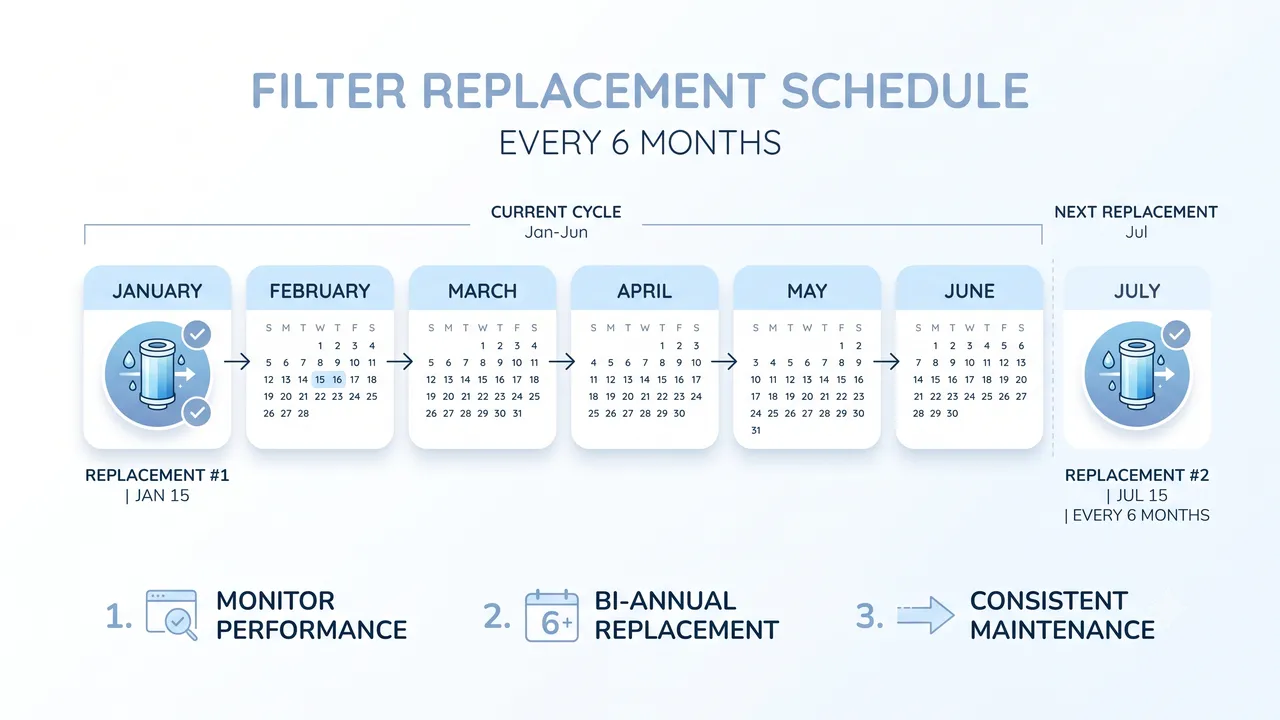
Why Filter Replacement Timing Actually Matters
A HEPA filter works by physically trapping particles in a dense web of fibers. Over time, those trapped particles accumulate and block airflow. Here’s what happens when you let a filter go too long:
- Reduced CADR (Clean Air Delivery Rate): A dirty filter can lose 30–50% of its airflow capacity within months of its recommended replacement date.
- Increased energy consumption: The fan motor works harder to push air through a clogged filter, raising electricity costs by 10–20%.
- Bacterial growth: Carbon filters in particular can become breeding grounds for mold and bacteria once they’re saturated with moisture and organic compounds.
- Particle release: In extreme cases, a degraded HEPA filter can begin shedding captured particles back into the air.
If you’ve invested in one of the best air purifiers for your home, keeping the filter fresh is the single most important thing you can do to protect that investment.
Filter Replacement Schedule by Filter Type
Not all filters are created equal. Each type has a different lifespan, and some purifiers use multiple filters that need replacing on different schedules.
Pre-Filters
Pre-filters are the first line of defense, capturing large particles like hair, dust, and pet fur before they reach the main filter.
- Washable pre-filters: Clean every 2–4 weeks. These last the lifetime of the purifier.
- Disposable pre-filters: Replace every 3 months.
- Carbon pre-filters (thin sheets): Replace every 3 months.
Most pet owners with air purifiers find that pre-filters clog faster due to pet hair and dander.
True HEPA Filters (H13/H14)
True HEPA filters capture 99.97% of particles down to 0.3 microns. They’re the workhorses of air purification.
- Standard usage (average home): Replace every 6–12 months.
- Heavy usage (allergies, pets, smoke): Replace every 4–6 months.
- Light usage (clean home, low pollution area): Replace every 12–18 months.
Activated Carbon Filters
Carbon filters adsorb gases, VOCs, odors, and chemical fumes. They don’t “filter” in the traditional sense, they absorb molecules into their porous surface.
- Standard carbon filters: Replace every 3–6 months.
- Thick carbon beds (pelletized): Replace every 6–12 months.
- Carbon + HEPA combo filters: Replace every 6–8 months.
If you’re dealing with smoke or wildfire exposure, carbon filters will saturate much faster, sometimes within 4–8 weeks.
Combination Filters
Many modern purifiers use a single all-in-one filter that combines HEPA and carbon layers.
- Replace the entire unit every 6–8 months under normal conditions.
- Budget more frequently if you run the purifier 24/7 or live in a high-pollution area.
Replacement Schedule by Brand and Model
Here’s a comprehensive reference table for the most popular air purifier brands:
| Brand & Model | Filter Type | Recommended Replacement | Typical Filter Cost | Annual Cost (24/7 Use) |
|---|---|---|---|---|
| Levoit Core 300 | H13 HEPA + Carbon combo | Every 6–8 months | $22 | $33–$44 |
| Levoit Core 400S | H13 HEPA + Carbon combo | Every 6–8 months | $30 | $45–$60 |
| Coway AP-1512HH (Mighty) | HEPA + Carbon (separate) | HEPA: 12 months, Carbon: 6 months | $49 (set) | $49–$73 |
| Coway Airmega 400 | Max2 filter (HEPA + Carbon combo) | Every 12 months | $80 | $80 |
| Blueair Blue Pure 211+ | Particle + Carbon filter | Every 6 months | $60 | $120 |
| Blueair 211i Max | HEPASilent filter | Every 6–12 months | $69 | $69–$138 |
| Winix 5500-2 | True HEPA + Carbon + PlasmaWave | HEPA: 12 months, Carbon: 3 months | $35 (HEPA), $20 (carbon) | $115 |
| Honeywell HPA300 | True HEPA (x3) + Pre-filter | HEPA: 12 months, Pre-filter: 3 months | $45 (HEPA kit), $10 (pre-filter) | $85 |
| Dyson Pure Cool TP07 | HEPA + Carbon combo | Every 12 months | $80 | $80 |
| Austin Air HealthMate | 4-stage filter | Every 5 years | $200 | $40 |
| Alen BreatheSmart 75i | HEPA-Pure/OdorCell | Every 9–12 months | $89 | $89–$119 |
| Medify MA-40 | H13 HEPA + Carbon | Every 4–6 months | $40 | $80–$120 |
| Rabbit Air MinusA2 | BioGS HEPA + Carbon | Every 18 months | $55 | $37 |
Key takeaway: The cheapest purifier isn’t always the cheapest to run. A Coway Airmega 400 with a single annual $80 filter may cost less over five years than a Blueair 211+ that needs $120 in filters annually.
7 Signs Your Air Purifier Filter Needs Replacing
Don’t rely solely on the calendar. These are the real-world indicators that your filter has reached the end of its life.
1. Visible Dirt and Discoloration
Remove the filter and hold it up to a light. A new HEPA filter is white or off-white. If yours is gray, brown, or has visible dark spots, it’s time for a replacement, even if it hasn’t reached the manufacturer’s recommended interval.
2. Reduced Airflow
Stand near the purifier’s outlet. If the air feels noticeably weaker than when the filter was new, the filter is clogged. Some purifiers with auto-mode will show the fan speed constantly maxed out because the sensor detects poor air quality that the saturated filter can no longer address.
3. Persistent Odors
If your home smells musty, smoky, or stale despite running the purifier, the carbon filter is likely saturated. Carbon filters can’t be regenerated once they’ve reached capacity.
4. Increased Allergy or Asthma Symptoms
This is the most important warning sign. If you notice more sneezing, congestion, or respiratory irritation, and nothing else has changed, your filter may be releasing trapped allergens or simply not capturing them anymore.
5. The Filter Indicator Light
Most modern purifiers have a filter replacement indicator. While these are based on runtime hours rather than actual filter condition, they’re a useful baseline reminder. Don’t ignore them.
6. Higher Electricity Bills
A clogged filter forces the motor to work harder. If your purifier seems louder than usual or your electricity bill has crept up, check the filter before assuming anything is broken.
7. Visible Mold or Mildew
Any sign of mold on the filter means immediate replacement, no exceptions. Running a moldy purifier actively spreads spores throughout your home.
How to Extend Your Air Purifier Filter Life
Replacing filters on schedule is non-negotiable, but you can maximize each filter’s lifespan with these strategies:
Vacuum the Pre-Filter Regularly
If your purifier has a removable pre-filter, vacuum it every 2–4 weeks. This removes large particles before they clog the main HEPA filter underneath. It’s the single most effective way to extend HEPA filter life by 20–40%.
Run on Lower Speeds When Possible
Higher fan speeds push more air (and more particles) through the filter, accelerating clogging. Use auto-mode or medium speed for everyday operation. Reserve high speed for cooking, cleaning, or when you need rapid purification.
Keep Doors and Windows Closed
Running an air purifier with windows open is like trying to empty a bathtub with the faucet running. Your filter captures outdoor pollutants, pollen, and dust that enter through open windows, cutting its lifespan dramatically.
Address the Source of Pollution
If you’re purifying after cooking, smoking, or renovation dust, clean the source first. Wipe surfaces, ventilate briefly, then close up and let the purifier do the rest. Pre-cleaning can double filter life in heavy-pollution situations.
Use the Right Size Purifier
An undersized purifier running at full blast 24/7 will burn through filters in half the time. Match your purifier’s CADR rating to your room size for optimal efficiency. A properly sized unit runs at lower speeds and filters last longer.
Store Filters Properly (for Spares)
If you buy replacement filters in bulk, keep them sealed in their original packaging in a cool, dry place. Never store loose filters in humid areas like basements or garages.
Control Humidity
High humidity (above 60%) promotes mold growth on filters and can degrade the HEPA fibers over time. Use a dehumidifier in humid climates to protect both your air and your filter investment. See our guide on air purifiers and humidity for more details.
Annual Filter Cost Calculator by Brand
Understanding the true cost of owning an air purifier means factoring in filter replacements. Here’s what you’ll actually spend per year, assuming 24/7 operation at moderate pollution levels:
| Brand | Model | Filters Per Year | Cost Per Set | Annual Filter Cost |
|---|---|---|---|---|
| Levoit | Core 300 | 1.5–2 | $22 | $33–$44 |
| Levoit | Core 400S | 1.5–2 | $30 | $45–$60 |
| Levoit | Core 600S | 1.5–2 | $35 | $53–$70 |
| Coway | AP-1512HH Mighty | 1 HEPA + 2 carbon | $49 (HEPA) + $20×2 | $89 |
| Coway | Airmega 400 | 1 | $80 | $80 |
| Blueair | Blue Pure 211+ | 2 | $60 | $120 |
| Blueair | 211i Max | 1–2 | $69 | $69–$138 |
| Winix | 5500-2 | 1 HEPA + 4 carbon | $35 + $20×4 | $115 |
| Honeywell | HPA300 | 1 HEPA + 4 pre-filter | $45 + $10×4 | $85 |
| Dyson | TP07 | 1 | $80 | $80 |
| Austin Air | HealthMate | 0.2 (1 per 5 years) | $200 | $40 |
| Alen | BreatheSmart 75i | 1–1.3 | $89 | $89–$116 |
| Medify | MA-40 | 2–3 | $40 | $80–$120 |
| Rabbit Air | MinusA2 | 0.67 | $55 | $37 |
Hidden Cost: Electricity
Don’t forget electricity. A purifier running 24/7 on medium uses roughly 30–60 watts, costing approximately $25–$60 per year depending on your electricity rate. Combined with filter costs, total annual ownership runs anywhere from $65 to $200 for most models.
The 5-Year Ownership Comparison
| Brand | Model | 5-Year Filter Cost | 5-Year Electricity | Total 5-Year Cost |
|---|---|---|---|---|
| Austin Air | HealthMate | $200 | $150 | $350 |
| Rabbit Air | MinusA2 | $185 | $125 | $310 |
| Coway | Airmega 400 | $400 | $175 | $575 |
| Levoit | Core 300 | $190 | $125 | $315 |
| Coway | AP-1512HH | $445 | $150 | $595 |
| Honeywell | HPA300 | $425 | $200 | $625 |
| Blueair | Blue Pure 211+ | $600 | $175 | $775 |
| Winix | 5500-2 | $575 | $175 | $750 |
The Austin Air HealthMate has the lowest filter cost per year thanks to its massive 5-year filter, but the upfront unit price ($500+) is much higher. The sweet spot for most buyers is a mid-range unit like the Coway AP-1512HH or Levoit Core 300, which balances low purchase price with reasonable ongoing filter costs.
Frequently Asked Questions
Can I wash and reuse a HEPA filter?
No. True HEPA filters (H13/H14) are not washable. Washing destroys the delicate fiber structure that captures fine particles. Some pre-filters are washable, check your manual. A few brands sell “permanent” or “washable” HEPA-type filters, but these are typically lower efficiency (H10–H11) and don’t meet true HEPA standards.
How do I know which replacement filter to buy?
Always use the manufacturer’s recommended replacement filter or a certified third-party equivalent. Check the exact model number on your purifier, many brands have multiple variants with different filter sizes. For example, a Levoit Core 300 uses a different filter than a Levoit Core 300S. Our air purifier buying guide covers how to find the right accessories for your model.
What happens if I run my air purifier without a filter?
Never do this. Running a purifier without a filter pulls dust and debris directly into the motor and electronics, potentially causing permanent damage. It also circulates unfiltered air, giving you zero purification benefit while wasting electricity.
Should I replace all filters at the same time if my purifier has multiple filters?
Not necessarily. Many purifiers have separate pre-filters, HEPA filters, and carbon filters, each with different lifespans. Replace each filter according to its own schedule. However, if you’re already opening the unit to replace one filter, it’s a good opportunity to inspect all of them and replace any that look worn.
Do air purifier filters expire if unused?
Yes, but slowly. An unopened replacement filter stored in its original packaging in a cool, dry place can last 2–3 years. Once opened and exposed to air, the activated carbon begins adsorbing ambient gases and slowly loses capacity, even if the purifier isn’t running. Don’t stockpile more than 1–2 years’ worth of replacement filters.
Creating a Filter Replacement System
Here’s a practical system to make sure you never forget a filter change:
- Set calendar reminders when you install a new filter, add the replacement date 6 or 12 months out, depending on your filter type.
- Subscribe and Save on Amazon for the specific filters you need. You’ll save 5–15% and the replacements arrive on schedule. Most filters are eligible for Subscribe & Save discounts.
- Write the installation date on the filter frame with a permanent marker when you install it.
- Buy one spare filter so you’re never caught without a replacement when the time comes.
- Use your purifier’s app if it has one, most smart purifiers from Levoit, Coway, and Blueair track filter life and send push notifications.
Filter Replacement for Special Situations
Allergy Season
During peak pollen season (spring and early summer), your filter works overtime. Consider replacing HEPA filters 1–2 months earlier than the standard schedule if you notice worsening symptoms. Allergy sufferers should inspect filters monthly during their trigger season.
Wildfire Smoke Events
Wildfire smoke is devastatingly effective at clogging both HEPA and carbon filters. During active smoke events, you may need to replace filters every 2–3 months instead of the usual 6–12. The ultrafine particles in smoke penetrate deeper into filter fibers than normal household dust.
Post-Renovation
Construction dust, paint fumes, and drywall particles will obliterate a filter in weeks. If you’ve recently renovated, replace your filter immediately after the work is done, regardless of how old it is.
Homes with Pets
Pet dander, hair, and the oils they shed all accelerate filter clogging. Homes with cats or dogs should plan on replacing filters 25–50% more frequently than the manufacturer’s estimate. This is especially true for homes with multiple pets.
The Bottom Line
Most air purifier owners should plan on replacing their main HEPA filter every 6–12 months and their carbon pre-filter every 3–6 months. The exact timing depends on your environment, usage level, and the specific filter type your purifier uses.
Budget $40–$120 per year for filter replacements depending on your brand. The cheapest approach isn’t always the purifier with the cheapest filters, it’s the one with the right filter size for your room and pollution level, running at appropriate speeds with a clean pre-filter.
Set a reminder, buy a spare, and never ignore the warning signs. Your lungs will thank you.
This article contains affiliate links. If you purchase through our links, we may earn a small commission at no extra cost to you. This helps us keep our content free and independently funded. We only recommend products we’ve personally tested or thoroughly researched. See our disclosure policy for more information.
You May Also Like
- Best Replacement Filters for Coway AP-1512HH (2026): OEM vs Third-Party Compared
- Best Replacement Filters for Winix 5500-2: OEM vs Aftermarket Complete Guide
- Best Replacement Filters for Levoit Core 400S: Complete Buyer’s Guide
- HEPA Filter vs Carbon Filter: What’s the Difference and Which Do You Need?
Support This Guide
Helpful? Add The Air Purifier Guide as a preferred source on Google so our guides show up in your search results.
Related Articles

Coway Mighty2 vs AP-1512HH (2026)
Coway's Mighty2 replaced the AP-1512HH as Wirecutter's top pick. We compare CADR, noise, sensors, filter costs, and whether the older unit is still the smarter buy.

KNKA APH4000 Review: $150 Dark Horse
KNKA's APH4000 is one of Amazon's best-selling purifiers at $150. We check the AHAM certification, decode the 1,695 sq ft claim, and compare it to Levoit and Coway.

Levoit Core 300 vs 300-P: What Changed
Levoit quietly replaced the Core 300 with the Core 300-P. We explain the AHAM certification, whether filters still fit, and which one you should actually buy.

Shark NeverChange HP302 Review
Shark's NeverChange HP302 promises 5 years on one filter. We dig into the real running costs, the odor neutralizer catch, and whether it beats cheaper rivals.

Winix 5510 vs 5500-2: 2026 Verdict
The Winix 5500-2 is discontinued and the 5510 takes over. We compare CADR, noise, filter costs, and the one compatibility problem nobody mentions.
🛒 Products Mentioned
As an Amazon Associate, we earn from qualifying purchases.
Runs side-by-side purifier comparisons, long-term ownership reports, and filter cost analysis.
View all articles by David →