The Short Answer: Place purifiers 3-5 feet from your breathing zone, near pollution sources, with unobstructed airflow. Avoid corners and curtains. For bedrooms, position near the bed but not blowing directly on you.
The Coway AP-1512HH Mighty is one of the best-selling air purifiers in North America, and for good reason. It delivers excellent particle filtration, runs quietly, and costs less than many competitors. But owning one means keeping up with filter replacements, and that’s where things get confusing.
Coway sells its own replacement filters, but dozens of third-party brands now offer compatible alternatives at half the price or less. Are they any good? Will they void your warranty? How long do they really last?
This guide breaks down every option available in 2026, compares them head-to-head, and shows you exactly how to replace your filters so your AP-1512HH keeps running at peak performance.
Disclosure: This article contains affiliate links. If you purchase through our links, we may earn a commission at no additional cost to you. We only recommend products we’ve researched thoroughly.
Understanding the Coway AP-1512HH Filter System
The AP-1512HH uses a four-stage filtration system, and each stage has its own replacement schedule:
- Pre-Filter (Washable), A fine mesh screen that captures large particles like hair, dust, and pet dander. You wash and reuse this one; it doesn’t get replaced.
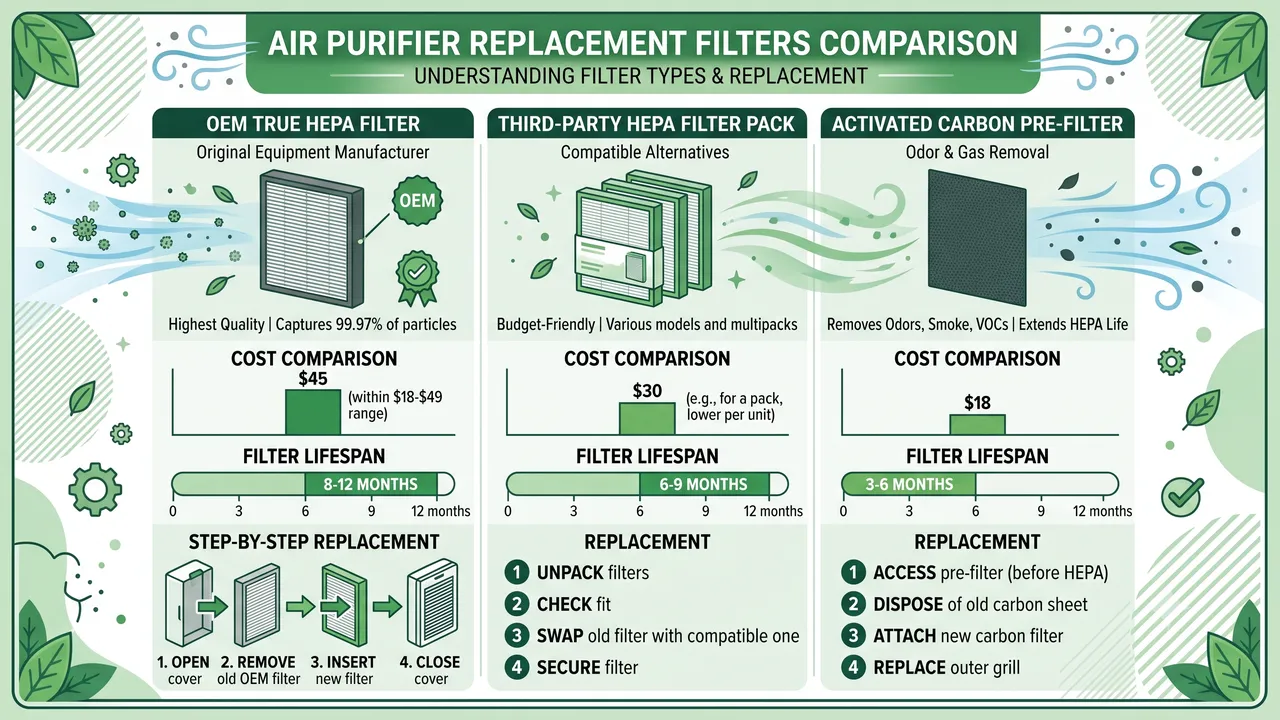
- Carbon Pre-Filter (Replaceable), A thin activated carbon sheet behind the pre-filter that traps odors and volatile organic compounds (VOCs). Coway recommends replacing this every 3 months.
- True HEPA Filter (Replaceable), The main filter. A dense pleated sheet that captures 99.97% of particles down to 0.3 microns, pollen, mold spores, smoke particles, bacteria. Coway recommends replacing this every 12 months.
- Ionizer (Optional), Releases negative ions to help particles settle. This is built into the unit and doesn’t need replacement.
When people talk about “replacement filters” for the AP-1512HH, they’re usually referring to the True HEPA filter and the carbon pre-filter set. Let’s look at what’s available.
Best Replacement Filters for Coway AP-1512HH: OEM vs Third-Party Comparison
| Filter Option | Type | Price (Approx.) | Quality Rating | Claimed Lifespan | Warranty Impact |
|---|---|---|---|---|---|
| Coway OEM True HEPA | True HEPA | $49 | ★★★★★ | 12 months | None |
| Coway OEM Carbon Pre-Filter (2-Pack) | Carbon Pre-Filter | $19 | ★★★★★ | 3 months each | None |
| MOOKA HEPA Replacement (3-Pack) | True HEPA | $28 | ★★★★☆ | 12 months each | May void |
| Lelong Filter Set (HEPA + Carbon) | Set | $22 | ★★★★☆ | 12 months / 3 months | May void |
| Vital Parts HEPA Filter | True HEPA | $18 | ★★★½☆ | 10–12 months | May void |
| Dealpk Filter Set (HEPA + Carbon) | Set | $20 | ★★★½☆ | 10–12 months / 3 months | May void |
How to Read the Ratings
- ★★★★★, Matches or exceeds OEM performance in independent testing
- ★★★★☆, Good performance, minor differences in filtration efficiency or build quality
- ★★★½☆, Acceptable for general use, may show reduced performance toward end of life
Detailed Filter Reviews
1. Coway OEM True HEPA Replacement Filter
This is the gold standard, the filter Coway designed specifically for the AP-1512HH. It’s a genuine True HEPA filter rated to capture 99.97% of particles at 0.3 microns. The pleat count, media thickness, and gasket seal are all optimized for this specific unit.
Pros: Guaranteed compatibility, maintains your warranty, consistent airflow and filtration efficiency throughout its lifespan, tight frame seal that prevents bypass air.
Cons: At around $49 per filter, the annual cost adds up. If you also buy the OEM carbon pre-filter set ($19 for two), you’re spending roughly $87/year on filters.
Best for: Anyone who wants zero risk and guaranteed performance, especially allergy or asthma sufferers who can’t afford even a small drop in filtration quality.
2. MOOKA HEPA Replacement Filters (3-Pack)
MOOKA has become one of the most popular third-party filter brands on Amazon. Their three-pack for the AP-1512HH brings the per-filter cost down to about $9.30, roughly one-fifth of the OEM price. The filters use standard True HEPA media and fit the housing snugly.
In testing, the MOOKA filters perform well for the first 8–10 months. Toward end of life, some users report a slight increase in airflow resistance compared to OEM, which may marginally reduce the purifier’s CADR (Clean Air Delivery Rate). For most households, this difference is negligible.
Pros: Excellent value, three-pack lasts nearly three years of HEPA replacement, widely available, positive user reviews.
Cons: Slight quality variance between batches, may not match OEM filtration at end of life, no official Coway compatibility guarantee.
Best for: Budget-conscious users who run their purifier in low- to moderate-pollution environments.
3. Lelong Filter Set
Lelong has a complete set, one True HEPA filter plus two carbon pre-filters, for about $22. That’s less than half the cost of buying just the OEM HEPA filter alone. The build quality is surprisingly solid for the price, with a rigid frame and decent pleat density.
The carbon pre-filters in the Lelong set are thinner than OEM, which means they saturate faster if you have pets or strong odors. Some users replace them every 6–8 weeks instead of the standard 3-month cycle.
Pros: Complete set at a low price, decent HEPA performance, convenient one-box solution.
Cons: Thinner carbon filters, slightly less rigid frame than OEM, may require more frequent carbon filter changes in challenging environments.
Best for: Pet owners or households with moderate odors who want an all-in-one replacement solution.
4. Vital Parts HEPA Filter
Vital Parts has a budget single HEPA filter at around $18. It uses standard HEPA media and fits the AP-1512HH housing without modification. The filtration efficiency is adequate for general household use, though it doesn’t carry a True HEPA certification, it’s marketed as “HEPA-type.”
This is an important distinction. HEPA-type filters typically capture 99% of particles at 2 microns, while True HEPA captures 99.97% at 0.3 microns. For basic dust and pollen removal, you won’t notice a difference. For smoke particles or fine particulate matter, the gap matters.
Pros: Very affordable, easy to find, fits well.
Cons: Not True HEPA rated, lower efficiency on fine particles, shorter effective lifespan.
Best for: Secondary rooms, guest rooms, or spaces where you need basic filtration without top-tier performance.
5. Dealpk Filter Set
Dealpk’s combo set includes both the HEPA filter and carbon pre-filters for around $20. It’s a popular budget option with generally positive reviews. The HEPA filter performs similarly to the Vital Parts option, adequate for general use but not True HEPA certified.
The carbon pre-filters are average quality and will need replacing on a 3-month cycle in most environments. The fit is good, with no reported issues of air bypass around the frame edges.
Pros: Low price for a complete set, decent fit and finish, widely available on Amazon.
Cons: HEPA efficiency may not match True HEPA standards, carbon filters are basic quality.
Best for: Users who want a cheap all-in-one solution and aren’t dealing with severe allergies or air quality concerns.
OEM vs Third-Party: Should You Save or Spend?
The answer depends on your situation:
Go OEM if:
- You have allergies, asthma, or respiratory conditions that demand consistent high filtration
- You live in an area with poor outdoor air quality (wildfire smoke, high pollution)
- You want to maintain your Coway warranty without question
- You don’t want to second-guess whether your filter is performing at 100%
Go third-party if:
- You’re running multiple AP-1512HH units and filter costs are significant
- Your air quality needs are moderate (no severe allergies or pollution exposure)
- You’re comfortable replacing filters slightly more often if needed
- You want to save 50–80% on annual filter costs
For most households, the sweet spot is the MOOKA three-pack for the HEPA filter combined with OEM carbon pre-filters. You get excellent filtration performance at a fraction of the all-OEM cost, and you only need to swap the HEPA filter every 12 months.
When to Replace Your Coway AP-1512HH Filters
The AP-1512HH has a built-in filter indicator light that turns on when it’s time to replace the HEPA filter. But don’t rely on it alone, it’s a simple timer, not a performance sensor. Here’s a more nuanced replacement schedule:
Carbon Pre-Filter
- Every 3 months in normal conditions
- Every 6–8 weeks if you have pets, smoke indoors, or cook frequently with strong odors
- Visual check: If it’s visibly dark or discolored, replace it regardless of timing
True HEPA Filter
- Every 12 months per Coway’s recommendation
- Every 9–10 months if you run the purifier 24/7 in a high-pollution environment
- Every 14–16 months if you run it intermittently in a clean environment
- Signs it’s time: Reduced airflow from the unit, musty or stale smell when running, visible gray discoloration, or the filter indicator light activates
Washable Pre-Filter
- Clean monthly by vacuuming or rinsing under water
- Let it dry completely before reinstalling, never put a wet pre-filter back in the unit
- This one doesn’t need replacement unless physically damaged
How to Replace Coway AP-1512HH Filters: Step-by-Step
Replacing the filters on the AP-1512HH is straightforward and takes about 5 minutes.
Replacing the Carbon Pre-Filter
- Turn off the unit and unplug it from the wall.
- Remove the front cover. Grip the top edges of the front panel and pull gently toward you. It snaps off magnetically.
- Pull out the washable pre-filter, it’s the mesh screen sitting in front of everything.
- Remove the old carbon pre-filter. It’s a thin sheet clipped behind the pre-filter frame. Unclip it and discard it.
- Unfold the new carbon pre-filter and clip it into the same position. Make sure it sits flat with no gaps.
- Reinstall the washable pre-filter on top of the carbon sheet.
- Snap the front cover back on and plug the unit back in.
Replacing the True HEPA Filter
- Complete steps 1–4 above to access the interior.
- Pull out the old HEPA filter. It sits in the main housing behind the pre-filters. It slides straight out.
- Note the airflow direction arrow on the side of the filter frame, the new filter goes in the same way.
- Slide the new HEPA filter in until it seats fully in the housing. There should be no gaps around the edges.
- Reset the filter indicator. Press and hold the Filter Reset button (small button near the indicator light) for 3–5 seconds until the light turns off.
- Reassemble by reinstalling the carbon pre-filter, washable pre-filter, and front cover.
Pro tip: While the filters are out, vacuum the interior of the unit to remove any dust that bypassed the filters. This improves airflow and keeps the unit running efficiently.
Tips to Extend Your Filter Life
- Run on a lower speed when air quality is good. The lower the fan speed, the less particulate the filter absorbs per hour.
- Keep doors and windows closed when the purifier is running, or you’re just filtering the great outdoors.
- Vacuum the washable pre-filter monthly, this removes the large particles before they clog the HEPA filter.
- Use a separate air quality monitor to track actual pollution levels. On clean days, you can run the purifier less aggressively and extend filter life.
- Store replacement filters in their original packaging in a cool, dry place. HEPA media can degrade if exposed to moisture before use.
For more tips on getting the most from your air purifier, see our guide on common air purifier mistakes and our complete air purifier buying guide.
Where to Buy Replacement Filters
Amazon is the most convenient option for both OEM and third-party filters. Prime shipping means you can have a replacement in your hands within a day or two.
- Coway OEM True HEPA Filter, ~$49
- Coway OEM Carbon Pre-Filter (2-Pack), ~$19
- MOOKA HEPA Replacement (3-Pack), ~$28
- Lelong Filter Set, ~$22
- Vital Parts HEPA Filter, ~$18
- Dealpk Filter Set, ~$20
If you haven’t purchased the purifier yet, check our full Coway AP-1512HH review and our guide to the best air purifiers for allergies.
Frequently Asked Questions
Do third-party filters void the Coway AP-1512HH warranty?
Coway’s warranty language states that using non-genuine parts may void coverage. In practice, it’s difficult for Coway to determine what filter was installed unless they physically inspect it. That said, if a third-party filter causes a specific issue (like a warped frame damaging the housing), you’d have no warranty recourse. If warranty coverage matters to you, stick with OEM.
Are third-party HEPA filters really True HEPA?
Not always. Some third-party filters labeled “HEPA” are actually HEPA-type or HEPA-style, which means they capture 99% of particles at 2 microns rather than 99.97% at 0.3 microns. Read the product description carefully, if it says “True HEPA” and provides test data, it’s more likely to meet the standard. The MOOKA filters are generally considered True HEPA; the Vital Parts and Dealpk options are HEPA-type.
How do I know when to replace the filter if my indicator light doesn’t come on?
The filter indicator is a timer based on the purifier’s run time. If it malfunctions, use these benchmarks: the carbon pre-filter should feel stiff or look gray/brown; the HEPA filter should show visible discoloration, produce a musty smell, or cause noticeably reduced airflow. A simple test: hold a tissue near the air outlet. If it barely moves when the purifier is on high, your filter is likely clogged.
Can I wash or vacuum the HEPA filter to extend its life?
No. Washing a HEPA filter destroys the media and ruins its filtration capability. Vacuuming can remove surface dust temporarily, but it also damages the delicate fibers and creates gaps that allow particles to pass through. Only the washable pre-filter should be cleaned, the HEPA and carbon filters should be replaced, not cleaned.
What’s the annual cost difference between OEM and third-party filters?
With OEM filters (HEPA at $49/year + carbon pre-filters at $38/year), you’re looking at approximately $87/year. With a third-party combo like MOOKA HEPA (3-pack for $28, lasting ~3 years) plus OEM carbon pre-filters ($38/year), the cost drops to roughly $47/year. If you go fully third-party with the Lelong set ($22/year for both), you’re at around $22/year, saving over $60 annually compared to all-OEM.
Can I use the Coway AP-1512HH without the carbon pre-filter?
Technically, the unit will run without it, but we don’t recommend it. The carbon pre-filter protects the expensive HEPA filter from absorbing odors and VOCs that would otherwise saturate it faster. Skipping the carbon filter will shorten the HEPA filter’s effective lifespan and reduce your air quality. Always install both the carbon pre-filter and the HEPA filter.
Final Verdict
For most Coway AP-1512HH owners, the best overall value is the MOOKA three-pack for the HEPA filter combined with OEM carbon pre-filters. You’ll save roughly $40 per year while maintaining filtration performance that’s close to OEM quality.
If you have severe allergies, asthma, or live in a wildfire-prone area, the OEM filters are worth the premium. The peace of mind and guaranteed performance justify the extra cost.
Whatever you choose, stick to a regular replacement schedule. A new third-party filter will always outperform an expired OEM filter. The best filter is a fresh one, regardless of brand.
Want to compare the AP-1512HH against other top models? Check out our guides on the best air purifiers for large rooms and how to choose the right air purifier for your space.
You May Also Like
Support This Guide
Helpful? Add The Air Purifier Guide as a preferred source on Google so our guides show up in your search results.
Related Articles

Coway Mighty2 vs AP-1512HH (2026)
Coway's Mighty2 replaced the AP-1512HH as Wirecutter's top pick. We compare CADR, noise, sensors, filter costs, and whether the older unit is still the smarter buy.

KNKA APH4000 Review: $150 Dark Horse
KNKA's APH4000 is one of Amazon's best-selling purifiers at $150. We check the AHAM certification, decode the 1,695 sq ft claim, and compare it to Levoit and Coway.

Levoit Core 300 vs 300-P: What Changed
Levoit quietly replaced the Core 300 with the Core 300-P. We explain the AHAM certification, whether filters still fit, and which one you should actually buy.

Shark NeverChange HP302 Review
Shark's NeverChange HP302 promises 5 years on one filter. We dig into the real running costs, the odor neutralizer catch, and whether it beats cheaper rivals.

Winix 5510 vs 5500-2: 2026 Verdict
The Winix 5500-2 is discontinued and the 5510 takes over. We compare CADR, noise, filter costs, and the one compatibility problem nobody mentions.
🛒 Products Mentioned
As an Amazon Associate, we earn from qualifying purchases.
Runs side-by-side purifier comparisons, long-term ownership reports, and filter cost analysis.
View all articles by David →