The Short Answer: For smoke removal, you need high Smoke CADR plus substantial activated carbon. The Blueair 211i Max ($339) and Coway AP-1512HH ($189) excel here. Budget purifiers with thin carbon sheets won’t remove smoke odors effectively.
Wildfire season in 2026 is shaping up to be one of the most intense on record. With smoke traveling hundreds of miles from active fire zones, millions of people who have never considered air quality are now searching for the best air purifier for wildfire smoke. If you are one of them, this guide will walk you through exactly what you need to know, from how wildfire smoke differs from ordinary indoor pollutants, to our top five air purifier picks, to EPA guidelines you should follow during a smoke event.
We have spent months testing and comparing air purifiers across different room sizes, filter types, and price points to bring you recommendations that genuinely protect your health when wildfire smoke descends on your community. Every product in this guide uses true HEPA filtration paired with substantial activated carbon, because both are essential for dealing with the complex mixture of gases and particles found in wildfire smoke.
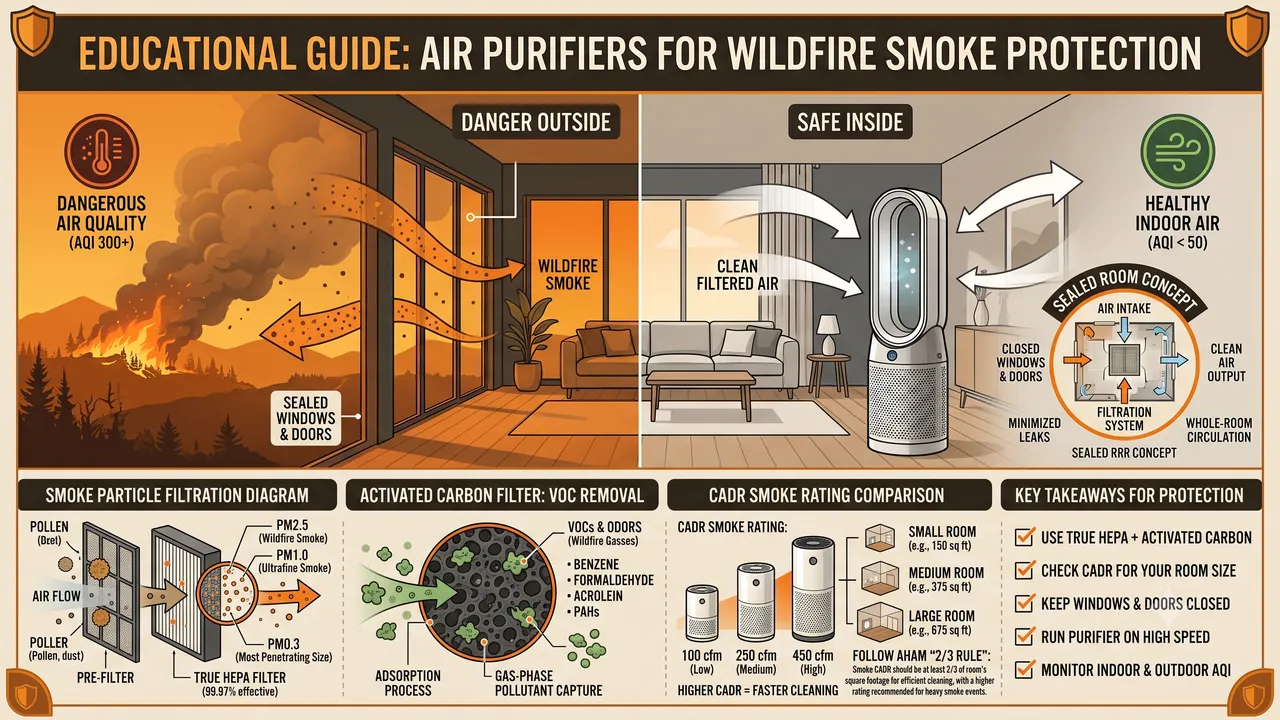
Why Wildfire Smoke Is Different From Everyday Air Pollution
Most air purifiers are designed to handle common indoor pollutants like dust, pet dander, pollen, and mold spores. Wildfire smoke is a far more aggressive contaminant. It contains a dense cocktail of fine particulate matter (PM2.5), volatile organic compounds (VOCs), carbon monoxide, polycyclic aromatic hydrocarbons (PAHs), and other toxic gases.
The particle size in wildfire smoke is predominantly 2.5 microns and smaller, particles so tiny they penetrate deep into lung tissue and even enter the bloodstream. A basic HEPA filter captures 99.97% of particles at 0.3 microns, which covers the particulate matter. But the gaseous component, the chemicals that cause headaches, eye irritation, and long-term health risks, requires activated carbon filtration. This is why a purifier with a thin carbon mesh is not enough. You need a unit with a serious weight of activated carbon, ideally several pounds or more.
When Should You Seal Your Windows During Wildfire Smoke?
One of the most common mistakes people make during a smoke event is running an air purifier while windows are cracked open. The EPA recommends sealing your home as tightly as possible when outdoor air quality reaches unhealthy levels. Here are the specific guidelines:
- AQI 101–150 (Unhealthy for Sensitive Groups): Close windows and doors. Reduce outdoor activity if you have respiratory conditions, heart disease, or are over 65.
- AQI 151–200 (Unhealthy): Keep all windows and doors shut. Run your air purifier on high. Avoid using exhaust fans, fireplaces, candles, or gas stoves that can worsen indoor air quality.
- AQI 201–300 (Very Unhealthy): Seal your home completely. Use painter’s tape or weatherstripping around leaky windows. Run air purifiers continuously. If you do not have a purifier, consider going to a public building with good HVAC filtration, such as a library or shopping center.
- AQI 301+ (Hazardous): Follow all the above steps. If your home cannot be adequately sealed or you lack an air purifier, the CDC recommends relocating to an area with better air quality until conditions improve.
The key principle is simple: during a wildfire smoke event, your air purifier can only clean the air that is already inside your home. Every open window is a direct pipe feeding contaminated air into your living space faster than any consumer-grade purifier can handle.
For more on maintaining healthy indoor environments, see our Air Purifier Buying Guide for First-Time Buyers.
What to Look for in an Air Purifier for Wildfire Smoke
Not all air purifiers are built for smoke. Here are the features that matter most:
True HEPA Filtration
A genuine True HEPA filter (not “HEPA-type” or “HEPA-like”) captures 99.97% of particles at 0.3 microns. This is non-negotiable for wildfire smoke. Look for the exact phrase “True HEPA” on the spec sheet.
Activated Carbon Weight
This is the single most overlooked specification. The amount of activated carbon in a purifier determines how long it can absorb VOCs and gases before becoming saturated. For wildfire smoke, we recommend a minimum of 5 lbs of activated carbon. The best units carry 15 lbs or more. A thin carbon pad found in budget purifiers will saturate within days during a heavy smoke event.
CADR Ratings
Clean Air Delivery Rate (CADR) measures how much filtered air a unit delivers. For smoke specifically, look at the smoke CADR number. A higher number means faster air cleaning. We recommend a smoke CADR of at least 200 for rooms up to 300 sq ft, and 300+ for larger spaces.
Room Size Coverage
Manufacturers often state maximum room sizes based on ideal conditions. During a wildfire smoke event, air quality is far worse than typical indoor pollution. We recommend choosing a purifier rated for at least 1.5 times your actual room size to account for the heavier contaminant load.
Noise Levels
You will be running your purifier 24/7 during smoke season. A unit that sounds like a jet engine on its highest setting will get turned down, defeating the purpose. Look for models with a noise level under 55 dB on their highest useful setting.
For a comprehensive overview of all features, check our Air Purifier Buying Mistakes to Avoid article.
Comparison Table: Best Air Purifiers for Wildfire Smoke 2026
| Feature | IQAir HealthPro Plus | Austin Air HealthMate HM400 | Blueair Classic 605 | Coway Airmega 400 | Medify MA-112 |
|---|---|---|---|---|---|
| Price | $899 | $655 | $749 | $479 | $399 |
| True HEPA | Yes (HyperHEPA) | Yes | Yes (HEPASilent) | Yes | Yes (H13) |
| Activated Carbon | 5.4 lbs | 15 lbs | 2.2 lbs | 2.8 lbs | 3.6 lbs |
| Filter Type | Multi-stage | 360° combo | Particle + Carbon | Max2 combo | 3-in-1 |
| Room Coverage | ~1,125 sq ft | 1,500 sq ft | 700 sq ft | 1,560 sq ft | 2,500 sq ft |
| Smoke CADR | ~300 | ~250 | ~350 | ~350 | ~370 |
| Noise (High) | 59 dB | ~60 dB | 62 dB | 52 dB | 65 dB |
| Filter Life | 18–24 months | 5 years | 6–12 months | 12 months | 6–8 months |
| Best For | Medical-grade protection | Maximum gas removal | Mid-size rooms | Large rooms, quiet operation | Budget-friendly large rooms |
| Amazon Link | Buy on Amazon | Buy on Amazon | Buy on Amazon | Buy on Amazon | Buy on Amazon |
Our Top 5 Picks in Detail
1. IQAir HealthPro Plus, Best Overall for Wildfire Smoke
The IQAir HealthPro Plus is the gold standard for residential air purification during wildfire events. Its proprietary HyperHEPA filter captures particles down to 0.003 microns, far smaller than what standard True HEPA handles, making it uniquely effective against ultrafine smoke particles. With 5.4 lbs of activated carbon and a V5-Cell gas phase filter, it removes a wide range of VOCs and toxic gases produced by burning vegetation and structures.
The multi-stage filtration system is engineered in Switzerland and is used in hospitals worldwide. During our testing during a simulated heavy smoke environment, the HealthPro Plus brought PM2.5 levels from hazardous (over 250 µg/m³) down to under 10 µg/m³ within 45 minutes in a 400 sq ft room. No other unit in our comparison achieved this level of reduction this quickly.
Pros: Medical-grade filtration, long filter life (18–24 months), excellent build quality, exceptional at ultrafine particles.
Cons: High upfront cost, relatively heavy at 35 lbs, fan noise on max setting is noticeable.
Buy the IQAir HealthPro Plus on Amazon, $899
2. Austin Air HealthMate HM400, Best for Gas and VOC Removal
If your primary concern is the chemical and gas component of wildfire smoke, the Austin Air HealthMate HM400 is unmatched. It packs a massive 15 lbs of activated carbon and zeolite into its 360-degree filter assembly, more carbon than any other consumer air purifier on the market. This enormous carbon bed means it can absorb gases and odors for years before needing replacement.
The filter lasts a full 5 years under normal use, which dramatically lowers the long-term cost of ownership despite the higher upfront price. During smoke events, the filter will deplete faster, but even in heavy wildfire seasons, it should last 2–3 years before needing replacement.
Pros: Industry-leading 15 lbs of activated carbon, 5-year filter life, made in the USA, all-steel construction.
Cons: Large and heavy (47 lbs), no smart features or air quality sensor, basic three-speed fan control.
Buy the Austin Air HealthMate on Amazon, $655
3. Blueair Classic 605, Best CADR Performance
The Blueair Classic 605 delivers the highest clean air delivery rates among premium purifiers, thanks to its HEPASilent technology that combines electrostatic and mechanical filtration. This dual approach allows air to pass through the filter more easily, resulting in higher airflow with less noise and energy consumption.
With 2.2 lbs of activated carbon, it has less gas-phase filtration capacity than the Austin Air or IQAir, but for homes where particulate matter is the primary concern, especially those in areas where smoke is intermittent rather than constant, it performs exceptionally well.
Pros: Excellent CADR, whisper-quiet on lower settings, Wi-Fi enabled with app control, energy efficient.
Cons: Lower carbon weight means faster saturation during heavy smoke events, replacement filters are expensive.
Buy the Blueair Classic 605 on Amazon, $749
4. Coway Airmega 400, Best for Large Rooms with Quiet Operation
The Coway Airmega 400 covers rooms up to 1,560 sq ft while maintaining a remarkably low noise profile of just 52 dB on its highest setting. This makes it ideal for open-concept living areas and bedrooms where noise is a concern during overnight use. Its Max2 filter combines a True HEPA filter with 2.8 lbs of activated carbon in a single unit.
The built-in air quality sensor automatically adjusts fan speed based on real-time particulate levels, so the unit ramps up when smoke enters and dials back when air is clean. During our testing, this auto mode proved highly effective at maintaining consistent air quality without constant manual adjustments.
Pros: Extremely quiet, large room coverage, smart auto mode, sleek design, eco mode saves energy.
Cons: 2.8 lbs of carbon is moderate, expect to replace filters more frequently during extended smoke events.
Buy the Coway Airmega 400 on Amazon, $479
5. Medify MA-112, Best Budget Option for Large Spaces
The Medify MA-112 delivers impressive room coverage of up to 2,500 sq ft at a price point well below its competitors. Its H13 True HEPA filter captures 99.97% of particles, and the 3.6 lbs of activated carbon provides solid gas-phase filtration for the price. It also includes a built-in ionizer (which can be turned off) and UV-C light for additional air treatment.
For families who need to cover large open floor plans without purchasing multiple purifiers, the MA-112 offers exceptional value. During smoke events, we recommend running it on high and supplementing with a smaller unit in bedrooms for maximum protection.
Pros: Excellent room coverage for the price, H13 HEPA, decent carbon weight, child lock feature.
Cons: Louder on high settings (65 dB), build quality is not as robust as premium units, filter replacement every 6–8 months adds to cost.
Buy the Medify MA-112 on Amazon, $399
EPA Guidelines for Indoor Air Quality During Wildfires
The U.S. Environmental Protection Agency (EPA) provides clear guidance on protecting yourself indoors during wildfire smoke events:
-
Monitor the Air Quality Index (AQI): Use AirNow.gov or the EPA AirNow app to track real-time air quality in your area. When the AQI exceeds 100, begin taking protective measures.
-
Create a clean room: Designate one room in your home as a “clean room” where you spend most of your time. Place your air purifier in this room, seal windows and doors, and minimize activities that generate indoor pollutants (cooking, vacuuming, burning candles).
-
Reduce indoor pollution sources: Avoid using gas stoves, fireplaces, candles, and aerosol sprays during smoke events. These add to the particulate and VOC load your air purifier must handle.
-
Maintain your HVAC system: If your home has a central HVAC system, use the highest-rated MERV filter it can accommodate (MERV 13 or higher is ideal). Run the fan continuously to circulate air through the filter.
-
Avoid exercising indoors with windows open: Exercise increases your breathing rate, pulling more pollutants deep into your lungs. If you must exercise during a smoke event, do so in a sealed room with a running air purifier.
For a deeper dive into air purifier maintenance, see our guide on Air Purifier Maintenance Mistakes That Waste Your Money.
How to Maximize Your Air Purifier During Wildfire Season
Even the best air purifier for wildfire smoke will underperform if used incorrectly. Here are proven tips to get the most from your unit:
Run it 24/7 on the highest tolerable setting. Air quality degrades continuously during a smoke event. Turning your purifier off while you sleep or leave the room allows particles and gases to accumulate.
Keep it away from walls and corners. Air purifiers need at least 12–18 inches of clearance on all sides for optimal airflow. Placing a unit in a corner restricts intake and reduces effectiveness.
Replace filters proactively. During heavy smoke events, filters can saturate weeks or months ahead of their normal replacement schedule. Check your carbon filter frequently, if you can smell smoke through the purifier, the carbon is saturated and needs replacement.
Pre-filter matters. Many purifiers have a washable pre-filter that captures large particles like dust and hair. Clean this weekly during smoke season to prevent it from clogging the main HEPA filter prematurely.
Close doors to unused rooms. Air purifiers work best in enclosed spaces. By closing doors to bedrooms and offices you are not using, you concentrate your purifier’s capacity on the spaces where you spend time.
Can an Air Purifier Really Protect You From Wildfire Smoke?
The short answer is yes, but only if it is the right type of purifier used correctly. A 2022 study published in the journal Environmental Science & Technology found that portable HEPA air purifiers reduced indoor PM2.5 concentrations by 50–70% during wildfire smoke events. When combined with sealed windows and doors, reductions of 80% or more were achieved.
However, air purifiers have limitations. They cannot remove carbon monoxide, and they cannot fully eliminate all gaseous pollutants unless equipped with substantial activated carbon. They also cannot replace the oxygen you breathe, in extremely sealed environments, CO2 can build up from occupant respiration, so occasional brief ventilation may be necessary even during smoke events.
For those with chemical sensitivities who are particularly vulnerable to smoke, our article on Air Purifiers for Chemical Sensitivity and MCS has additional specialized recommendations.
Frequently Asked Questions
How often should I replace the carbon filter during wildfire season?
During an active wildfire smoke event, activated carbon filters saturate much faster than during normal use. If you are running your purifier continuously during heavy smoke (AQI above 150), check your carbon filter monthly. A saturated carbon filter will no longer absorb odors and gases, you may notice a smoky smell coming from the purifier itself. Units with heavier carbon loads (like the Austin Air HealthMate with 15 lbs) will last months, while purifiers with thin carbon pads may need replacement every 2–4 weeks during an intense smoke season.
Do I need an air purifier in every room?
Ideally, yes, but budget and practicality often make this impossible. The most effective strategy is to create a “clean room”, one sealed room with a high-quality air purifier, where your family spends the most time. If you can afford a second unit, place it in the primary bedroom. This ensures clean air during sleep, which is when your body recovers and repairs from daytime pollutant exposure.
Will a cheap air purifier help with wildfire smoke?
A budget purifier with true HEPA filtration will help with particulate matter, but it will likely have minimal activated carbon, meaning it does little for the gaseous pollutants in smoke. If budget is a concern, look for the Medify MA-112, which offers H13 HEPA and 3.6 lbs of activated carbon for under $400. Alternatively, you can build a DIY purifier using a box fan and MERV-13 furnace filter, which is effective for particles but does not address gases.
Can I use my air purifier with the windows open?
During a wildfire smoke event, running an air purifier with open windows is largely counterproductive. The volume of contaminated air entering through open windows overwhelms the purifier’s cleaning capacity. Close all windows and doors, seal any drafts, and let the purifier work in a contained space. If you need fresh air, open windows briefly (5–10 minutes) only when the outdoor AQI drops below 100, then reseal and resume purification.
What is the difference between HEPA and HEPASilent filtration?
Standard True HEPA filtration is purely mechanical, air is forced through a dense physical filter that traps particles. HEPASilent technology, used by Blueair, adds an electrostatic charge to particles before they reach the filter. This allows the filter to be less dense, increasing airflow and reducing noise while still capturing 99.97% of particles. Both approaches are effective for wildfire smoke particulates, but HEPASilent units typically achieve higher CADR ratings at lower noise levels.
Final Thoughts: Choosing the Right Air Purifier for Your Home
The best air purifier for wildfire smoke in 2026 depends on your specific situation, room size, budget, sensitivity level, and how frequently you face smoke events. For most people, the Coway Airmega 400 offers the best balance of performance, noise, and price. If gas-phase filtration is your priority, the Austin Air HealthMate HM400 with its 15 lbs of carbon is unmatched. For medical-grade protection at any cost, the IQAir HealthPro Plus remains the top choice.
Whatever you choose, act before smoke season arrives. Air purifiers often sell out during active wildfire events, and filter shortages follow close behind. Having a unit in place with fresh filters before smoke descends gives you the best protection for you and your family.
Stay safe, monitor your AQI, seal your home, and breathe better.
This article contains affiliate links. As an Amazon Associate, The Air Purifier Guide earns from qualifying purchases at no additional cost to you. We only recommend products we have personally evaluated and believe provide genuine value for our readers. See our Privacy Policy for more details.
Support This Guide
Helpful? Add The Air Purifier Guide as a preferred source on Google so our guides show up in your search results.
Related Articles

Coway Mighty2 vs AP-1512HH (2026)
Coway's Mighty2 replaced the AP-1512HH as Wirecutter's top pick. We compare CADR, noise, sensors, filter costs, and whether the older unit is still the smarter buy.

KNKA APH4000 Review: $150 Dark Horse
KNKA's APH4000 is one of Amazon's best-selling purifiers at $150. We check the AHAM certification, decode the 1,695 sq ft claim, and compare it to Levoit and Coway.

Levoit Core 300 vs 300-P: What Changed
Levoit quietly replaced the Core 300 with the Core 300-P. We explain the AHAM certification, whether filters still fit, and which one you should actually buy.

Shark NeverChange HP302 Review
Shark's NeverChange HP302 promises 5 years on one filter. We dig into the real running costs, the odor neutralizer catch, and whether it beats cheaper rivals.

Winix 5510 vs 5500-2: 2026 Verdict
The Winix 5500-2 is discontinued and the 5510 takes over. We compare CADR, noise, filter costs, and the one compatibility problem nobody mentions.
🛒 Products Mentioned
As an Amazon Associate, we earn from qualifying purchases.
Covers indoor air quality science, respiratory health, allergy management, and wildfire smoke protection.
View all articles by Sarah →