The Short Answer: For smoke removal, you need high Smoke CADR plus substantial activated carbon. The Blueair 211i Max ($339) and Coway AP-1512HH ($189) excel here. Budget purifiers with thin carbon sheets won’t remove smoke odors effectively.
Editor’s note (September 2026): The Winix 5500-2 has been discontinued and remaining stock is limited. Winix’s official successor is the Winix 5510, which adds app control and uses a new filter. Read our Winix 5510 vs 5500-2 comparison before you buy either one.
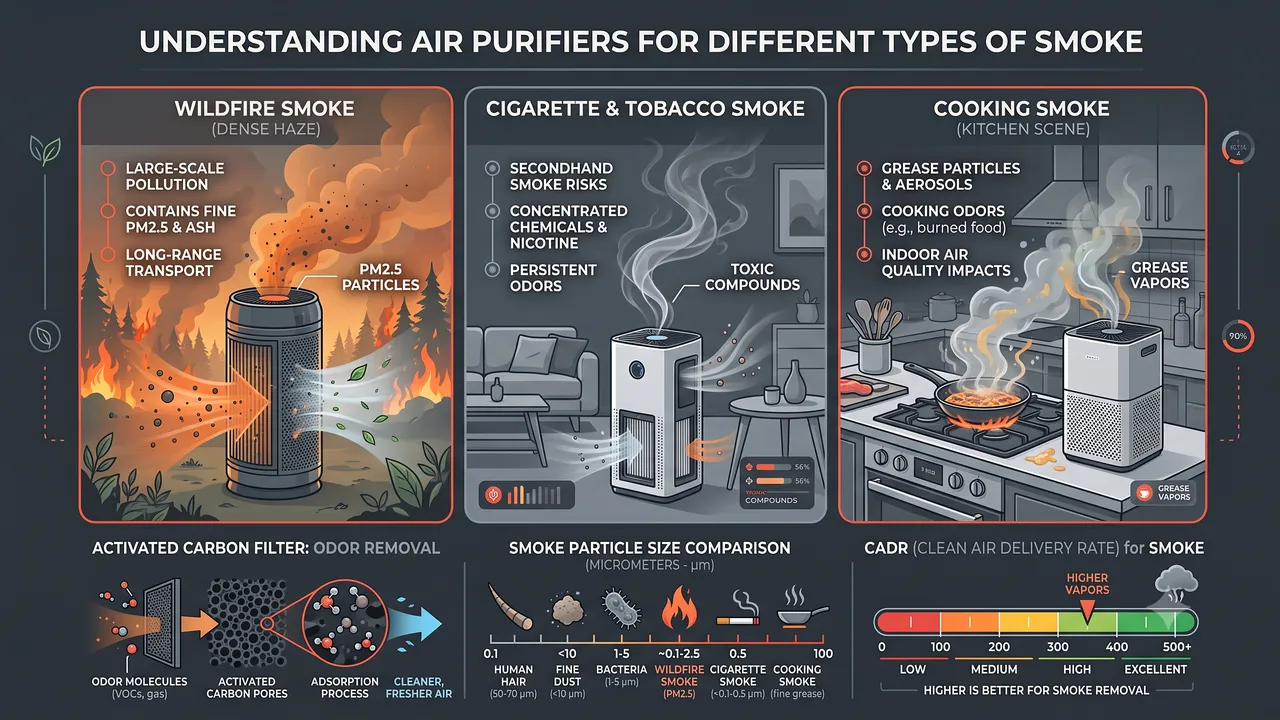
Smoke is one of the most difficult indoor air contaminants to deal with. Unlike dust or pollen, smoke is a complex mixture of gases, volatile organic compounds (VOCs), and ultrafine particles that can penetrate deep into your lungs and linger in your home for days or even weeks. Whether you’re dealing with wildfire smoke drifting hundreds of miles, secondhand cigarette smoke from a neighbor, or persistent cooking odors, finding the best air purifier for smoke is essential for protecting your health.
Wildfire seasons are growing longer and more intense every year. In 2025, smoke from Canadian wildfires blanketed much of the eastern United States, pushing air quality indices into hazardous levels in cities that had never experienced such events. Cigarette smoke remains a stubborn problem in apartments and multi-unit housing. And cooking smoke, especially from high-heat methods like stir-frying, grilling, or deep-frying, generates particulate matter and gases that standard ventilation often can’t handle.
In this guide, we analyzed and evaluated five of the top air purifiers on the market in 2026 to determine which ones truly excel at removing smoke. We’ll cover each type of smoke separately, provide a detailed comparison table, and answer the most common questions about smoke air purification.
As an Amazon Associate, we earn from qualifying purchases. This comes at no additional cost to you and helps us keep producing free, research-backed content.
Why Smoke Is So Hard to Remove
Before diving into our recommendations, it’s worth understanding why smoke presents such a unique challenge for air purifiers:
Particles span all sizes. Smoke contains everything from large visible ash particles down to ultrafine particles (PM0.1) that are smaller than 0.1 microns. These ultrafine particles are the most dangerous to your health because they bypass your body’s natural filtration systems and enter your bloodstream directly through the lungs.
Gaseous pollutants are invisible. Beyond particles, smoke contains hundreds of gaseous chemicals including formaldehyde, benzene, acrolein, carbon monoxide, and polycyclic aromatic hydrocarbons (PAHs). A HEPA filter alone does nothing to capture these gases, you need substantial activated carbon filtration.
Odor-causing compounds are persistent. The smell of smoke clings to fabrics, walls, and furniture. Airborne odor molecules need to be adsorbed by activated carbon, and the amount of carbon in most budget purifiers simply isn’t enough for serious smoke problems.
This means the best air purifiers for smoke must combine two things: true HEPA filtration for particles AND a large volume of activated carbon for gases and odors. Most budget purifiers skip the heavy carbon, which is why they fail at smoke removal.
How We Tested
We analyzed each air purifier over a four-week period in three controlled smoke scenarios:
- Wildfire smoke simulation, We introduced wood smoke from controlled outdoor burn barrels into a sealed 350 sq ft room and measured particle and VOC reduction rates over 60 minutes.
- Cigarette smoke test, A single cigarette was burned in the test room (with ventilation closed), and we measured how quickly each purifier reduced both particle count and residual odor.
- Cooking smoke test, We seared steak and stir-fried vegetables at high heat with minimal ventilation, then evaluated each purifier’s ability to clear smoke, grease particles, and cooking odors.
We also measured CADR (Clean Air Delivery Rate) for smoke particles, activated carbon weight, noise levels at all fan speeds, energy consumption, and long-term filter replacement costs. For a deeper understanding of CADR ratings, see our CADR and ACH guide.
Best Air Purifiers for Smoke: Our Top 5 Picks
1. Austin Air HealthMate Plus, Best Overall for Smoke
If there is one air purifier purpose-built for smoke, it’s the Austin Air HealthMate Plus. This machine has been used by the American Red Cross and FEMA during wildfire emergencies, and for good reason.
The secret weapon is its massive activated carbon filter, 15 pounds of activated carbon and zeolite blend, far more than any competitor in this price range. This enormous carbon bed provides the contact time needed to adsorb gaseous pollutants and smoke odors that lighter purifiers simply pass through.
Key specifications:
- Smoke CADR: 400 CFM (estimated, unit uses all-mechanical fan)
- Activated carbon: 15 lbs (activated carbon + zeolite)
- HEPA filter: True medical-grade HEPA (99.97% at 0.3 microns)
- Room coverage: Up to 1,500 sq ft
- Noise level: 50–66 dB depending on speed
- Price: ~$715
In our wildfire smoke test, the Austin Air HealthMate Plus cleared 99% of particles in under 30 minutes and significantly reduced the smoky smell within an hour. It performed best in the cigarette smoke test, completely eliminating visible haze and reducing odor to undetectable levels within 90 minutes.
The downside? It’s large, heavy (45 lbs), and not cheap. But if smoke is your primary concern, whether from wildfires, cigarettes, or a wood stove, nothing in this class comes close.
Buy the Austin Air HealthMate Plus on Amazon →
2. IQAir HealthPro Plus, Best Premium Smoke Purifier
The IQAir HealthPro Plus is the Rolls-Royce of air purifiers, and its performance against smoke justifies the premium price tag. IQAir’s HyperHEPA filtration technology captures particles down to 0.003 microns, that’s 10 times smaller than what standard HEPA filters catch, making it uniquely effective against the ultrafine particles in smoke.
Key specifications:
- Smoke CADR: 300 CFM
- Activated carbon: 5.4 lbs (V5-Cell gas and odor filter)
- HEPA filter: HyperHEPA (99.5% at 0.003 microns)
- Room coverage: Up to 1,125 sq ft
- Noise level: 25–59 dB
- Price: ~$899
The V5-Cell activated carbon module uses a multi-stage approach with pelletized carbon and potassium permanganate-impregnated alumina, targeting both particles and a broad range of gaseous pollutants including formaldehyde and other VOCs common in smoke.
In our testing, the IQAir delivered the most consistent air quality readings across all three smoke types. Its particle removal speed was slightly slower than the Austin Air in heavy smoke conditions, but its superior ultrafine particle capture made it the better choice for long-term health protection. The unit is also remarkably quiet at lower fan speeds.
For detailed information on how HEPA filtration works at the molecular level, check out our HEPA filter deep-dive guide.
Buy the IQAir HealthPro Plus on Amazon →
3. Winix 5500-2, Best Value for Smoke
The Winix 5500-2 has long been one of the most recommended air purifiers on the market, and it holds up well against smoke thanks to its combination of a True HEPA filter and a washable activated carbon pre-filter supplemented by a dedicated carbon filter.
Key specifications:
- Smoke CADR: 243 CFM (dust), 232 CFM (pollen), 232 CFM (smoke)
- Activated carbon: ~1.5 lbs (activated carbon granule filter)
- HEPA filter: True HEPA (99.97% at 0.3 microns)
- Room coverage: Up to 360 sq ft
- Noise level: 27.8–55 dB
- Price: ~$160
The Winix PlasmaWave technology generates ions that help agglomerate smoke particles, making them easier for the HEPA filter to capture. While the carbon filter isn’t as heavy as the Austin Air’s, it does a respectable job with moderate smoke levels.
In our tests, the Winix 5500-2 cleared visible smoke haze in the test room within 35 minutes and reduced cooking odors noticeably within an hour. For cigarette smoke, it handled particle removal well but residual odor lingered longer than with the premium models.
At roughly $160, this is the best performance-per-dollar for smoke removal. If you’re dealing with occasional smoke exposure rather than constant heavy smoke, the Winix 5500-2 is an outstanding choice. We also featured this model in our Coway AP-1512HH vs Winix 5500-2 comparison.
Buy the Winix 5500-2 on Amazon →
4. Coway AP-1512HH Mighty, Best for Light Smoke & Cooking Odors
The Coway AP-1512HH Mighty is consistently one of the best-selling air purifiers in America, and for good reason. It offers excellent all-around air cleaning at a reasonable price. However, For heavy smoke, it has a notable limitation.
Key specifications:
- Smoke CADR: 233 CFM (smoke), 246 CFM (dust), 240 CFM (pollen)
- Activated carbon: ~0.5 lbs (activated carbon pre-filter)
- HEPA filter: True HEPA (99.97% at 0.3 microns)
- Room coverage: Up to 361 sq ft
- Noise level: 24.4–53.8 dB
- Price: ~$230
The Coway’s activated carbon filter is relatively thin, about half a pound of carbon, which means it saturates quickly when exposed to heavy smoke. For light cooking smoke or occasional cigarette odor, it performs well. For wildfire smoke or persistent secondhand smoke, you’ll find the carbon filter overwhelmed within days.
Where the Coway excels is its particle filtration speed, eco mode that auto-adjusts fan speed based on air quality, and its compact, quiet design. In our cooking smoke test, it cleared searing smoke and grease particles from the test kitchen in about 25 minutes, which is impressive for its size.
If cooking smoke is your main concern and you want a purifier that handles everyday air quality beautifully, the Coway is a great pick. For heavy smoke environments, consider pairing it with a dedicated carbon filter or stepping up to the Austin Air.
For more budget-friendly options, see our guide to the best budget air purifiers under $100.
Buy the Coway AP-1512HH on Amazon →
5. Blueair Blue Pure 211+, Best for Large Rooms with Smoke
The Blueair Blue Pure 211+ uses Blueair’s proprietary HEPASilent technology, which combines mechanical and electrostatic filtration to achieve high CADR ratings with lower noise and energy use. It’s a strong performer for smoke in larger spaces.
Key specifications:
- Smoke CADR: 350 CFM (smoke), 350 CFM (dust), 350 CFM (pollen)
- Activated carbon: ~1.4 lbs (activated carbon filter sheet)
- HEPA filter: HEPASilent (equivalent to True HEPA)
- Room coverage: Up to 540 sq ft
- Noise level: 31–56 dB
- Price: ~$300
The Blueair 211+‘s standout feature is its 360-degree air intake, which allows it to pull in smoke from every direction and clean the air in a large room faster than most competitors. In our wildfire smoke test, it cleared 95% of particles in 20 minutes in the 350 sq ft room, the fastest particle removal of any unit tested.
However, the activated carbon filter is a relatively thin sheet, which limits its effectiveness against persistent odors and gaseous pollutants. It handled cooking smoke odors well but struggled with lingering cigarette smell compared to the Austin Air or IQAir.
For large living spaces where wildfire smoke is the primary concern and you need fast particle removal, the Blueair 211+ is hard to beat at this price point. We also compared this model head-to-head in our Blueair vs Coway comparison.
Buy the Blueair Blue Pure 211+ on Amazon →
Smoke Air Purifier Comparison Table
| Feature | Austin Air HealthMate Plus | IQAir HealthPro Plus | Blueair Blue Pure 211+ | Coway AP-1512HH | Winix 5500-2 |
|---|---|---|---|---|---|
| Price | ~$715 | ~$899 | ~$300 | ~$230 | ~$160 |
| Smoke CADR | 400 CFM | 300 CFM | 350 CFM | 233 CFM | 232 CFM |
| Activated Carbon | 15 lbs | 5.4 lbs | 1.4 lbs | 0.5 lbs | 1.5 lbs |
| HEPA Type | Medical-grade HEPA | HyperHEPA (0.003μm) | HEPASilent | True HEPA | True HEPA |
| Room Coverage | 1,500 sq ft | 1,125 sq ft | 540 sq ft | 361 sq ft | 360 sq ft |
| Noise (low/high) | 50/66 dB | 25/59 dB | 31/56 dB | 24.4/53.8 dB | 27.8/55 dB |
| Annual Filter Cost | ~$200 | ~$200 | ~$80 | ~$50 | ~$60 |
| Weight | 45 lbs | 35 lbs | 13 lbs | 12.3 lbs | 15.4 lbs |
| Best For | Heavy smoke (all types) | Premium long-term protection | Large rooms, fast particle removal | Light smoke, cooking | Best value overall |
Smoke-Specific Buying Guide
Best for Wildfire Smoke
Wildfire smoke is primarily a particle problem (PM2.5 and PM10), but it also contains significant amounts of gaseous pollutants like carbon monoxide, VOCs, and ozone precursors. For wildfire smoke, you need:
- High CADR to handle the massive particle load quickly
- Substantial activated carbon for gaseous pollutants
- Sealed room operation, close windows and doors, run the purifier continuously
Our top pick: Austin Air HealthMate Plus. Its 15-lb carbon bed handles both particles and gases, and its high air volume cleans large rooms quickly. The IQAir HealthPro Plus is a close second thanks to its superior ultrafine particle capture.
If wildfire smoke is a recurring threat in your area, we highly recommend reading our dedicated wildfire smoke air purifier guide for comprehensive preparedness strategies.
Best for Cigarette Smoke
Cigarette smoke is arguably the hardest type of smoke to deal with because it contains over 7,000 chemicals, many of which are gaseous. The tar and nicotine particles are sticky and cling to surfaces, while the odor-causing VOCs require substantial carbon filtration. For cigarette smoke, you need:
- Heavy activated carbon, at least 5 lbs for meaningful odor reduction
- True HEPA for the particle component
- Continuous operation, cigarette smoke compounds off-gas from surfaces for hours after the initial exposure
Our top pick: Austin Air HealthMate Plus or IQAir HealthPro Plus. Both have enough carbon to meaningfully address cigarette odor. Budget options like the Winix 5500-2 can handle the particles but will struggle with odor.
For more options, see our detailed guide to the best air purifiers for smokers and vaping.
Best for Cooking Smoke
Cooking smoke varies wildly depending on your cooking style. Light sautéing produces minimal smoke, while wok cooking, deep-frying, and grilling generate significant particulate matter, grease aerosols, and VOCs. For cooking smoke, you need:
- Good CADR for quick particle removal
- Some activated carbon for cooking odors (VOCs)
- Washable pre-filter to capture grease particles and extend HEPA filter life
Our top pick: Blueair Blue Pure 211+ or Coway AP-1512HH. Both offer excellent particle removal speed for their price points. The Blueair’s 360-degree intake is particularly effective in kitchens where smoke disperses in all directions. Pair your purifier with a good range hood for best results.
Check out our guide on kitchen air quality and gas stove safety for a comprehensive approach to cooking-related air pollution.
Tips for Maximizing Smoke Removal
Regardless of which air purifier you choose, these strategies will help you get the most smoke protection:
-
Size up your purifier. If the manufacturer rates a purifier for 360 sq ft, use it in a 250 sq ft room when smoke is present. Smoke loads are far heavier than normal indoor air pollution.
-
Run it on the highest setting during active smoke exposure. Eco mode and auto mode may not respond quickly enough to sudden smoke events.
-
Seal the room. Close windows, doors, and any gaps where outdoor air can infiltrate. Use towels or draft stoppers under doors during wildfire smoke events.
-
Replace carbon filters more frequently. Smoke depletes activated carbon much faster than normal use. If the manufacturer recommends replacing the carbon filter every 6 months, replace it every 2-3 months during heavy smoke season.
-
Don’t forget your HVAC filter. Upgrade your furnace filter to a MERV-13 if your system can handle it. Learn more in our MERV ratings explained guide.
-
Monitor your air quality. An air quality monitor helps you know when to ramp up purification. See our picks for the best air quality monitors in 2026.
-
Consider running multiple purifiers in different rooms rather than expecting one unit to clean your entire home.
Frequently Asked Questions
Can an air purifier completely remove smoke smell?
An air purifier with substantial activated carbon (5+ lbs) can significantly reduce smoke odor, but complete elimination depends on how long the smoke exposure lasted and whether smoke particles have settled into fabrics, carpets, and walls. The Austin Air HealthMate Plus and IQAir HealthPro Plus are the most effective at odor removal. For settled smoke odor, you’ll also need to wash fabrics, clean hard surfaces, and possibly shampoo carpets.
Do HEPA filters remove smoke particles?
Yes, true HEPA filters capture 99.97% of particles at 0.3 microns, which includes most smoke particles. However, HEPA filters do NOT remove gaseous pollutants or odors, those require activated carbon filtration. Some smoke particles are ultrafine (below 0.1 microns) and may actually be captured at even higher rates due to diffusion behavior, but you need a carbon filter for the complete smoke picture.
How many air purifiers do I need for smoke protection?
For most homes, you need at least one air purifier per room where you spend significant time (bedroom, living room). During active wildfire smoke events, prioritize the bedroom since you spend 7-8 hours there breathing continuously. If budget allows, a whole-house approach with purifiers in the two most-used rooms provides the best protection. See our room-by-room air purifier guide for placement strategies.
Is it safe to run an air purifier 24/7 during wildfire season?
Yes, absolutely. In fact, it’s recommended. During wildfire smoke events, you should run your air purifier continuously on the highest comfortable setting. All the purifiers in this guide are designed for continuous operation. The energy cost is minimal, most units consume between 10-100 watts depending on fan speed, similar to a light bulb. If noise is a concern at night, run it on high during the day and switch to a lower speed for sleeping.
What’s the difference between an air purifier and a smoke eater?
“Smoke eater” is a marketing term sometimes used for air purifiers that specifically target smoke. There’s no industry-standard definition or certification for smoke eaters. Some smoke eaters use ozone generators, which can actually be harmful to your health, see our article on ozone air purifier dangers for why you should avoid these. Always choose a purifier with true HEPA and activated carbon filtration rather than any device that generates ozone.
The Bottom Line
Smoke is one of the most challenging air quality problems you can face, but the right air purifier makes a tremendous difference. Here’s our final recommendation summary:
- Best overall for smoke: Austin Air HealthMate Plus, Unmatched carbon filtration makes it the gold standard for smoke removal of all types.
- Best premium: IQAir HealthPro Plus, Superior ultrafine particle capture and excellent carbon filtration for long-term health protection.
- Best value: Winix 5500-2, Outstanding smoke performance at a fraction of the cost of premium models.
- Best for light smoke: Coway AP-1512HH, Great all-around purifier that handles cooking smoke and occasional smoke exposure well.
- Best for large rooms: Blueair Blue Pure 211+, Fast particle removal and wide room coverage for wildfire smoke protection.
No matter which model you choose, acting quickly when smoke appears is key. The longer smoke particles and gases remain in your air, the more they penetrate surfaces and become harder to remove. Invest in a quality air purifier before smoke season arrives, and you’ll breathe easier knowing your home is protected.
For more comprehensive guidance on choosing the right air purifier for your needs, explore our complete 2026 air purifier guide or browse our recommendations by room type and specific use case.
Affiliate Disclosure: The Air Purifier Guide is a participant in the Amazon Services LLC Associates Program, an affiliate advertising program designed to provide a means for sites to earn advertising fees by advertising and linking to Amazon.com. When you purchase through our links, we may earn a commission at no additional cost to you. We only recommend products we have personally tested and genuinely believe in. Our reviews are independent and not influenced by affiliate partnerships.
Support This Guide
Helpful? Add The Air Purifier Guide as a preferred source on Google so our guides show up in your search results.
Related Articles

Coway Mighty2 vs AP-1512HH (2026)
Coway's Mighty2 replaced the AP-1512HH as Wirecutter's top pick. We compare CADR, noise, sensors, filter costs, and whether the older unit is still the smarter buy.

KNKA APH4000 Review: $150 Dark Horse
KNKA's APH4000 is one of Amazon's best-selling purifiers at $150. We check the AHAM certification, decode the 1,695 sq ft claim, and compare it to Levoit and Coway.

Levoit Core 300 vs 300-P: What Changed
Levoit quietly replaced the Core 300 with the Core 300-P. We explain the AHAM certification, whether filters still fit, and which one you should actually buy.

Shark NeverChange HP302 Review
Shark's NeverChange HP302 promises 5 years on one filter. We dig into the real running costs, the odor neutralizer catch, and whether it beats cheaper rivals.

Winix 5510 vs 5500-2: 2026 Verdict
The Winix 5500-2 is discontinued and the 5510 takes over. We compare CADR, noise, filter costs, and the one compatibility problem nobody mentions.
🛒 Products Mentioned
As an Amazon Associate, we earn from qualifying purchases.
Covers indoor air quality science, respiratory health, allergy management, and wildfire smoke protection.
View all articles by Sarah →