The Short Answer: Remove all packaging, place on a flat surface with 3-5 feet clearance, and run on medium for 24 hours before first use. Set a calendar reminder for filter replacement based on manufacturer recommendations.
Editor’s note (September 2026): The Winix 5500-2 has been discontinued and remaining stock is limited. Winix’s official successor is the Winix 5510, which adds app control and uses a new filter. Read our Winix 5510 vs 5500-2 comparison before you buy either one.
Every room in your home has a different air quality problem. The allergens floating in your bedroom bear little resemblance to the grease particles coating your kitchen, and both are completely different from the mold spores lurking in your basement. Treating your entire house with a single purifier, or worse, placing the same model everywhere, means you’re either overpaying for some rooms or dangerously underprotecting others.
This room-by-room air purifier guide breaks down exactly what each space demands, which purifiers fit those demands, and how to avoid the placement and sizing mistakes that waste money while leaving your air dirty.
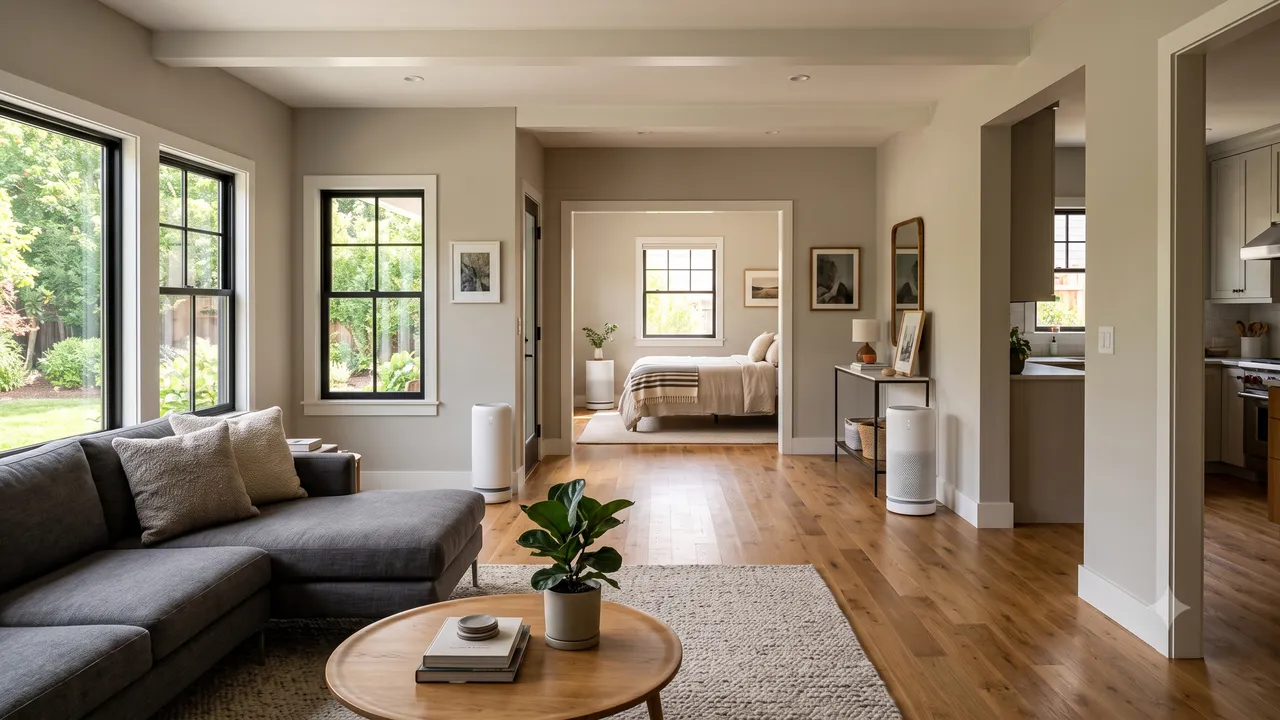
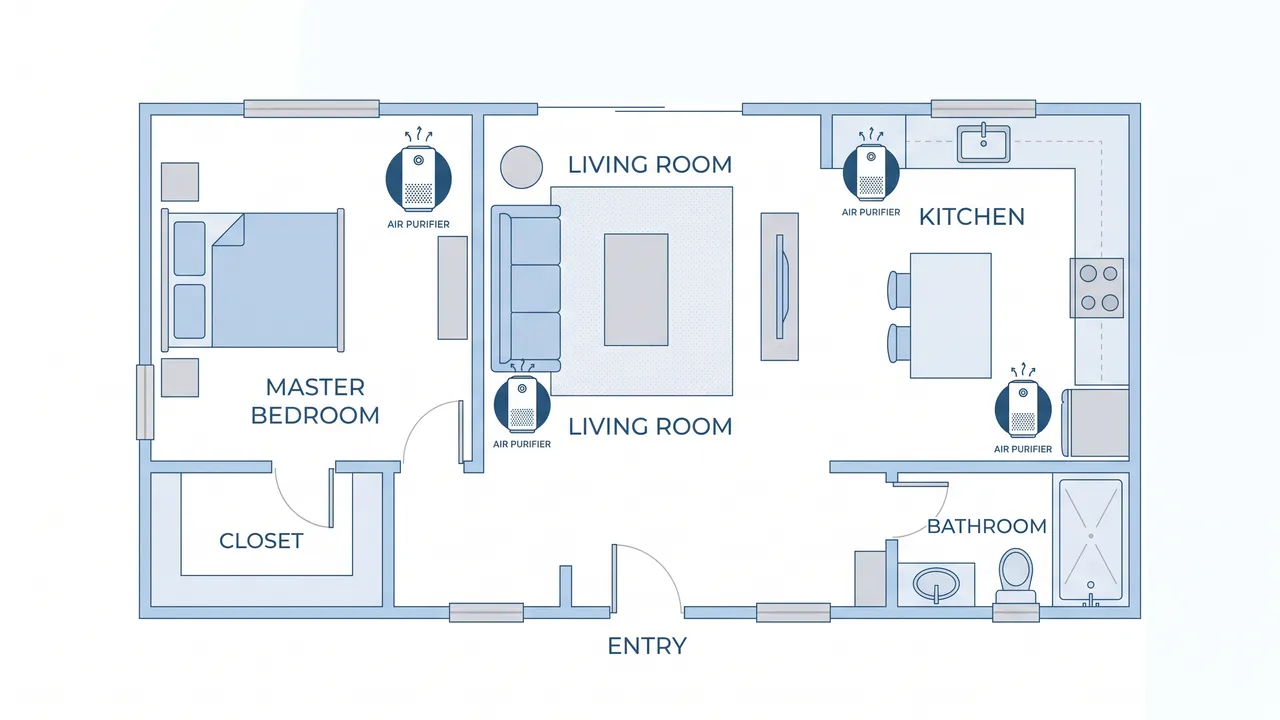
Why One-Size-Fits-All Doesn’t Work
A purifier that’s perfect for your master bedroom might be completely wrong for your kitchen and nearly useless in your basement. Each room has a unique combination of pollutant types, room volume, occupancy patterns, and noise tolerance. A bedroom needs whisper-quiet operation and zero light emissions. A kitchen needs aggressive odor removal and grease-resistant filters. A basement needs 24/7 continuous-duty filtration and mold-focused performance.
Understanding these differences is the first step toward actually breathing cleaner air, not just running a machine that makes you feel better while changing nothing. For a deeper dive into how CADR and air changes per hour determine real-world performance, see our complete CADR and ACH sizing guide.
Room-by-Room Recommendations
The table below summarizes the key requirements for every major room in a typical home. Use it as a quick reference, then read the detailed room sections that follow.
| Room | Typical Size | Key Pollutants | CADR Needed | Best Purifier | Special Tips |
|---|---|---|---|---|---|
| Bedroom | 120–250 sq ft | Dust mites, pet dander, PM2.5 | 120–200 | Coway AP-1512HH | Must be below 30 dB; all LEDs defeatable |
| Living Room | 250–600 sq ft | Cooking particles, VOCs, pet hair | 250–400+ | Blueair 211i Max | Prioritize aesthetics; washable pre-filter for pets |
| Kitchen | 100–200 sq ft | PM2.5 from cooking, NO2, odors | 200–300+ | Winix 5500-2 | Run on turbo 15 min post-cooking; need heavy carbon |
| Basement | 200–800 sq ft | Mold spores, mVOCs, musty odors | 150–300 | Levoit Core 300 | Dehumidifier first, purifier second |
| Home Office | 80–150 sq ft | CO2, VOCs, printer particles | 80–150 | Levoit Core Mini | Crack a door or window for CO2 |
| Nursery | 100–200 sq ft | VOCs from furniture, dust, PM2.5 | 100–180 | Blueair Blue Pure 411i Max | Zero ozone; mechanical filtration only |
| Bathroom | 40–80 sq ft | Mold spores, humidity, bacteria | 40–80 | PureZone Mini | Exhaust fan is more important than purifier |
Detailed Room-by-Room Breakdown
Bedroom
Primary Pollutants: Dust mite allergens, pet dander, general household dust, outdoor PM2.5 infiltration through windows and gaps.
Key Requirements:
- Quiet operation, Below 30 dB on low or night mode. You spend 7–9 hours sleeping in this room, and noise directly impacts sleep quality. A purifier running at 40+ dB may not wake you fully but will fragment your sleep cycles, reducing restorative deep sleep.
- Lights-off mode, Any LED indicators must be dimmable or completely defeatable. A single blue LED can illuminate a dark bedroom enough to disrupt melatonin production.
- Moderate CADR, Most bedrooms are 120–250 sq ft. A purifier with a smoke CADR of 120–200 is appropriate to achieve 4–6 air changes per hour.
Our Pick: Coway AP-1512HH, 24 dB on low, light defeatable, CADR 246. For more options specifically designed for quiet nighttime use, check our guide to the quietest air purifiers for bedrooms.
Living Room / Family Room
Primary Pollutants: Cooking particles (in open-plan layouts), outdoor PM2.5, pet dander and hair, dust resuspended by foot traffic and activity, VOCs off-gassing from furniture, carpet, and electronics.
Key Requirements:
- High CADR, Living rooms are typically 250–600 sq ft with higher ceilings. You need significantly more air-moving capacity than a bedroom.
- Aesthetics matter, This room is visible to guests. Industrial-looking purifiers may not pass the “spouse test.” Fabric-wrapped designs and wood-grain finishes blend better with home décor.
- Pet-focused pre-filtration, If you have pets, a washable pre-filter that catches hair without weekly replacement saves significant money on filter costs over time.
Our Pick: Blueair 211i Max, CADR 410, fabric pre-filter available in multiple colors, handles large open spaces. For households with shedding pets, also see our best air purifiers for pets and dander.
Kitchen
Primary Pollutants: PM2.5 from cooking (especially frying, broiling, and searing), NO2 and CO from gas stoves, VOCs from cleaning products, and persistent food odors.
Key Requirements:
- High CADR for short bursts, Cooking generates intense but brief pollution spikes. A single stir-fry session can push kitchen PM2.5 above 200 µg/m³. The purifier needs to clear the air quickly after cooking.
- Significant carbon filtration, Kitchen odors and gas combustion byproducts require substantial gas-phase filtration. Thin carbon sheets won’t cut it, you need pounds of activated carbon.
- Grease-resistant pre-filter, Cooking aerosol contains grease that coats filter media and degrades performance. A washable metal mesh pre-filter is ideal.
Our Pick: Winix 5500-2, high CADR, washable carbon filter, handles rapid particle spikes well. For a deeper look at kitchen-specific air quality strategies, read our kitchen air quality and gas stove guide.
Basement
Primary Pollutants: Mold spores, mVOCs (musty odor compounds), radon decay products (attached to dust particles), general dampness-related particulates.
Key Requirements:
- Continuous operation design, Basements need 24/7 filtration. Look for models rated for continuous use with long-life motors.
- Washable or long-life carbon, Musty odors are ongoing, not episodic. Disposable carbon filters will bankrupt you within months.
- Dehumidifier first, purifier second, Without humidity control, mold will continue growing on surfaces and releasing new spores faster than any purifier can capture them.
Our Pick: Levoit Core 300 (affordable 24/7 operation, compact for cluttered basements) paired with a 50-pint dehumidifier. Our mold prevention and humidity control guide explains the dehumidifier-purifier combination in detail.
Home Office
Primary Pollutants: CO2 buildup from respiration in a closed room, VOCs from office equipment and furniture, printer toner particles, and general dust.
Key Requirements:
- CO2 handling capability, No purifier removes CO2. You need ventilation. Keep the door open or crack a window to prevent the drowsiness and headaches that come with CO2 levels above 1,000 ppm.
- Desktop-friendly size, Floor space may be limited in a home office.
- Quiet enough for calls, The purifier shouldn’t be audible on Zoom or phone calls.
Our Pick: Levoit Core Mini, desktop-sized, 25 dB on low, USB-powered.
Nursery / Baby’s Room
Primary Pollutants: Dust, VOCs from new furniture and paint, outdoor PM2.5.
Key Requirements:
- Zero ozone, No ionizers, no UV-C accessible to the room, no PlasmaWave unless permanently disabled. Ozone is a lung irritant, and developing lungs are especially vulnerable.
- Ultra-quiet, Below 25 dB. Babies wake easily.
- No bright lights, Must have a true dark mode with all LEDs off.
- Mechanical filtration only, HEPA + carbon, nothing else. No electronic gimmicks.
Our Pick: Blueair Blue Pure 411i Max, 18 dB on low, mechanical plus electrostatic charging only, designer fabric pre-filter. For a complete nursery air quality setup, see our dedicated air purifier for nursery and baby room guide.
Bathroom
Primary Pollutants: Mold spores, excess humidity, aerosolized bacteria from toilets (the “toilet plume” is real, a 2022 University of Colorado study visualized the particle plume from flushing).
Key Requirements:
- Small, moisture-resistant design, Bathrooms are typically 40–80 sq ft. A compact unit is fine.
- Not the primary solution, An exhaust fan venting outdoors is far more important than a purifier. The purifier is supplementary.
- Can handle humidity, The unit shouldn’t short out or grow mold internally in humid conditions.
Our Pick: Exhaust fan first. If a purifier is needed, Pure Enrichment PureZone Mini, small, simple, USB-powered from a GFCI outlet.
Sizing Guide: How Many Purifiers Do You Need?
The most common mistake buyers make is assuming one purifier can cover an entire floor. It can’t, at least not effectively. Air purifiers work by circulating and filtering the air in an enclosed space. They do not push clean air down hallways and around corners the way an HVAC system does.
The basic rule: You need one appropriately sized purifier per enclosed room where you spend significant time. For most homes, that means:
- Bedrooms, One unit per bedroom where someone sleeps. A purifier in the master bedroom does nothing for the kids’ rooms down the hall.
- Living area, One unit for the main living space. If you have an open floor plan connecting the kitchen, dining, and living room, a single high-CADR unit can sometimes cover the combined space (more on this below).
- Home office, One unit if you work from home more than a few hours per day.
- Basement, One unit if the basement is used regularly for anything other than storage.
For a typical three-bedroom house, that’s three to five purifiers: one per bedroom, one for the living room, and possibly one for the basement or office. This sounds expensive, but the math works out: a few mid-range units placed strategically outperform a single expensive unit trying to cover too much space.
Understanding air changes per hour is critical for sizing. Our CADR and ACH guide walks through the calculation step by step, but the summary is: aim for 4–6 ACH in bedrooms and living rooms, and at least 2 ACH in lower-priority spaces like hallways.
If budget forces you to choose, prioritize the bedroom. You spend more hours there than any other room, and your body is in its most vulnerable state, sleeping, breathing slowly and deeply with no conscious control over air intake.
Placement Rules for Maximum Effectiveness
Where you place a purifier matters as much as which one you buy. A $400 purifier stuck in a corner behind a couch performs worse than a $150 unit positioned correctly. Follow these rules:
- Give it breathing room. Keep the purifier at least 12–18 inches from walls, furniture, and curtains on all sides. Air purifiers pull air in from multiple directions; blocking any intake reduces performance dramatically.
- Place it where you breathe. In a bedroom, position the purifier 3–6 feet from the head of the bed, at roughly bed height or on a nightstand. You want the cleanest air flowing toward where your nose actually is.
- Elevate off the floor. Most purifiers perform better when raised 2–5 feet off the ground. This catches airborne particles at breathing height rather than filtering floor-level air first. A sturdy shelf or table works well.
- Avoid corners. Corners trap air. Placing a purifier in a corner means it’s recirculating the same pocket of air instead of drawing fresh air from the room.
- Don’t place near pollution sources. Putting a purifier right next to the stove or directly under an air vent creates turbulence and short-circuits the airflow pattern. Instead, place it across the room from the pollution source so it filters the air as it circulates naturally.
- Keep away from humidity sources. Running a purifier next to a humidifier or in a steamy bathroom (unless rated for moisture) can promote mold growth inside the unit and damage filters.
For a complete visual guide with diagrams, see our dedicated air purifier placement guide.
Open Floor Plan Challenges
Open floor plans are the nemesis of air purifiers. That beautiful combined kitchen-dining-living space you love is, from a filtration perspective, one giant room that’s extremely difficult to clean with a single unit.
Why open plans are hard:
- Volume multiplication. An open plan connecting a 150 sq ft kitchen, a 200 sq ft dining area, and a 350 sq ft living room creates a combined 700 sq ft space with ceilings that often reach 9–10 feet. That’s 5,800–7,000 cubic feet of air, requiring a CADR of 350+ just to achieve 4 ACH.
- Pollution cross-contamination. Cooking particles from the kitchen drift into the living room. Pet dander from the couch floats into the dining area. You can’t isolate pollutants when there are no walls.
- Airflow dead zones. Large open spaces with irregular shapes create pockets where air barely circulates. A purifier in one corner may leave the opposite corner essentially untouched.
Solutions for open floor plans:
- One large unit in the center. A high-CADR tower purifier like the Blueair HealthProtect 7770i (CADR 400+) placed near the center of the open space can cover 500–700 sq ft effectively.
- Two smaller units at opposite ends. Two mid-range purifiers (each CADR 200+) placed at opposite ends of the open space often outperform a single expensive unit because they eliminate dead zones.
- Run on higher speeds during pollution events. Cooking generates the biggest pollution spikes in open plans. Crank the kitchen-adjacent purifier to turbo mode during and for 20 minutes after cooking.
- Use ceiling fans to help circulation. A ceiling fan on low helps break up dead zones and pushes air toward the purifier intake.
For more strategies on air purification in large shared spaces, check our open-plan office air purifier guide, the principles apply to residential open plans too.
Common Mistakes to Avoid
Before you buy, make sure you’re not falling into these traps:
- Buying based on room size alone. A kitchen at 150 sq ft and a bedroom at 150 sq ft need very different purifiers because the pollutants are different. Size tells you the minimum CADR, not the right type of filtration.
- Ignoring filter replacement costs. A $150 purifier with $80 annual filter costs is more expensive over three years than a $250 purifier with $40 annual filters. Always calculate the total cost of ownership.
- Placing one purifier in the hallway. Hallway placement is a compromise that under-serves every room. The purifier filters hallway air while each bedroom and the living room remain largely untreated.
- Turning it off when you leave the room. Purifiers work best when they maintain clean air continuously. Turning one off lets pollutants accumulate, and the purifier has to work harder to catch up when you turn it back on. For guidance on continuous operation and energy costs, see our air purifier energy cost guide.
FAQ
Q: Can I use one large purifier for my whole house? A: Not effectively. Air purifiers are designed for single-room use. They can’t push clean air through closed doors, around corners, or down long hallways. Even a high-CADR unit rated for 1,000 sq ft will only perform to that rating in an open, unobstructed space. In a typical house with walls and doors, you need one per room where you want clean air. The only exception is a whole-house air purifier integrated into your HVAC system, which is a different product category entirely, see our MERV ratings and HVAC filter guide for that approach.
Q: Should I run my air purifier 24/7 or only when I’m in the room? A: Run it 24/7 in rooms where pollutants accumulate continuously (bedrooms, basements) and on-demand in rooms with episodic pollution (kitchens during cooking). Purifiers work best at maintaining clean air rather than rescuing dirty air. Once pollutants settle onto surfaces, carpet, walls, furniture, a purifier can’t retrieve them. Continuous operation prevents that settling. The energy cost of running a mid-range purifier 24/7 is typically $3–6 per month, which is far less than most people expect.
Q: Do I need a purifier if I already have a whole-house HVAC filter? A: Most HVAC systems use MERV-8 or MERV-11 filters, which capture large particles but miss the fine PM2.5, VOCs, and allergens that cause the most health problems. A portable HEPA purifier in the rooms where you spend the most time provides a significant upgrade. If you’ve upgraded to a MERV-13 or higher HVAC filter, you may not need portable units for basic particle filtration, but you’ll still want a purifier with activated carbon for VOC and odor removal, which HVAC filters don’t address.
Q: What’s more important, the purifier’s CADR rating or the type of filter? A: Both matter, but for different reasons. CADR determines how quickly the purifier can clean the air in your specific room size. Filter type determines what it can remove. A high-CADR purifier with only a basic particle filter won’t help with odors or VOCs. A purifier with excellent activated carbon but low CADR won’t clean the air fast enough. Match CADR to your room size first, then verify the filter technology handles your specific pollutants. Our CADR and ACH guide explains the math.
Q: Is it safe to run an air purifier in a baby’s room? A: Yes, but choose carefully. Stick to mechanical filtration only (HEPA + activated carbon). Avoid any purifier that generates ozone, uses ionization, or has UV-C light exposed to the room air. Ozone is a respiratory irritant, and a baby’s developing lungs are especially sensitive. Also ensure the purifier has a true lights-off mode and operates below 25 dB on its lowest setting. Our best air purifiers for nursery and baby room guide covers safety certifications and specific model recommendations in detail.
Disclosure: This article contains affiliate links. If you purchase through our links, we may earn a small commission at no extra cost to you. We only recommend products we’ve genuinely evaluated and believe are worth your money. See our full disclosure policy for details.
You May Also Like
- Air Purifier Placement Guide: Where to Put It for Maximum Effectiveness
- Air Purifier Electricity Cost: How Much Does It Really Cost to Run 24/7?
- Air Purifier Filter Replacement Guide: Costs, Schedules, and How to Extend Filter Life
- Air Purifier Buying Guide for First-Time Buyers: Everything You Need in One Place
Support This Guide
Helpful? Add The Air Purifier Guide as a preferred source on Google so our guides show up in your search results.
Related Articles

Coway Mighty2 vs AP-1512HH (2026)
Coway's Mighty2 replaced the AP-1512HH as Wirecutter's top pick. We compare CADR, noise, sensors, filter costs, and whether the older unit is still the smarter buy.

KNKA APH4000 Review: $150 Dark Horse
KNKA's APH4000 is one of Amazon's best-selling purifiers at $150. We check the AHAM certification, decode the 1,695 sq ft claim, and compare it to Levoit and Coway.

Levoit Core 300 vs 300-P: What Changed
Levoit quietly replaced the Core 300 with the Core 300-P. We explain the AHAM certification, whether filters still fit, and which one you should actually buy.

Shark NeverChange HP302 Review
Shark's NeverChange HP302 promises 5 years on one filter. We dig into the real running costs, the odor neutralizer catch, and whether it beats cheaper rivals.

Winix 5510 vs 5500-2: 2026 Verdict
The Winix 5500-2 is discontinued and the 5510 takes over. We compare CADR, noise, filter costs, and the one compatibility problem nobody mentions.
🛒 Products Mentioned
As an Amazon Associate, we earn from qualifying purchases.
Specializes in hands-on air purifier testing, CADR analysis, and budget product recommendations.
View all articles by Alex →