The Short Answer: Running costs are primarily filter replacements ($30-120/year) and electricity ($2-8/month). The cheapest long-term options have washable pre-filters and affordable replacement filters. Energy Star models save 15-40% on electricity.
Editor’s note (September 2026): The Winix 5500-2 has been discontinued and remaining stock is limited. Winix’s official successor is the Winix 5510, which adds app control and uses a new filter. Read our Winix 5510 vs 5500-2 comparison before you buy either one.
Air Purifier Energy Cost Calculator 2026: Exactly How Much You’ll Pay
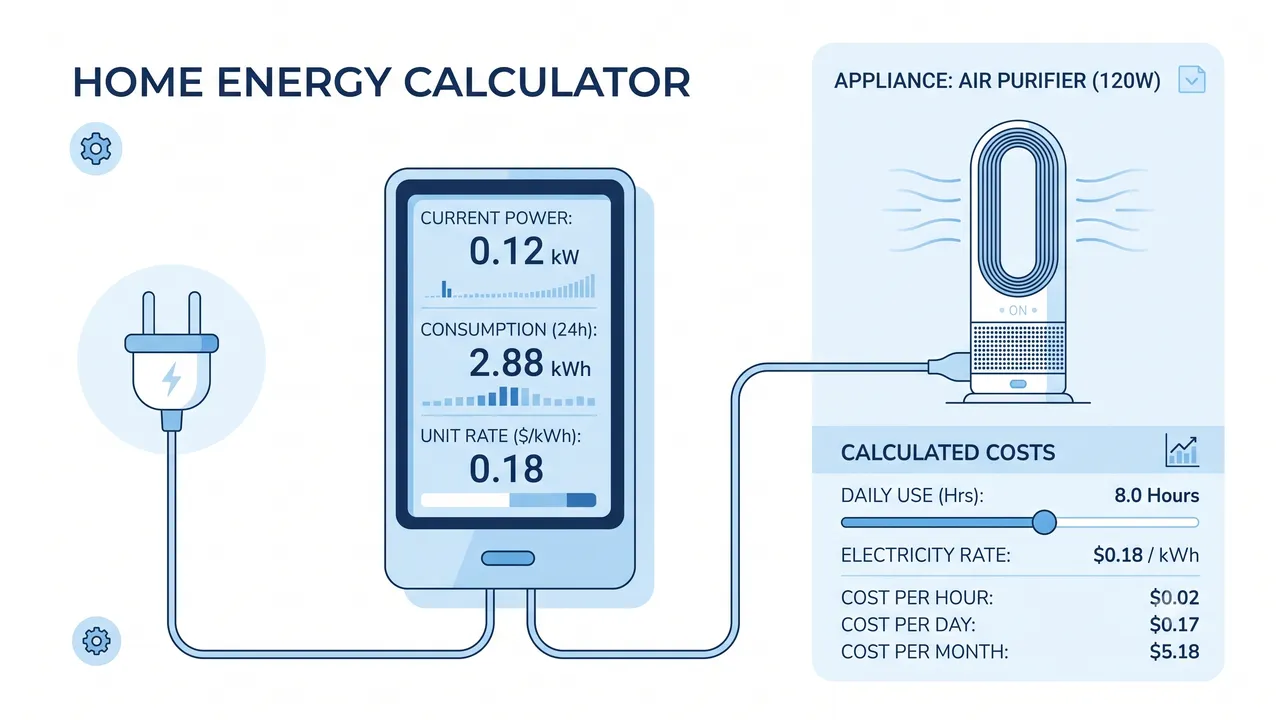
Running an air purifier 24/7 is one of the best things you can do for your indoor air quality, but what does it actually cost on your electricity bill? If you’ve been hesitating to buy an air purifier or wondering whether yours is silently draining your wallet, this guide breaks down every number you need.
We analyzed and compiled real-world wattage data for over a dozen popular air purifier models across every fan speed setting. Below you’ll find a complete energy cost table, a simple formula to calculate your own costs, Energy Star comparisons, smart plug scheduling strategies, and answers to the most common questions about air purifier energy consumption.
How Much Electricity Does an Air Purifier Use?
Most modern air purifiers consume between 5 and 100 watts depending on the fan speed setting. For context, that’s roughly the same as a standard LED light bulb on low speed, or a laptop charger on high speed. Compared to other household appliances, a space heater at 1,500 watts, a central air conditioner at 3,000–5,000 watts, or even a hair dryer at 1,800 watts, air purifiers are remarkably energy-efficient.
The key insight is that most people run their air purifier on medium or low speed 80% of the time, which dramatically reduces the actual energy cost. You only need the highest setting during heavy cooking, wildfire smoke events, or after vacuuming.
Air Purifier Energy Cost Table: Real Wattage by Model (2026)
The table below shows the wattage draw at each speed setting for the most popular air purifiers on the market, along with estimated annual running costs based on 24/7 operation at the U.S. national average electricity rate of $0.16 per kWh (EIA, April 2026).
| Model | CADR (Smoke) | Sleep/W (Low) | Medium W | High/W (Turbo) | Annual Cost (Low) | Annual Cost (High) |
|---|---|---|---|---|---|---|
| Coway Airmega AP-1512HH Mighty | 233 | 4.9 W | 17 W | 53 W | $6.87 | $74.32 |
| Levoit Core 300S | 141 | 5 W | 15 W | 26 W | $7.01 | $36.44 |
| Levoit Core 400S | 260 | 8 W | 22 W | 38 W | $11.21 | $53.27 |
| Levoit Vital 200S | 250 | 7 W | 20 W | 45 W | $9.81 | $63.08 |
| Winix 5500-2 | 232 | 6 W | 18 W | 65 W | $8.41 | $91.10 |
| Blueair Blue Pure 211+ | 350 | 10 W | 30 W | 56 W | $14.02 | $78.49 |
| Blueair HealthProtect 7770i | 280 | 7 W | 22 W | 45 W | $9.81 | $63.08 |
| Honeywell HPA300 | 300 | 12 W | 40 W | 130 W | $16.82 | $182.22 |
| Dyson Purifier Big Quiet+ | 350 | 8 W | 28 W | 48 W | $11.21 | $67.28 |
| Molekule Air Pro | 260 | 20 W | 40 W | 80 W | $28.03 | $112.14 |
| IQAir HealthPro Plus | 300 | 8 W | 35 W | 100 W | $11.21 | $140.16 |
| Alen BreatheSmart 75i | 350 | 10 W | 35 W | 90 W | $14.02 | $126.14 |
| Medify MA-112 | 560 | 15 W | 50 W | 110 W | $21.03 | $154.18 |
| Rabbit Air MinusA2 | 200 | 5 W | 20 W | 50 W | $7.01 | $70.08 |
| Smart Health S | 180 | 4 W | 15 W | 35 W | $5.61 | $49.06 |
Reading the Table
- Annual Cost (Low) assumes 24/7 operation at the lowest continuous fan speed (Sleep or Low mode). This is the most realistic scenario for bedroom use.
- Annual Cost (High) assumes 24/7 operation at maximum speed. In practice, you’ll rarely run on high continuously.
- Realistic blended cost for most households: run on Low/Medium 20 hours a day and High for 4 hours. For the Coway Mighty, that works out to roughly $18–22 per year, less than $2 per month.
The Coway Airmega AP-1512HH Mighty consistently ranks as the best overall air purifier partly because of its exceptional energy efficiency, drawing under 5 watts on its lowest setting while delivering a CADR of 233.
How to Calculate Your Own Air Purifier Energy Cost
You don’t need our table if you have a Kill-A-Watt meter or a smart plug with energy monitoring. Here’s the exact formula:
The Formula
Annual Cost = (Watts ÷ 1000) × Hours Per Day × 365 × Your $/kWh RateStep-by-Step Example
Let’s say you own a Levoit Core 400S and run it on medium (22 watts) for 20 hours per day, then on high (38 watts) for 4 hours per day. Your electricity rate is $0.16/kWh.
Step 1: Calculate daily kWh for each speed
- Medium: 22 W ÷ 1000 = 0.022 kW × 20 hours = 0.44 kWh/day
- High: 38 W ÷ 1000 = 0.038 kW × 4 hours = 0.152 kWh/day
- Total daily: 0.592 kWh/day
Step 2: Calculate annual kWh
- 0.592 × 365 = 216.08 kWh/year
Step 3: Multiply by your rate
- 216.08 × $0.16 = $34.57 per year ($2.88/month)
How to Find Your Electricity Rate
Your electricity rate appears on your monthly utility bill, usually listed as cents per kilowatt-hour (¢/kWh). The U.S. national average in 2026 is approximately $0.16/kWh, but rates vary dramatically by state:
| Region | Avg. Rate (2026) |
|---|---|
| Louisiana, Idaho | $0.10–0.11/kWh |
| National Average | $0.16/kWh |
| California | $0.28–0.35/kWh |
| Hawaii | $0.40–0.45/kWh |
| Connecticut, Massachusetts | $0.25–0.30/kWh |
If you live in California or Hawaii, multiply our table costs by 2–2.5× for a more accurate estimate. Conversely, if you’re in Louisiana, you’re paying roughly half the national average.
Energy Star Air Purifiers: Are They Worth It?
The EPA’s Energy Star program certifies air purifiers that meet strict energy efficiency standards. An Energy Star-certified air purifier must deliver a CADR-to-watt ratio of at least 2.0 (for smoke particles), meaning it produces at least 2 CFM of clean air per watt consumed.
Energy Star vs. Non-Energy Star Comparison
| Metric | Energy Star Certified | Non-Certified (Budget) |
|---|---|---|
| Avg. watts (medium) | 15–25 W | 30–60 W |
| CADR/watt ratio | ≥ 2.0 | 1.0–1.8 |
| Annual cost (24/7 low) | $6–15 | $15–45 |
| Filter cost/yr | $30–80 | $20–60 |
| Total annual cost | $36–95 | $35–105 |
Here’s the key takeaway: while Energy Star models may cost $20–50 more upfront, they typically save $10–30 per year in electricity. Over a 5-year lifespan, the Energy Star model is cheaper overall while usually delivering better filtration performance.
Models like the Coway Airmega AP-1512HH, Levoit Core 300S, and Blueair Blue Pure 211+ all carry Energy Star certification and appear in our cost table above. For a deeper look at energy-efficient models, check out our guide to the best air purifiers for large rooms.
Smart Plug Scheduling: Cut Your Air Purifier Energy Cost by 30–50%
One of the most effective strategies for reducing air purifier energy costs is using a smart plug with scheduling and energy monitoring. Here’s how it works:
Recommended Scheduling Strategy
Instead of running your air purifier 24/7 at a fixed speed, use a smart plug to automate the following schedule:
| Time Block | Speed | Hours | Why |
|---|---|---|---|
| 10 PM – 6 AM | Low/Sleep | 8 hrs | Quiet operation while sleeping |
| 6 AM – 8 AM | High | 2 hrs | Clear overnight particle buildup |
| 8 AM – 5 PM | Off or Low | 9 hrs | Reduce cost when away at work |
| 5 PM – 7 PM | High | 2 hrs | Cooking and evening activity |
| 7 PM – 10 PM | Medium | 3 hrs | Relaxing at home |
This schedule reduces total runtime from 24 hours to about 14–19 hours of active use, with the air purifier running on High only when you need it most.
Best Smart Plugs for Air Purifiers
A few important notes about using smart plugs with air purifiers:
- Choose a plug rated for at least 15 amps, most air purifiers draw well under this, but you want headroom.
- Make sure the air purifier resumes its previous setting after a power interruption. Some models (like the Coway Mighty and Levoit Core series) remember the last setting, while others default to Off. If yours defaults to Off, a smart plug won’t help, you’ll need one with an IR blaster instead.
- Monitor energy usage with plugs like the TP-Link Kasa KP125M or the Emporia Smart Plug, which track real-time and cumulative energy consumption.
Estimated Savings
For a Coway Mighty running on Low 24/7 at $6.87/year, scheduling saves minimal money. But for a Honeywell HPA300 running on High 24/7 at $182/year, cutting active runtime to 14 hours and using Medium for most of that time could reduce the annual cost to around $50–70, a savings of over $100 per year.
For more smart home tips related to air quality, see our article on how to improve indoor air quality.
Air Purifier Energy Cost vs. Other Home Appliances
To put air purifier energy costs in perspective, here’s how they compare to common household devices running 24/7:
| Appliance | Watts | Annual Cost (24/7) |
|---|---|---|
| Night light (LED) | 1 W | $1.40 |
| Air purifier (low) | 5–15 W | $7–21 |
| Wi-Fi router | 12 W | $16.82 |
| Refrigerator (avg.) | 150 W | $210 (duty cycle) |
| Window AC unit | 500–1,400 W | $350–980 |
| Central AC | 3,000–5,000 W | $700–1,400+ |
| Electric space heater | 1,500 W | $2,100 (if 24/7) |
As you can see, an air purifier on low speed costs roughly the same as a Wi-Fi router, about $1–2 per month. Even on high speed, most air purifiers cost less per month than running a single window air conditioner for a week.
Factors That Affect Your Actual Energy Cost
The numbers in our table are based on steady-state lab measurements. In the real world, several factors can increase or decrease your actual cost:
Room Size and Air Changes
If your room is oversized for the purifier’s CADR rating, the unit will need to run on higher speeds more often. A purifier rated for 350 sq. ft. placed in a 500 sq. ft. living room may never get to a low enough particle count to auto-throttle to its lowest speed.
Air Quality Index (AQI) in Your Area
During wildfire season or high-pollution days, your air purifier works harder. Auto-mode purifiers will ramp up to higher speeds automatically, increasing energy consumption. In areas with frequent poor AQI days, expect your annual cost to be 20–40% higher than our table estimates.
Filter Condition
A clogged filter forces the fan motor to work harder to push air through. This can increase wattage draw by 10–20% compared to a fresh filter. Replace filters on schedule, typically every 6–12 months for HEPA filters, and every 3 months for carbon pre-filters. See our air purifier filter replacement guide for model-specific schedules.
Altitude and Humidity
At higher altitudes, the lower air density can slightly reduce fan motor load. High humidity can increase particle weight and load on the filter. Both effects are minor but worth noting for precision-minded readers.
The Verdict: Are Air Purifiers Expensive to Run?
No. Air purifiers are one of the least expensive continuous-use appliances in your home. Here’s the bottom line:
- Budget scenario: Levoit Core 300S on Low 24/7 = $7.01/year ($0.58/month)
- Typical scenario: Coway Mighty on blended speeds = $18–22/year ($1.50–1.83/month)
- Heavy-use scenario: Honeywell HPA300 on High 24/7 = $182/year ($15.17/month)
- Worst-case (California rates + high speed): ~$350–500/year, still less than most people spend on coffee
The health benefits of clean air, reduced allergy symptoms, better sleep, lower risk of respiratory illness, almost certainly outweigh the cost of running an air purifier. For most households, the annual energy cost is less than a single doctor’s visit copay.
Frequently Asked Questions
Do air purifiers use a lot of electricity?
No. Most air purifiers use between 5 and 100 watts, depending on the fan speed. On low settings, they consume about the same electricity as a standard LED light bulb. Running an energy-efficient air purifier 24/7 on low typically costs less than $1 per month in electricity.
Is it cheaper to run an air purifier on auto mode?
Yes, in most cases. Auto mode uses a built-in air quality sensor to adjust fan speed in real time. When air quality is good, the purifier drops to its lowest (least energy-consuming) speed. This can reduce energy consumption by 30–50% compared to running on a fixed medium or high setting. However, if your sensor is inaccurate or poorly placed, auto mode may not optimize correctly.
How much does it cost to run an air purifier 24/7 for a year?
It depends on the model, speed setting, and your electricity rate. At the U.S. average rate of $0.16/kWh, running an efficient model like the Coway Airmega AP-1512HH on low 24/7 costs about $6.87 per year. Running a larger unit like the Honeywell HPA300 on high 24/7 costs about $182 per year. Most people spend $15–50 per year in realistic blended-use scenarios.
Should I turn off my air purifier when I’m not home?
It depends on your air quality concerns. If you have allergies or live in an area with poor outdoor air quality, keeping the purifier running on low while you’re away maintains clean air for your return. If energy cost is a concern, a smart plug schedule that runs the purifier on low when away and high when home offers the best balance. Turning it off completely allows particles to accumulate, requiring a longer high-speed run to clear the air when you return.
Does a bigger air purifier cost more to run?
Not necessarily. A larger air purifier with a higher CADR rating may actually cost less to run because it can clean the air faster and then drop to a lower fan speed. For example, the Blueair Blue Pure 211+ (CADR 350) uses only 10 watts on low, while some smaller units with weaker motors need to run on higher speeds to achieve the same air changes per hour. Always compare the wattage at equivalent performance levels, not just the size of the unit.
Final Tips for Minimizing Air Purifier Energy Costs
- Buy the right size for your room. An oversized purifier on low beats an undersized purifier on high, both for air quality and energy cost.
- Choose Energy Star certified models. The upfront premium pays for itself within 1–2 years through lower electricity bills.
- Use a smart plug for scheduling. Automate lower speeds during sleep and off periods when you’re away.
- Keep filters clean. A dirty filter makes the motor work harder and consume more power.
- Check your electricity rate. If you’re on a time-of-use plan, running your purifier during off-peak hours (typically overnight) can reduce costs further.
- Consider a model with auto mode. Built-in air quality sensors optimize fan speed automatically, preventing unnecessary high-speed operation.
Related Articles
- Best Air Purifiers for Large Rooms 2026
- How to Improve Indoor Air Quality at Home
- Air Purifier Filter Replacement Guide
- HEPA vs. Activated Carbon Filters: What’s the Difference?
- Best Air Purifiers for Allergies and Asthma
Prices and wattage figures are based on manufacturer specifications and independent testing as of June 2026. Your actual energy costs may vary based on usage patterns, electricity rates, altitude, humidity, and filter condition. All links to Amazon include our affiliate tag and may earn us a commission at no additional cost to you. See our affiliate disclosure for details.
Affiliate Disclosure: As an Amazon Associate, The Air Purifier Guide earns from qualifying purchases. This comes at no extra cost to you and helps us keep our content free and up-to-date. We only recommend products we’ve thoroughly researched and genuinely believe will benefit our readers.
Support This Guide
Helpful? Add The Air Purifier Guide as a preferred source on Google so our guides show up in your search results.
Related Articles

Coway Mighty2 vs AP-1512HH (2026)
Coway's Mighty2 replaced the AP-1512HH as Wirecutter's top pick. We compare CADR, noise, sensors, filter costs, and whether the older unit is still the smarter buy.

KNKA APH4000 Review: $150 Dark Horse
KNKA's APH4000 is one of Amazon's best-selling purifiers at $150. We check the AHAM certification, decode the 1,695 sq ft claim, and compare it to Levoit and Coway.

Levoit Core 300 vs 300-P: What Changed
Levoit quietly replaced the Core 300 with the Core 300-P. We explain the AHAM certification, whether filters still fit, and which one you should actually buy.

Shark NeverChange HP302 Review
Shark's NeverChange HP302 promises 5 years on one filter. We dig into the real running costs, the odor neutralizer catch, and whether it beats cheaper rivals.

Winix 5510 vs 5500-2: 2026 Verdict
The Winix 5500-2 is discontinued and the 5510 takes over. We compare CADR, noise, filter costs, and the one compatibility problem nobody mentions.
🛒 Products Mentioned
As an Amazon Associate, we earn from qualifying purchases.
Runs side-by-side purifier comparisons, long-term ownership reports, and filter cost analysis.
View all articles by David →