The Short Answer: The best choice depends on your specific needs. True HEPA is essential for particles, activated carbon for gases and odors. Consider room size, noise tolerance, and budget when comparing models.
Editor’s note (September 2026): The Winix 5500-2 has been discontinued and remaining stock is limited. Winix’s official successor is the Winix 5510, which adds app control and uses a new filter. Read our Winix 5510 vs 5500-2 comparison before you buy either one.
As an Amazon Associate, The Air Purifier Guide earns from qualifying purchases. This comes at no extra cost to you and helps us keep producing free, research-backed content. Full affiliate disclosure.
Air Purifier vs Humidifier: Do You Need Both?
Walk into any home-improvement store and you’ll find two devices sitting side by side on the shelf, air purifiers and humidifiers. They look similar, they both claim to improve the air you breathe, and they both come in a dizzying range of prices. But they solve completely different problems.
An air purifier removes particles, allergens, and pollutants from the air. A humidifier adds moisture to the air. That single distinction drives every other difference between the two, and it’s the key to figuring out whether you need one, the other, or both.
In this guide we’ll break down exactly how each device works, compare them side-by-side, help you decide which one (or both) is right for your home, and recommend a few combo units that do double duty. ---
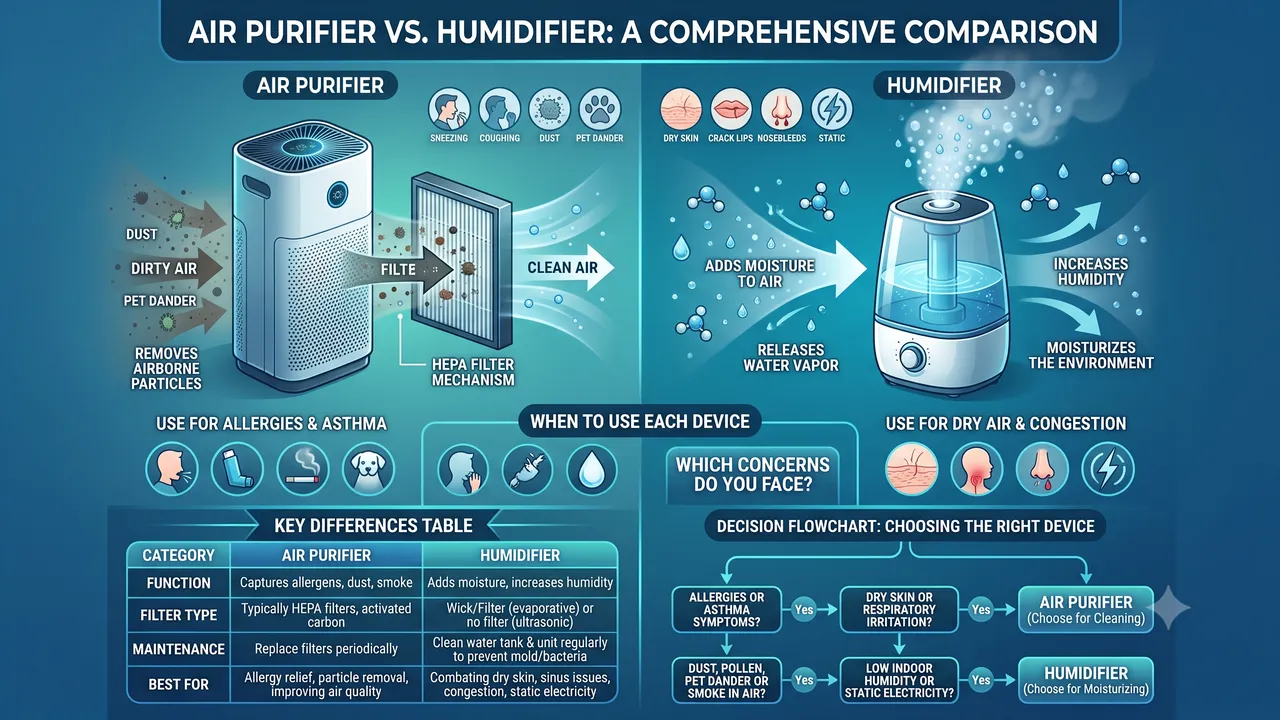
How Air Purifiers Work
An air purifier pulls room air through one or more filters, trapping airborne contaminants, then pushes clean air back out. The most common filtration technologies include:
- HEPA filters, Medical-grade pleated media that captures 99.97 % of particles 0.3 microns and larger (dust, pollen, pet dander, mold spores).
- Activated carbon filters, Porous charcoal that adsorbs odors, VOCs (volatile organic compounds), and gaseous pollutants.
- UV-C light, Germicidal ultraviolet light that deactivates bacteria and viruses as they pass through the unit.
- Ionizers / bipolar ionization, Release charged ions that attach to airborne particles, causing them to fall out of the air or be captured more easily by a collector plate.
A quality HEPA air purifier does not add moisture, heat, or fragrance to the air. It simply removes what shouldn’t be there.
When You Need an Air Purifier
- You suffer from allergies or asthma.
- You have pets that shed dander and hair.
- Wildfire smoke or outdoor pollution infiltrates your home.
- You notice lingering cooking, cigarette, or wildfire odors.
- You want to reduce airborne viruses and bacteria.
Internal link: Not sure which purifier to buy? Check our best air purifiers for allergies and asthma for tested recommendations.
How Humidifiers Work
A humidifier releases water vapor (or mist) into the air to raise the relative humidity (RH) level in a room. The main types are:
- Evaporative, A fan blows air through a wet wick or filter; the simplest and most self-regulating type.
- Ultrasonic, A vibrating diaphragm creates a fine cool mist; very quiet and energy-efficient.
- Warm mist / steam, Boils water to produce steam; kills bacteria in the process but uses more energy and can be a burn risk.
- Impeller, A rotating disc flings water at a diffuser to create a cool mist; common in children’s units.
Humidifiers do not filter the air. They add water molecules, nothing more.
When You Need a Humidifier
- Winter indoor humidity drops below 30–40 %.
- You wake up with dry skin, cracked lips, chapped hands, or nosebleeds.
- You have sinus congestion that worsens in dry conditions.
- Hardwood floors, furniture, or musical instruments are cracking.
- Your doctor recommends humidity control for respiratory conditions like croup or chronic sinusitis.
Internal link: For year-round humidity monitoring tips, see our guide to ideal indoor humidity levels.
Air Purifier vs Humidifier: Side-by-Side Comparison
| Feature | Air Purifier | Humidifier |
|---|---|---|
| Primary function | Remove airborne particles, allergens, odors, VOCs | Add moisture to the air |
| Affects humidity? | No | Yes, raises relative humidity |
| Removes dust & pollen? | Yes (HEPA) | No |
| Removes odors & smoke? | Yes (carbon + HEPA) | No |
| Helps dry skin & nosebleeds? | Indirectly | Directly |
| Helps allergies & asthma? | Yes, primary use case | Only if dry air is a trigger |
| Noise level | 25–55 dB (fan-based) | 25–50 dB (ultrasonic quieter) |
| Filter replacement? | Yes, every 6–12 months | Wick filters every 1–3 months; ultrasonic = none |
| Maintenance | Filter changes; occasional wipe-down | Daily water changes; weekly deep cleaning to prevent mold |
| Energy use | 30–100 W | 30–80 W (warm mist up to 250 W) |
| Price range | $50–$600 | $25–$200 |
| Ideal room size | 150–700 sq ft (varies by CADR) | 150–500 sq ft |
Key Takeaway
If your problem is particles (allergens, dust, smoke, pet dander), you need an air purifier. If your problem is dry air (dry skin, static shock, irritated sinuses), you need a humidifier. If you deal with both, which is extremely common, especially in winter, you may benefit from running both simultaneously.
Do You Need Both an Air Purifier and a Humidifier?
Here’s a quick decision guide to help you figure it out:
You Only Need an Air Purifier If…
✅ You have allergies, asthma, or chemical sensitivities. ✅ You live in an area with high outdoor pollution or wildfire smoke. ✅ You have pets. ✅ Indoor humidity is already in the comfortable 30–60 % range.
You Only Need a Humidifier If…
✅ Your indoor humidity regularly drops below 30 %. ✅ You experience dry skin, nosebleeds, or static electricity. ✅ Your doctor has recommended increased humidity. ✅ Air quality (allergens, odors) is not a concern.
You May Need Both If…
✅ You live in a cold, dry climate where the furnace runs constantly in winter and you have allergies. ✅ You or a family member has asthma triggered by both dry air and airborne allergens. ✅ You want comprehensive indoor air quality management year-round.
A Note About Running Them Together
There’s a common myth that a humidifier will “ruin” an air purifier’s filter. In practice, as long as you keep humidity below 60 % (to prevent mold growth) and avoid placing the humidifier’s mist directly into the purifier’s intake, there is no conflict. Many households run both devices in the same room every winter without issues.
The important thing to understand is that these devices operate on two entirely independent axes of indoor air quality. An air purifier addresses the composition of the air, what’s floating in it. A humidifier addresses the moisture content of the air, how much water vapor it carries. Neither interferes with the other’s core function when used sensibly. Think of it like a water filter and a kettle: one purifies water, the other heats it. Both improve your drinking experience, and neither one breaks the other.
What About Air Washers?
You might also encounter air washers, devices that draw air through a water reservoir, trapping some particles while simultaneously adding moisture. These are a hybrid approach, but they typically don’t match the filtration efficiency of a dedicated HEPA purifier (most capture only particles down to about 10 microns) and can’t match the humidification output of a standalone humidifier either. They’re best suited for homes with mild dust issues and moderate dryness rather than serious allergy or extremely arid environments.
Internal link: Need help choosing? Read our complete air purifier buying guide for step-by-step advice.
Air Purifier + Humidifier Combo Units
If counter space or budget is tight, a 2-in-1 combo unit that combines HEPA filtration with a built-in humidifier can be a convenient solution. Here are the top options available in 2026:
| Combo Unit | Type | Filter | Humidifier Type | Room Size | Price (approx.) | Best For |
|---|---|---|---|---|---|---|
| Dyson Purifier Humidify+Cool Formaldehyde | Purifier + Humidifier + Fan | HEPA H13 + activated carbon | Evaporative (UV-treated) | 800 sq ft | $799 | Premium all-in-one |
| SHARP KC-860U | Purifier + Humidifier | True HEPA + Plasmacluster ion tech | Evaporative | 500 sq ft | $450 | Large rooms |
| WINIX LAC-H2000 | Purifier + Humidifier | True HEPA + carbon | Evaporative | 360 sq ft | $280 | Mid-range |
| Boneco H680 | Purifier + Humidifier | HEPA + washable pre-filter | Evaporative | 600 sq ft | $500 | Swiss quality, large space |
| Samsung AX60R5080WD | Purifier + Humidifier | Multi-layered HEPA | Evaporative | 600 sq ft | $550 | Smart home integration |
Combo Unit Pros & Cons
Pros:
- One device, one plug, one maintenance schedule.
- Often more aesthetically cohesive than two separate boxes.
- Some models oscillate between purifying and humidifying automatically.
Cons:
- If one function breaks, you may lose both.
- Filter + wick replacement costs can be higher than separate units.
- Purification performance is sometimes slightly lower than a dedicated purifier of the same price.
Internal link: For a deeper dive on all-in-one models, see our best air purifier-humidifier combos roundup.
How to Use Both Devices Effectively Together
If you decide to run a separate air purifier and humidifier (which we generally recommend over combo units for best performance), follow these tips:
1. Placement Matters
- Place the air purifier where air circulates freely, at least 1–2 feet from walls, ideally near the center of the room or close to the pollution source (e.g., near the kitchen or pet area).
- Place the humidifier on a raised, flat surface. Keep it away from the purifier’s air intake so mist doesn’t saturate the filter.
2. Monitor Humidity Levels
Use a hygrometer ($10–$15 on Amazon) to keep humidity between 40–55 %. Above 60 %, mold and dust mites thrive, which defeats the purpose of your air purifier.
3. Maintain Both Devices on Schedule
| Task | Frequency |
|---|---|
| Refill humidifier water tank | Daily |
| Clean humidifier tank & base | Every 3 days |
| Replace humidifier wick/filter (evaporative) | Every 1–3 months |
| Check air purifier filter indicator | Monthly |
| Replace HEPA filter | Every 6–12 months |
| Replace carbon pre-filter | Every 3 months |
| Wipe down air purifier exterior | Monthly |
4. Seasonal Strategy
- Fall / Winter: Run both. Furnace heat dries the air; closed windows trap indoor pollutants.
- Spring: Keep the purifier running for pollen; humidifier usually not needed as outdoor humidity rises.
- Summer: Air purifier only (or neither if you use AC, which also dehumidifies). Some humid climates may not need either. If you run AC, it naturally dehumidifies, so the humidifier stays in storage.
5. Water Quality in Your Humidifier
Using distilled or demineralized water in your humidifier is strongly recommended, especially with ultrasonic models. Tap water contains minerals that create white dust on furniture and can introduce bacteria into the air. Distilled water costs about $1–$2 per gallon, and a typical humidifier uses 1–3 gallons per day, so budget roughly $30–$60 per month during heavy-use months. Alternatively, evaporative humidifiers are more forgiving of tap water since minerals are trapped in the wick rather than misted into the air.
Cost Comparison: Running Both vs. a Combo Unit
| Cost Factor | 2 Separate Devices | 1 Combo Unit |
|---|---|---|
| Upfront cost | $100–$400 (purifier) + $40–$120 (humidifier) | $300–$800 |
| Annual filter/wick cost | $40–$80 (purifier) + $20–$60 (humidifier) | $50–$120 |
| Annual electricity | ~$40–$80 combined | ~$30–$60 |
| Total Year-1 cost | $200–$660 | $380–$980 |
| Total Year-2 cost | $100–$200 | $80–$180 |
Separate devices cost more upfront but give you flexibility, you can run just the purifier in summer and add the humidifier only in winter. Combo units are convenient but less modular.
Frequently Asked Questions
Can I use a humidifier instead of an air purifier for allergies?
No. A humidifier adds moisture but does not capture or remove allergens like pollen, pet dander, or dust mites. In fact, over-humidifying can make allergies worse by promoting mold growth and dust mite reproduction. For allergy relief, you need a HEPA air purifier. A humidifier is a complement, not a substitute.
Will a humidifier make my air purifier less effective?
Not if you use them properly. Keep humidity below 60 % and don’t aim the humidifier’s mist directly at the purifier’s intake. Some moisture may reach the HEPA filter, but it won’t significantly degrade performance. If you notice the filter getting damp, increase the distance between the two devices.
Is it safe to run an air purifier and humidifier in a baby’s room?
Yes, in fact, it’s recommended by many pediatricians. Use an ultrasonic cool-mist humidifier (quiet and safe, no burn risk) and a HEPA air purifier to reduce airborne irritants. Monitor humidity with a hygrometer to stay in the 40–60 % range. Avoid warm-mist humidifiers near children due to burn risk.
How do I know if my indoor air is too dry?
Signs of low humidity include: static electricity shocks, dry or itchy skin, chapped lips, frequent nosebleeds, cracking wood furniture, and worsening respiratory symptoms. A hygrometer will give you an exact reading, anything below 30 % is too dry, and below 20 % is uncomfortable and potentially harmful.
Can I use essential oils in my humidifier or air purifier?
For humidifiers: only if the manufacturer specifically says it’s safe. Many ultrasonic humidifiers can be damaged by oils, and inhaling concentrated oils can irritate lungs, especially in children. For air purifiers: never put essential oils directly into a purifier, oils can degrade HEPA and carbon filters. Use a dedicated essential oil diffuser if you want aromatherapy.
The Bottom Line
An air purifier and a humidifier are not interchangeable. They solve fundamentally different problems:
- Air purifier = clean air (removes pollutants, allergens, odors).
- Humidifier = comfortable air (adds moisture to prevent dryness).
If you only struggle with allergies or pollution, a quality HEPA air purifier is your first purchase. If dry winter air is your main complaint, start with a humidifier. And if you face both, which is the reality for millions of households, investing in both devices (or a reliable combo unit) is one of the smartest things you can do for your family’s respiratory health.
Next steps:
- Browse our best air purifiers for allergies and asthma.
- Learn about ideal indoor humidity levels.
- Compare top air purifier-humidifier combos.
- Read our air purifier buying guide for in-depth advice.
Disclosure: As an Amazon Associate, The Air Purifier Guide earns from qualifying purchases. This comes at no extra cost to you and helps us keep producing free, research-backed content. Full affiliate disclosure.
You May Also Like
- Best Air Purifier and Humidifier Combo Units: 2-in-1 Devices Worth Considering
- Coway AP-1512HH vs Winix 5500-2: Which Air Purifier Is Better in 2026?
- Dyson Pure Cool vs Coway AP-1512HH: Which Air Purifier Deserves Your Money?
- Best Air Purifier Brands of 2026: Ranked by Performance, Reliability, and Value
Support This Guide
Helpful? Add The Air Purifier Guide as a preferred source on Google so our guides show up in your search results.
Related Articles

Coway Mighty2 vs AP-1512HH (2026)
Coway's Mighty2 replaced the AP-1512HH as Wirecutter's top pick. We compare CADR, noise, sensors, filter costs, and whether the older unit is still the smarter buy.

KNKA APH4000 Review: $150 Dark Horse
KNKA's APH4000 is one of Amazon's best-selling purifiers at $150. We check the AHAM certification, decode the 1,695 sq ft claim, and compare it to Levoit and Coway.

Levoit Core 300 vs 300-P: What Changed
Levoit quietly replaced the Core 300 with the Core 300-P. We explain the AHAM certification, whether filters still fit, and which one you should actually buy.

Shark NeverChange HP302 Review
Shark's NeverChange HP302 promises 5 years on one filter. We dig into the real running costs, the odor neutralizer catch, and whether it beats cheaper rivals.

Winix 5510 vs 5500-2: 2026 Verdict
The Winix 5500-2 is discontinued and the 5510 takes over. We compare CADR, noise, filter costs, and the one compatibility problem nobody mentions.
🛒 Products Mentioned
As an Amazon Associate, we earn from qualifying purchases.
Runs side-by-side purifier comparisons, long-term ownership reports, and filter cost analysis.
View all articles by David →