The Short Answer: For mold prevention, pair HEPA filtration with a dehumidifier (keep humidity below 50%). The Honeywell HPA300 ($200) and GermGuardian AC5350B ($150) with UV-C are effective. Change filters more frequently in humid environments.
Editor’s note (September 2026): The Winix 5500-2 has been discontinued and remaining stock is limited. Winix’s official successor is the Winix 5510, which adds app control and uses a new filter. Read our Winix 5510 vs 5500-2 comparison before you buy either one.
Most air purifier buyers focus on CADR ratings and filter types while overlooking a critical variable that can undermine both: indoor humidity. The moisture level in your home directly affects how well your purifier works, how long your filters last, and whether your air quality monitor gives you accurate readings. A purifier running in a room at 70% relative humidity can perform 30–50% worse than the same unit in a properly managed environment.
This guide breaks down the science behind the humidity-purifier interaction, gives you room-by-room strategies, and helps you decide whether you need a dehumidifier alongside your air purifier.
How Humidity Affects Each Filter Stage
Your air purifier passes air through multiple filtration layers, and humidity impacts each one differently. Understanding these mechanisms helps you spot problems before they degrade your indoor air quality.
HEPA Filters
True HEPA media is moisture-resistant on its own, the fiberglass or synthetic fibers won’t dissolve or break down when exposed to damp air. However, the accumulated dust, pollen, pet dander, and skin cells trapped on the filter surface are a different story entirely. When relative humidity exceeds 70% for extended periods, this organic debris absorbs moisture and becomes a breeding ground for mold and bacteria.
A 2019 study in Indoor Air found that HEPA filters operating above 70% RH for more than 48 hours showed measurable mold colonization on the loaded filter surface. Once mold establishes on a HEPA filter, the unit stops being an air purifier and becomes an air contaminator, actively releasing mold spores with every cubic foot of air it processes.
This is especially dangerous in basements, bathrooms, and coastal homes where humidity stays elevated and the purifier may sit idle for hours. If your filters smell musty when you replace them, that’s a red flag that humidity-driven mold growth has been outpacing your purifier’s ability to clean the air.
See also: Best Air Purifier for Basement Mold and Mildew, Air Purifier Mold Prevention and Humidity Control.
Activated Carbon Filters
This is where humidity causes the most dramatic performance loss. Activated carbon works through adsorption, VOCs, formaldehyde, and odor molecules physically bind to the millions of microscopic pores on the carbon surface. Water vapor competes for those same binding sites.
Research published in the journal Carbon demonstrates that activated carbon loses 30–50% of its VOC adsorption capacity when relative humidity stays above 60–70%. The mechanism is straightforward: water molecules are small and polar, so they access the narrowest pores first and effectively block larger pollutant molecules from binding.
In practical terms, a carbon filter running in a consistently humid environment can perform as if it’s half-spent even when brand new. This explains why some users notice their purifier “stops working” against cooking odors or new furniture smells after a few months, the carbon didn’t saturate with pollutants; it saturated with water.
Tip: If you live in a humid climate, budget for replacing carbon filters twice as often, or run a dehumidifier to keep RH below 55%. For more on VOC removal specifically, see our Air Purifier VOCs and Formaldehyde Guide.
Pre-Filters
Pre-filters catch the largest particles, hair, lint, and coarse dust. In dry conditions, this dust sits loosely on the filter surface and doesn’t significantly impede airflow. Above 60% RH, however, fine dust absorbs moisture and clumps into a paste-like consistency that clogs the pre-filter mesh much faster.
A clogged pre-filter forces the fan motor to work harder, increasing noise and energy consumption while reducing the volume of air reaching the HEPA and carbon layers. Wash or vacuum pre-filters every two to three weeks in humid conditions instead of the usual monthly schedule. For a full maintenance breakdown, see our Air Purifier Clean Pre-Filter Maintenance Guide.
The Air Quality Monitor Problem
Low-cost laser particle counters, the type used in most consumer air quality monitors and built into smart purifiers from brands like Dyson and Levoit, can produce false elevated PM2.5 readings in high humidity. Water droplets in fog, mist, or extremely humid air scatter laser light in a way that’s nearly identical to how solid particulate matter scatters it. The sensor cannot distinguish between a 2.5-micron dust particle and a 2.5-micron water droplet.
If your monitor suddenly spikes to 150 µg/m³ on a humid morning or during a shower, check outdoor humidity conditions before assuming your indoor air is toxic. Cross-reference with a separate hygrometer, if RH is above 70%, the PM2.5 reading is likely inflated. This is one reason we recommend pairing any smart purifier with a dedicated humidity sensor.
See also: Best Air Quality Monitors 2026, How to Read Air Quality Index (AQI).
The 60% Threshold Most People Ignore
Sixty percent relative humidity is a critical tipping point for indoor air quality. At this level, several problems converge simultaneously:
- Dust mite populations explode. Dust mites absorb water directly from ambient air rather than drinking liquid water, so they thrive at 60%+ RH without any visible moisture source. A single mattress can house over two million dust mites in humid conditions.
- Mold spores germinate. Most common indoor molds (Aspergillus, Penicillium, Cladosporium) require 65–70% RH to germinate on surfaces, but the micro-environment directly around a dust-loaded filter can reach that threshold even when room RH is 60%.
- Activated carbon loses roughly half its capacity. As described above, water vapor occupies binding sites meant for pollutants.
- Bacteria multiply faster. Many bacterial species double their reproduction rate for every 10% increase in RH above 50%.
Your purifier is fighting a multi-front war at high humidity, and it’s losing on most of them. The practical implication: a purifier in a consistently humid room (60%+ RH) needs its carbon filter replaced twice as often and still underperforms. Fix the humidity first, then evaluate the purifier’s performance. A $200 dehumidifier combined with a $90 unit like the Levoit Core 300 cleans air more effectively than a $300 purifier alone in a humid room.
Optimal Humidity Ranges for Air Purifier Performance
| Relative Humidity | Effect on Purifier | Recommended Action |
|---|---|---|
| Below 30% | Dry air irritates airways; static electricity makes dust cling to surfaces and filters | Add a humidifier (use distilled water to avoid white mineral dust settling on filters) |
| 30–40% | Good purifier performance; slightly dry for comfort | Acceptable range, no action needed |
| 40–55% | Optimal for filter efficiency and human comfort | Ideal, maintain this range |
| 55–65% | Carbon filter efficiency begins to decline; dust mite activity increases | Monitor closely; run a dehumidifier if sustained |
| 65–70% | Significant carbon filter degradation; mold risk on loaded HEPA; sensor accuracy drops | Run dehumidifier alongside purifier |
| Above 70% | Severe carbon filter loss (30–50%); active mold growth likely; false PM2.5 readings | Must dehumidify immediately; consider mold-resistant filter media; inspect filters weekly |
Signs Your Purifier Is Struggling with Humidity
How do you know if humidity is undermining your air purifier? Watch for these warning signs:
- Musty or damp smell from the unit. This indicates mold or bacteria growing on the filter surface. Replace the filter immediately and address the humidity source.
- Visible discoloration on HEPA filters at replacement. Healthy used filters are gray or brown from dust. Green, black, or white patches suggest biological growth.
- Filters clogging faster than expected. If your pre-filter or HEPA filter reaches end-of-life months ahead of schedule, moisture-laden particles are accelerating the buildup.
- Persistent odors despite running the purifier. If cooking smells, pet odors, or that “new furniture” scent linger even with a fresh carbon filter, humidity has likely reduced the carbon’s adsorption capacity.
- Fan running on high constantly with no improvement. Smart purifiers ramp up fan speed when they detect poor air quality. If the unit stays on high but air doesn’t feel cleaner, false sensor readings from humidity may be the culprit.
- Allergy or asthma symptoms worsening indoors. If your purifier is actively growing mold, it’s spreading spores every time it runs. Worse air quality with the purifier on than off is a definitive sign something is wrong.
How to Measure and Monitor Indoor Humidity
You can’t manage what you don’t measure. Here’s how to stay on top of indoor humidity levels:
Hygrometer Options
- Standalone digital hygrometers ($10–$30) are the simplest solution. Place one in each room where you run a purifier. Look for models with a min/max memory feature so you can see the humidity range over the past 24 hours.
- Smart home sensors from brands like Govee, SensorPush, or Aqara log humidity data over time and send alerts to your phone when levels cross your set thresholds.
- Built-in sensors on smart purifiers (Dyson, Levoit, Coway) display humidity on the unit or in their companion apps, though these sensors are sometimes less accurate than dedicated hygrometers.
Where to Measure
Place hygrometers at breathing height (roughly 3–5 feet from the floor) and away from direct sources of moisture like showers, stovetops, or open windows. Avoid placing them directly next to the purifier’s exhaust, which can give an artificially low reading.
Target Ranges
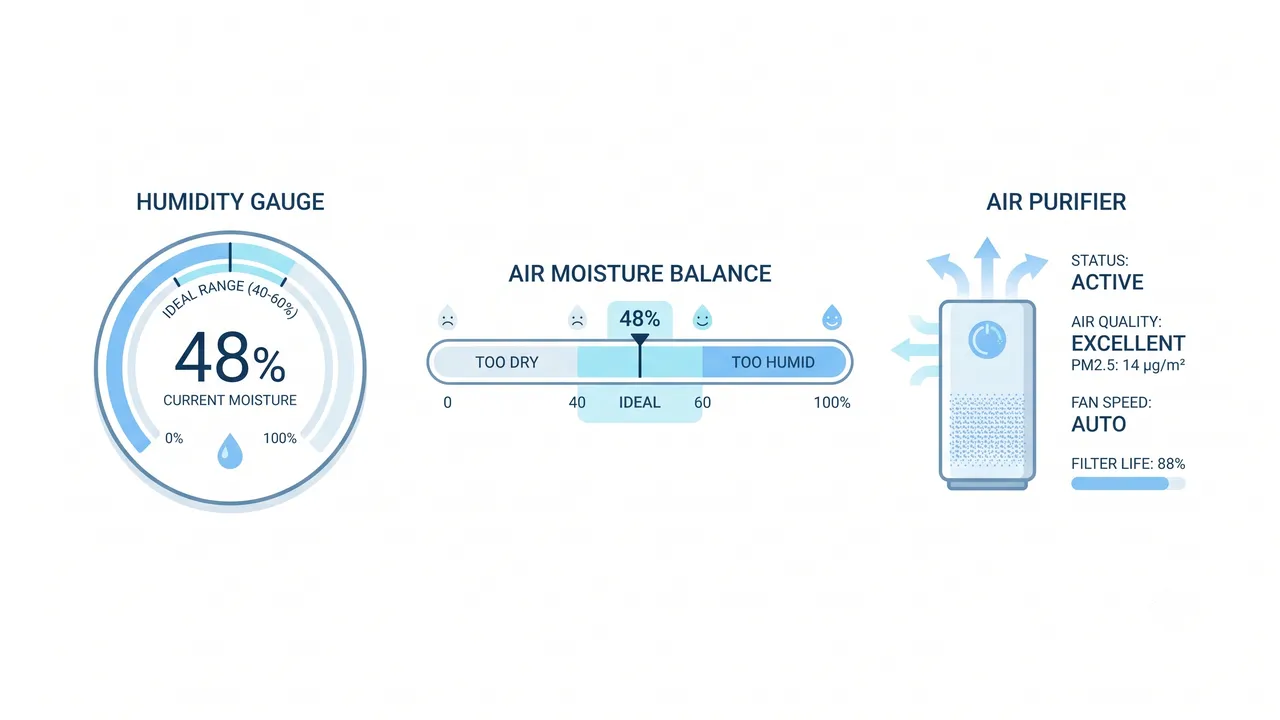
Aim for 40–55% relative humidity year-round. Use a dehumidifier when readings consistently exceed 55% and a humidifier when they drop below 35%. Check readings at different times of day, humidity often peaks overnight when windows are closed and breathing adds moisture to the air.
Best Dehumidifier-Purifier Combos by Room Size
Pairing the right dehumidifier with your air purifier solves the humidity problem at its source. Here are proven combinations:
| Room Size | Dehumidifier | Air Purifier | Est. Combined Cost | Notes |
|---|---|---|---|---|
| Small (up to 300 sq ft) | hOmeLabs 30-pint | Levoit Core 300 | ~$250 | Great for bedrooms and small offices |
| Medium (300–500 sq ft) | Frigidaire 50-pint | Coway AP-1512HH | ~$380 | Ideal for living rooms; Coway’s auto mode adjusts to conditions |
| Large (500–800 sq ft) | LG PuriCare 50-pint | Winix 5500-2 | ~$420 | Strong carbon filter on the Winix handles residual odors |
| Basement (800+ sq ft) | Frigidaire 70-pint | Blueair Classic 480i | ~$600 | Heavy-duty dehumidification paired with high-CADR filtration |
See also: Best Air Purifier Humidifier Combo Units, Air Purifier vs Humidifier vs Dehumidifier: Which Do You Need?.
Room-by-Room Humidity Guide
Different rooms have different moisture challenges. Here’s how to manage each one:
Bathroom
Bathrooms are the most humid room in most homes, regularly hitting 80–100% RH during and after showers. An air purifier in the bathroom is fighting a losing battle unless you control moisture first. Run the exhaust fan during and for 20 minutes after every shower. If the bathroom has no fan, crack a window or use a small portable dehumidifier. A purifier with a washable pre-filter works best here because you’ll be cleaning it frequently.
Bedroom
You spend 7–9 hours breathing bedroom air every night, so this is the highest-impact room for clean air. Typical bedroom humidity ranges from 40–55% in most climates, which is ideal for purifier performance. However, overnight breathing by two adults can add 1–2 pints of moisture to a closed bedroom, pushing RH up by 5–10%. Keep a hygrometer on the nightstand and crack a window if humidity climbs above 55% overnight.
See also: Quietest Air Purifiers for Bedrooms, Best Air Purifier for Nursery and Baby Room.
Basement
Below-grade spaces are chronically damp. Even in dry climates, ground moisture wicks through concrete foundations and keeps basement RH above 60% much of the year. Run a dedicated dehumidifier set to 50% RH continuously from spring through fall. Place the air purifier at least 3 feet from the dehumidifier to avoid the dehumidifier’s dry exhaust interfering with the purifier’s intake readings.
See also: Best Air Purifier for Basement Mold and Mildew.
Kitchen
Cooking generates enormous amounts of moisture, boiling a pot of pasta can raise kitchen RH by 15–20% in minutes. Always run the range hood (vented to the outside, not recirculating) while cooking. If you don’t have a range hood, open a window and position the air purifier to capture both the cooking moisture and airborne grease particles before they reach other rooms.
Living Room
Living rooms are generally moderate in humidity unless they adjoin a kitchen or have large windows that collect condensation. A hygrometer here helps you track seasonal swings, winter heating often drops RH below 30%, while summer can push it above 60%. Adjust with a humidifier or dehumidifier as needed.
See also: Room-by-Room Air Purifier Guide.
Practical Tips for Managing Purifier Performance in Humid Environments
Beyond controlling humidity, these habits help maintain purifier effectiveness:
- Replace carbon filters more frequently in humid climates. Budget for twice the manufacturer’s recommended replacement interval if RH regularly exceeds 60%.
- Store replacement filters in sealed plastic bags. Carbon filters adsorb moisture from the air even when sitting in storage. An unsealed replacement filter can lose 10–20% of its capacity before you ever install it.
- Run the purifier continuously rather than intermittently. Constant airflow prevents moisture from settling on the filter surface. Turning the unit off for long periods lets humidity build up on the loaded filter, creating conditions for mold growth.
- Clean the pre-filter every 2–3 weeks in humid conditions instead of the typical monthly schedule. A clogged pre-filter reduces airflow to the HEPA and carbon stages.
- Position the purifier away from windows and exterior walls that collect condensation. These spots have the highest localized humidity.
- Use the purifier’s auto mode if available. Smart sensors can ramp up fan speed when air quality degrades, which also increases airflow across the filters and reduces moisture buildup.
For more maintenance tips, see our Air Purifier Filter Replacement Guide and Costs and Air Purifier Setup and Installation Guide.
When to Consider a Combo Unit
If you’re dealing with chronic humidity above 60% and don’t want two separate appliances, a combined air purifier and dehumidifier unit can save space and simplify management. The tradeoff is that combo units typically compromise on both functions, the dehumidifier capacity is lower than a standalone unit, and the air purifier section may lack a full-size carbon filter.
For most homes, we recommend separate units. A standalone dehumidifier gives you precise humidity control, and a standalone air purifier gives you the best filtration. However, for small apartments or single rooms where space is limited, a combo unit is better than doing nothing about humidity.
See also: Best Air Purifier Humidifier Combo Units.
FAQ
Can I use an air purifier and dehumidifier in the same room?
Yes, and you should if humidity is above 55%. Place them at least 3 feet apart so the dehumidifier’s dry exhaust doesn’t confuse the purifier’s air quality sensor. Run the dehumidifier set to 45–50% RH and let the purifier handle particle and VOC filtration.
Does humidity affect all air purifier types equally?
No. HEPA-only purifiers are less affected by humidity than units with activated carbon filters. Ionic and electrostatic purifiers can see reduced effectiveness in very high humidity because water droplets interfere with the electrical charge that attracts particles. UV-C purifiers are mostly unaffected by humidity since UV light kills microbes regardless of moisture levels.
Should I turn off my air purifier when running a dehumidifier?
No, run both simultaneously. The dehumidifier lowers the moisture level, which allows the purifier’s filters to work more efficiently. The purifier captures any mold spores or dust that the dehumidifier’s intake kicks up. They complement each other.
How often should I check humidity levels in my home?
Check at least once daily, ideally at different times. Humidity fluctuates significantly, it’s usually lowest in the afternoon (when outdoor air is warmest) and highest overnight (when windows are closed and breathing adds moisture). Smart sensors that log data over time give you the most useful picture.
Can low humidity also affect air purifier performance?
Yes. Below 30% RH, air becomes very dry, which irritates airways and makes you more susceptible to the particles the purifier is trying to remove. Dry air also increases static electricity, causing dust to cling to surfaces and filter media in clumps rather than passing through evenly. Use a humidifier to maintain at least 35% RH in winter.
The Bottom Line
Humidity is the invisible variable that most air purifier owners overlook until their filters fail early or their air quality doesn’t improve. The sweet spot is 40–55% relative humidity, maintain that range and your HEPA filters will last their full rated lifespan, your carbon filters will adsorb VOCs at peak capacity, and your air quality readings will be accurate.
If your home regularly exceeds 55% RH, a dehumidifier isn’t optional, it’s a prerequisite for your air purifier to do its job. Measure first with a hygrometer, address the moisture source, and then your purifier can focus on what it was designed to do: clean the air.
Related reading: Air Purifier vs Humidifier vs Dehumidifier: Which Do You Need?, Best Air Purifier Humidifier Combo Units, Air Purifier Mold Prevention and Humidity Control, HEPA Filter Deep Dive Guide, How to Choose an Air Purifier: CADR and ACH Guide.
Disclosure: This article contains affiliate links. We may earn a commission from qualifying purchases made through links on this page, at no additional cost to you. This helps us keep our content free and independently researched. We only recommend products we’ve thoroughly evaluated and believe provide genuine value.
You May Also Like
- Air Purifier for Mold Prevention: Why Humidity Control Matters More Than Filtration
- Air Purifier vs Humidifier vs Dehumidifier: Which One Do You Actually Need?
- Air Purifier Placement Guide: Where to Put It for Maximum Effectiveness
- Air Purifier vs Opening Windows: Which Is Better for Indoor Air Quality?
Support This Guide
Helpful? Add The Air Purifier Guide as a preferred source on Google so our guides show up in your search results.
Related Articles

Coway Mighty2 vs AP-1512HH (2026)
Coway's Mighty2 replaced the AP-1512HH as Wirecutter's top pick. We compare CADR, noise, sensors, filter costs, and whether the older unit is still the smarter buy.

KNKA APH4000 Review: $150 Dark Horse
KNKA's APH4000 is one of Amazon's best-selling purifiers at $150. We check the AHAM certification, decode the 1,695 sq ft claim, and compare it to Levoit and Coway.

Levoit Core 300 vs 300-P: What Changed
Levoit quietly replaced the Core 300 with the Core 300-P. We explain the AHAM certification, whether filters still fit, and which one you should actually buy.

Shark NeverChange HP302 Review
Shark's NeverChange HP302 promises 5 years on one filter. We dig into the real running costs, the odor neutralizer catch, and whether it beats cheaper rivals.

Winix 5510 vs 5500-2: 2026 Verdict
The Winix 5500-2 is discontinued and the 5510 takes over. We compare CADR, noise, filter costs, and the one compatibility problem nobody mentions.
🛒 Products Mentioned
As an Amazon Associate, we earn from qualifying purchases.
Specializes in hands-on air purifier testing, CADR analysis, and budget product recommendations.
View all articles by Alex →