The Short Answer: Air purifiers alone can’t solve basement air quality. You need a three-step approach: 1) Dehumidifier to control moisture (below 50% humidity), 2) HEPA air purifier to capture mold spores, 3) Radon test ($15-30). The Winix 5500-2 ($159) is the best basement purifier because of its washable carbon filter for ongoing mold odors.
Editor’s note (September 2026): The Winix 5500-2 has been discontinued and remaining stock is limited. Winix’s official successor is the Winix 5510, which adds app control and uses a new filter. Read our Winix 5510 vs 5500-2 comparison before you buy either one.
Why basements are different
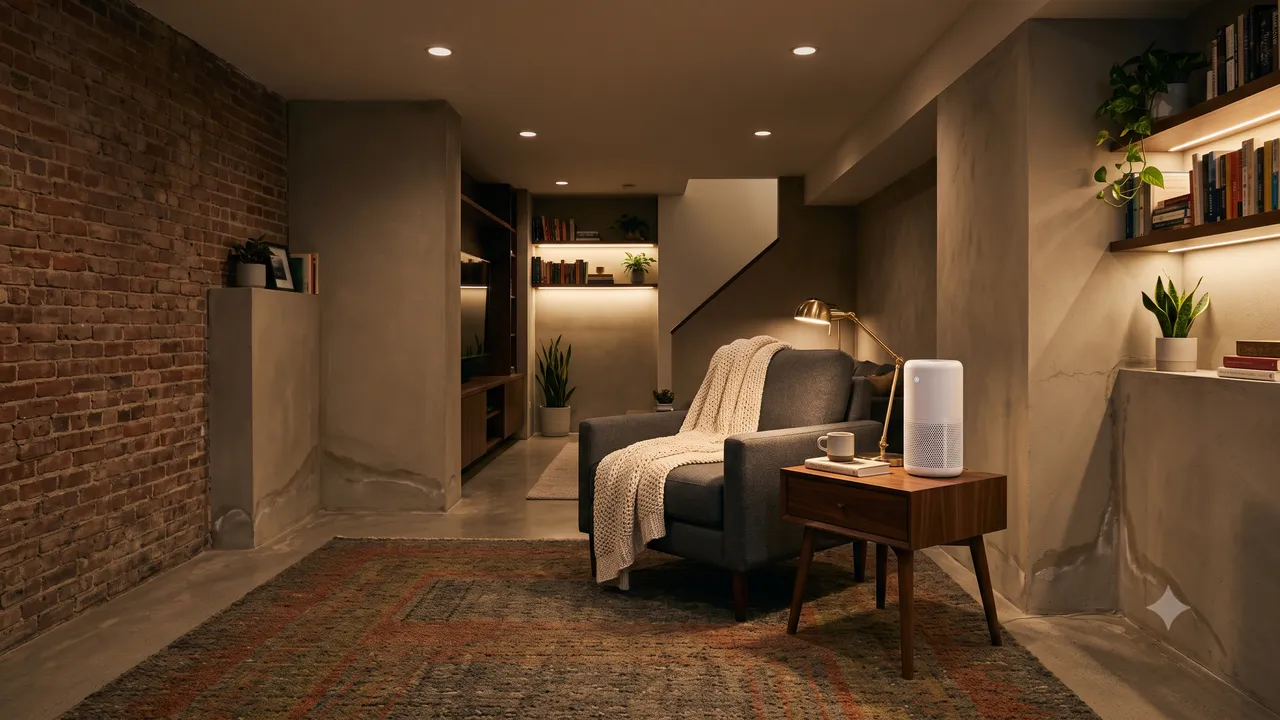
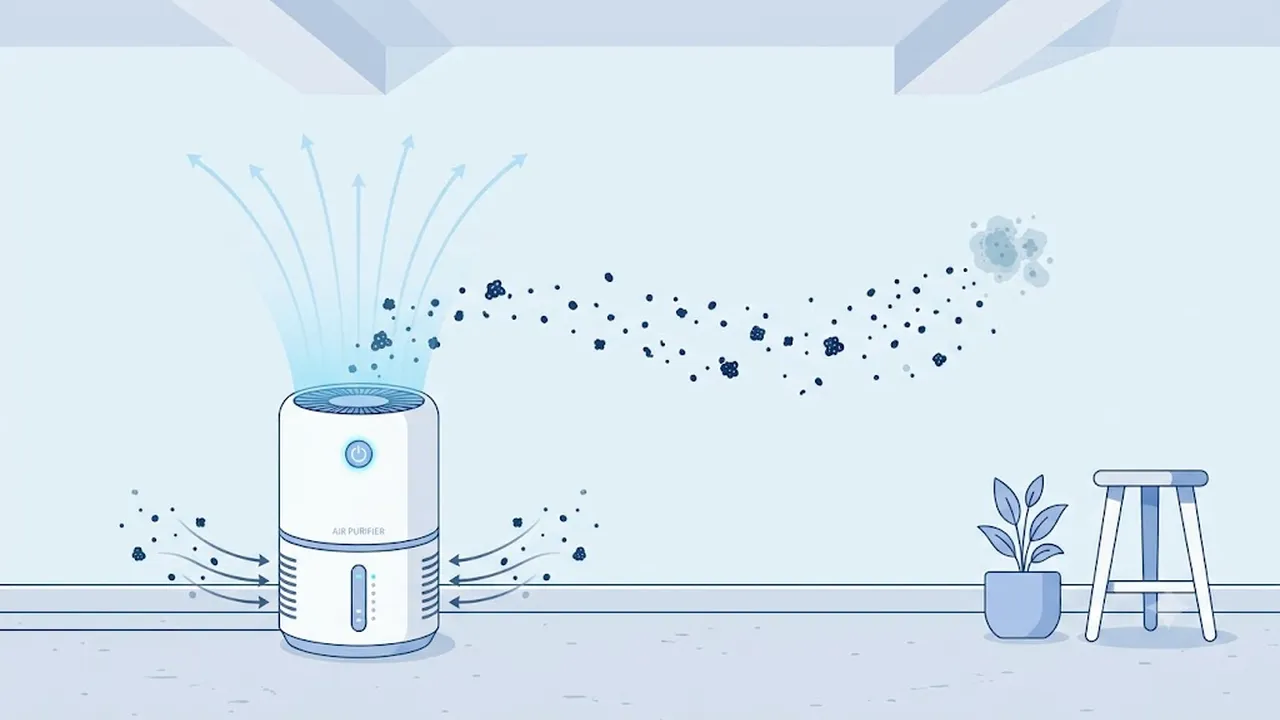
Below-grade spaces are fundamentally different from above-ground rooms For air quality. Concrete walls and floors naturally wick moisture from the surrounding soil through capillary action, creating perpetually elevated humidity. That humidity creates ideal conditions for mold. And mold spores become airborne and circulate through the rest of the house via the stack effect (warm air rising pulls basement air upward).
According to the EPA, 60% of homes in the U.S. have some degree of basement moisture problem. The University of Minnesota Extension service notes that visible mold growth can begin within 24-48 hours when relative humidity exceeds 60% and an organic food source (drywall paper, wood, carpet) is present.
Learn more about mold prevention and humidity control.
The three-step basement air quality solution
An air purifier alone cannot solve basement air quality. It must be part of a three-component system:
1. Moisture control (first priority)
Without moisture control, an air purifier is fighting a losing battle. Mold will continue to grow on surfaces and release new spores faster than any purifier can capture them.
- Dehumidifier rated for the basement square footage, A 50-pint dehumidifier handles most 1,000-1,500 sq ft basements. Look for models with a built-in pump that can drain upward to a sink or window.
- Set humidity to 45-50%, Below 50%, mold can’t germinate; below 45%, dust mites can’t reproduce. Don’t go below 30% or the air becomes irritatingly dry.
- Fix foundation leaks and groundwater intrusion, A dehumidifier can’t keep up with active water entry. Grade soil away from the foundation and ensure gutters direct water at least 5 feet from the house.
Calculate your room size to determine the right dehumidifier capacity.
2. Air purification
Once humidity is controlled, an air purifier captures the mold spores that are already airborne and any new spores that become aerosolized:
- True HEPA filter is essential. Mold spores range from 3-40 microns, well within HEPA’s 99.97% capture range at 0.3 microns.
- Activated carbon addresses the musty odor (mVOCs, microbial volatile organic compounds produced by mold metabolism).
- UV-C light is more relevant in basements than other rooms because the extended air residence time in a closed basement may allow enough UV exposure for some germicidal effect. But mechanical HEPA filtration remains the primary mechanism.
3. Radon testing
Radon is the second leading cause of lung cancer in the U.S., responsible for approximately 21,000 deaths per year. It’s an invisible, odorless radioactive gas that seeps from soil into homes through foundation cracks. Basements have the highest radon concentrations because they’re closest to the soil source.
No air purifier captures radon. Radon is a noble gas that passes through HEPA filters and is not adsorbed by activated carbon. It requires a dedicated radon mitigation system ($800-1,500 professionally installed) that vents soil gases from beneath the foundation to the outdoors.
Test for radon before investing in other air quality improvements. A $15-30 test kit takes 2-7 days. If levels exceed 4 pCi/L, mitigation is the priority.
Best air purifiers for basements
| Purifier | Price | Room Size | Filter | Annual Cost | Best For |
|---|---|---|---|---|---|
| Winix 5500-2 | $159 | 360 sq ft | HEPA + washable carbon | $55-65 | Overall basements |
| Coway Airmega 400 | $549-649 | 625 sq ft | Dual HEPA + carbon | $100-120 | Large basements |
| Levoit Core 300 | $89 | 219 sq ft | HEPA + carbon | $45-60 | Small/budget basements |
| MOOKA PR1 | $55 | 450 sq ft | HEPA + carbon | $40-80 | Budget large basements |
Best overall: Winix 5500-2 ($159)
The Winix 5500-2 is the best basement purifier because of its washable AOC carbon filter. Mold mVOCs are continuously produced in basements, and a disposable carbon filter would need prohibitively frequent replacement. The washable carbon component handles this ongoing odor load without recurring costs.
- Room size: Up to 360 sq ft at 4.8 ACH
- Filter: True HEPA + washable AOC carbon + PlasmaWave (can be turned off)
- Annual cost: $55-65
- Price: $159-199
Read our Winix review for more details.
Best for large basements: Coway Airmega 400 ($549-649)
For finished basements over 500 sq ft. Game rooms, home theaters, guest suites. The Airmega 400 provides the CADR necessary to achieve meaningful air turnover. Its dual-filter system is particularly effective in basements because the higher particulate load is split between two filters.
- Room size: Up to 625 sq ft at 4.8 ACH
- Filter: Dual True HEPA + activated carbon
- Annual cost: $100-120
- Price: $549-649
Best for unfinished basements: Levoit Core 300 ($89)
For unfinished basements used primarily for storage and laundry, a budget purifier running continuously provides meaningful spore reduction. The Levoit Core 300’s compact size and 360-degree intake make it easy to place in cluttered basement spaces. The filter replacement cost ($30 every 6-8 months) is manageable.
- Room size: Up to 219 sq ft at 4.8 ACH
- Annual cost: $45-60
- Price: $89-99
Read our budget purifier guide for more options.
Best budget option: MOOKA PR1 ($55)
If you need large room coverage on a tight budget, the MOOKA PR1 covers up to 450 sq ft for $55. The trade-off is lower build quality and shorter filter life. Good for basements where you don’t want to invest in expensive equipment.
Read our MOOKA review for more details.
Placement and operation
- Run continuously. Basement spore levels don’t fluctuate with daily activity the way living spaces do. Continuous operation keeps spore counts consistently low.
- Place near the center of the space or near any known moisture sources, not in a corner. Read our placement guide for more tips.
- Elevate 12-24 inches off the floor. Mold spores concentrate near the floor in the cooler, denser basement air.
- Keep the basement door closed to prevent mold spores from being drawn upward into the house by the stack effect.
- Run a dehumidifier simultaneously. They complement each other: the dehumidifier prevents new mold growth, the purifier captures spores from existing colonies.
The basement purifier that dies in 18 months
Basements kill purifiers. High humidity corrodes circuit boards. Concrete dust clogs filters twice as fast as household dust. Cold temperatures (below 55F) cause some fan bearings to stiffen. And if there’s any standing water. Even a puddle from a slow leak. The purifier can pull that moisture through the filter, creating a mold farm inside the unit.
For basement use, choose a purifier with sealed electronics (Winix and Coway have better-sealed enclosures than budget brands). Elevate the unit on a small platform or shelf. Never place directly on a concrete floor where cold and moisture transfer. And pair with a dehumidifier rated for the basement’s square footage. A purifier in a damp basement without a dehumidifier is fighting a battle it can’t win.
Total cost of basement air quality
| Item | Cost | Frequency | Annual Cost |
|---|---|---|---|
| Air purifier (Winix 5500-2) | $159 | Once | $159 (year 1) |
| Replacement filters | $65 | Every 12 months | $65 |
| Dehumidifier | $249 | Once | $249 (year 1) |
| Dehumidifier electricity | $300 | Annual | $300 |
| Radon test kit | $20 | Every 2 years | $10 |
| Total year 1 | $783 | ||
| Total years 2-5 (annual) | $375/year |
The upfront investment is significant, but protecting your home from mold damage and your family from respiratory issues is worth it.
Calculate your electricity cost for running the purifier and dehumidifier 24/7.
You May Also Like
- Air Purifier for Mold Prevention
- Best Air Purifier for Mold 2026
- Air Purifier Electricity Cost
- Air Purifier Filter Replacement Guide
Frequently Asked Questions
Can air purifiers prevent mold growth?
Air purifiers capture airborne mold spores but don’t prevent mold growth on surfaces. For complete mold prevention, combine HEPA filtration with a dehumidifier (keep humidity below 50%). This removes both existing spores and the moisture mold needs to grow.
Do air purifiers kill mold spores?
HEPA filters capture 99.97% of mold spores but don’t kill them. UV-C light purifiers can kill captured spores, preventing them from being released back into the air. However, UV-C effectiveness depends on exposure time and intensity.
How do I know if I have a mold problem?
Signs include musty odors, visible mold growth (black, green, or white patches), increased allergy symptoms indoors, and water stains or condensation on windows. If you suspect mold, address the moisture source first, then use air purification to remove airborne spores.
What humidity level prevents mold?
Keep indoor humidity below 50% to inhibit mold growth. Use a hygrometer to monitor levels. In humid climates or basements, a dehumidifier is essential. Air purifiers work better in lower humidity because filters last longer and mold growth is inhibited.
Can I use an air purifier in a damp basement?
Yes, but pair it with a dehumidifier. Basements with high humidity require both moisture control and air purification. Change filters more frequently in damp environments—mold spores and musty odors saturate filters faster.
Disclosure: We may earn a commission from qualifying purchases.
Support This Guide
Helpful? Add The Air Purifier Guide as a preferred source on Google so our guides show up in your search results.
Related Articles

Coway Mighty2 vs AP-1512HH (2026)
Coway's Mighty2 replaced the AP-1512HH as Wirecutter's top pick. We compare CADR, noise, sensors, filter costs, and whether the older unit is still the smarter buy.

KNKA APH4000 Review: $150 Dark Horse
KNKA's APH4000 is one of Amazon's best-selling purifiers at $150. We check the AHAM certification, decode the 1,695 sq ft claim, and compare it to Levoit and Coway.

Levoit Core 300 vs 300-P: What Changed
Levoit quietly replaced the Core 300 with the Core 300-P. We explain the AHAM certification, whether filters still fit, and which one you should actually buy.

Shark NeverChange HP302 Review
Shark's NeverChange HP302 promises 5 years on one filter. We dig into the real running costs, the odor neutralizer catch, and whether it beats cheaper rivals.

Winix 5510 vs 5500-2: 2026 Verdict
The Winix 5500-2 is discontinued and the 5510 takes over. We compare CADR, noise, filter costs, and the one compatibility problem nobody mentions.
🛒 Products Mentioned
As an Amazon Associate, we earn from qualifying purchases.
Covers indoor air quality science, respiratory health, allergy management, and wildfire smoke protection.
View all articles by Sarah →