Editor’s note (September 2026): The Winix 5500-2 has been discontinued and remaining stock is limited. Winix’s official successor is the Winix 5510, which adds app control and uses a new filter. Read our Winix 5510 vs 5500-2 comparison before you buy either one.
The Short Answer: For most homes, MERV 11 or MERV 13 in a 4-inch media cabinet is the sweet spot. MERV 8 is safe for any system but provides minimal air quality improvement. MERV 13 captures 90% of particles at 1-3 microns but requires a system that can handle the airflow resistance. Pair your HVAC filter with a standalone HEPA purifier in the bedroom for the best results.
Beyond the blue fiberglass filter
The standard 1-inch blue fiberglass filter that comes with most HVAC systems has a MERV rating of 1-4. It exists to protect your furnace. Catching only the largest particles that could damage the blower motor or heat exchanger. It does almost nothing for your indoor air quality.
Upgrading to a higher-MERV filter is one of the cheapest ways to improve whole-house air quality. But only if your system can handle it.
What MERV actually means
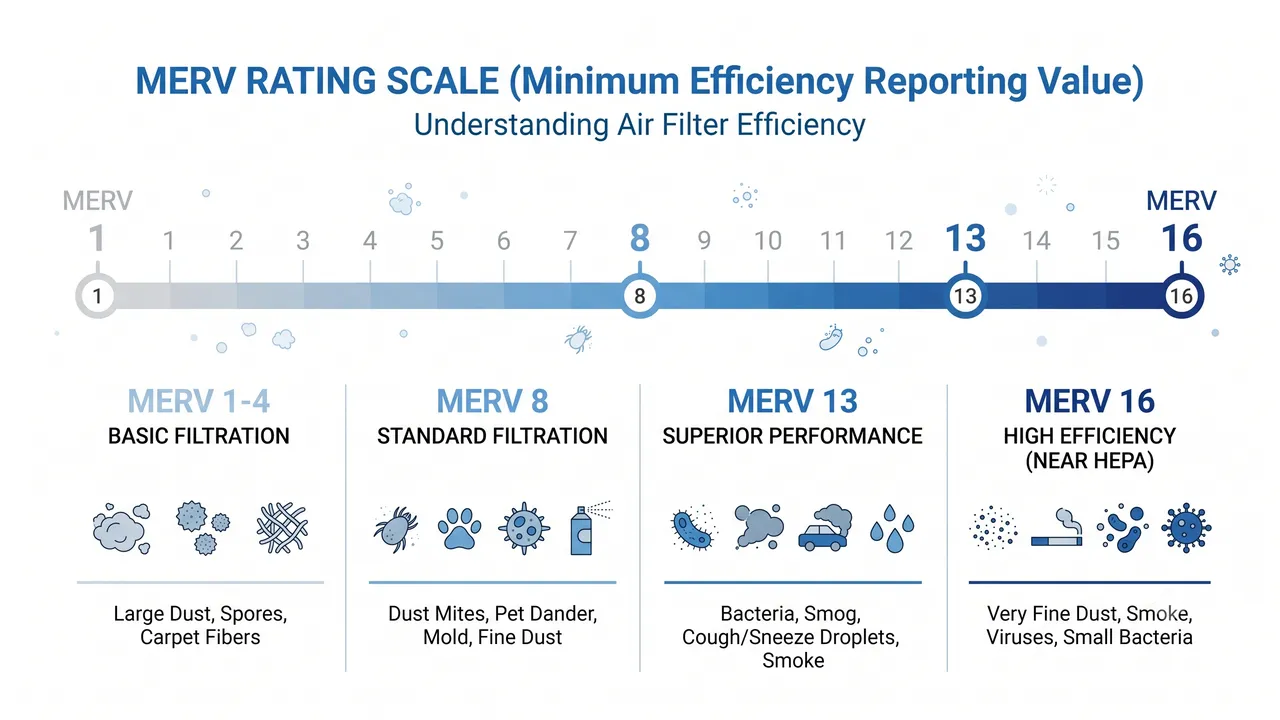
MERV stands for Minimum Efficiency Reporting Value, a standard developed by ASHRAE (the American Society of Heating, Refrigerating and Air-Conditioning Engineers). It rates filters on a scale of 1 to 16 based on their ability to capture particles of different sizes.
The test measures three particle size ranges:
- E1 (0.3-1.0 microns): Smoke, bacteria, viruses, the smallest combustion particles
- E2 (1.0-3.0 microns): Fine dust, some mold spores, legionella
- E3 (3.0-10.0 microns): Pollen, dust mites, mold spores, pet dander
| MERV Rating | What It Captures | Typical Use |
|---|---|---|
| 1-4 | Particles > 10 microns: dust, pollen, carpet fibers | Basic furnace protection only |
| 5-8 | Particles > 3 microns: mold spores, dust mite debris, pet dander (partial) | Standard residential; minimum for allergy concerns |
| 9-12 | Particles > 1 micron: legionella, auto emissions, humidifier dust, most allergens | Better residential; good for homes with pets |
| 13-16 | Particles > 0.3 microns: bacteria, tobacco smoke, sneeze nuclei, most viruses | Hospital and commercial; best residential filtration |
A MERV-13 filter captures approximately 90% of particles in the 1-3 micron range and 50-75% of particles in the 0.3-1 micron range. This is the level recommended by the EPA and CDC for improving indoor air quality, particularly during wildfire smoke events or for households with respiratory conditions.
Learn more about air quality and health.
The catch: static pressure
A higher MERV filter is denser and creates more resistance to airflow. Called static pressure drop. Your HVAC system’s blower was designed to push air against a certain amount of resistance. Exceed that, and:
- Airflow drops, reducing heating and cooling efficiency
- The blower motor works harder, consuming more electricity and potentially shortening its lifespan
- In extreme cases, the evaporator coil can freeze (in cooling mode) or the heat exchanger can overheat (in heating mode)
The rule of thumb: For standard 1-inch residential filters, MERV 8 is safe for virtually any system. MERV 11 is safe for most systems less than 20 years old. MERV 13 should only be used with 4-5 inch media cabinets (not 1-inch slots) or if your HVAC contractor confirms your system’s static pressure can accommodate it.
1-inch vs. 4-5 inch filters
If your system uses standard 1-inch filter slots, you’re limited to MERV 8-11 without risking airflow restriction. The narrow frame simply doesn’t provide enough surface area for dense filtration without excessive pressure drop.
A 4-5 inch media cabinet (which many newer systems have or can be retrofitted with) provides 4-5 times the surface area, allowing MERV 13-16 filtration with the same or lower pressure drop than a 1-inch MERV 8 filter. The filters also last 6-12 months instead of 1-3 months, making the annual cost similar despite higher per-filter prices.
MERV vs. HEPA: what’s the difference?
| Feature | MERV 13 | MERV 16 | HEPA |
|---|---|---|---|
| Capture rate (0.3 microns) | 50-75% | 95% | 99.97% |
| Capture rate (1-3 microns) | 90% | 98% | 99.99% |
| Where it works | HVAC system | HVAC system | Standalone purifier |
| Airflow restriction | Moderate | High | N/A (separate fan) |
| Annual cost | $30-60 | $60-120 | $50-150 (filters) |
HEPA is more efficient but requires a standalone air purifier with its own fan. MERV filters work in your HVAC system for whole-house filtration. The best approach is to use both: MERV 13 in your HVAC for whole-house coverage, plus a HEPA purifier in the bedroom for maximum filtration where you sleep.
Read our air purifier guide for standalone HEPA recommendations.
When to upgrade
- You have seasonal allergies, Upgrade to MERV 11 minimum, ideally MERV 13 with a 4-inch cabinet. Read our allergy guide for more.
- You live in a wildfire-prone area, MERV 13 with a 4-inch cabinet, run the fan continuously during smoke events. Read our wildfire guide for more.
- Someone in the household has asthma, MERV 13, plus a standalone HEPA purifier in the bedroom.
- You cook frequently with gas, MERV 11 minimum; the filtration helps capture combustion particles. A range hood that vents outdoors is more important. Read our kitchen air quality guide.
- Your home is newer/well-sealed, Higher MERV is safer in tight homes because there’s less natural air exchange; the filter becomes your primary air cleaning mechanism.
When NOT to upgrade
- Your HVAC system is 20+ years old, The blower motor may not handle the additional resistance.
- You don’t change filters regularly, A clogged MERV 13 filter is worse than a clean MERV 8. Higher-MERV filters need more frequent changes.
- Your ducts are leaky, If 30% of your air leaks from the ducts before reaching your rooms, a better filter at the furnace barely helps.
Filter costs by MERV rating
| Filter Size | MERV 8 | MERV 11 | MERV 13 |
|---|---|---|---|
| 1-inch (each) | $5-10 | $10-20 | $15-30 |
| 4-inch (each) | $15-25 | $25-40 | $35-60 |
| Replacement frequency | 1-3 months | 2-4 months | 3-6 months |
| Annual cost (1-inch) | $20-120 | $60-120 | $60-180 |
| Annual cost (4-inch) | $30-50 | $50-80 | $70-120 |
The 4-inch filters cost more per unit but last 3-4x longer. Over a year, the total cost is similar. The 4-inch filter provides better filtration with less airflow restriction.
How to check your HVAC’s static pressure
If you’re unsure whether your system can handle a higher MERV filter:
- Check the owner’s manual. Look for the maximum static pressure rating (measured in inches of water column, or “wc”).
- Look at the blower motor. PSC (permanent split capacitor) motors are less efficient and struggle with high-MERV filters. ECM (electronically commutated motor) motors handle restriction better.
- Listen to the blower. If you hear the motor working harder (higher pitch) after installing a higher-MERV filter, it’s struggling.
- Check your energy bills. A significant increase after installing a higher-MERV filter indicates the system is working harder.
- Consult an HVAC professional. They can measure static pressure and recommend the highest MERV your system can safely handle.
MERV 13: the sweet spot your HVAC can actually handle
MERV 13 filters capture 90% of particles at 1-3 microns. Good enough to qualify as “HEPA-like” for practical purposes. But they create significant airflow resistance. Older HVAC systems (pre-2010) with PSC blower motors may not be able to push enough air through a MERV 13 filter, reducing system efficiency and potentially overheating the blower.
Before upgrading from MERV 8 to MERV 13: check your HVAC’s static pressure rating. If the system wasn’t designed for high-MERV filters, you’ll hear the blower working harder (a noticeable change in pitch) and see higher energy bills. Split the difference with MERV 11. Captures 65% of 1-3 micron particles with roughly half the airflow penalty of MERV 13.
The bottom line
For most homes, the sweet spot is a 4-inch MERV 11 or MERV 13 filter in a media cabinet, changed every 6 months. It provides meaningful whole-house air quality improvement without taxing your HVAC system, at an annual cost of $30-60 in filters. Pair this with a standalone HEPA purifier in the bedroom, and you’ve addressed air quality at both the whole-house and personal-space levels.
My recommendation: If you have a 4-inch media cabinet, use MERV 13. If you have a 1-inch slot, use MERV 8-11. Always pair your HVAC filter with a standalone HEPA purifier in the bedroom for the best results.
You May Also Like
- Whole-House Air Purification Systems
- How to Improve Indoor Air Quality Without an Air Purifier
- Seasonal Indoor Air Quality Guide
- How to Read the Air Quality Index (AQI)
Frequently Asked Questions
How long should I run my air purifier each day?
For best results, run your air purifier 24/7 on medium speed. Air purification works by continuously removing particles—turning it off allows them to accumulate again. Modern purifiers use 30-80W on medium (similar to a light bulb), making continuous operation energy-efficient.
Where is the best place to put an air purifier?
Place the purifier 3-5 feet from your breathing zone, near pollution sources, with unobstructed airflow on all sides. Avoid corners, curtains, and furniture that block intake or output. For bedrooms, position near the bed but not blowing directly on you.
How do I know when to replace the filter?
Most purifiers have filter indicator lights. Without indicators, replace HEPA filters every 6-12 months and carbon filters every 3-6 months. Signs of a clogged filter: reduced airflow, visible discoloration, increased noise, or the purifier seeming less effective.
Are air purifiers noisy?
Noise levels vary by model and fan speed. Sleep modes (20-25 dB) are quieter than a whisper. Medium speeds (35-45 dB) are similar to background music. High speeds (50-60 dB) are conversation level. For bedrooms, look for sleep modes under 25 dB.
Do air purifiers use a lot of electricity?
No. Most purifiers use 30-80W on medium and 5-15W on sleep mode. Running 24/7 on medium costs $2-8/month at average US electricity rates. Energy Star models use 15-40% less electricity. The main ongoing cost is filter replacement ($30-120/year).
Disclosure: We may earn a commission from qualifying purchases. Consult an HVAC professional before upgrading beyond MERV 11 in older systems.
Support This Guide
Helpful? Add The Air Purifier Guide as a preferred source on Google so our guides show up in your search results.
Related Articles

Coway Mighty2 vs AP-1512HH (2026)
Coway's Mighty2 replaced the AP-1512HH as Wirecutter's top pick. We compare CADR, noise, sensors, filter costs, and whether the older unit is still the smarter buy.

Levoit Core 300 vs 300-P: What Changed
Levoit quietly replaced the Core 300 with the Core 300-P. We explain the AHAM certification, whether filters still fit, and which one you should actually buy.

Shark NeverChange HP302 Review
Shark's NeverChange HP302 promises 5 years on one filter. We dig into the real running costs, the odor neutralizer catch, and whether it beats cheaper rivals.

Winix 5510 vs 5500-2: 2026 Verdict
The Winix 5500-2 is discontinued and the 5510 takes over. We compare CADR, noise, filter costs, and the one compatibility problem nobody mentions.

Does an Air Purifier Dry Out the Air? The Honest Answer
If your throat feels dry after running a purifier, you're not imagining it — but it's probably not the purifier. Here's the humidifier-vs-purifier reality, with the measurements to prove it.
🛒 Products Mentioned
As an Amazon Associate, we earn from qualifying purchases.
Runs side-by-side purifier comparisons, long-term ownership reports, and filter cost analysis.
View all articles by David →