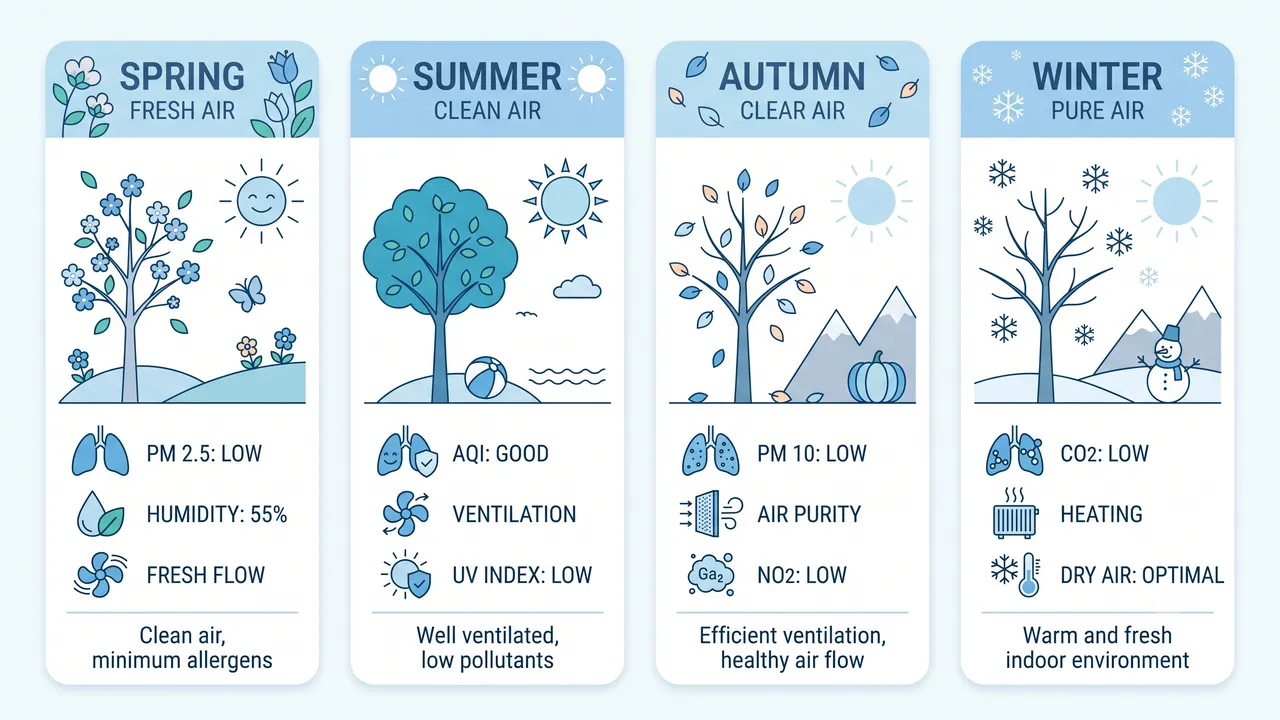
The Short Answer: Indoor air quality changes with seasons. Spring: pollen (run purifier on high, keep windows closed). Summer: humidity (use dehumidifier, maintain 45-50%). Fall: wildfire smoke (create clean room, run purifier on high). Winter: dry air (use humidifier, maintain 35-45%). Adjust your purifier settings seasonally for the best results.
Editor’s note (September 2026): The Winix 5500-2 has been discontinued and remaining stock is limited. Winix’s official successor is the Winix 5510, which adds app control and uses a new filter. Read our Winix 5510 vs 5500-2 comparison before you buy either one.
The seasonal reality
Indoor air quality isn’t static. It changes dramatically with the seasons as outdoor conditions shift, HVAC usage patterns change, and different pollutant sources become active. A strategy that works beautifully in January might be completely inadequate in July.
Here’s what to expect in each season, and the specific adjustments that make the biggest difference.
Spring (March-May): pollen invasion
The problem: Tree pollen peaks in early spring (March-April in most of the U.S.), grass pollen in late spring (May-June). A single birch tree can release 5 million pollen grains per day, and those grains. Typically 10-40 microns. Easily infiltrate homes through open windows, on clothing, and on pets.
Indoor pollen levels can reach 40-60% of outdoor levels even with windows closed, according to a 2018 study in the journal Aerobiologia. With windows open (as people naturally do in pleasant spring weather), indoor and outdoor levels become nearly identical.
What to do:
- Keep windows closed during peak pollen hours (5 AM to 10 AM, when most plants release pollen) and on high-pollen-count days. Check pollen counts on weather.com or Pollen.com.
- Run your air purifier on medium or high during the day, especially in the bedroom. Pollen grains are large enough to settle, but they’re constantly resuspended by movement.
- Change clothes and shower before bed if you’ve been outdoors. Pollen on your hair and clothing transfers to your pillow.
- Upgrade your HVAC filter to MERV 11-13 and run the fan continuously during peak pollen weeks. Read our MERV guide for more.
- Clean or replace your purifier’s pre-filter more frequently. Pollen loads up pre-filters faster than everyday dust.
Read our allergy guide for more on pollen management.
Summer (June-August): humidity and mold
The problem: Warm air holds more moisture, and in much of the U.S., summer means outdoor humidity above 70%. That humidity infiltrates homes and, when indoor levels exceed 60%, creates conditions for mold growth and dust mite proliferation. Dust mite populations can double in as little as 3 weeks at 70% humidity. And their allergenic feces become airborne and trigger symptoms.
Summer also brings increased indoor VOC levels as heat accelerates off-gassing from furniture, flooring, and building materials. A 2019 study in Indoor Air found that indoor formaldehyde concentrations increase by approximately 30-50% for every 10F increase in temperature.
What to do:
- Run a dehumidifier in the basement or main living area, set to maintain 45-50% humidity. Read our humidity guide for more.
- Use air conditioning (which dehumidifies as a side effect of cooling) rather than opening windows on humid days.
- Run bathroom exhaust fans for 30 minutes after showering, and kitchen exhaust when cooking. Read our kitchen guide for more.
- Your air purifier’s carbon filter will saturate faster due to higher VOC levels. Check it monthly.
- Avoid VOC-heavy activities (painting, using strong cleaning products, applying certain adhesives) during summer unless you can ventilate aggressively.
Fall (September-November): wildfire smoke and autumn allergens
The problem: Ragweed pollen peaks in late summer through fall, affecting roughly 23 million Americans. Simultaneously, wildfire season in the western U.S. now extends through November, with smoke plumes traveling thousands of miles.
The fall of 2023 demonstrated how extreme this can become: Canadian wildfire smoke turned New York City’s sky orange and pushed the AQI to 484, temporarily making it the most polluted city on Earth. Even homes thousands of miles from active fires experienced indoor PM2.5 levels 3-5 times above normal.
What to do:
- Create a “clean room”, typically a bedroom, with a properly sized HEPA purifier, sealed windows, and weather stripping around the door.
- Run the purifier on high during active smoke events. Noise is a secondary concern to particulate exposure.
- Upgrade to MERV 13 HVAC filter and run the fan continuously. Read our MERV guide for more.
- Avoid creating indoor particles. No vacuuming (unless HEPA), no frying or broiling, no candles or incense.
- Monitor outdoor AQI on AirNow.gov and keep windows sealed when AQI exceeds 100.
Read our wildfire smoke guide for more detailed instructions.
Winter (December-February): dry air and trapped pollutants
The problem: Cold outdoor air holds very little moisture. When it’s heated indoors, the relative humidity can drop to 15-25%. Well below the 30% minimum recommended for respiratory comfort. Dry air irritates nasal passages and airways, making you more susceptible to respiratory infections. A 2020 study in the Annual Review of Virology found that low humidity impairs the mucosal immune response in the respiratory tract.
Simultaneously, homes are sealed tight against the cold, trapping indoor-generated pollutants (cooking particles, VOCs from cleaning, CO2 from respiration) with minimal fresh air exchange.
What to do:
- Use a humidifier in bedrooms, set to maintain 35-45% humidity. Ultrasonic humidifiers should use distilled water to avoid “white dust” (aerosolized minerals that your air purifier will detect as PM2.5).
- Run your air purifier continuously. With windows sealed, indoor-generated particles have nowhere to go.
- Ventilate briefly on mild winter days (above 40F, with good outdoor AQI). 10 minutes with windows open flushes accumulated CO2 and VOCs.
- Monitor CO2 with an air quality monitor. Levels above 1,500 ppm in winter indicate insufficient ventilation. Even 5 minutes of window opening drops CO2 dramatically.
- Clean humidifiers weekly to prevent microbial growth. A dirty humidifier aerosolizes bacteria and mold, defeating the purpose.
The seasonal purifier settings guide
| Season | Main Threat | Purifier Speed | Windows | Extra Equipment |
|---|---|---|---|---|
| Spring | Pollen | Medium-High | Closed | MERV 11-13 HVAC filter |
| Summer | Humidity/Mold | Auto | Closed (A/C) | Dehumidifier |
| Fall | Smoke/Ragweed | High | Closed | MERV 13 HVAC filter |
| Winter | Dry air/Trapped pollutants | Medium | Brief ventilation | Humidifier |
Year-round habits
Regardless of season:
- Replace HVAC filters on schedule. Every 90 days for 1-inch filters, every 6-12 months for 4-inch media cabinets.
- Vacuum with a HEPA vacuum at least twice weekly in high-traffic areas.
- Keep indoor humidity between 30-50%. The goldilocks zone where mold can’t grow and airways aren’t irritated by dryness.
- Test for radon if you haven’t in the past 2 years. Radon levels don’t change seasonally the way other pollutants do, but testing is the only way to know.
The seasonal rotation strategy
Different seasons demand different purifier settings and strategies. Spring (pollen): run high in bedroom, keep windows closed, shower before bed to remove pollen from hair. Summer (humidity + ozone): if using A/C, the coil condensation helps dehumidify and pre-filter incoming air. Run purifier on auto and save on electricity. Fall (ragweed + leaf mold): similar to spring pollen strategy but add a humidity monitor. Fall rains can spike indoor humidity and enable mold. Winter (tightly sealed home + gas heating): CO2 buildup is the hidden villain. Use a CO2 monitor and periodically air out even in cold weather.
Many purifier owners set one speed and forget it year-round. A purifier running on medium in January is handling 1/3 the particulate load of the same purifier in May during peak pollen. Adjust seasonally.
Electricity costs by season
Purifier electricity costs vary by season based on speed settings:
| Season | Typical Speed | Watts | Monthly Cost | Annual Cost |
|---|---|---|---|---|
| Spring | Medium-High | 35-55W | $3.50-5.50 | $10-17 |
| Summer | Auto | 20-40W | $2.00-4.00 | $6-12 |
| Fall | High | 55-65W | $5.50-6.50 | $11-13 |
| Winter | Medium | 25-35W | $2.50-3.50 | $8-11 |
| Annual Total | $35-53 |
Based on average US electricity rate of $0.15/kWh
Calculate your exact electricity cost based on your local rate.
Filter replacement by season
| Season | Filter Stress | Replacement Frequency |
|---|---|---|
| Spring | High (pollen) | Check monthly, replace every 6 months |
| Summer | Moderate (humidity) | Check monthly, replace every 8 months |
| Fall | High (smoke/ragweed) | Check monthly, replace every 6 months |
| Winter | Low (sealed home) | Check monthly, replace every 12 months |
Read our filter replacement guide for more on maintenance.
Related Articles
- Wildfire Smoke Air Purifier Guide
- Best Air Purifier for Allergies
- Air Purifier and Humidity Interaction Guide
- MERV Ratings Explained
Frequently Asked Questions
How long does it take for an air purifier to help with allergies?
Most people notice improvement within 24-48 hours of continuous operation. For maximum benefit, run the purifier 24/7 on medium. It takes about 30-60 minutes to complete one full air change in a typical bedroom.
Do air purifiers help with dust mites?
Yes, HEPA purifiers capture airborne dust mite allergens (feces and body fragments). However, dust mites also live in bedding, carpets, and upholstery. Combine air purification with allergen-proof mattress and pillow covers for best results.
Should I run the air purifier with windows open?
No, for allergy relief keep windows closed during high pollen days. The purifier works by cleaning the air already in the room—open windows introduce new allergens. Use the purifier’s air quality sensor (if available) to monitor when to ventilate.
Can air purifiers make allergies worse?
Only if they produce ozone (ionizers, some UV-C models). Ozone is a respiratory irritant that can worsen allergy symptoms. Choose only True HEPA mechanical filtration without ionizers. If you notice increased symptoms, check if your purifier has an ionizer feature and disable it.
Where should I place the air purifier for allergies?
Place it in the bedroom (where you spend 7-9 hours) near the bed but not blowing directly on you. Avoid corners and curtains that block airflow. For severe allergies, consider a second unit in the living room or home office.
Disclosure: We may earn a commission from qualifying purchases. Seasonal guidance based on EPA and CDC recommendations.
Support This Guide
Helpful? Add The Air Purifier Guide as a preferred source on Google so our guides show up in your search results.
Related Articles

Air Purifier for Asthma Attacks at Night: What the Science Says
Nighttime asthma attacks have a bedroom trigger pattern — dust mites, dander, and allergens that accumulate where you sleep. Here's what HEPA filtration can do, what the studies show, and the full bedroom protocol.

Best Air Purifier for Wildfire Season 2027: Prepare Before the Sky Turns Orange
Wildfire season is coming. Here's what 2026's fires taught us about purifier sizing, the CADR specs that matter for smoke, and the units to buy before demand spikes.

Wildfire Smoke Season 2026: What to Expect and How to Prepare
Wildfire season 2026 outlook: the regions at risk, what the forecasts say, and the 5-step preparation plan — including which purifiers actually hold the line.

What Is a Good AQI Level? The Complete Guide to Air Quality Numbers
What AQI is 'good'? Here's the complete AQI scale explained — what each number means, who should care, and when to act.

AQI vs PM2.5: What's the Difference and Why It Matters
AQI and PM2.5 are everywhere in air quality news — but they're not the same thing. Here's what each number means and how to use them.
🛒 Products Mentioned
As an Amazon Associate, we earn from qualifying purchases.
Covers indoor air quality science, respiratory health, allergy management, and wildfire smoke protection.
View all articles by Sarah →