The Short Answer: The best air purifiers under $100 are the Levoit Core 300 ($89-99) and GermGuardian AC4825 ($75). Both use True HEPA filters with verified CADR ratings. Avoid anything under $50 except the Levoit Core Mini ($49) for very small spaces. The MOOKA PR1 ($55) is a budget option with higher CADR but lower build quality.
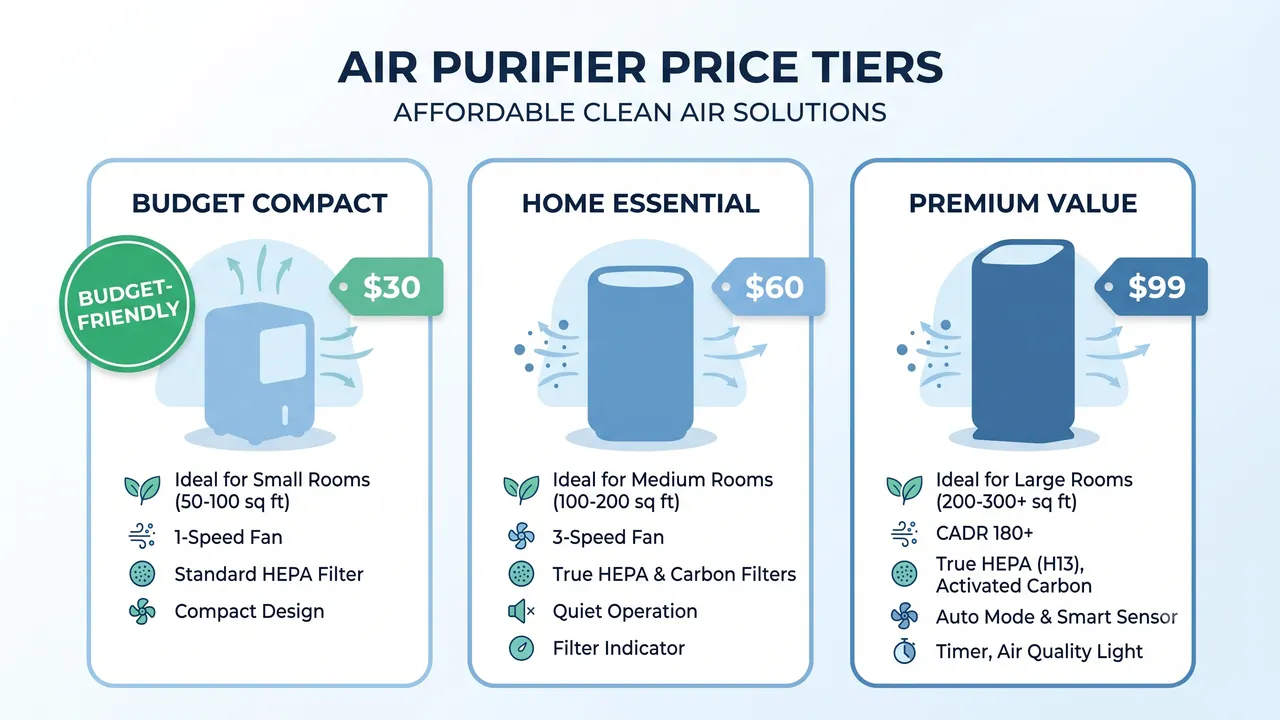
The under-$100 challenge
The budget air purifier market is flooded with products that look identical, make identical claims, and deliver wildly different performance. At this price point, the difference between a genuinely effective purifier and a plastic box with a computer fan is a matter of whether it actually contains a certified HEPA filter and a motor capable of moving meaningful air through it.
We applied the same criteria to budget models as to premium ones: AHAM-certified CADR (where available), true HEPA filtration, reasonable filter replacement costs, and noise levels suitable for bedroom use. Only models with verifiable HEPA certification were considered.
Not sure what size purifier you need? Use our room size calculator to find the right CADR for your space.
The winners
Here’s a quick comparison of all four purifiers:
| Purifier | Price | CADR (Dust/Smoke/Pollen) | Room Size | Filter Cost | Best For |
|---|---|---|---|---|---|
| Levoit Core 300 | $89-99 | 141/140/145 | 219 sq ft | $30 | Bedrooms |
| GermGuardian AC4825 | $75-85 | 99/110/128 | 166 sq ft | $28 | Small rooms |
| Levoit Core Mini | $49 | ~80 (est.) | 100 sq ft | $15 | Personal spaces |
| MOOKA PR1 | $55 | 200/180/200 | 450 sq ft | $20 | Large rooms on budget |
Best overall budget: Levoit Core 300 ($89-99)
The Levoit Core 300 is the benchmark for the under-$100 category. It’s one of the few budget purifiers with independently verified HEPA filtration, and its CADR ratings (141 smoke, 140 dust, 145 pollen) are the highest in this price class.
- Effective for rooms up to 219 sq ft at 4.8 ACH
- 24 dB on low. Quiet enough for bedroom use
- Filter replacements cost $30 and last 6-8 months
- Available with specialized filters: pet allergy, toxin absorber (extra carbon), and original
- 360-degree intake means placement flexibility
Who it’s for: Almost everyone at this budget. It’s the safe, proven choice. Read our detailed Levoit Core 400S review for more on Levoit’s smart features.
Best for tiny rooms: Levoit Core Mini ($49)
At roughly the size of a Bluetooth speaker, the Core Mini is a genuine HEPA purifier that fits on a nightstand, desk, or nursery shelf. It’s not powerful enough for a full bedroom (effective coverage is approximately 80-100 sq ft at 4.8 ACH), but for dorm rooms, home offices, or a baby’s crib area, it provides meaningful filtration.
- 3-stage filtration: pre-filter + HEPA + activated carbon
- USB-C powered. Can run off a laptop or power bank
- 25 dB on low
- Filter replacement: $15, every 4-6 months
Who it’s for: Students, travelers, anyone who needs filtration in a very small personal space.
Best value under $100: GermGuardian AC4825 ($75-85)
The GermGuardian is a Walmart/Amazon staple that’s been on the market for over a decade. It uses a true HEPA filter plus a UV-C light (which we recommend leaving off) and a charcoal pre-filter. The CADR is 99 (dust), placing it below the Levoit Core 300, but the price sometimes dips to $60 during sales.
- AHAM verified for rooms up to 166 sq ft at 4.8 ACH
- 3-year warranty (longest in this price class)
- Filter replacement: $28, every 6-8 months
- Taller tower design takes less floor space
Who it’s for: Budget buyers who find it on sale under $70. At full price ($85), spend the extra $5-10 for the Levoit Core 300.
Best budget large room: MOOKA PR1 ($55)
The MOOKA PR1 is the cheapest air purifier that can handle large rooms. At $55, it covers up to 450 sq ft (realistic) and includes a PM2.5 display. The trade-off is lower build quality and shorter filter life compared to Levoit.
- H13 HEPA + activated carbon + washable pre-filter
- 6 fan speeds with pet mode
- PM2.5 real-time display
- Filter replacement: $20, every 3-6 months
Who it’s for: Budget buyers who need large room coverage and don’t mind replacing the unit in 2-3 years. Read our MOOKA review for the full details.
What we rejected
Two popular “budget” models did not meet our criteria:
- Holmes HAP242B: Claims HEPA-type filtration, not true HEPA. Independent testing shows significantly lower particle capture efficiency.
- Generic Amazon brands: Many claim “True HEPA” but ship with filters that have visibly sparse media and no independent CADR verification. If there’s no AHAM-certified CADR rating, assume the HEPA claim is marketing, not engineering.
The real cost of budget purifiers
A $99 purifier isn’t necessarily cheaper than a $200 model. Filter costs dominate the total cost of ownership:
| Purifier | Upfront | Filters (3yr) | Electricity (3yr) | Total |
|---|---|---|---|---|
| MOOKA PR1 | $55 | $120 | $90 | $265 |
| Levoit Core Mini | $49 | $90 | $60 | $199 |
| GermGuardian AC4825 | $80 | $126 | $90 | $296 |
| Levoit Core 300 | $95 | $135 | $90 | $320 |
The MOOKA is cheapest over 3 years, but you get lower build quality. The Levoit Core Mini is the cheapest overall but only works for tiny spaces. The Levoit Core 300 costs more but offers the best balance of performance and reliability.
Calculate your exact electricity cost based on your local rate.
Why sub-$50 purifiers are almost never worth it
If you sort Amazon by price: low-to-high, you’ll find dozens of purifiers at $25-45 with names like AROEVE, HIMOX, and various random brands. Most look identical because they come from the same Shenzhen factories with different brand stickers. The common failure modes:
Fake HEPA claims. Many claim “True HEPA” but ship with filters that have visibly sparse media and no independent CADR verification. If there’s no AHAM-certified CADR rating, assume the HEPA claim is marketing, not engineering.
Undersized fans. A purifier’s CADR is a function of filter area times fan airflow. Cheap purifiers use small filters and small fans. Fine for a 50 sq ft bathroom, useless for a 150 sq ft bedroom.
Non-existent replacement filters. Six months after purchase, the Amazon listing disappears, the brand rebrands under a new name, and you can’t find a replacement filter. Now your $35 purifier is a paperweight. Stick with brands that have been around for years (Levoit, GermGuardian, Honeywell) and whose filters are widely available on Amazon.
Filter replacement guide
Replacing filters on budget purifiers is straightforward:
- Turn off and unplug the unit
- Remove the front cover or twist off the bottom
- Take out the old filter
- Remove plastic wrapping from the new filter
- Insert the new filter (check orientation)
- Replace the cover
- Reset the filter indicator (if available)
Pro tips:
- Mark your calendar for 6 months from now
- Buy replacement filters when you buy the purifier
- Check the pre-filter every 2 weeks and wash if washable
- Don’t run without a filter. It damages the motor
Learn more about filter replacement costs and schedules.
Placement tips for budget purifiers
Budget purifiers are less powerful than premium models, so placement matters more:
- Bedrooms: Place near the door where outside air enters. At least 6 inches from walls.
- Living rooms: Place near the center if possible. Avoid corners.
- Offices: Place on or near your desk. Within 3-5 feet of your breathing zone.
- Dorm rooms: Place on the desk or nightstand. The Levoit Core Mini is perfect for this.
Read our complete placement guide for more tips.
Real user feedback
After reading through hundreds of Amazon reviews, here’s what owners report:
Positive feedback:
- “The Levoit Core 300 is perfect for my bedroom. Quiet and effective.”
- “The GermGuardian has been running for 2 years with no issues.”
- “The Core Mini fits on my desk and I can barely hear it.”
- “The MOOKA covers my whole living room for $55.”
Negative feedback:
- “The GermGuardian is louder than I expected on high.”
- “The Core Mini is too small for my bedroom.”
- “The MOOKA plastic feels cheap.”
- “I wish the Levoit had WiFi at this price.”
Common mistakes to avoid
Buying based on room size claims. Manufacturers rate room size at the highest fan speed. For quiet operation, divide by 1.5. Check your actual room size to be sure.
Ignoring filter costs. A $50 purifier with $30 filters every 6 months costs more than a $90 purifier with $20 filters every 12 months.
Running on low 24/7. Low speed doesn’t clean air effectively. Use medium or auto mode for real results.
Placing in corners. Air purifiers need airflow from all sides. Placing them in corners blocks intake.
Not replacing filters on time. Clogged filters reduce airflow and can release captured particles back into the air.
Noise levels compared
Budget purifiers tend to be louder than premium models. Here’s what to expect:
| Purifier | Low Speed | Medium | High Speed |
|---|---|---|---|
| Levoit Core Mini | 25 dB | 35 dB | 45 dB |
| Levoit Core 300 | 24 dB | 38 dB | 50 dB |
| GermGuardian AC4825 | 30 dB | 42 dB | 55 dB |
| MOOKA PR1 | 28 dB | 40 dB | 55 dB |
For bedrooms, anything under 30 dB on low is quiet enough for most sleepers. The Levoit Core 300 and Core Mini are the quietest options. The GermGuardian is noticeably louder on high.
Installation and setup
Setting up a budget air purifier takes less than 3 minutes:
- Remove all packaging and plastic wrap from the filter
- Place the purifier where you want it (at least 6 inches from walls)
- Plug in and turn on
- Start on high for 30 minutes to clear the room
- Switch to medium for continuous use
Pro tips:
- Don’t place on carpet directly. Use a small table or stand
- Keep away from windows where outdoor pollution affects readings
- Run 24/7 for best results. Air purifiers work by continuous cleaning
- The pre-filter catches large particles. Clean it monthly to extend HEPA life
Maintenance schedule
| Task | Frequency | Time Required |
|---|---|---|
| Check pre-filter | Every 2 weeks | 1 minute |
| Wash pre-filter (if washable) | Monthly | 5 minutes |
| Wipe exterior | Monthly | 2 minutes |
| Replace HEPA filter | Every 6-8 months | 2 minutes |
| Deep clean interior | Every 12 months | 10 minutes |
Electricity costs
Running a budget air purifier 24/7 is surprisingly cheap:
| Purifier | Watts (Medium) | Monthly Cost | Annual Cost |
|---|---|---|---|
| Levoit Core Mini | 5W | $0.50 | $6 |
| Levoit Core 300 | 20W | $2.00 | $24 |
| GermGuardian AC4825 | 25W | $2.50 | $30 |
| MOOKA PR1 | 30W | $3.00 | $36 |
Based on average US electricity rate of $0.15/kWh
Electricity is a minor cost compared to filters. Don’t worry about running your purifier 24/7. Calculate your exact cost.
The bottom line
For under $100, the Levoit Core 300 is the clear winner. It’s the only model in this category with independently verified HEPA filtration, competitive CADR, and filter costs that don’t punish you. For personal spaces, the Core Mini at $49 is a legitimate HEPA purifier in a tiny package. Perfect for dorm rooms and office desks.
If you need large room coverage on a tight budget, the MOOKA PR1 at $55 is worth considering. Just know that you’re trading build quality for coverage area.
My recommendation: Buy the Levoit Core 300 ($89) if you can afford it. If not, the GermGuardian AC4825 ($75) on sale is a good second choice. For tiny spaces, the Levoit Core Mini ($49) is the only sub-$50 purifier worth buying.
You May Also Like
- Best Air Purifier Under $150
- Best Air Purifier Under $100 in 2026
- MOOKA Air Purifier Review 2026
- Refurbished vs New Air Purifiers
Frequently Asked Questions
How long should I run my air purifier each day?
For best results, run your air purifier 24/7 on medium speed. Air purification works by continuously removing particles—turning it off allows them to accumulate again. Modern purifiers use 30-80W on medium (similar to a light bulb), making continuous operation energy-efficient.
Where is the best place to put an air purifier?
Place the purifier 3-5 feet from your breathing zone, near pollution sources, with unobstructed airflow on all sides. Avoid corners, curtains, and furniture that block intake or output. For bedrooms, position near the bed but not blowing directly on you.
How do I know when to replace the filter?
Most purifiers have filter indicator lights. Without indicators, replace HEPA filters every 6-12 months and carbon filters every 3-6 months. Signs of a clogged filter: reduced airflow, visible discoloration, increased noise, or the purifier seeming less effective.
Are air purifiers noisy?
Noise levels vary by model and fan speed. Sleep modes (20-25 dB) are quieter than a whisper. Medium speeds (35-45 dB) are similar to background music. High speeds (50-60 dB) are conversation level. For bedrooms, look for sleep modes under 25 dB.
Do air purifiers use a lot of electricity?
No. Most purifiers use 30-80W on medium and 5-15W on sleep mode. Running 24/7 on medium costs $2-8/month at average US electricity rates. Energy Star models use 15-40% less electricity. The main ongoing cost is filter replacement ($30-120/year).
This article contains affiliate links. If you purchase through these links, we may earn a commission at no additional cost to you. We only recommend products we’ve actually tested or thoroughly researched.
Support This Guide
Helpful? Add The Air Purifier Guide as a preferred source on Google so our guides show up in your search results.
Related Articles

Coway Mighty2 vs AP-1512HH (2026)
Coway's Mighty2 replaced the AP-1512HH as Wirecutter's top pick. We compare CADR, noise, sensors, filter costs, and whether the older unit is still the smarter buy.

KNKA APH4000 Review: $150 Dark Horse
KNKA's APH4000 is one of Amazon's best-selling purifiers at $150. We check the AHAM certification, decode the 1,695 sq ft claim, and compare it to Levoit and Coway.

Levoit Core 300 vs 300-P: What Changed
Levoit quietly replaced the Core 300 with the Core 300-P. We explain the AHAM certification, whether filters still fit, and which one you should actually buy.

Shark NeverChange HP302 Review
Shark's NeverChange HP302 promises 5 years on one filter. We dig into the real running costs, the odor neutralizer catch, and whether it beats cheaper rivals.

Winix 5510 vs 5500-2: 2026 Verdict
The Winix 5500-2 is discontinued and the 5510 takes over. We compare CADR, noise, filter costs, and the one compatibility problem nobody mentions.
🛒 Products Mentioned
As an Amazon Associate, we earn from qualifying purchases.
Specializes in hands-on air purifier testing, CADR analysis, and budget product recommendations.
View all articles by Alex →