Editor’s note (September 2026): The Winix 5500-2 has been discontinued and remaining stock is limited. Winix’s official successor is the Winix 5510, which adds app control and uses a new filter. Read our Winix 5510 vs 5500-2 comparison before you buy either one.
The Short Answer: Manufacturer-certified refurbished air purifiers are worth it. You save 20-40% off retail with a 1-year warranty and new filter. The Coway AP-1512HH ($140 refurbished vs $190-230 new) is the best deal. Avoid third-party refurbishers with short warranties. Avoid refurbished budget purifiers (under $80 new) because the savings are too small.
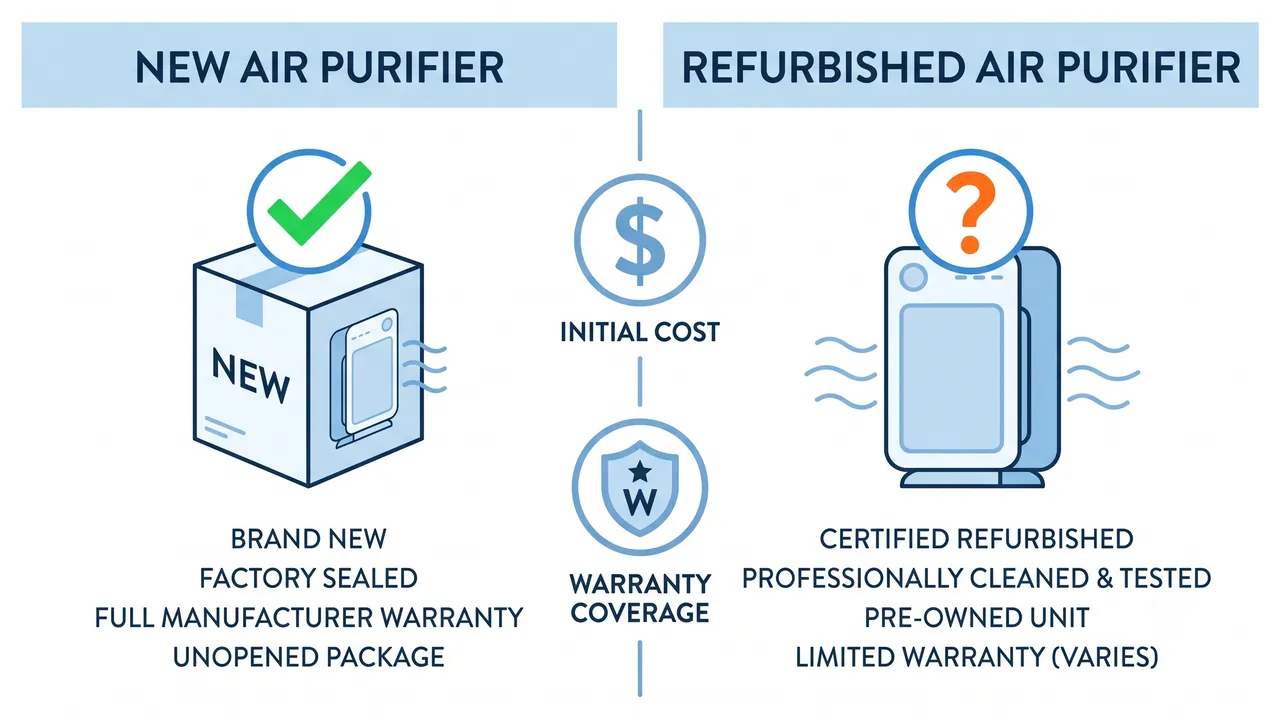
Types of refurbished units
Manufacturer-certified refurbished: Coway, Blueair, and Winix all offer refurbished units directly through their websites. These are tested to like-new specifications, include new filters, and come with a warranty. Often the same warranty as new units. This is the gold standard and the only refurbished category we recommend without reservation.
Amazon Renewed: A middle ground. Units are inspected and tested by Amazon-qualified suppliers and come with a 90-day Amazon Renewed Guarantee. Quality varies by supplier. Check reviews of the specific Renewed seller before purchasing.
Third-party refurbishers (eBay, Walmart Marketplace): The riskiest option. Warranties are short or nonexistent. Filters may be used. No guarantee the unit was actually refurbished rather than just cleaned and repackaged. Avoid unless the seller has thousands of positive reviews specifically for refurbished air purifiers.
Which brands offer the best refurbished deals
| Model | Refurbished Price | New Price | Savings | Warranty |
|---|---|---|---|---|
| Coway AP-1512HH | $140 | $190-230 | 26-39% | 1 year |
| Winix 5500-2 | $120 | $159-190 | 25-37% | 1 year |
| Blueair 411i Max | $100 | $140-160 | 29-38% | 1 year |
| Levoit Core 300 | $70 | $89-99 | 21-29% | 1 year |
| Budget models (<$80 new) | $45-60 | $60-80 | 15-25% | 90 days |
Avoid refurbished budget purifiers (under $80 new): The discount on a $60 purifier might be $15. Not meaningful enough to justify any risk. Read our budget purifier guide for new budget options.
What to check before buying refurbished
- Warranty period: Manufacturer refurbished should have at least a 1-year warranty. 90 days is the absolute minimum.
- New filter included: The unit must ship with a new, sealed filter. A used filter defeats the purpose.
- Return policy: At least 30 days, free return shipping preferred.
- Cosmetic condition: Minor scratches are acceptable; dents or cracks are not.
- Serial number: Verify the serial number is valid and not reported stolen.
The hidden costs of refurbished
Refurbished units almost never include free shipping both ways. A new Coway AP-1512HH from Amazon ships free and comes with free returns. A refurbished unit from the Coway website might charge $15-25 for shipping and another $15 for return shipping if something’s wrong. Suddenly your $50 savings is $20. And you’ve lost the frictionless return experience.
Check the math on filter costs too. If a refurbished unit arrives with a “new” filter that’s actually been sitting in a warehouse for 18 months, the carbon component has already been passively adsorbing warehouse air. Activated carbon doesn’t last forever on a shelf. It slowly loses capacity. A genuinely new filter from a sealed package eliminates this variable.
Also verify whether the refurbished unit comes with the latest filter revision. Manufacturers occasionally update filter designs. A refurbished Coway from 2023 might ship with the older filter spec that doesn’t fit the current replacement filters on Amazon. Annoying, but fixable if you catch it during the return window.
Read our filter replacement guide for more on filter costs and compatibility.
When refurbished is actually better than new
Sounds counterintuitive, but there’s a case for it. Refurbished units are individually tested. A new unit rolls off the assembly line, gets boxed, and ships. Quality control catches defects, but it’s statistical. A small percentage of new units have out-of-box issues. A manufacturer-refurbished unit has been opened, inspected, tested, and certified by a human being.
That individual attention means refurbished units sometimes have a lower defect rate than brand-new units straight from the factory. Coway in particular runs their refurbished units through the same test protocol as new production, then adds the refurbishment-specific checks. You’re essentially buying a unit that’s passed QC twice.
Anecdotally, several HVAC professionals we’ve spoken with actually prefer manufacturer-refurbished units for their own homes. The logic: a unit that’s been running for 6 months and then professionally refurbished has already proven its motor and electronics work under load. A brand-new unit hasn’t.
The Amazon Renewed gray zone
Amazon Renewed sits in a weird middle ground between manufacturer-refurbished and third-party. The 90-day guarantee is better than nothing but worse than the 1-year warranty you get from Coway or Winix direct. The “qualified supplier” inspection is Amazon’s standard, not the manufacturer’s.
If you go Amazon Renewed, three rules:
- Buy only models where the Renewed seller is the manufacturer itself or a seller with 1,000+ reviews at 95%+ positive.
- Open the unit immediately and run it on high for 24 hours straight. Any motor bearing noise or electronic whine should show up fast.
- Register the serial number with the manufacturer within the return window to confirm it qualifies for warranty service. Some manufacturers honor warranties on Renewed units bought through Amazon; some don’t. Check before the return window closes.
What to actually inspect when it arrives
Beyond the obvious (dents, cracks, filter condition), check these:
- Motor sound on startup: Turn the unit on from cold. A healthy motor spins up smoothly. A grinding, clicking, or rumbling at startup suggests bearing wear.
- Fan speed consistency: Cycle through every speed. Listen for changes in pitch that suggest an unbalanced fan blade.
- Air quality sensor: If the unit has one, breathe directly on the sensor. The indicator should change within 10-15 seconds.
- Ionizer/PlasmaWave functionality: If equipped, toggle it on/off while listening near the unit. You should hear a faint change in electrical hum if it’s working.
- WiFi/app pairing (smart purifiers): Refurbished smart units sometimes retain the previous owner’s pairing. Factory reset before attempting setup.
Refurbished vs new: total cost of ownership
Let’s compare the 3-year total cost of refurbished vs new:
| Model | Refurbished (3yr) | New (3yr) | Savings |
|---|---|---|---|
| Coway AP-1512HH | $389 | $459 | $70 |
| Winix 5500-2 | $340 | $435 | $95 |
| Blueair 411i Max | $280 | $350 | $70 |
| Levoit Core 300 | $245 | $320 | $75 |
The savings are meaningful over 3 years. $70-95 adds up, especially if you’re buying multiple units for different rooms.
My recommendation
Buy refurbished if:
- You find a manufacturer-certified unit with a 1-year warranty
- New filters are included
- The savings are at least $30-40
- You’re comfortable with minor cosmetic imperfections
Buy new if:
- You want the latest model with all features
- You prefer the peace of mind of a full warranty
- The refurbished savings are less than $20
- You’re buying a budget model (under $80 new)
Never buy refurbished if:
- The warranty is less than 90 days
- No new filter is included
- The seller has few or no reviews
- The unit is from an unknown brand
Where to buy refurbished
| Source | Quality | Warranty | Return Policy |
|---|---|---|---|
| Manufacturer website | Excellent | 1 year | 30 days |
| Amazon Renewed | Good | 90 days | 30 days |
| eBay | Risky | Varies | Varies |
| Walmart Marketplace | Risky | Varies | Varies |
Best bet: Buy directly from the manufacturer (Coway, Winix, Blueair) or from Amazon Renewed with the manufacturer as the seller.
You May Also Like
- Best Air Purifier Under $150
- Best Air Purifier Under $100 in 2026
- Best Air Purifier for Cat Litter Smell
- Best Budget Air Purifiers Under $100
Frequently Asked Questions
How long should I run my air purifier each day?
For best results, run your air purifier 24/7 on medium speed. Air purification works by continuously removing particles—turning it off allows them to accumulate again. Modern purifiers use 30-80W on medium (similar to a light bulb), making continuous operation energy-efficient.
Where is the best place to put an air purifier?
Place the purifier 3-5 feet from your breathing zone, near pollution sources, with unobstructed airflow on all sides. Avoid corners, curtains, and furniture that block intake or output. For bedrooms, position near the bed but not blowing directly on you.
How do I know when to replace the filter?
Most purifiers have filter indicator lights. Without indicators, replace HEPA filters every 6-12 months and carbon filters every 3-6 months. Signs of a clogged filter: reduced airflow, visible discoloration, increased noise, or the purifier seeming less effective.
Are air purifiers noisy?
Noise levels vary by model and fan speed. Sleep modes (20-25 dB) are quieter than a whisper. Medium speeds (35-45 dB) are similar to background music. High speeds (50-60 dB) are conversation level. For bedrooms, look for sleep modes under 25 dB.
Do air purifiers use a lot of electricity?
No. Most purifiers use 30-80W on medium and 5-15W on sleep mode. Running 24/7 on medium costs $2-8/month at average US electricity rates. Energy Star models use 15-40% less electricity. The main ongoing cost is filter replacement ($30-120/year).
Disclosure: We may earn a commission from qualifying purchases.
Support This Guide
Helpful? Add The Air Purifier Guide as a preferred source on Google so our guides show up in your search results.
Related Articles

Coway Mighty2 vs AP-1512HH (2026)
Coway's Mighty2 replaced the AP-1512HH as Wirecutter's top pick. We compare CADR, noise, sensors, filter costs, and whether the older unit is still the smarter buy.

KNKA APH4000 Review: $150 Dark Horse
KNKA's APH4000 is one of Amazon's best-selling purifiers at $150. We check the AHAM certification, decode the 1,695 sq ft claim, and compare it to Levoit and Coway.

Levoit Core 300 vs 300-P: What Changed
Levoit quietly replaced the Core 300 with the Core 300-P. We explain the AHAM certification, whether filters still fit, and which one you should actually buy.

Shark NeverChange HP302 Review
Shark's NeverChange HP302 promises 5 years on one filter. We dig into the real running costs, the odor neutralizer catch, and whether it beats cheaper rivals.

Winix 5510 vs 5500-2: 2026 Verdict
The Winix 5500-2 is discontinued and the 5510 takes over. We compare CADR, noise, filter costs, and the one compatibility problem nobody mentions.
🛒 Products Mentioned
As an Amazon Associate, we earn from qualifying purchases.
Runs side-by-side purifier comparisons, long-term ownership reports, and filter cost analysis.
View all articles by David →