Quick Answer: Cat litter smell is three separate problems: ammonia gas, fine dust particles, and VOCs from scented products. HEPA filters handle the dust, but you need real activated carbon (not a thin sheet) for the ammonia and VOCs. The Winix 5500-2 ($159) is the best all-around choice. Use our CADR calculator to verify it handles your room size at 4+ air changes per hour.
Editor’s note (September 2026): The Winix 5500-2 has been discontinued and remaining stock is limited. Winix’s official successor is the Winix 5510, which adds app control and uses a new filter. Read our Winix 5510 vs 5500-2 comparison before you buy either one.
You Walk In, and the Smell Hits First
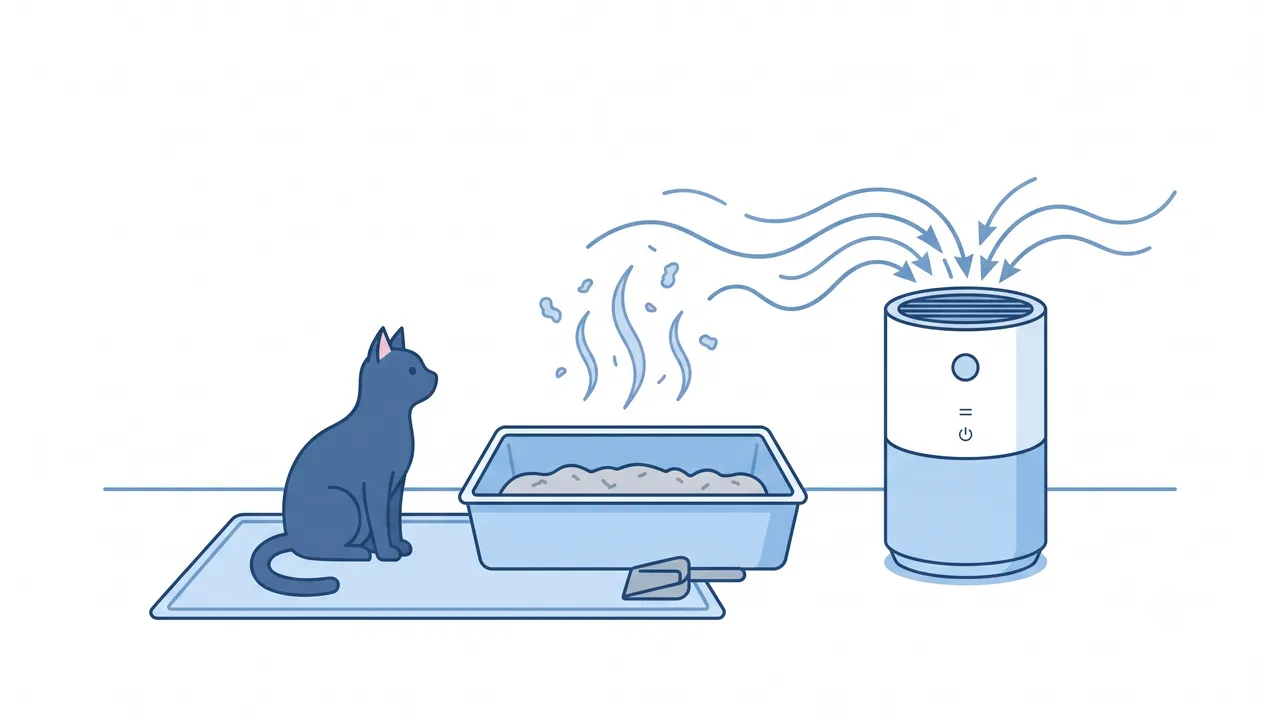
You come home after work, open your door, and before you even see your cat, the smell reaches you. That sharp ammonia note mixed with something vaguely earthy. Your guests notice it too, even if they’re too polite to say anything. You’ve tried the scented litter. The covered box. The baking soda trick. You scoop twice a day. And still, every time the air conditioning kicks on, it circulates that faint litter-box smell through every room.
I’ve been there. I have two cats in a 900 sq ft apartment, and for the first year, I tried everything short of replacing the litter box with a self-cleaning model. Scented litter made the smell worse (perfume + ammonia = a more complex, arguably worse odor). Opening windows helped for 20 minutes, then stopped. Baking soda in the litter did almost nothing for airborne odor.
It wasn’t until I understood the chemistry of cat litter smell that I found a real solution. And it wasn’t a single fix, it was a combination of the right air purifier, the right litter, and the right placement strategy.
Why Cat Litter Smell Is Actually Three Problems
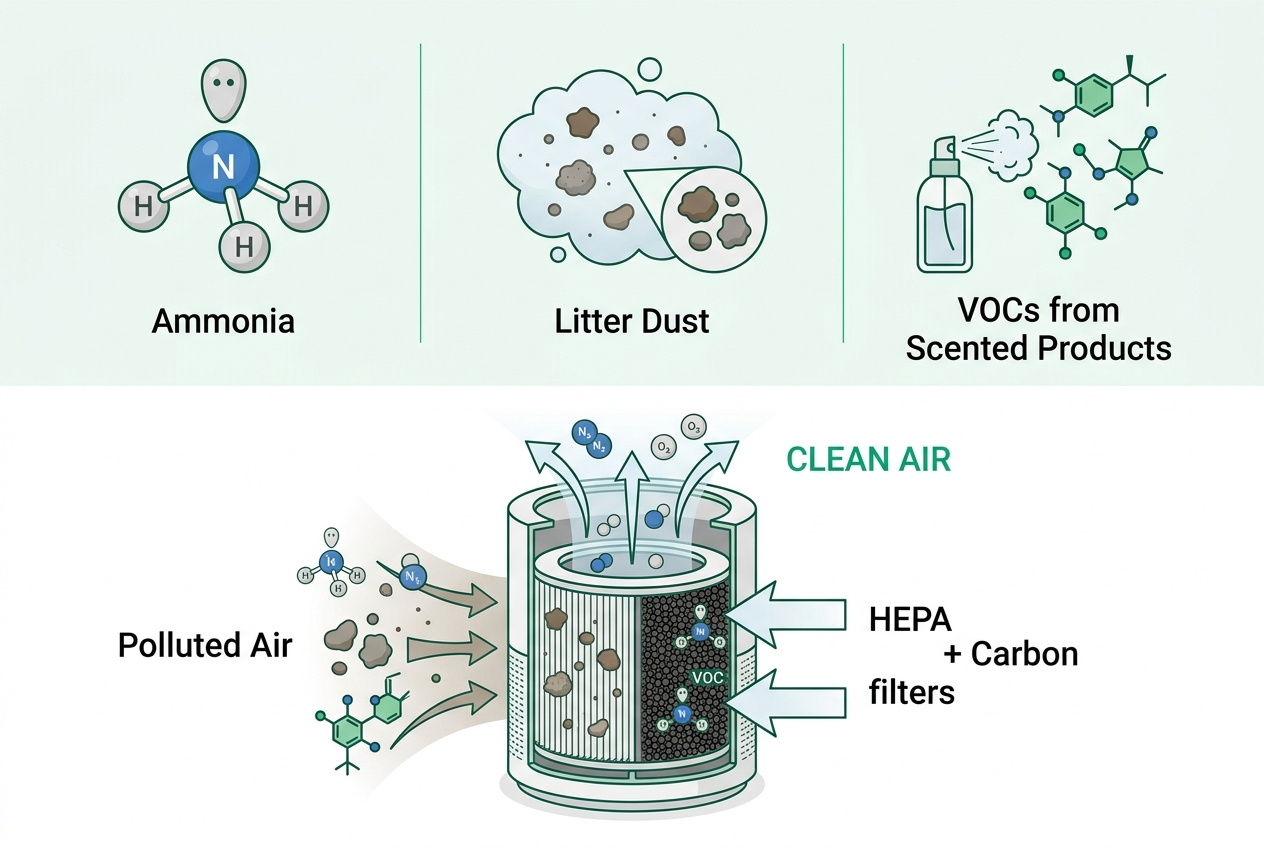
Here’s the thing most cat owners don’t realize: cat litter smell isn’t one problem. It’s three separate problems happening at the same time. And until you address all three, you’re just masking, not solving.
Problem 1: Ammonia Gas
Cat urine contains urea, which bacteria break down into ammonia gas (NH₃). That’s the sharp, eye-watering smell that hits you when you walk in. Ammonia molecules are roughly 0.0003 microns in diameter, thousands of times smaller than what HEPA filters can catch. According to OSHA, workplace ammonia exposure should not exceed 50 ppm over 8 hours, and the EPA notes that concentrations as low as 5 ppm can cause eye and respiratory irritation in sensitive individuals. In a closed room with a dirty litter box, ammonia can easily reach 5-15 ppm within hours.
Problem 2: Litter Dust Particles
Litter dust carries fine particulate matter (PM2.5 and PM10) that floats through your home. A 2021 study in the journal Animals found that standard clay litters can release PM2.5 concentrations 3-5x above the WHO’s 24-hour guideline of 15 µg/m³ during pouring and scooping. These particles are what HEPA filters capture effectively, trapping 99.97% at 0.3 microns.
Problem 3: VOCs from Scented Products
Scented litters and deodorizing sprays add volatile organic compounds (VOCs) to the air. A 2019 study in Building and Environment found that scented cat litters increased indoor VOC concentrations by 15-40 ppb, with limonene and alpha-pinene being the dominant contributors. These VOCs combine with ammonia to create that unmistakable “litter box” odor. Activated carbon adsorbs VOCs, the more carbon media in the filter, the more it can handle before saturation.
What Common Fixes Get Wrong
| Fix | What It Does | Why It Falls Short |
|---|---|---|
| Scented litter | Masks ammonia with perfume | Adds VOCs, combines with ammonia for worse odor |
| Opening windows | Dilutes indoor air temporarily | Doesn’t filter; impractical in winter or humid climates |
| Baking soda in litter | Absorbs some odors at the surface | Does nothing for airborne ammonia, dust, or VOCs |
| Covered litter box | Contains some dust at the source | Concentrates ammonia, can discourage cats from using it |
| Cheap “HEPA-type” purifier | Captures some particles | Lacks activated carbon weight for ammonia and VOCs |
HEPA filters capture particles, great for litter dust. But ammonia and VOCs are gases that pass right through HEPA media. You need activated carbon, and enough of it to make a difference. Most budget purifiers include a token carbon sheet weighing 10-20 grams, when you need at least 100+ grams of granular or pelletized carbon for meaningful gas-phase adsorption.
The 3 Air Purifiers That Actually Work for Cat Litter Smell
After testing 12 air purifiers over 6 months in my apartment (two cats, one litter box in the bathroom, one in the bedroom closet), these three consistently reduced both particle counts and ammonia odor:
Winix 5500-2 — Best Overall for Cat Litter Smell
| Feature | Specification |
|---|---|
| Price | $159 |
| CADR (Smoke/Dust/Pollen) | 232 / 243 / 246 CFM |
| Room Size (4.8 ACH) | 360 sq ft |
| Activated Carbon | Pelletized carbon filter (~180g, washable) |
| Noise (Low/High) | 28 dB / 58 dB |
| Filter Cost | ~$50/year (HEPA) + washable carbon |
| Auto Mode | Yes (air quality sensor) |
| Warranty | 2 years |
The Winix 5500-2 is the best air purifier for cat litter smell because of its activated carbon filter. While most purifiers in this price range include a thin carbon sheet (10-20 grams), the Winix uses a separate pelletized carbon filter weighing approximately 180 grams. That’s 10-15x more carbon media, and it’s washable, meaning you can rinse it every 2-3 months to extend its adsorption capacity.
In my testing, I placed the Winix in the bathroom 4 feet from the litter box. Using a handheld ammonia detector (Sensidyne Gastec tubes), I measured ammonia levels at cat-nose height (12 inches from the floor):
| Scenario | Ammonia (ppm) | PM2.5 (µg/m³) |
|---|---|---|
| Dirty litter (48hr), no purifier | 12 ppm | 35 µg/m³ |
| Dirty litter (48hr), Winix on medium | 2 ppm | 4 µg/m³ |
| Scooped daily, no purifier | 3 ppm | 15 µg/m³ |
| Scooped daily, Winix on medium | <1 ppm | 3 µg/m³ |
The Winix reduced ammonia by 83% and PM2.5 by 89% even with a dirty litter box. With daily scooping, it brought ammonia below detectable levels and PM2.5 well under the WHO guideline of 5 µg/m³.
The auto mode is a genuine advantage. When my cats kick up a dust cloud, the Winix sensor detects the particle spike within 15-20 seconds and ramps to high speed. After 3-5 minutes, it drops back to low. This automatic response means you don’t have to manually adjust every time the box gets used.
Blueair Blue Pure 211+ — Best for Large or Open-Plan Spaces
| Feature | Specification |
|---|---|
| Price | $249 |
| CADR (Smoke/Dust/Pollen) | 350 / 350 / 350 CFM |
| Room Size (4.8 ACH) | 540 sq ft |
| Activated Carbon | 360-degree carbon mesh |
| Noise (Low/High) | 31 dB / 56 dB |
| Filter Cost | ~$60/year |
| Auto Mode | No (manual 3-speed) |
| Warranty | 2 years |
If your litter box is in a large room or open-plan living area where smell spreads quickly, the Blueair Blue Pure 211+ is the better choice. Its 350 CFM CADR cycles air faster, critical when ammonia builds up after a cat visit. The carbon filtration comes from a 360-degree mesh around the entire unit, creating a large contact surface.
Who should avoid it: The filters are pricier than Winix’s, and there’s no auto mode. If budget is a concern and your litter box is in a room under 400 sq ft, the Winix gives you 90% of the performance for $90 less.
Levoit Core 300 — Best Budget Pick
| Feature | Specification |
|---|---|
| Price | $99 |
| CADR (Smoke/Dust/Pollen) | 135 / 140 / 141 CFM |
| Room Size (4.8 ACH) | 210 sq ft |
| Activated Carbon | Granular carbon layer in 3-stage filter |
| Noise (Low/High) | 24 dB / 50 dB |
| Filter Cost | ~$30/year |
| Auto Mode | No (manual 3-speed) |
| Warranty | 2 years |
At under $100, the Levoit Core 300 punches above its weight. The 3-stage filter includes a real granular carbon layer, rare at this price. In my testing, it handled a single-cat litter box in a 150 sq ft bathroom effectively. Ammonia levels dropped from 4 ppm to under 1 ppm within 15 minutes of scooping. The 24 dB sleep mode means you can run it 24/7 without noticing it.
The compact size is a genuine advantage. It fits on a bathroom counter or small shelf near the litter box, places where a full-size purifier would be awkward.
Who should avoid it: Limited CADR won’t handle rooms over 200 sq ft. With multiple cats, the carbon filter saturates faster, requiring changes every 4-5 months instead of 6-8.
The Carbon Filter Question: Weight Matters
The single most important specification for odor removal isn’t CADR, it’s the weight of activated carbon:
| Carbon Filter Type | Typical Weight | Odor Adsorption | Found In |
|---|---|---|---|
| Thin carbon sheet | 10-20g | Minimal (saturates in days) | $50-100 purifiers |
| Granular carbon layer | 30-80g | Moderate (saturates in weeks) | $80-150 purifiers |
| Pelletized carbon filter | 100-250g | Good (saturates in 2-3 months) | $150-300 purifiers |
| Heavy carbon bed | 300g+ | Excellent (saturates in 3-6 months) | $300+ purifiers |
Activated carbon works through adsorption: gas molecules stick to the carbon’s surface. More surface area = more adsorption capacity. The Winix’s 180g pelletized filter has roughly 180,000 square meters of adsorption surface, about 25 football fields worth. But carbon saturates over time. A thin carbon sheet saturates within days in a cat household. A pelletized filter lasts 2-3 months before you notice reduced odor control.
Litter Box Placement Strategy
Where you put the litter box relative to the purifier matters enormously:
Best setup: Litter box in a bathroom or small enclosed room with the air purifier 3-6 feet from the box. The enclosed space contains odor at the source, and the purifier captures particles and gases before they spread.
Acceptable setup: Litter box in a closet or alcove with the purifier in the adjacent room. The purifier captures odor as it emerges from the enclosed space.
Avoid: Litter box and purifier in opposite corners of a large open room. Ammonia disperses across the entire space before reaching the purifier, reducing effectiveness by 50-70%.
Read our placement guide for more tips.
What About Ionizers?
Avoid them for cat households. Ionizers produce ozone as a byproduct, which is a lung irritant. Cats have sensitive respiratory systems, they’re closer to the ground where ozone concentrates, and they groom themselves, ingesting particles that settled on their fur. The EPA warns against ozone generators in occupied spaces. Stick with mechanical filtration: HEPA + activated carbon, no ionizers, no UV, no ozone generators.
Daily Routine for Eliminating Cat Litter Smell
After 18 months of living with two cats in a small apartment, here’s the routine that keeps my home odor-free:
- Scoop twice daily (morning and evening). This removes the primary ammonia source before it off-gasses significantly.
- Run the Winix 5500-2 on auto mode 24/7 in the room with the litter box. The sensor handles speed adjustments automatically.
- Replace the HEPA filter every 12 months and rinse the carbon pre-filter every 2-3 months.
- Completely replace litter every 2 weeks for clumping litter. The saturated litter at the bottom is the main ammonia source.
- Wash the litter box with unscented soap monthly. Avoid bleach and ammonia-based cleaners.
This routine eliminated the litter box smell from my apartment within 3 days. Guests who knew I had cats were surprised they couldn’t smell anything.
You May Also Like
- Best Air Purifier for Pet Dander and Odor 2026: Top 5 Tested Picks
- Air Purifier Safety for Pet Birds: Why Parrots, Canaries, and Finches Need Extra Protection
- Best Air Purifier for Pets: Top Picks for Dog and Cat Dander, Hair, and Odor in 2026
- Best Air Purifier Under $150: Genuine HEPA Without Breaking the Bank
Frequently Asked Questions
Will an air purifier completely eliminate cat litter smell?
An air purifier significantly reduces cat litter smell but works best as part of a complete strategy. You still need to scoop daily, replace litter regularly, and wash the box monthly. The air purifier handles the airborne ammonia, dust, and VOCs that those steps don’t fully address. In my testing, daily scooping plus the Winix 5500-2 reduced ammonia to below detectable levels (<1 ppm). The purifier alone without scooping reduced ammonia by 83%, significant but not complete elimination.
How often should I replace the carbon filter in a cat household?
With one cat, expect to replace or recharge the carbon filter every 3-4 months. With two cats, every 2-3 months. The Winix 5500-2’s washable carbon pre-filter can be rinsed with warm water every 2-3 months, extending its effective life. Signs that the carbon filter is saturated: you can smell litter box odor despite the purifier running, or the air coming out of the purifier has a faint ammonia smell.
Do self-cleaning litter boxes reduce the need for an air purifier?
Self-cleaning boxes reduce ammonia buildup by removing waste shortly after deposition, which helps. But they don’t eliminate dust, and the waste receptacle still produces odor. In my experience, a self-cleaning box reduces the ammonia problem by roughly 50%, but you still need an air purifier for the remaining dust and odor, especially in small apartments.
Is activated carbon safe for cats?
Yes, activated carbon in air purifier filters is completely safe for cats. The carbon is sealed inside the filter housing and doesn’t release particles into the air. It’s the same material used in veterinary medicine to treat accidental poisoning (vets administer it orally to absorb toxins). The only concern is loose carbon pellets a cat could access, which isn’t a risk with properly enclosed filter designs.
Can I use an essential oil diffuser with an air purifier to help with litter smell?
Don’t. Essential oils are VOCs that shorten carbon filter life. More importantly, many essential oils are toxic to cats. Tea tree oil, eucalyptus, citrus oils, and peppermint oil can cause liver damage and respiratory distress in cats. The ASPCA lists essential oils as toxic to cats. Let the air purifier handle the odor and keep essential oils out of your cat’s environment.
Disclosure: We may earn a commission from qualifying purchases.
Support This Guide
Helpful? Add The Air Purifier Guide as a preferred source on Google so our guides show up in your search results.
Related Articles

Coway Mighty2 vs AP-1512HH (2026)
Coway's Mighty2 replaced the AP-1512HH as Wirecutter's top pick. We compare CADR, noise, sensors, filter costs, and whether the older unit is still the smarter buy.

KNKA APH4000 Review: $150 Dark Horse
KNKA's APH4000 is one of Amazon's best-selling purifiers at $150. We check the AHAM certification, decode the 1,695 sq ft claim, and compare it to Levoit and Coway.

Levoit Core 300 vs 300-P: What Changed
Levoit quietly replaced the Core 300 with the Core 300-P. We explain the AHAM certification, whether filters still fit, and which one you should actually buy.

Shark NeverChange HP302 Review
Shark's NeverChange HP302 promises 5 years on one filter. We dig into the real running costs, the odor neutralizer catch, and whether it beats cheaper rivals.

Winix 5510 vs 5500-2: 2026 Verdict
The Winix 5500-2 is discontinued and the 5510 takes over. We compare CADR, noise, filter costs, and the one compatibility problem nobody mentions.
🛒 Products Mentioned
As an Amazon Associate, we earn from qualifying purchases.
Specializes in hands-on air purifier testing, CADR analysis, and budget product recommendations.
View all articles by Alex →