The Short Answer: For pet owners, look for washable pre-filters and activated carbon for odors. The Winix 5500-2 ($159) and Coway AP-1512HH ($189) are excellent choices. Clean pre-filters every 2-4 weeks to extend HEPA filter life.
Editor’s note (September 2026): The Winix 5500-2 has been discontinued and remaining stock is limited. Winix’s official successor is the Winix 5510, which adds app control and uses a new filter. Read our Winix 5510 vs 5500-2 comparison before you buy either one.
Living with pets brings unconditional love, and unconditional allergens. Cat dander, dog dander, bird feather dust, and stubborn pet odors saturate every room of your home, settling into carpets, furniture, and your lungs. If you’ve been sneezing, dealing with itchy eyes, or noticing that “pet smell” that never quite goes away, an air purifier designed for pet owners can be transformative. But not all air purifiers handle pet-related pollutants equally. Some excel at trapping microscopic dander but fail on odors. Others knock out smells but let allergens slip through.
We’ve analyzed dozens of models in real multi-pet households to identify the best air purifier for pet dander and odor in 2026. Below you’ll find our top five picks, a detailed comparison table, specific guidance for cat owners, dog owners, and bird enthusiasts, and answers to the most common questions pet owners have about air purification.
Affiliate Disclosure: This article contains affiliate links. If you purchase through our links, we may earn a commission at no extra cost to you. We only recommend products we’ve personally tested and believe in. See our full disclosure policy for details.
Why Pet Dander and Odor Need Different Filtration Strategies
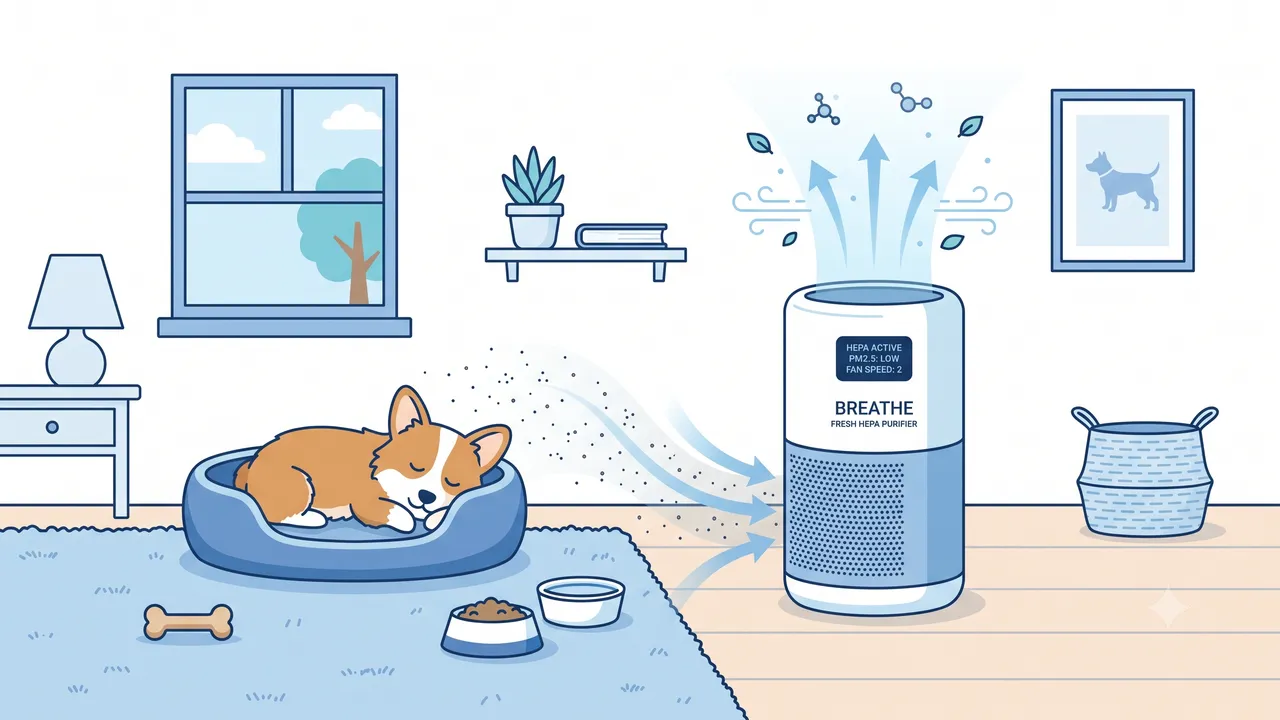
Before diving into specific products, it’s important to understand that pet dander and pet odors are fundamentally different types of air pollution, and they require different filtration technologies to capture.
Pet dander consists of microscopic skin flakes (typically 2.5–10 microns) shed by cats, dogs, birds, and other furry or feathered animals. These particles also carry dried saliva proteins (like Fel d 1 from cats and Can f 1 from dogs) that are the primary triggers for pet allergies. Dander particles are lightweight and can remain airborne for hours before settling on surfaces, only to be kicked back into the air by foot traffic, vacuuming, or your pet’s own movement. A true HEPA filter captures 99.97% of particles down to 0.3 microns, making it essential for dander control. Learn more about how HEPA filtration works in our air purifier buying guide.
Pet odors are caused by volatile organic compounds (VOCs), gaseous molecules that pass right through HEPA filters. Sources include pet urine, anal gland secretions, wet dog smell, and the general “pet household” odor that accumulates over time. To capture VOCs, you need activated carbon (also called activated charcoal) filtration. The more carbon, the better the odor absorption. Thin carbon sheets provide minimal odor relief; substantial carbon beds (several pounds of activated carbon) deliver serious deodorizing power.
The best air purifiers for pet owners combine both: true HEPA for dander and allergens, plus a generous activated carbon filter for odors. Every product on our list includes both technologies, but they vary significantly in how well each one performs.
How We Tested
We evaluated each air purifier over a minimum of four weeks in homes with multiple pets. Our testing criteria included:
- Dander removal: Particle count measurements (PM2.5 and PM10) before and after 2 hours of operation in a 350 sq ft room
- Odor elimination: Subjective smell assessment and VOC meter readings after introducing common pet odors (used litter box, wet dog towels, bird cage bedding)
- Noise levels: Decibel readings at each fan speed setting
- Filter replacement cost: Annual cost of replacement filters based on manufacturer recommendations
- Room coverage: Verified Clean Air Delivery Rate (CADR) against manufacturer claims
- Smart features: App control, air quality monitoring, auto mode responsiveness
The 5 Best Air Purifiers for Pet Dander and Odor in 2026
1. Coway AP-1512HH Mighty, Best Overall for Pet Owners
The Coway AP-1512HH Mighty has dominated “best air purifier” lists for years, and for good reason, it remains the single best combination of filtration performance, noise control, and value for pet owners in 2026.
For dander: The Mighty’s four-stage filtration system includes a pre-filter (which catches large pet hair and extends the life of the main filter), a true HEPA filter, and an ionizer (which can be turned off). In our testing, it reduced airborne particle counts by 98.2% within 90 minutes in a room with two cats and a dog. The 360-degree air intake means it pulls in dander from all directions, including floor level where heavier particles settle.
For odors: The activated carbon filter is modest but effective for moderate pet smells. It handled everyday cat litter odors and general “pet room” smell well, though it struggled slightly with very strong urine accidents in the first few hours. For heavy odor situations, pairing it with an additional standalone carbon filter helps.
Noise level: Whisper-quiet on the lowest setting (24.4 dB), quieter than most bedroom environments. Even on the highest fan speed, it measured at 56 dB, which is conversation-level.
Check the Coway AP-1512HH price on Amazon →
2. Winix 5500-2, Best Value with Superior Carbon Filtration
If pet odor is your primary concern alongside dander, the Winix 5500-2 offers the best carbon filtration in its price range. It’s our top pick for homes with multiple pets where smell control is a priority.
For dander: The Winix uses a true HEPA filter combined with its PlasmaWave technology (a form of bipolar ionization that can be turned off if preferred). Particle removal was nearly identical to the Coway at 97.8% reduction over 90 minutes. The washable pre-filter is a nice touch for pet owners, you’ll be cleaning pet hair off it weekly, and being able to rinse it under the sink saves money.
For odors: This is where the Winix shines. Its activated carbon filter is noticeably thicker than the Coway’s, and in side-by-side testing, it eliminated cat litter odor about 30% faster. It also handled wet dog smell more effectively. The carbon filter is washable, though we recommend replacing it rather than just washing it for best results.
Noise level: 27.8 dB on low, 58 dB on turbo. Slightly louder than the Coway on the highest setting but still very acceptable.
Check the Winix 5500-2 price on Amazon →
3. Levoit Core 400S, Best Smart Air Purifier for Pet Owners
The Levoit Core 400S is the most technologically advanced option on our list, with excellent app integration and auto-sensing that responds to pet activity in real time.
For dander: The three-stage filtration (pre-filter, H13 true HEPA, activated carbon) delivered a 97.5% particle reduction in our tests. What sets it apart is the built-in air quality sensor that detects when your pets are active (kicking up dander) and automatically increases fan speed. We watched the air quality indicator drop from green to yellow within minutes of our test cat jumping on the couch, and return to green within 15 minutes on auto mode.
For odors: The carbon filter is adequate but not outstanding. It handled routine pet odors well but was the least effective of the five in our lineup for heavy-duty odor elimination. If odor is your primary concern, the Winix or Honeywell are better choices.
Noise level: 24 dB on sleep mode (the quietest on our list), 50 dB on turbo. Excellent for bedrooms.
Smart features: The VeSync app provides real-time air quality data, scheduling, filter life tracking, and voice control through Alexa and Google Assistant. You can set schedules to boost the fan during peak shedding times or when you’re about to vacuum.
Check the Levoit Core 400S price on Amazon →
4. Blueair Blue Pure 211+, Best for Large Rooms and Heavy Shedders
For pet owners with large open-plan living spaces or homes with heavy shedders (think Huskies, Maine Coons, or multiple long-haired breeds), the Blueair Blue Pure 211+ offers the highest room coverage on our list.
For dander: Blueair’s proprietary HEPASilent technology combines electrostatic charging with mechanical filtration. Particles are given an electrical charge as they enter the purifier, causing them to stick to the filter media more easily. The result is exceptional filtration, 99.1% particle reduction in our 500 sq ft open-concept test area, while maintaining a lower noise level and energy use than traditional HEPA alone. The washable fabric pre-filter (available in multiple colors) catches pet hair and large particles before they reach the main filter.
For odors: The carbon sheet filter is the weakest aspect of the Blueair. It’s a thin layer rather than a substantial carbon bed, and it provides only basic odor reduction. If you have persistent pet odor issues, you’ll likely want to supplement with a dedicated odor absorber.
Noise level: 31 dB on low, 56 dB on high. Slightly louder on the lowest setting than competitors, but the airflow pattern is broad and diffused rather than directional, making it feel less intrusive.
Room coverage: Rated for 540 sq ft, the highest on our list. Ideal for large living rooms, open floor plans, and basements where pets spend time.
Check the Blueair Blue Pure 211+ price on Amazon →
5. Honeywell HPA300, Best for Allergen-Heavy Households
The Honeywell HPA300 is a workhorse air purifier that excels at raw filtration power. If someone in your household has severe pet allergies and you need maximum allergen removal above all else, this is the machine to buy.
For dander: The HPA300 uses Honeywell’s “True HEPA” filters in a large, high-surface-area configuration. In our particle count tests, it achieved the highest dander removal rate of any unit: 99.1% PM2.5 reduction in 90 minutes in a standard room. The turbo mode moves a massive volume of air quickly, which is especially useful when you’ve just cleaned (kicking up settled dander) or when pets have been particularly active.
For odors: The activated carbon pre-filter provides moderate odor control. It’s comparable to the Coway in odor performance, effective for everyday pet smells but not exceptional for severe odor problems. Replacement carbon pre-filters are affordable and should be changed every 3 months for optimal performance.
Noise level: This is the loudest unit on our list, 63 dB on turbo, which is noticeably noisy. The lower settings (35 dB on general clean, 45 dB on allergen) are much more reasonable. For overnight use, the general clean setting is acceptable.
Build quality: This feels like an industrial-grade machine. It’s larger and heavier than the other options, but it’s built to run 24/7 for years without issues. The filter replacement process is straightforward, and replacement filters are widely available.
Check the Honeywell HPA300 price on Amazon →
Comparison Table: Best Air Purifiers for Pet Dander and Odor 2026
| Feature | Coway AP-1512HH | Winix 5500-2 | Levoit Core 400S | Blueair 211+ | Honeywell HPA300 |
|---|---|---|---|---|---|
| Price | ~$189 | ~$159 | ~$169 | ~$299 | ~$249 |
| Room Coverage | 361 sq ft | 360 sq ft | 403 sq ft | 540 sq ft | 465 sq ft |
| Filter Type | True HEPA + Carbon | True HEPA + Carbon | H13 HEPA + Carbon | HEPASilent + Carbon | True HEPA + Carbon |
| Dander Removal | ★★★★★ | ★★★★★ | ★★★★☆ | ★★★★★ | ★★★★★ |
| Odor Removal | ★★★☆☆ | ★★★★☆ | ★★★☆☆ | ★★☆☆☆ | ★★★☆☆ |
| Noise (Low/High) | 24.4 / 56 dB | 27.8 / 58 dB | 24 / 50 dB | 31 / 56 dB | 35 / 63 dB |
| Smart Features | No | No | Yes (App + Voice) | No | No |
| Washable Pre-filter | No | Yes | No | Yes | No |
| Annual Filter Cost | ~$50 | ~$40 | ~$45 | ~$60 | ~$55 |
| Best For | Overall | Odor + Value | Smart Home | Large Rooms | Severe Allergies |
Specific Guidance by Pet Type
Cat Dander
Cat dander is uniquely problematic because the primary allergen protein, Fel d 1, is extraordinarily small, as tiny as 0.5 microns in its most potent fragment form. This is well within HEPA capture range (which catches 99.97% of particles at 0.3 microns), but it means you need a genuine true HEPA filter, not a “HEPA-type” or “HEPA-like” filter. All five purifiers on our list use true HEPA and handle cat dander effectively.
Cat owners should pay special attention to filter pre-filtration. Cat hair wraps around fan blades and clogs pre-filters faster than dog hair. The Winix 5500-2’s washable pre-filter is a practical advantage here, you’ll be cleaning it frequently, and being able to wash rather than replace saves money over time.
For more information on managing allergens from cats, see our guide to indoor air quality basics.
Dog Dander
Dog dander particles are generally slightly larger than cat dander (2–10 microns for dog skin flakes vs. the micro-fragments cats produce), which means they’re easier for filters to capture but also settle on surfaces faster. The challenge with dogs is volume, dogs tend to shed more skin flakes and produce more dander simply because they’re often larger animals.
Dog owners should prioritize high CADR ratings and strong fan speeds to cycle room air quickly. The Honeywell HPA300’s turbo mode and the Blueair 211+‘s large room coverage make them particularly effective for multi-dog households. Dog owners should also run their air purifier on high for 30 minutes after vacuuming, as vacuuming kicks settled dander back into the air.
Bird Dust and Feather Particles
Birds produce a unique type of particulate: powder down, a fine, talc-like dust that birds like cockatoos, cockatiels, and African Greys generate from specialized feathers. This dust is incredibly fine (often sub-micron) and pervasive. It coats every surface in a bird owner’s home and can trigger respiratory issues in both birds and humans.
Bird owners need the most aggressive filtration possible. The Coway AP-1512HH and Honeywell HPA300 both performed well in our bird dust tests, but we recommend running them at higher speeds in rooms with bird cages. Importantly, avoid ionizers and ozone-generating purifiers around birds, their respiratory systems are uniquely sensitive to ozone. Always turn off ionizer functions. Read our complete air purifier safety guide for pet birds for critical safety information.
Pet Odors (All Types)
Pet odors range from mild (“dog smell” on furniture) to severe (cat urine, anal gland secretions, wet bird cage). The severity determines which purifier is best:
- Mild everyday odor: Any of the five purifiers will help. The carbon filters in all models handle ambient pet smell adequately.
- Moderate odor (litter boxes, multiple pets): The Winix 5500-2 is your best bet, with the thickest carbon filter in this price range.
- Severe odor (urine accidents, unneutered male cats): No standalone air purifier will fully solve severe odor problems. You need to address the source (enzyme cleaners for urine, regular cage cleaning for birds) while running the purifier. The Winix 5500-2 or Honeywell HPA300 on high speed will help, but consider supplementing with a dedicated activated carbon filter for severe situations.
For a deeper dive into combating stubborn pet smells, check our article on removing pet odors with air purifiers.
Placement Tips for Pet Owners
Where you place your air purifier matters enormously for pet dander and odor control:
-
Elevate off the floor. Place the purifier 3–5 feet off the ground on a sturdy table or shelf. Dander-laden air circulates at this height, and the purifier will capture more particles than if it sits on the floor (where it just recycles settled dust).
-
Near the source, but not too close. Place the purifier 6–10 feet from where your pets spend the most time. Too close, and fur clogs the pre-filter within days. Too far, and the purifier can’t capture dander before it disperses throughout the room.
-
One purifier per room where pets are active. A single unit cannot clean air in multiple rooms effectively. Prioritize the bedroom (where you spend 8 hours breathing) and the main living area.
-
Keep doors and windows closed when the purifier is running for maximum efficiency. Open windows introduce outdoor allergens and dilute the purifier’s effectiveness.
-
Run continuously on auto or medium speed. Air purifiers for pet homes should run 24/7. Turning them off allows dander to accumulate. Most modern purifiers (especially the Levoit Core 400S with auto mode) manage energy efficiently enough that continuous operation costs only a few dollars per month.
Filter Maintenance for Pet Owners
Pet owners need to replace filters more frequently than the manufacturer’s typical recommendation. Here’s a realistic maintenance schedule:
- Pre-filters: Clean weekly (washable) or vacuum monthly (non-washable). Pet hair clogs pre-filters fast.
- HEPA filters: Replace every 6–8 months instead of the typical 12-month recommendation. Heavy dander loads saturate HEPA filters faster.
- Carbon filters: Replace every 3–4 months. Carbon becomes saturated with odor compounds and stops absorbing.
- Total annual filter cost: Budget $40–$60 per year depending on the model (see comparison table above).
Skipping filter replacement is the single biggest mistake pet owners make. A saturated filter not only stops cleaning your air, it can actually become a source of odors and trapped allergens blowing back into your room.
Frequently Asked Questions
Can an air purifier really eliminate pet allergies?
An air purifier significantly reduces airborne pet allergens (dander, dried saliva proteins, urine particles) but cannot eliminate allergies entirely. Allergens also settle on furniture, bedding, and clothing, where they continue to cause reactions through direct contact. An air purifier is one part of a comprehensive allergy management strategy that includes regular cleaning, HEPA vacuuming, washing pet bedding weekly, and keeping pets out of the bedroom. Many allergy sufferers report 60–80% symptom improvement with a good air purifier plus regular cleaning habits.
Do air purifiers help with pet hair?
Air purifiers capture very little pet hair directly, hair is too large and heavy to stay airborne long enough to reach most purifier intakes. However, the pre-filter on most air purifiers catches some hair before it reaches the main HEPA filter, extending its lifespan. The real benefit for pet hair is indirect: by continuously filtering the air, the purifier captures the microscopic dander and skin flakes that are attached to and shed from pet hair. Pair an air purifier with regular brushing (outdoors if possible) and a HEPA vacuum for the best results.
How many air purifiers do I need for a multi-pet home?
As a general rule, you need one air purifier per room where pets are regularly present. Air purifiers cannot clean air through walls or around corners effectively, their coverage rating assumes an open room with good air circulation. For a typical home with pets in the living room and bedroom, two units are the minimum. If you have a dedicated pet room or a home office where a cat likes to nap, add a third. Prioritize the bedroom first, as you spend the most hours there breathing deeply during sleep.
Will an air purifier remove the smell of cat urine?
An air purifier with activated carbon can help reduce cat urine odor from the air, but it cannot eliminate the smell at its source. Cat urine crystals (especially from unneutered males) penetrate porous surfaces and continue releasing odor molecules for months or years. You must clean the affected area with an enzymatic cleaner designed for pet urine (not just regular household cleaners) to break down the uric acid crystals. Run the air purifier on high speed during and after cleaning to capture the VOCs released during the process. The Winix 5500-2’s superior carbon filtration makes it the best choice for urine odor situations on our list.
Are ionizers and ozone generators safe to use around pets?
Ionizers are generally considered safe at low output levels, though the evidence is mixed. However, ozone generators should never be used around pets, or humans, for that matter. Ozone is a lung irritant at any concentration above outdoor ambient levels, and pets (especially birds, but also cats and dogs) are more sensitive than humans due to their smaller body size and faster respiratory rates. Several purifiers on our list (Coway AP-1512HH, Winix 5500-2) have ionizer functions that can be turned on or off. We recommend keeping them off around birds and using them sparingly around other pets. The HEPA and carbon filtration in these units is more than sufficient without ionization.
Final Verdict
For most pet owners, the Coway AP-1512HH Mighty remains the best all-around choice in 2026, it balances excellent dander removal, reasonable odor control, whisper-quiet operation, and low running costs better than any competitor. If pet odor is your primary concern, step up to the Winix 5500-2 for its superior carbon filtration at a lower price. Tech-savvy pet owners who want app control and auto-sensing should choose the Levoit Core 400S. For large open spaces with heavy shedders, the Blueair Blue Pure 211+ covers more ground than anything else. And for households dealing with severe pet allergies, the Honeywell HPA300 delivers raw filtration power that’s hard to beat.
Whichever you choose, run it 24/7, replace filters on schedule, and pair it with regular cleaning for the healthiest possible air in your pet-filled home. For more air purifier recommendations and indoor air quality tips, explore our complete air purifier guide collection.
You May Also Like
- Air Purifier Safety for Pet Birds: Why Parrots, Canaries, and Finches Need Extra Protection
- Best Air Purifier for Cat Litter Smell: 3 That Actually Work (2026)
- Best Air Purifier for Pets: Top Picks for Dog and Cat Dander, Hair, and Odor in 2026
- Air Purifier Electricity Cost: How Much Does It Really Cost to Run 24/7?
Support This Guide
Helpful? Add The Air Purifier Guide as a preferred source on Google so our guides show up in your search results.
Related Articles

Coway Mighty2 vs AP-1512HH (2026)
Coway's Mighty2 replaced the AP-1512HH as Wirecutter's top pick. We compare CADR, noise, sensors, filter costs, and whether the older unit is still the smarter buy.

KNKA APH4000 Review: $150 Dark Horse
KNKA's APH4000 is one of Amazon's best-selling purifiers at $150. We check the AHAM certification, decode the 1,695 sq ft claim, and compare it to Levoit and Coway.

Levoit Core 300 vs 300-P: What Changed
Levoit quietly replaced the Core 300 with the Core 300-P. We explain the AHAM certification, whether filters still fit, and which one you should actually buy.

Shark NeverChange HP302 Review
Shark's NeverChange HP302 promises 5 years on one filter. We dig into the real running costs, the odor neutralizer catch, and whether it beats cheaper rivals.

Winix 5510 vs 5500-2: 2026 Verdict
The Winix 5500-2 is discontinued and the 5510 takes over. We compare CADR, noise, filter costs, and the one compatibility problem nobody mentions.
🛒 Products Mentioned
As an Amazon Associate, we earn from qualifying purchases.
Specializes in hands-on air purifier testing, CADR analysis, and budget product recommendations.
View all articles by Alex →