The Short Answer: The best choice depends on your specific needs. True HEPA is essential for particles, activated carbon for gases and odors. Consider room size, noise tolerance, and budget when comparing models.
Editor’s note (September 2026): The Winix 5500-2 has been discontinued and remaining stock is limited. Winix’s official successor is the Winix 5510, which adds app control and uses a new filter. Read our Winix 5510 vs 5500-2 comparison before you buy either one.
HEPA Filter vs Carbon Filter: What’s the Difference?
If you’ve ever shopped for an air purifier, you’ve probably encountered two terms over and over: HEPA filter and carbon filter. They sound similar, they’re often sold together, and they both claim to clean the air, but they work in fundamentally different ways and target completely different pollutants.
Choosing the wrong filter (or skipping one entirely) can mean your air purifier fails to address the specific problem you’re facing, whether that’s allergies, smoke, chemical odors, or pet dander. In this guide, we break down exactly how HEPA and carbon filters work, what each one captures, and when you need one, the other, or both.
Quick Comparison: HEPA Filter vs Carbon Filter
| Feature | HEPA Filter | Carbon Filter |
|---|---|---|
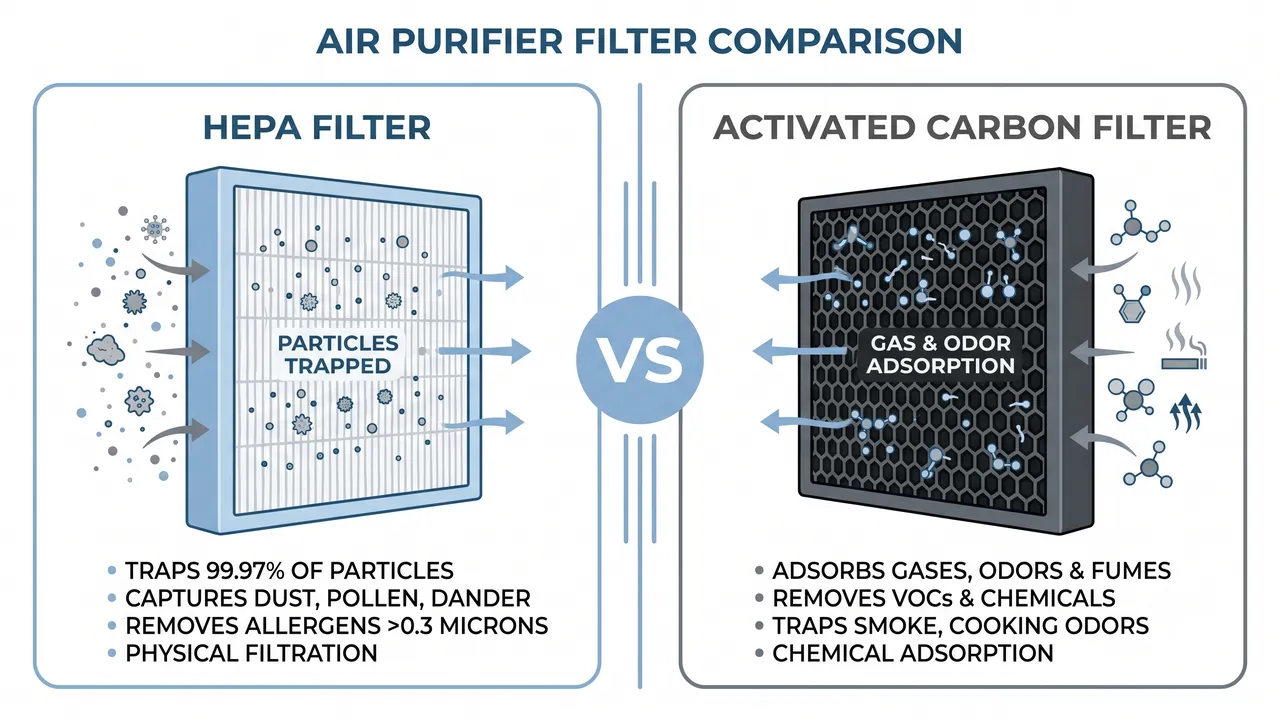
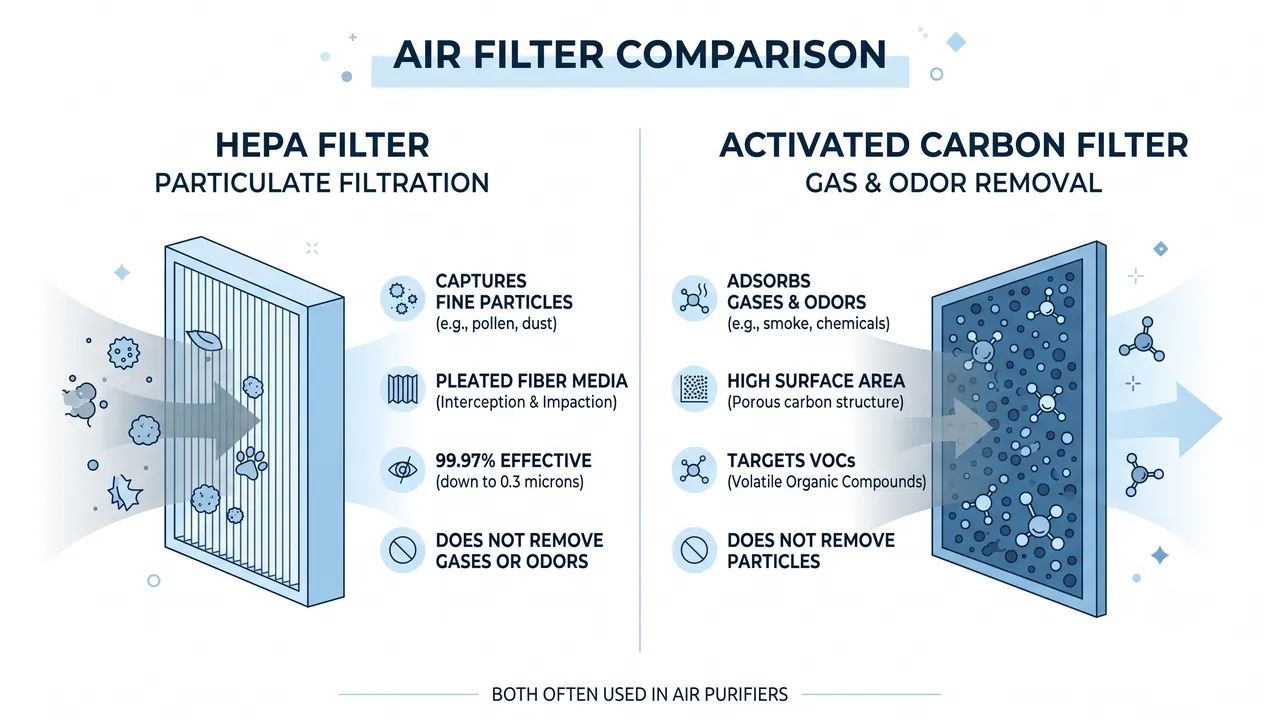
| Primary function | Captures physical particles | Adsorbs gases, odors, and VOCs |
| Made of | Dense mat of fine glass or synthetic fibers | Activated carbon (granules, pellets, or cloth) |
| Targets | Dust, pollen, mold spores, pet dander, smoke particles | Chemical fumes, odors, VOCs, formaldehyde, ammonia |
| Particle size | 99.97% of particles ≥ 0.3 microns | Not designed for particles |
| Mechanism | Mechanical filtration (interception, impaction, diffusion) | Adsorption (molecules stick to carbon surface) |
| Lifespan | 6–12 months (typical) | 3–6 months (can saturate faster in polluted environments) |
| Replaceable? | Yes (some are washable pre-filters) | Yes, once saturated, carbon releases trapped gases |
| Best for | Allergies, asthma, dust, pet hair, mold | Odors, smoke smells, chemical sensitivities, new furniture off-gassing |
| Certification | True HEPA must meet DOE STD 0.3 µm standard | No universal standard for residential carbon filters |
| Cost | $15–$80 per replacement | $10–$60 per replacement |
How a HEPA Filter Works
HEPA stands for High-Efficiency Particulate Air. Originally developed in the 1940s for nuclear facility ventilation, HEPA technology has become the gold standard for particle filtration in homes, hospitals, and cleanrooms.
A true HEPA filter is made from a dense mat of randomly arranged fibers, typically fiberglass or synthetic polypropylene. The fibers are extremely thin (0.5–2.0 microns in diameter) and folded in an accordion-like pattern to maximize surface area within a compact frame.
The Three Mechanisms of Particle Capture
HEPA filtration relies on three physical mechanisms working simultaneously:
-
Interception, Particles following an airstream come within one radius of a fiber and adhere to it. This is effective for medium-sized particles (0.5–1.0 microns).
-
Impaction, Larger particles (above 1 micron) can’t follow the air as it bends around fibers. Their inertia carries them directly into the fiber surface where they get stuck.
-
Diffusion, The smallest particles (below 0.1 microns) don’t travel in straight lines. Random collisions with air molecules cause them to move erratically (Brownian motion), increasing the chance they’ll contact a fiber.
Together, these three mechanisms create a “catch-all” effect. Particles in the 0.1–0.3 micron range, the most difficult size to capture, are trapped at a rate of 99.97% in a true HEPA filter. Larger and smaller particles are actually captured at even higher rates.
What a HEPA Filter Captures
- Dust and dust mite allergens
- Pollen (typically 10–100 microns)
- Mold spores (2–100 microns)
- Pet dander (0.5–100 microns)
- Bacteria (0.3–10 microns)
- Smoke particles (0.1–1.0 microns)
- Fine particulate matter (PM2.5)
What a HEPA Filter Does NOT Capture
HEPA filters are purely mechanical. They cannot remove:
- Gases and fumes (volatile organic compounds, formaldehyde)
- Odors (cooking smells, pet odors, smoke smell)
- Very small gas molecules (they pass right through the fiber matrix)
This is a critical limitation. If you buy a HEPA-only air purifier and expect it to eliminate cooking odors or off-gassing from new furniture, you will be disappointed. For those problems, you need a carbon filter.
How a Carbon Filter Works
Carbon filters use activated carbon, also called activated charcoal, to remove gases, odors, and volatile organic compounds (VOCs) from the air. The key word here is “activated.”
What Makes Carbon “Activated”?
Raw carbon (charcoal) is heated to extremely high temperatures (600–1200°C) in an oxygen-free environment. This process, called activation, creates millions of microscopic pores on the carbon’s surface. A single gram of activated carbon can have a surface area of 1,000–3,000 square meters, roughly the size of half a football field.
This enormous surface area gives activated carbon its remarkable ability to trap gas molecules.
The Adsorption Process
Carbon filtration works through adsorption (not absorption). The distinction matters:
- Absorption = a substance is taken into another material (like a sponge soaking up water)
- Adsorption = molecules stick to the surface of a material
When air passes through a carbon filter, gas molecules and odor-causing compounds come into contact with the activated carbon’s surface and form weak chemical bonds (Van der Waals forces). The molecules adhere to the pore walls and are effectively removed from the airstream.
What a Carbon Filter Captures
- Volatile organic compounds (VOCs) from paint, cleaning products, and building materials
- Formaldehyde off-gassing from furniture, flooring, and textiles
- Cooking and food odors
- Pet odors
- Tobacco and cannabis smoke odor
- Chemical fumes (ammonia, benzene, toluene)
- Gaseous pollutants from traffic and industrial emissions
- Musty or mildew smells (partially)
What a Carbon Filter Does NOT Capture
Carbon filters are not effective at removing:
- Particulate matter (dust, pollen, dander)
- Allergens
- Bacteria and viruses
- Mold spores
Gas molecules pass through HEPA filters, and particles pass through carbon filters. This is precisely why the best air purifiers combine both.
HEPA vs Carbon: Which Do You Need?
Your ideal filter depends on what’s polluting your indoor air.
Choose a HEPA Filter If You Need to Address:
- Allergies or asthma, HEPA is the single most effective technology for removing airborne allergens like pollen, dust mites, and pet dander.
- Dust control, If your home gets dusty quickly, a HEPA filter captures particles that settle on surfaces.
- Mold concerns, HEPA captures airborne mold spores, reducing the chance of colonization in other areas.
- General air quality, For everyday particle removal, HEPA is the baseline recommendation by allergists and pulmonologists.
Choose a Carbon Filter If You Need to Address:
- Odors, Cooking smells, pet odors, musty basements, or tobacco smoke odor cannot be removed by HEPA alone.
- Chemical sensitivities, If you react to VOCs, formaldehyde, or cleaning product fumes, carbon filtration is essential.
- New home or furniture off-gassing, Fresh paint, new flooring, and composite wood furniture release formaldehyde and other VOCs for months or even years.
- Smoke smell, After a fire, during wildfire season, or in a household with a smoker, carbon filters trap the gaseous components that carry odor.
Choose Both If:
- You have allergies and live near a busy road (particles + traffic fumes)
- You’re a pet owner who also cooks frequently (dander + food odors)
- You want comprehensive air purification for general health
- You live in an area affected by wildfires (smoke particles + gaseous pollutants)
- You have a new home with off-gassing materials and dust from construction
In practice, most households benefit from having both. The most effective air purifiers on the market ship with both HEPA and activated carbon stages for exactly this reason.
When You Need Both: The Combination Approach
Many top-performing air purifiers use a multi-stage filtration design:
- Pre-filter, Captures large particles like hair and lint, extending the life of the main filters.
- HEPA filter, Removes fine particles and allergens.
- Activated carbon filter, Adsorbs gases, VOCs, and odors.
This layered approach addresses the full spectrum of indoor air pollutants. Skipping either stage leaves a significant gap:
- HEPA only = you breathe fewer particles but still inhale chemical fumes and odors.
- Carbon only = your air smells cleaner, but allergens and fine particulate matter remain at full concentration.
For a deeper dive into choosing the right unit, see our guide to the best air purifiers for allergies and our breakdown of HEPA air purifiers worth buying.
Carbon Filter Varieties: Not All Are Equal
carbon filters come in several forms, and their effectiveness varies dramatically:
Thin Carbon Cloth (Low End)
Many budget air purifiers include a flimsy carbon “pre-filter” that’s essentially a thin fabric sheet lightly coated with carbon dust. These provide minimal odor removal and saturate within weeks. They’re mostly a marketing checkbox.
Granular Activated Carbon (Mid Range)
Granular carbon filters contain loose carbon pellets in a tray or cartridge. They offer significantly more surface area and longer lifespan than carbon cloth. This is the sweet spot for most homes.
Pelletized / Coconut Shell Carbon (High End)
Premium air purifiers use dense beds of pelletized or coconut shell-derived activated carbon. These provide the highest adsorption capacity and longest life. Some specialty units contain 15–20 lbs of carbon, which can last a year or more even in heavily polluted environments.
Impregnated Carbon
Some carbon filters are treated (impregnated) with additional chemicals like potassium permanganate to enhance adsorption of specific gases like formaldehyde or hydrogen sulfide. These are common in industrial and commercial-grade units.
Maintenance and Replacement
HEPA Filter Replacement
- Typical lifespan: 6–12 months
- Signs it’s time to replace: Visible discoloration, reduced airflow, or a persistent musty smell
- Tip: A dirty pre-filter shortens HEPA life dramatically. Clean or replace pre-filters monthly.
Carbon Filter Replacement
- Typical lifespan: 3–6 months
- Key warning: Once carbon is saturated, it stops working, and can actually start releasing trapped pollutants back into the air (off-gassing)
- Tip: In high-pollution environments (wildfire smoke, heavy cooking, new construction), carbon may need replacement every 1–3 months
- Storage: Keep spare carbon filters sealed in plastic until use. Carbon adsorbs whatever it contacts, including ambient moisture and odors.
Frequently Asked Questions
Can a HEPA filter remove smoke smell?
No. HEPA filters capture smoke particles very effectively, but the odor-causing gaseous compounds in smoke pass right through. To remove smoke smell, you need an activated carbon filter. For full smoke removal, use both together.
How often should I replace my carbon filter?
Most residential carbon filters need replacement every 3 to 6 months. In high-pollution situations, such as during wildfire season, in a home with a smoker, or in a newly renovated space, replacement may be needed every 1 to 3 months. Check the manufacturer’s recommendations for your specific unit.
Are washable HEPA filters as effective as replaceable ones?
Generally, no. Most “washable HEPA filters” are actually HEPA-type or HEPA-style filters that don’t meet the true HEPA standard (99.97% at 0.3 microns). Washing can also damage the fiber structure, reducing effectiveness over time. True HEPA filters are typically not washable and should be replaced on schedule.
Can I use a carbon filter without a HEPA filter?
You can, but it’s only advisable if your sole concern is gases and odors. A standalone carbon filter will address chemical fumes and smells but will do nothing for particulate pollutants like dust, pollen, or mold spores. For most people, combining both filters is the better choice.
Do carbon filters produce ozone?
Activated carbon filters themselves do not produce ozone. However, some air purifiers that include carbon filters also use ionizers, UV-C lights, or electrostatic technology, which can produce trace amounts of ozone. If ozone is a concern, look for units certified by the California Air Resources Board (CARB), which limits ozone emissions to 0.050 ppm.
Final Thoughts
The HEPA filter vs carbon filter debate isn’t really about choosing one over the other, it’s about understanding what each does best:
- HEPA = particle filtration. Dust, pollen, dander, mold spores, fine particulate matter.
- Carbon = gas-phase filtration. Odors, VOCs, chemical fumes, formaldehyde.
For most homes, the ideal air purifier combines both filtration stages in a single unit. This gives you comprehensive protection against the full range of indoor air pollutants, from allergens you can see to invisible chemical fumes you can’t.
When shopping, pay attention to the quality and quantity of carbon (more is better), confirm the HEPA filter meets the true HEPA standard (not just “HEPA-type”), and commit to a regular replacement schedule. An air purifier with spent filters is just a fan.
Ready to find the right air purifier for your needs? Explore our guides to the best air purifiers for smoke and how to choose an air purifier for your room size.
Disclosure: This article contains affiliate links. If you purchase through links on this page, we may earn a commission at no additional cost to you. We only recommend products we’ve researched and believe in. See our disclosure policy for details.
You May Also Like
- HEPA Filters Explained: H10 Through H14, True HEPA vs HEPA-Type, and What Those Grades Actually Mean
- How Often to Change Air Purifier Filter: Complete Replacement Guide
- Best Replacement Filters for Coway AP-1512HH (2026): OEM vs Third-Party Compared
- Best Replacement Filters for Winix 5500-2: OEM vs Aftermarket Complete Guide
Support This Guide
Helpful? Add The Air Purifier Guide as a preferred source on Google so our guides show up in your search results.
Related Articles

Coway Mighty2 vs AP-1512HH (2026)
Coway's Mighty2 replaced the AP-1512HH as Wirecutter's top pick. We compare CADR, noise, sensors, filter costs, and whether the older unit is still the smarter buy.

KNKA APH4000 Review: $150 Dark Horse
KNKA's APH4000 is one of Amazon's best-selling purifiers at $150. We check the AHAM certification, decode the 1,695 sq ft claim, and compare it to Levoit and Coway.

Levoit Core 300 vs 300-P: What Changed
Levoit quietly replaced the Core 300 with the Core 300-P. We explain the AHAM certification, whether filters still fit, and which one you should actually buy.

Shark NeverChange HP302 Review
Shark's NeverChange HP302 promises 5 years on one filter. We dig into the real running costs, the odor neutralizer catch, and whether it beats cheaper rivals.

Winix 5510 vs 5500-2: 2026 Verdict
The Winix 5500-2 is discontinued and the 5510 takes over. We compare CADR, noise, filter costs, and the one compatibility problem nobody mentions.
🛒 Products Mentioned
As an Amazon Associate, we earn from qualifying purchases.
Runs side-by-side purifier comparisons, long-term ownership reports, and filter cost analysis.
View all articles by David →