The Short Answer: The best choice depends on your specific needs. True HEPA is essential for particles, activated carbon for gases and odors. Consider room size, noise tolerance, and budget when comparing models.
Editor’s note (September 2026): The Winix 5500-2 has been discontinued and remaining stock is limited. Winix’s official successor is the Winix 5510, which adds app control and uses a new filter. Read our Winix 5510 vs 5500-2 comparison before you buy either one.
For mid-range air purifiers that deliver genuine cleaning power without breaking the bank, two models consistently rise to the top of recommendation lists: the Winix 5500-2 and the Blueair Blue Pure 211+. Both have earned loyal followings, stellar reviews, and proven track records in real-world homes. But they take fundamentally different approaches to filtration, design, and user experience.
If you’re trying to decide between these two popular units, this in-depth comparison will walk you through every specification that matters, weigh the pros and cons of each, and help you match the right purifier to your specific living situation.
Affiliate Disclosure: Some links in this article are affiliate links. If you purchase through them, we may earn a small commission at no extra cost to you. This helps us keep producing free, honest air quality content. See our privacy policy for details.
Table of Contents
Open Table of Contents
- At a Glance: Winix 5500-2 vs Blueair Blue Pure 211+
- Filtration Technology: Two Philosophies
- Performance: CADR and Real-World Cleaning
- Noise Levels: The Bedroom Test
- Smart has and Automation
- Design and Build Quality
- Pros and Cons
- Price and Total Cost of Ownership
- Who Should Buy Which?
- Frequently Asked Questions
- The Verdict
- Related Articles
At a Glance: Winix 5500-2 vs Blueair Blue Pure 211+
Before diving into the details, here’s a side-by-side snapshot of the two purifiers.
| Specification | Winix 5500-2 | Blueair Blue Pure 211+ |
|---|---|---|
| Filtration Type | 3-stage (Washable Pre-filter + AOC Carbon + True HEPA) | 3-stage (Fabric Pre-filter + Particle + Carbon) using HEPASilent™ |
| HEPA Standard | True HEPA (99.97% @ 0.3 µm) | HEPASilent™ (99.97% @ 0.1 µm) |
| Room Coverage (CADR) | 360 sq. ft. (AHAM verified) | 540 sq. ft. (AHAM verified) |
| Smoke CADR | 232 CFM | 350 CFM |
| Dust CADR | 243 CFM | 350 CFM |
| Pollen CADR | 246 CFM | 350 CFM |
| Noise Level (Low) | 27.8 dB | 31 dB |
| Noise Level (High) | 56 dB | 56 dB |
| Fan Speeds | 4 (Low, Med, High, Turbo) + Sleep/Auto | 3 (Low, Medium, High) |
| Smart Sensors | Air Quality Sensor + Auto Mode + Light Sensor (Sleep Mode) | None (manual speed selection only) |
| PlasmaWave Technology | Yes (optional ionizer) | No |
| Filter Replacement Cost | ~$40–50 (HEPA + Carbon combo) | ~$50–70 (Particle + Carbon combo) |
| Filter Lifespan | ~12 months | ~6 months |
| Annual Filter Cost | ~$40–50/year | ~$100–140/year |
| Dimensions | 14.9” × 8.2” × 23.6” | 13” × 13” × 21” |
| Weight | 14.8 lbs | 12.5 lbs |
| Energy Star Certified | Yes | Yes |
| Power Consumption (High) | ~70W | ~61W |
| Price (MSRP) | ~$200–250 | ~$250–300 |
| Warranty | 2 years (5 years on motor with registration) | 2 years |
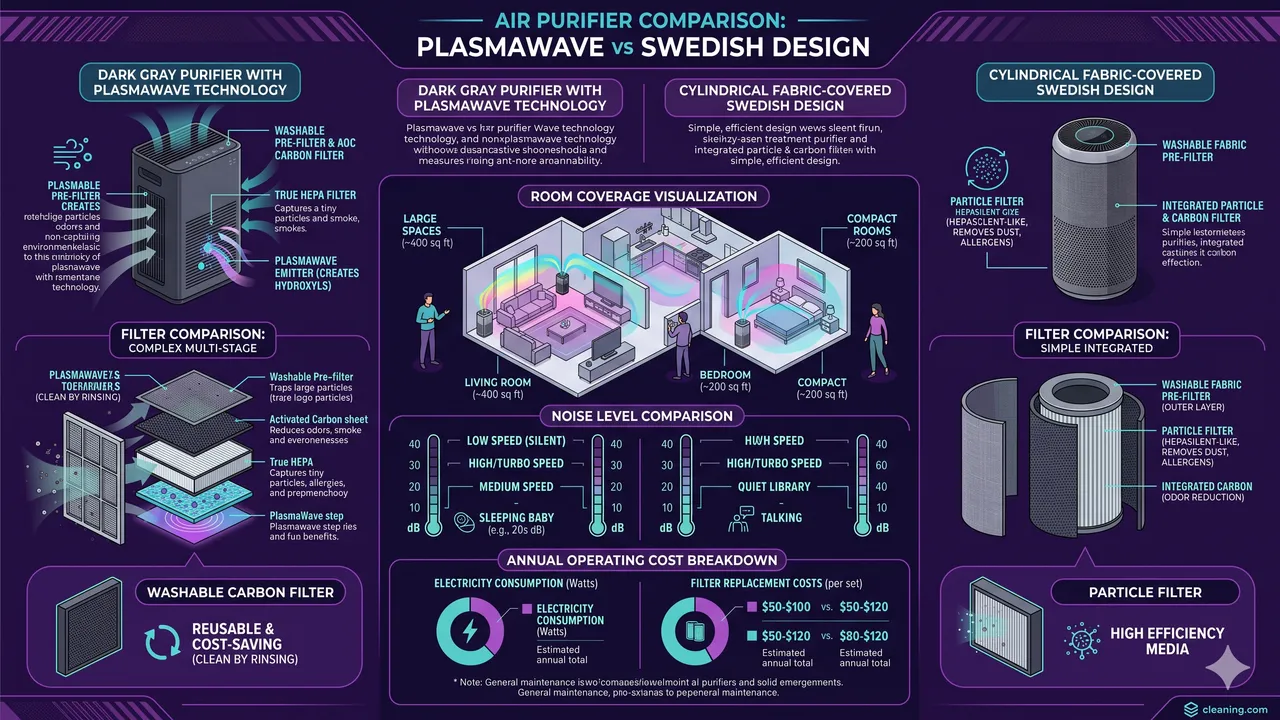
Filtration Technology: Two Philosophies
Winix 5500-2: The Multi-Stage Traditionalist
The Winix 5500-2 employs a tried-and-true three-stage filtration approach. Air first passes through a washable fine-mesh pre-filter that captures large particles like pet hair, dust bunnies, and lint. This extends the life of the downstream filters considerably, a small but meaningful cost-saving feature.
The second stage is an Activated Odor Control (AOC) carbon filter, essentially a honeycomb-style carbon sheet that adsorbs VOCs, cooking odors, pet smells, and gaseous pollutants. While it’s not as heavy-duty as a multi-pound carbon bed found in specialty units, it does a respectable job for everyday odor control.
The final and most critical stage is a True HEPA filter rated to capture 99.97% of particles down to 0.3 microns. This is the gold standard in the air purifier industry, independently verified and well-understood. Pollen, mold spores, dust mite debris, bacteria, and fine smoke particles are all captured at this stage.
Additionally, the Winix 5500-2 includes PlasmaWave technology, an optional bipolar ionization feature. When enabled, it generates positive and negative ions that attach to airborne pollutants, causing them to cluster and fall out of the air or be captured more easily by the filters. Some users appreciate this extra layer; others prefer to leave it off due to concerns about trace ozone production (Winix states PlasmaWave produces ozone well below the FDA limit of 50 ppb).
Blueair Blue Pure 211+: The HEPASilent Innovator
Blueair takes a different engineering approach with its proprietary HEPASilent™ technology. Rather than forcing air through a dense, high-resistance True HEPA membrane alone, Blueair combines mechanical and electrostatic filtration. Air is first charged with ions, then passed through a lower-density filter media. The electrostatic charge makes particles stick to the filter fibers far more efficiently than mechanical filtration alone.
The practical result: Blueair achieves 99.97% particle removal down to 0.1 microns, a tighter standard than the Winix’s 0.3-micron threshold, while maintaining lower air resistance. This means higher airflow (CADR) with less noise and less energy consumption. It’s genuinely clever engineering.
The Blue Pure 211+ uses a particle filter as its main stage, which is integrated with the unit’s fabric pre-filter. The washable fabric outer sleeve catches large particles and doubles as the purifier’s aesthetic shell (available in several colors). An optional carbon filter can be added for odor and gas removal, but notably, this is sold separately or as a bundle, it’s not always included in the base price.
The trade-off of HEPASilent technology is that the filters cannot be independently cleaned or reused. The electrostatic charge gradually diminishes as the filter loads with particles, and the entire filter assembly must be replaced every six months for optimal performance, roughly twice as often as the Winix.
Performance: CADR and Real-World Cleaning
The Clean Air Delivery Rate (CADR) is the most objective metric for comparing air purifier performance, and this is where the Blueair Blue Pure 211+ pulls ahead clearly.
| CADR Category | Winix 5500-2 | Blueair Blue Pure 211+ |
|---|---|---|
| Smoke | 232 CFM | 350 CFM |
| Dust | 243 CFM | 350 CFM |
| Pollen | 246 CFM | 350 CFM |
| Recommended Room Size | 360 sq. ft. | 540 sq. ft. |
The Blueair’s CADR numbers are roughly 45–50% higher across the board. In practical terms, this means the Blue Pure 211+ can clean the air in a given room significantly faster, or effectively handle a much larger room. For a 350-square-foot living room, the Winix is operating near its upper limit while the Blueair is comfortably within its sweet spot.
That said, the Winix 5500-2 is no slouch. Its CADR ratings are solidly above average for its price class, and it handles medium-sized rooms (bedrooms, home offices, small living rooms) with ease. If your space is under 300 square feet, the Winix may be all you need, and you’ll save money in the process.
For a broader look at how these models fit into the full market of air purifiers, check out our Complete Air Purifier Buying Guide.
Noise Levels: The Bedroom Test
If you plan to run your air purifier in a bedroom, which is one of the most common and health-beneficial use cases, noise matters enormously.
| Speed Setting | Winix 5500-2 | Blueair Blue Pure 211+ |
|---|---|---|
| Low / Sleep | 27.8 dB | 31 dB |
| Medium | ~40 dB | ~43 dB |
| High / Turbo | ~56 dB | ~56 dB |
At the lowest setting, the Winix is noticeably quieter, 27.8 dB is essentially whisper-quiet, and its dedicated Sleep Mode automatically dims the display lights and reduces fan speed when the room darkens. This makes the Winix 5500-2 the better bedroom purifier by a clear margin.
The Blueair’s lowest setting at 31 dB is still quite quiet by general standards, but light sleepers may notice it. Blueair has no automatic sleep mode or light sensor, you simply choose one of three fan speeds and leave it.
At full speed, both units produce roughly the same noise output (around 56 dB), which is comparable to a normal conversation, fine for daytime use but too loud for sleeping.
Smart has and Automation
This is another area where the two purifiers diverge significantly.
Winix 5500-2 Smart Features
- Air Quality Sensor: An integrated sensor monitors particulate levels and displays them via a color-coded LED (blue = good, amber = moderate, red = poor).
- Auto Mode: The fan speed automatically adjusts based on real-time air quality readings. When you’re cooking and particles spike, the Winix ramps up. When the air clears, it dials back down.
- Sleep Mode: Triggered by a built-in light sensor. When the room goes dark, the purifier drops to its quietest setting and turns off indicator lights.
- PlasmaWave On/Off: You can toggle the ionizer feature depending on your preference.
Blueair Blue Pure 211+ Smart Features
- None. The Blue Pure 211+ is a beautifully designed but deliberately simple device. There are three buttons (one per speed) and an LED indicator for filter replacement. No sensors, no auto mode, no connectivity.
For users who want a “set it and forget it” experience with intelligent automation, the Winix 5500-2 is the clear winner. For users who prefer simplicity and don’t want to fuss with settings, the Blueair’s minimalist approach can be appealing.
Design and Build Quality
The Blueair Blue Pure 211+ is one of the most aesthetically pleasing air purifiers on the market. Its soft, rounded rectangular form with a washable fabric pre-filter sleeve comes in several colors (Divide Blue, Dark Shadow, Arch Gray, and others), allowing it to blend with or complement room décor. It looks like a piece of Scandinavian furniture rather than an appliance.
The Winix 5500-2, by contrast, is purely functional in its design. It’s a boxy, dark gray plastic tower with a digital display panel on top. It looks like what it is, an air purifier. It’s not ugly, but it won’t win any design awards.
If your air purifier will sit in a prominent living space and aesthetics matter to you, the Blueair has a significant edge. If it’s going in a bedroom corner or home office, the Winix’s utilitarian appearance is perfectly fine.
Pros and Cons
Winix 5500-2
Pros:
- True HEPA + carbon filtration at a lower price point
- Auto Mode with air quality sensor, genuinely smart operation
- Sleep Mode with light sensor, excellent for bedrooms
- Washable pre-filter extends HEPA filter life
- Lower annual filter replacement cost (~$40–50/year)
- 12-month filter lifespan means less frequent maintenance
- Optional PlasmaWave ionization for extra cleaning
- Energy Star certified
- Exceptional value for the price
Cons:
- Lower CADR ratings, less effective in larger rooms (360 sq. ft. max)
- Bulky, utilitarian design that doesn’t blend into décor
- PlasmaWave may produce trace ozone (though within safe limits)
- Carbon filter is thin, limited odor/gas removal for heavy smells
- No app or smart home integration
Blueair Blue Pure 211+
Pros:
- Outstanding CADR, cleans air faster and covers larger rooms (540 sq. ft.)
- HEPASilent technology achieves 99.97% @ 0.1 µm, a finer particle threshold
- Beautiful, award-winning Scandinavian design with color options
- Very low energy consumption
- Simple 3-button operation, no learning curve
- Whisper-quiet at low speeds
- Washable fabric pre-filter sleeve
Cons:
- Higher upfront cost ($250–300)
- Filters need replacement every 6 months, double the frequency of the Winix
- Annual filter costs can reach $100–140/year, expensive to maintain
- Carbon filter is optional/sold separately on some bundles
- No air quality sensor, no auto mode, no smart features whatsoever
- No light sensor or dedicated sleep mode
- Only 2-year warranty
Price and Total Cost of Ownership
This is where the comparison gets really interesting. Let’s look at total cost over three years.
| Cost Component | Winix 5500-2 | Blueair Blue Pure 211+ |
|---|---|---|
| Purchase Price | ~$220 | ~$280 |
| Year 1 Filter Cost | ~$45 | ~$120 |
| Year 2 Filter Cost | ~$45 | ~$120 |
| Year 3 Filter Cost | ~$45 | ~$120 |
| 3-Year Total | ~$355 | ~$640 |
Over three years, the Winix 5500-2 costs roughly $285 less to own and operate than the Blueair Blue Pure 211+. That’s a substantial difference, enough to buy a second Winix for another room.
The Blueair’s higher CADR does justify a premium, but the recurring filter costs are its Achilles’ heel. If you’re budget-conscious, the Winix is the much smarter financial choice.
For more budget-friendly options, see our guide to the Best Air Purifiers Under $200.
Who Should Buy Which?
Choose the Winix 5500-2 if you:
- Want the best value in a mid-range air purifier
- Need a bedroom purifier (quiet sleep mode, auto-dimming lights)
- Have a room under 350 square feet
- Want smart automation (auto mode, air quality sensor)
- Prefer lower long-term maintenance costs
- Don’t mind a functional, appliance-like appearance
Choose the Blueair Blue Pure 211+ if you:
- Need to purify a large room (350–540 square feet)
- Want the highest possible CADR and fastest air cleaning
- Value beautiful, modern design that complements your home
- Prefer dead-simple operation, just pick a speed and go
- Want HEPASilent’s 0.1-micron filtration standard
- Don’t mind paying more upfront and for ongoing filters
For Pet Owners
Both units handle pet dander and hair well, but for pet odors, the Winix 5500-2’s included carbon filter gives it a slight edge out of the box. The Blueair’s carbon filter is often sold separately. If smells are your primary concern with pets, the Winix is more convenient. See our dedicated guide to Best Air Purifiers for Pet Owners for more options.
For Allergy Sufferers
Both will capture pollen, mold spores, and dust mite allergens effectively. The Blueair’s higher CADR means it cycles the air in your room more times per hour, which can translate to fewer allergen particles lingering. For large rooms where allergen exposure is high, the Blueair may provide faster relief. For smaller bedrooms, the Winix is more than adequate.
Frequently Asked Questions
1. Is the Winix PlasmaWave feature safe?
Winix states that PlasmaWave produces ozone at levels well below the FDA’s limit of 50 parts per billion (ppb) for medical devices and well under the California Air Resources Board (CARB) limit of 50 ppb for indoor air cleaners. Independent tests have generally confirmed this. However, if you have a respiratory condition like asthma and prefer to minimize any ozone exposure, you can simply leave PlasmaWave turned off, the HEPA and carbon filters work independently and are highly effective on their own.
2. How often do I need to replace the filters?
For the Winix 5500-2, the washable pre-filter should be cleaned every 2–3 weeks, and the HEPA + carbon combo filter should be replaced approximately every 12 months depending on usage and air quality. For the Blueair Blue Pure 211+, the particle filter should be replaced every 6 months. The fabric pre-filter sleeve is washable and reusable.
3. Can either air purifier remove viruses and bacteria?
Both units capture airborne bacteria and virus-carrying respiratory droplets on their filter media. The Winix True HEPA captures 99.97% of particles at 0.3 microns, while the Blueair HEPASilent captures 99.97% at 0.1 microns. Neither is a medical device, and neither should be relied upon as a sole defense against airborne illness, but both significantly reduce airborne particulate concentration in a room.
4. Which air purifier is more energy efficient?
Both are Energy Star certified. The Blueair Blue Pure 211+ consumes approximately 61W on its highest setting compared to the Winix’s 70W. However, the Winix’s Auto Mode often keeps the fan on lower speeds when air quality is good, potentially using less energy on average throughout the day. In practice, the difference in annual electricity cost is negligible, roughly $5–10 per year.
5. Can I run either air purifier 24/7?
Absolutely. Both units are designed for continuous operation and doing so is recommended for the best air quality. They are both Energy Star certified, meaning they meet strict energy efficiency guidelines. Running your purifier continuously, especially in Auto Mode on the Winix, ensures that particulate levels stay consistently low rather than allowing pollutants to accumulate between uses.
The Verdict
The Winix 5500-2 and the Blueair Blue Pure 211+ are both excellent air purifiers, but they serve different priorities.
The Winix 5500-2 is the smarter buy for most people. It offers true HEPA filtration, intelligent auto mode, quiet sleep operation, and dramatically lower long-term filter costs, all at a lower purchase price. For bedrooms, home offices, and typical living rooms under 350 square feet, it delivers outstanding performance and value.
The Blueair Blue Pure 211+ is the premium performer for large spaces. Its superior CADR ratings mean it can handle open-concept living areas, great rooms, and large master bedrooms that would overwhelm the Winix. Its HEPASilent technology is genuinely innovative, and its design is beautiful. But you’ll pay for that performance, both upfront and every six months when filters need replacing.
Our recommendation: If your room is under 350 square feet and you value automation and low costs, go with the Winix 5500-2. If you have a large room (400+ sq. ft.), want the fastest possible air cleaning, and budget isn’t the primary concern, the Blueair Blue Pure 211+ is the stronger performer.
Related Articles
- Best Air Purifiers for Allergies in 2026
- Do Air Purifiers Really Work? The Science Explained
- HEPA vs HEPASilent: What’s the Difference?
- How to Choose the Right Air Purifier for Your Room Size
- Air Purifier Maintenance Guide: Keep Your Unit Running Like New
Last updated: June 9, 2026. Prices and specifications are subject to change. All information is based on manufacturer data and independent testing. For our full disclosure policy, visit About Us.
Support This Guide
Helpful? Add The Air Purifier Guide as a preferred source on Google so our guides show up in your search results.
Related Articles

Coway Mighty2 vs AP-1512HH (2026)
Coway's Mighty2 replaced the AP-1512HH as Wirecutter's top pick. We compare CADR, noise, sensors, filter costs, and whether the older unit is still the smarter buy.

KNKA APH4000 Review: $150 Dark Horse
KNKA's APH4000 is one of Amazon's best-selling purifiers at $150. We check the AHAM certification, decode the 1,695 sq ft claim, and compare it to Levoit and Coway.

Levoit Core 300 vs 300-P: What Changed
Levoit quietly replaced the Core 300 with the Core 300-P. We explain the AHAM certification, whether filters still fit, and which one you should actually buy.

Shark NeverChange HP302 Review
Shark's NeverChange HP302 promises 5 years on one filter. We dig into the real running costs, the odor neutralizer catch, and whether it beats cheaper rivals.

Winix 5510 vs 5500-2: 2026 Verdict
The Winix 5500-2 is discontinued and the 5510 takes over. We compare CADR, noise, filter costs, and the one compatibility problem nobody mentions.
🛒 Products Mentioned
As an Amazon Associate, we earn from qualifying purchases.
Runs side-by-side purifier comparisons, long-term ownership reports, and filter cost analysis.
View all articles by David →