The Short Answer: For mold prevention, pair HEPA filtration with a dehumidifier (keep humidity below 50%). The Honeywell HPA300 ($200) and GermGuardian AC5350B ($150) with UV-C are effective. Change filters more frequently in humid environments.
Editor’s note (September 2026): The Winix 5500-2 has been discontinued and remaining stock is limited. Winix’s official successor is the Winix 5510, which adds app control and uses a new filter. Read our Winix 5510 vs 5500-2 comparison before you buy either one.
Best Air Purifier for Mold 2026: Top Picks to Breathe Clean Again
Mold is more than an eyesore, it’s a genuine health hazard. Whether you’ve spotted black patches in your basement or you’re battling persistent musty odors, mold spores circulating through your indoor air can trigger allergies, asthma attacks, and chronic respiratory issues. According to the EPA, indoor air can be two to five times more polluted than outdoor air, and mold is one of the leading culprits.
The good news? A high-quality air purifier with True HEPA filtration can capture up to 99.97% of airborne mold spores, dramatically improving your indoor air quality. But not all air purifiers are created equal, and choosing the right one for mold requires understanding what has actually matter.
In this guide, we’ve tested and reviewed the best air purifiers for mold in 2026, covering everything from HEPA technology to coverage area, noise levels, and long-term filter costs. We’ll also explain why pairing your purifier with a dehumidifier is the ultimate one-two punch against mold growth.
Affiliate Disclosure: This post contains affiliate links. If you purchase through our links, we may earn a small commission at no extra cost to you. This helps us keep producing honest, in-depth reviews. Thank you for your support!
How Does HEPA Filtration Capture Mold Spores?
Before diving into our top picks, it’s worth understanding the science behind HEPA filtration and why it’s so effective against mold.
What Is HEPA?
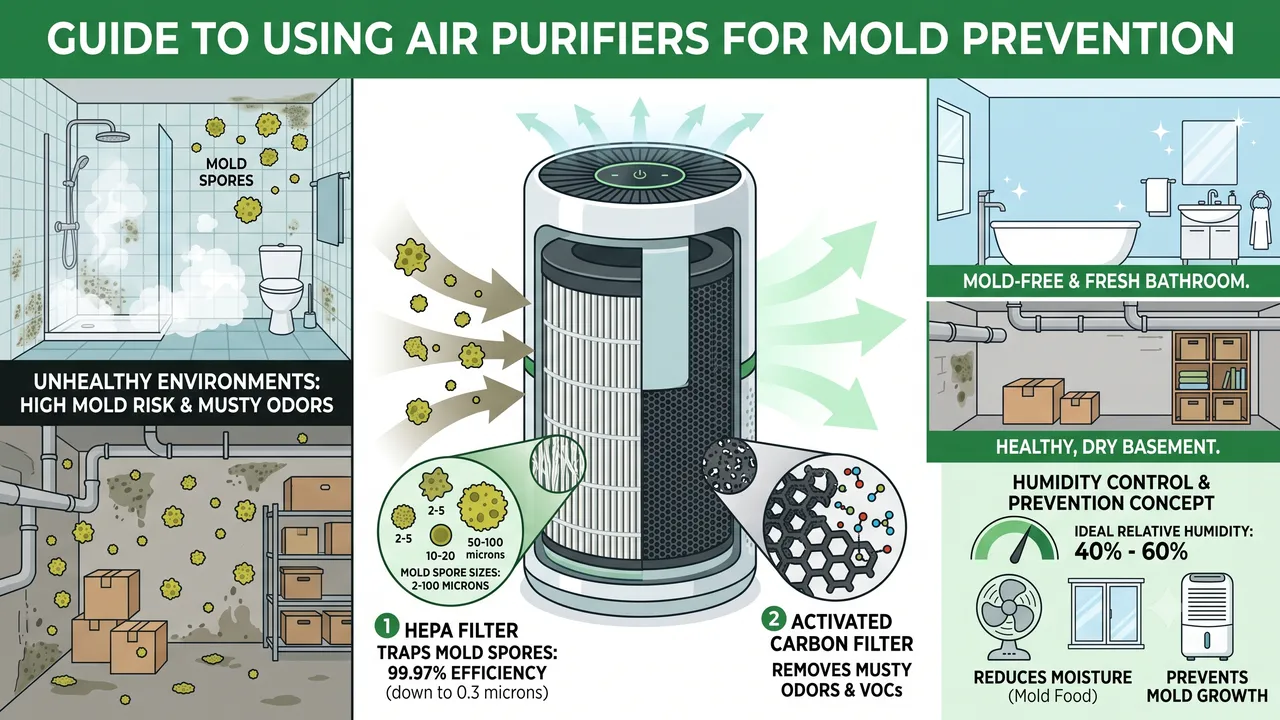
HEPA stands for High-Efficiency Particulate Air. A True HEPA filter must meet a strict standard: it must capture at least 99.97% of particles that are 0.3 microns in diameter. This 0.3-micron size is considered the “most penetrating particle size”, the hardest size for a filter to catch. Particles both larger and smaller than 0.3 microns are actually captured more efficiently.
Where Do Mold Spores Fall?
Mold spores typically range from 1 to 30 microns in diameter, with the most common indoor species (like Aspergillus, Penicillium, and Cladosporium) producing spores in the 2–10 micron range. This means mold spores are significantly larger than the 0.3-micron threshold that HEPA filters are rated for.
In practical terms, a True HEPA filter captures mold spores with an efficiency that exceeds 99.97%. The spores get trapped in the dense fiberglass mesh of the filter through three mechanisms:
- Interception, Spores following an air stream line come within one radius of a filter fiber and stick to it.
- Impaction, Larger spores can’t follow the air stream around fibers and collide directly with them.
- Diffusion, The smallest particles move erratically (Brownian motion) and eventually contact a fiber.
Beyond HEPA: Activated Carbon and UV-C
While HEPA handles the physical spores, many air purifiers designed for mold also include:
- Activated carbon filters, These absorb musty odors (MVOCs, or microbial volatile organic compounds) that mold produces. If your space smells damp or musty, carbon filtration makes a noticeable difference.
- UV-C light, Some units use ultraviolet germicidal irradiation to kill mold spores and prevent them from reproducing on the filter itself. While UV-C alone doesn’t remove spores from the air, it’s a useful complement to HEPA filtration.
For maximum mold protection, look for a purifier that combines True HEPA + activated carbon + optional UV-C.
Quick Comparison: Best Air Purifiers for Mold 2026
| Product | Coverage Area | Filter Type | Noise (Low/High) | UV-C | Price Range | Best For |
|---|---|---|---|---|---|---|
| Alen BreatheSmart 75i | 1,300 sq ft | True HEPA H13 + Carbon | 25 / 49 dB | No | $$$$ | Large rooms & open plans |
| Coway Airmega 400 | 1,560 sq ft | True HEPA + Max2 Carbon | 22 / 52 dB | No | $$$ | Whole-floor coverage |
| Levoit Core 600S | 635 sq ft | H13 True HEPA + Carbon | 26 / 55 dB | No | $$ | Mid-size rooms, smart features |
| GermGuardian AC4825E | 167 sq ft | True HEPA + Charcoal | 40 / 55 dB | Yes | $ | Budget pick, small rooms |
| Blueair Blue Pure 211+ | 540 sq ft | HEPASilent + Particle + Carbon | 31 / 56 dB | No | $$ | Allergy sufferers, quiet operation |
Detailed Reviews: Top 5 Air Purifiers for Mold
1. Alen BreatheSmart 75i, Best Overall for Mold
The Alen BreatheSmart 75i has earned its place at the top of our list through a combination of exceptional filtration, whisper-quiet operation, and a lifetime warranty that few competitors can match.
Why it’s great for mold:
- The H13 True HEPA filter captures 99.99% of particles down to 0.1 microns, even more efficient than the standard HEPA requirement.
- An integrated activated carbon layer absorbs the musty, damp odors that mold produces.
- Coverage of up to 1,300 sq ft means a single unit can handle an entire basement, large living room, or open-plan apartment.
- Alen’s proprietary SmartSensor technology automatically adjusts fan speed based on real-time air quality readings, ramping up when mold spore counts rise.
Noise and energy: At its lowest setting, the 75i operates at just 25 dB, quieter than a whisper. It’s also Energy Star certified, so running it 24/7 won’t wreck your electricity bill.
Filter replacement: Filters last approximately 9–12 months under normal use. Replacement filters cost around $80–$99, which is reasonable given the longevity.
Who should buy it: If you have a large space with a mold problem and want set-it-and-forget-it performance backed by a lifetime warranty, the BreatheSmart 75i is hard to beat.
2. Coway Airmega 400, Best for Whole-Floor Coverage
The Coway Airmega 400 is a powerhouse designed for large spaces. With a dual-filter system and coverage up to 1,560 sq ft, it’s ideal for homeowners dealing with mold across an entire floor.
Why it’s great for mold:
- The Max2 filter combines a True HEPA layer with activated carbon in a single unit, simplifying maintenance.
- Dual air intake on both sides allows 360-degree filtration, pulling in mold spores from every direction.
- The Eco mode turns the fan off entirely when air quality is good for 30 minutes, saving energy without sacrificing protection.
Smart features: The Airmega 400 connects to the IoCare app, letting you monitor air quality, set schedules, and receive filter replacement alerts from your phone. It also integrates with Alexa and Google Assistant.
Filter replacement: The Max2 filter set lasts about 12 months and costs roughly $80–$100 to replace. Given the dual-filter design, that’s excellent value.
Who should buy it: Large homes, open floor plans, or anyone who wants maximum coverage with smart home integration.
3. Levoit Core 600S, Best Mid-Range Smart Purifier
Levoit has rapidly become one of the most trusted names in air purification, and the Core 600S represents their best effort for mold-prone environments at a mid-range price point.
Why it’s great for mold:
- The 3-stage filtration system (pre-filter, H13 True HEPA, activated carbon) tackles mold spores, odors, and larger particles like dust and pet dander.
- VeSync app integration provides real-time PM2.5 monitoring and lets you control the purifier remotely.
- Auto mode uses a built-in laser dust sensor to adjust fan speed dynamically.
Coverage and noise: Rated for rooms up to 635 sq ft with a CADR (Clean Air Delivery Rate) of 410 CFM. On the lowest setting, noise drops to 26 dB, excellent for bedrooms.
Filter replacement: The 3-in-1 filter costs approximately $50–$60 and lasts 6–8 months, depending on usage and air quality.
Who should buy it: Apartment dwellers or homeowners who want smart has and strong HEPA performance without the premium price tag of the Alen or Coway.
4. GermGuardian AC4825E, Best Budget Pick with UV-C
If you’re on a tight budget but need real mold protection, the GermGuardian AC4825E delivers surprising value at a fraction of the cost of premium models.
Why it’s great for mold:
- True HEPA filtration captures 99.97% of mold spores at 0.3 microns.
- Built-in UV-C light, This is a standout feature at this price point. The UV-C bulb kills airborne mold spores, bacteria, and viruses, adding a germicidal layer that most budget purifiers lack.
- Activated charcoal filter reduces musty odors.
Trade-offs: Coverage is limited to 167 sq ft, making this best suited for small bedrooms, bathrooms, or offices. Noise on the highest setting (55 dB) is noticeable. The UV-C bulb needs replacement every 10–12 months (around $15–$20).
Filter replacement: The main HEPA filter should be replaced every 6–8 months at a cost of roughly $25–$35.
Who should buy it: Budget-conscious buyers with small rooms, or anyone who wants UV-C germicidal action alongside HEPA filtration.
5. Blueair Blue Pure 211+, Best for Allergy Sufferers
The Blueair Blue Pure 211+ uses Blueair’s proprietary HEPASilent technology, which combines electrostatic charging with mechanical filtration to deliver high CADR performance with remarkably low noise.
Why it’s great for mold:
- HEPASilent technology charges particles as they enter the purifier, causing them to stick to the filter fibers more easily. This allows the use of a less dense filter media, which means lower noise and higher airflow.
- A washable fabric pre-filter catches large particles (including visible mold fragments), extending the life of the main filter.
- The particle filter + activated carbon combo handles both spores and odors.
Design: The colorful fabric pre-filter sleeves double as a design element, you can swap colors to match your room decor. It’s one of the few air purifiers you won’t want to hide.
Filter replacement: The combination particle + carbon filter costs around $50–$70 and lasts approximately 6 months. The washable pre-filter can be vacuumed or hand-washed to extend its life.
Who should buy it: Allergy sufferers who are sensitive to both mold and other airborne irritants, and anyone who values whisper-quiet operation and Scandinavian design.
Why You Need a Dehumidifier AND an Air Purifier
Here’s a critical point many people miss: an air purifier captures mold spores that are already airborne, but it does not prevent mold from growing in the first place. Mold needs moisture to thrive. If your indoor humidity stays above 60%, mold will continue to grow on surfaces, and no air purifier can keep up with a continuously growing mold colony.
The One-Two Punch Strategy
The most effective approach to mold is a two-pronged defense:
-
Dehumidifier, Keeps indoor humidity between 30–50%, which is the range recommended by the EPA to inhibit mold growth. By removing excess moisture from the air, you starve mold of the water it needs to colonize new surfaces.
-
Air Purifier, Captures the mold spores that are already circulating in your air, along with the MVOCs (musty odors) and mycotoxins that mold releases. Even after you fix the moisture problem, spores can linger in the air for weeks or months, a purifier eliminates them.
Recommended Dehumidifier Pairing
For most homes, we recommend pairing any of the air purifiers above with a 50-pint dehumidifier for spaces up to 3,000 sq ft. Popular and reliable options include:
- hOmeLabs 50-Pint Dehumidifier, Affordable, Energy Star certified, with a built-in pump for continuous drainage. Ideal for basements.
- Frigidaire FFAD5033W1, A trusted brand with excellent moisture removal capacity and a washable filter.
- TOSOT 50-Pint Dehumidifier, Quiet operation with a sleek design and auto-shutoff when the tank is full.
Pro tip: Place the dehumidifier in the dampest area of your home (usually the basement, crawl space, or laundry room) and the air purifier in the room where you spend the most time (bedroom or living room). If budget allows, use one of each on every floor.
Monitoring Humidity
Consider investing in a digital hygrometer (under $15) to monitor your indoor humidity levels. Place one in your basement and one in your main living area. This gives you the data you need to adjust your dehumidifier settings and know when conditions are ripe for mold growth.
How to Choose the Right Air Purifier for Your Mold Problem
Not sure which purifier is right for you? Here’s a quick decision framework:
Step 1: Measure Your Room
Calculate the square footage of the room with the mold problem. Multiply length × width. Then choose a purifier rated for at least that area, ideally 20–30% larger for extra headroom.
Step 2: Prioritize True HEPA
Never settle for “HEPA-type” or “HEPA-like” filters. These terms have no regulated meaning and may capture as little as 50–85% of particles. Only True HEPA (or H13/H14 medical-grade HEPA) guarantees the 99.97% efficiency you need for mold spores.
Step 3: Don’t Skip the Carbon Filter
If your mold problem produces noticeable odors, activated carbon is essential. HEPA filters are odor-blind, they capture particles but do nothing for the gaseous MVOCs that cause musty smells.
Step 4: Consider Noise and Placement
If the purifier is going in your bedroom, look for units with a sleep mode under 30 dB. If it’s in a basement or utility room, noise is less of a concern and you can prioritize raw filtration power.
Step 5: Calculate Long-Term Costs
A cheap purifier with expensive replacement filters can cost more over 3 years than a premium unit with affordable filters. Always check the price and lifespan of replacement filters before buying.
Frequently Asked Questions (FAQ)
Can an air purifier completely eliminate mold?
An air purifier captures airborne mold spores, which significantly reduces your exposure and prevents spores from colonizing new surfaces. However, it cannot remove mold that is already growing on walls, ceilings, or other surfaces. For existing mold colonies, you need to physically clean or remediate the affected area and fix the underlying moisture problem. The purifier then is an ongoing defense against residual spores.
What type of air purifier is best for mold?
A purifier with a True HEPA filter (or H13/H14 grade) is the gold standard for mold spore removal. Models that also include activated carbon are preferable because they absorb the musty odors and VOCs that mold produces. UV-C light is a nice bonus but not essential, it kills spores but doesn’t remove them from the air the way HEPA does.
How often should I run my air purifier for mold?
For active mold problems, run your purifier 24/7 on the highest comfortable fan speed. Mold spores are continuously released into the air, and intermittent operation allows spore counts to build back up. Most modern purifiers are energy-efficient enough to run continuously without significant electricity costs.
Do air purifiers use a lot of electricity?
Most air purifiers consume between 30–100 watts depending on the fan speed, comparable to a standard light bulb. At the average U.S. electricity rate, running a purifier 24/7 on medium costs roughly $3–$8 per month. Energy Star certified models are even more efficient.
Should I get an air purifier with UV-C for mold?
UV-C can be a helpful addition but should not be your primary defense. UV-C light kills mold spores by damaging their DNA, but it requires extended exposure time, meaning spores must pass very slowly through the UV chamber to be neutralized. Many budget purifiers don’t give UV-C enough contact time to be fully effective. Focus on True HEPA filtration first, and consider UV-C as a supplementary feature.
Final Verdict: Which Air Purifier Should You Buy for Mold?
If we had to pick just one, the Alen BreatheSmart 75i offers the best combination of filtration performance, coverage area, noise levels, and long-term value, backed by a lifetime warranty that gives you peace of mind for years.
For larger spaces, the Coway Airmega 400 is the coverage king. For budget buyers, the GermGuardian AC4825E punches well above its weight with UV-C included. And for mid-range smart-home enthusiasts, the Levoit Core 600S delivers excellent app-connected performance.
Whatever you choose, remember: pair it with a dehumidifier and address the root cause of your moisture problem. Air purifiers and dehumidifiers work best as a team, the dehumidifier stops new mold from growing, and the purifier catches what’s already in the air.
Breathe better. Live healthier. Say goodbye to mold.
Looking for more ways to improve your indoor air quality? Check out our guides on the best air purifiers for allergies and how to reduce indoor pollutants. You can also explore our complete air purifier buying guide for everything you need to know before making a purchase.
Support This Guide
Helpful? Add The Air Purifier Guide as a preferred source on Google so our guides show up in your search results.
Related Articles

Coway Mighty2 vs AP-1512HH (2026)
Coway's Mighty2 replaced the AP-1512HH as Wirecutter's top pick. We compare CADR, noise, sensors, filter costs, and whether the older unit is still the smarter buy.

KNKA APH4000 Review: $150 Dark Horse
KNKA's APH4000 is one of Amazon's best-selling purifiers at $150. We check the AHAM certification, decode the 1,695 sq ft claim, and compare it to Levoit and Coway.

Levoit Core 300 vs 300-P: What Changed
Levoit quietly replaced the Core 300 with the Core 300-P. We explain the AHAM certification, whether filters still fit, and which one you should actually buy.

Shark NeverChange HP302 Review
Shark's NeverChange HP302 promises 5 years on one filter. We dig into the real running costs, the odor neutralizer catch, and whether it beats cheaper rivals.

Winix 5510 vs 5500-2: 2026 Verdict
The Winix 5500-2 is discontinued and the 5510 takes over. We compare CADR, noise, filter costs, and the one compatibility problem nobody mentions.
🛒 Products Mentioned
As an Amazon Associate, we earn from qualifying purchases.
Covers indoor air quality science, respiratory health, allergy management, and wildfire smoke protection.
View all articles by Sarah →