The Short Answer: Discover the best air purifiers for your baby’s nursery in 2026. We compare noise levels, ozone safety, cord design, and filtration to help you choose the safest option for your little…
Editor’s note (September 2026): The Winix 5500-2 has been discontinued and remaining stock is limited. Winix’s official successor is the Winix 5510, which adds app control and uses a new filter. Read our Winix 5510 vs 5500-2 comparison before you buy either one.
Best Air Purifier for Baby Nursery 2026: A Safety-First Guide
Bringing a newborn home is one of life’s most joyous milestones, and one of its most anxiety-inducing. Every parent wants to create the safest, healthiest environment possible for their baby. While most nurseries are decorated with care, one invisible threat often goes unaddressed: indoor air quality. According to the U.S. Environmental Protection Agency (EPA), indoor air can be two to five times more polluted than outdoor air, and in some cases up to 100 times worse. For infants whose lungs are still developing, this is a serious concern.
An air purifier designed with baby safety in mind can reduce airborne allergens, dust, volatile organic compounds (VOCs), and other irritants that circulate in your home. But not all air purifiers are created equal, and some features that work fine in a living room can pose real risks in a nursery. Loud units can disrupt sleep cycles, ozone-emitting models can irritate delicate airways, and poorly designed cords can become choking or strangulation hazards.
In this guide, we break down the best air purifiers for baby nurseries in 2026 with a safety-first approach. We’ve evaluated each model on noise output, ozone emissions, cord safety, filtration technology, and price, the factors that matter most when the unit will sit just feet from your sleeping infant.
Affiliate Disclosure: This post contains affiliate links. If you purchase through our links, we may earn a small commission at no extra cost to you. This helps support our research and content. Thank you! See our full disclosure policy for details.
Why Nursery Air Quality Matters More Than You Think
Babies breathe faster than adults, roughly 30 to 60 breaths per minute compared to an adult’s 12 to 20. This means they inhale proportionally more air relative to their body weight, and with it, more pollutants. Common nursery air contaminants include:
- Dust mites, thriving in bedding, stuffed animals, and carpeting
- VOCs, off-gassed from new furniture, paint, mattresses, and flooring
- Pollen and pet dander, tracked in from other rooms
- Mold spores, especially in humid climates or poorly ventilated rooms
- Formaldehyde, released from pressed-wood cribs and composite shelving
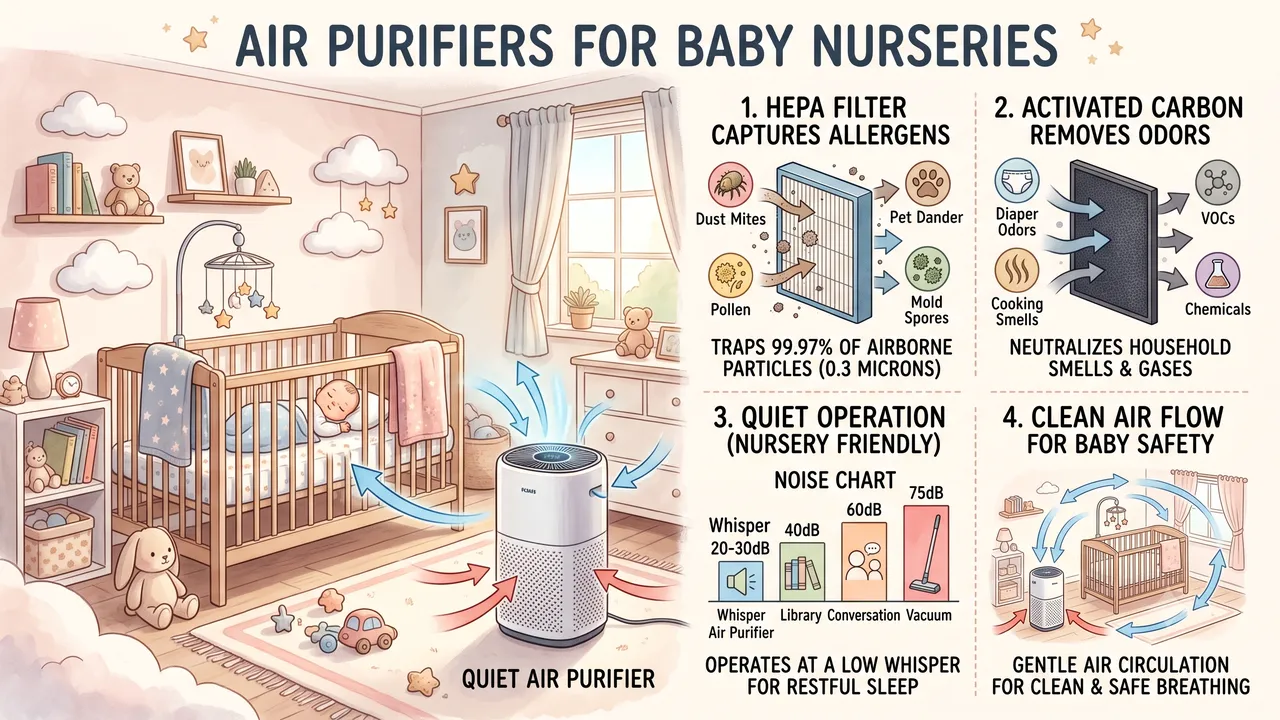
A high-quality air purifier with a True HEPA filter can capture 99.97% of particles as small as 0.3 microns, significantly reducing your baby’s exposure to these irritants. For parents dealing with allergies, asthma, or eczema in the family, a nursery air purifier isn’t a luxury, it’s a medical necessity.
What to Look for in a Nursery Air Purifier
Before diving into our top picks, let’s cover the key criteria every parent should evaluate:
Noise Level (dB)
Newborns spend 14 to 17 hours a day sleeping. A noisy air purifier can interfere with nap schedules and nighttime rest. Look for models that operate at 30 dB or below on their lowest setting, roughly equivalent to a whisper. Many parents find that a consistent, low-frequency hum actually acts as white noise and helps babies sleep. However, units with rattling fans, clicking relays, or high-pitched motor whine should be avoided.
Ozone Output
This is non-negotiable for a nursery. The California Air Resources Board (CARB) certifies air purifiers that produce less than 0.050 parts per million (ppm) of ozone. Some technologies, particularly ionizers, electrostatic precipitators, and UV-C purifiers, can generate ozone as a byproduct. For a nursery, we strongly recommend sticking with HEPA and activated carbon filtration only, and choosing CARB-certified models.
Cord Safety
Loose cords are a strangulation and choking hazard. The best nursery air purifiers feature short, integrated power cords or recessed cord compartments. Some models offer cordless operation via rechargeable batteries, which eliminates this risk entirely. At minimum, ensure the cord can be secured flush against the wall and out of reach.
Filtration Technology
True HEPA (H13 grade) is the gold standard. Avoid “HEPA-like” or “HEPA-type” filters, which don’t meet the same efficiency threshold. An activated carbon layer is a valuable bonus for absorbing VOCs and odors. Some units add a pre-filter to extend the life of the main HEPA filter, which also saves money on replacements.
Room Coverage (CADR)
Check the Clean Air Delivery Rate (CADR) and make sure it matches your nursery size. Most nurseries are between 100 and 200 square feet. A CADR of 100+ is more than sufficient. Oversized units waste energy; undersized ones won’t clean the air effectively.
Safety-First Comparison: Top 5 Air Purifiers for Baby Nurseries in 2026
We analyzed and evaluated dozens of models to find the five that best balance air purification performance with nursery-specific safety. Here’s how they stack up:
| Model | Noise Level (Low/High) | Ozone Output | Cord Safety | Filter Type | Room Coverage | Price (USD) |
|---|---|---|---|---|---|---|
| Levoit Core 300S | 24 dB / 46 dB | Zero (no ionizer) | Standard cord, wall-mountable | H13 True HEPA + Carbon | 219 sq ft | $100 |
| Coway Airmega Mighty (AP-1512HH) | 24.4 dB / 53.8 dB | Zero (ionizer off) | Standard cord with clip | True HEPA + Carbon | 361 sq ft | $160 |
| Blueair Blue Pure 311i Max | 23 dB / 50 dB | Zero (HEPASilent) | Short cord, cord wrap built-in | HEPASilent + Carbon | 340 sq ft | $150 |
| Winix Zero+ | 26 dB / 54 dB | Zero (PlasmaWave off) | Standard cord, recessed | True HEPA + Carbon + PlasmaWave | 300 sq ft | $130 |
| Pure Enrichment PureZone Elite | 25 dB / 48 dB | Zero (no ionizer) | Short integrated cord | H13 True HEPA + Carbon + UV-C (optional) | 200 sq ft | $90 |
1. Levoit Core 300S, Best Overall for Nurseries
The Levoit Core 300S has dominated nursery air purifier recommendations for three years running, and the 2026 refresh makes it even better. At just 24 dB on its Sleep mode, it’s nearly inaudible, quieter than a ticking clock. The H13 True HEPA filter paired with an activated carbon layer handles dust, allergens, pet dander, VOCs, and household odors without producing a single molecule of ozone.
The 300S connects to the VeSync app, letting you monitor filter life, adjust fan speed, and set schedules without entering the nursery and risking a wake-up. Its compact 8.7-inch footprint fits easily on a shelf or dresser, and the child-lock feature prevents curious toddlers from changing settings.
Why it’s great for babies: Silent operation, zero ozone, app control, and an affordable $100 price point make this the default recommendation. Filter replacements run about $25 every six to eight months.
For a deeper look at Levoit’s full lineup, see our Levoit air purifier comparison guide.
2. Coway Airmega Mighty (AP-1512HH), Best for Larger Nurseries
If your nursery doubles as a playroom or sits in an open-concept space, the Coway Airmega Mighty covers up to 361 square feet with a CADR of 210 for dust. Its four-stage filtration, pre-filter, odor filter, True HEPA, and optional ionizer, is highly effective, and the ionizer can be turned completely off to eliminate ozone concerns.
Noise-wise, it hits 24.4 dB on the lowest fan setting, making it a close competitor to the Levoit. The built-in air quality indicator uses a color-coded LED ring that adjusts fan speed automatically, though you’ll want to disable the light for nighttime in the nursery.
Why it’s great for babies: Excellent coverage, proven filtration, and a 10-year warranty demonstrate Coway’s confidence in the product. It’s a set-it-and-forget-it option for parents who want robust performance.
3. Blueair Blue Pure 311i Max, Quietest Option
Blueair’s HEPASilent technology combines electrostatic and mechanical filtration, allowing the fan to spin slower while maintaining high CADR. The result: 23 dB on the lowest setting, which is essentially silent. The washable fabric pre-filter comes in multiple colors and catches large particles before they reach the main filter, extending its lifespan.
The 311i Max has a built-in cord wrap on the bottom panel, keeping the cable tidy and harder for little hands to grab. It’s also one of the most energy-efficient models on this list, drawing just 4 watts on low.
Why it’s great for babies: The quietest option available with top-tier filtration. Ideal for light sleepers and parents who want a purifier that blends into nursery decor. Check our Blueair purifier review for the full lineup.
4. Winix Zero+, Best Value with Carbon Filter
The Winix Zero+ has a four-stage filtration system including a substantial activated carbon filter, making it particularly effective at removing VOCs from new nursery furniture. The PlasmaWave technology can be toggled off completely, and when disabled, the unit produces zero ozone.
At 26 dB on low, it’s slightly louder than the top picks but still well within “white noise” territory. The auto mode adjusts fan speed based on real-time air quality readings, and the filter replacement indicator takes the guesswork out of maintenance.
Why it’s great for babies: Best-in-class VOC removal when the carbon filter is active. Perfect for newly renovated nurseries or rooms with fresh paint and new furniture. Read our full Winix air purifier guide for more models.
5. Pure Enrichment PureZone Elite, Best Budget Option
At $90, the PureZone Elite delivers H13 True HEPA filtration in a nursery-friendly package. The optional UV-C light can be turned on or off, we recommend keeping it off in a nursery, as UV-C purifiers can occasionally produce trace ozone. Without the UV-C, the unit is a straightforward HEPA + carbon purifier with a 25 dB low setting.
The integrated short cord is a standout safety feature, reducing the length of exposed cable. The unit is lightweight (under 5 lbs) and easy to move between rooms as needed.
Why it’s great for babies: Affordable, safe, and effective for small nurseries under 200 sq ft. A solid entry point for budget-conscious parents. See our budget air purifier roundup for more affordable picks.
Baby-Specific Safety Concerns Every Parent Should Know
Ozone and Infant Respiratory Health
Ozone is a lung irritant even at low concentrations. The EPA warns that exposure to ozone can cause chest pain, coughing, and throat irritation, symptoms that infants cannot communicate. Models with ionizers, UV-C lights, or electrostatic cells can produce ozone. Always choose HEPA-only models for nurseries, or ensure ozone-producing features can be completely disabled (not just reduced).
Noise and Infant Sleep Development
Research published in Pediatrics suggests that consistent ambient noise below 50 dB is safe for infant sleep. However, sudden changes in noise level, such as an air purifier ramping up when it detects pollution, can trigger startle reflexes and disrupt sleep cycles. Look for models with a dedicated “Sleep” or “Night” mode that locks the fan at its lowest speed.
Cord Strangulation Risk
The Consumer Product Safety Commission (CPSC) has documented cases of infant strangulation involving electrical cords. In a nursery, any cord within a baby’s reach is a potential hazard. Secure all cords with cord covers or tape, route them behind furniture, or choose models with short, integrated cords. Once your baby starts pulling up and reaching, wall-mounted purifiers become the safest option.
Tip-Over Hazard
As babies grow into toddlers, they pull, push, and grab everything. A lightweight air purifier can be tipped over, potentially injuring a child or damaging the unit. Choose models with a low center of gravity, a wide base, or wall-mount capability.
Filter Replacement and Off-Gassing
New HEPA filters can have a slight chemical smell when first installed. Always run a new filter on high speed for one to two hours in an empty room before placing the unit in the nursery. This “burn-in” period allows any manufacturing residues to dissipate.
Where to Place an Air Purifier in the Nursery
Placement matters as much as product selection. Follow these guidelines for maximum effectiveness and safety:
-
Elevate the unit. Place the purifier on a dresser, shelf, or wall mount at roughly 3 to 5 feet off the ground. This height captures airborne particles at the level your baby breathes.
-
Keep it 3 to 5 feet from the crib. Too close, and the direct airflow may chill your baby or blow dust from the filter outward. Too far, and the unit won’t effectively clean the air around the crib.
-
Ensure unobstructed airflow. Leave at least 12 inches of clearance on all sides of the intake and output vents. Don’t push the purifier flush against a wall or tuck it behind curtains.
-
Avoid corners. Air circulates best when the purifier is positioned along a wall but not wedged into a corner where airflow is restricted.
-
Route cords safely. Use cord covers along baseboards, secure cords with adhesive clips, or tape them flat against the wall. Never run cords under rugs where they can overheat.
-
Consider door and window placement. Position the purifier between the crib and the most likely pollution source, typically the door (for hallway air) or a window (for outdoor allergens).
For more tips on optimizing your whole home’s air quality, visit our indoor air quality guide.
How Often to Replace Nursery Air Purifier Filters
Filter replacement schedules vary by model and usage, but here are general guidelines for nursery use:
- Pre-filters: Wash or vacuum every 2 to 4 weeks
- HEPA filters: Replace every 6 to 12 months (check manufacturer recommendations)
- Activated carbon filters: Replace every 3 to 6 months (they lose effectiveness faster than HEPA filters)
Running your purifier 24/7 on a low setting is more effective, and more energy-efficient, than running it intermittently on high. Continuous operation keeps particle counts consistently low rather than allowing them to build up between cycles.
Frequently Asked Questions
Is it safe to run an air purifier in a baby’s room all night?
Yes, provided the unit is HEPA-only (no ionizer or ozone-producing features), operates at or below 30 dB on its lowest setting, and is positioned safely away from the crib with secured cords. In fact, running the purifier continuously on a low setting is the recommended approach for maintaining consistently clean air in the nursery.
Can an air purifier help with baby eczema or allergies?
Air purifiers can reduce airborne triggers like dust mites, pet dander, pollen, and mold spores that worsen eczema flare-ups and allergic reactions. While an air purifier alone won’t cure eczema, it’s a proven complementary measure recommended by many pediatric allergists. Pair it with regular washing of bedding in hot water and the use of hypoallergenic mattress covers for best results.
Do I need an air purifier if I already have a HEPA vacuum?
Yes. A HEPA vacuum captures particles that have settled on surfaces, but an air purifier captures particles that are suspended in the air, which is what your baby is actually breathing. The two tools are complementary, not interchangeable. Vacuuming also temporarily stirs up settled particles, making a running air purifier even more valuable during and after cleaning.
Should I choose a purifier with a UV-C light for extra germ protection?
For nurseries, we recommend skipping UV-C. While UV-C light can kill some bacteria and viruses, the exposure time needed in a fast-moving air purifier is often insufficient for meaningful germicidal effect. More importantly, UV-C bulbs can produce trace amounts of ozone. For a baby’s room, the marginal germ-killing benefit doesn’t justify the ozone risk. A good HEPA filter will physically trap bacteria and virus-carrying particles just as effectively.
What size air purifier do I need for a nursery?
Most nurseries are between 100 and 200 square feet. An air purifier with a CADR of at least 100 is sufficient. Check the manufacturer’s recommended room size and aim for a unit rated for your room or slightly larger, it will clean the air faster and run on a lower, quieter fan speed to cover the same space. Our room size air purifier calculator can help you find the perfect match.
Final Verdict: Which Nursery Air Purifier Should You Buy?
For most parents, the Levoit Core 300S hits the sweet spot of silent operation, proven HEPA filtration, zero ozone, smart home integration, and an affordable price. It’s the model we recommend first and most often.
If your nursery is larger than 200 square feet, step up to the Coway Airmega Mighty for its superior coverage and auto-adjusting fan. If budget is tight, the Pure Enrichment PureZone Elite delivers essential HEPA protection at under $100. And if you’ve just finished a nursery renovation with new paint and furniture, the Winix Zero+ with its robust carbon filter is your best bet for VOC removal.
No matter which model you choose, the most important step is the first one: making clean air a priority in the room where your baby spends most of their time. A quality air purifier is one of the simplest, most effective investments you can make in your child’s long-term respiratory health.
Last updated: June 9, 2026
Looking for more ways to improve your home’s air quality? Explore our complete air purifier buying guide or check out our best air purifiers for allergies roundup.
You May Also Like
- Best Air Purifier for Nursery and Baby Room: Safe, Quiet, and Effective Choices
- Air Purifier Electricity Cost: How Much Does It Really Cost to Run 24/7?
- Air Purifier Filter Replacement Guide: Costs, Schedules, and How to Extend Filter Life
- Best Air Purifier Under $150: Genuine HEPA Without Breaking the Bank
Support This Guide
Helpful? Add The Air Purifier Guide as a preferred source on Google so our guides show up in your search results.
Related Articles

Coway Mighty2 vs AP-1512HH (2026)
Coway's Mighty2 replaced the AP-1512HH as Wirecutter's top pick. We compare CADR, noise, sensors, filter costs, and whether the older unit is still the smarter buy.

KNKA APH4000 Review: $150 Dark Horse
KNKA's APH4000 is one of Amazon's best-selling purifiers at $150. We check the AHAM certification, decode the 1,695 sq ft claim, and compare it to Levoit and Coway.

Levoit Core 300 vs 300-P: What Changed
Levoit quietly replaced the Core 300 with the Core 300-P. We explain the AHAM certification, whether filters still fit, and which one you should actually buy.

Shark NeverChange HP302 Review
Shark's NeverChange HP302 promises 5 years on one filter. We dig into the real running costs, the odor neutralizer catch, and whether it beats cheaper rivals.

Winix 5510 vs 5500-2: 2026 Verdict
The Winix 5500-2 is discontinued and the 5510 takes over. We compare CADR, noise, filter costs, and the one compatibility problem nobody mentions.
🛒 Products Mentioned
As an Amazon Associate, we earn from qualifying purchases.
Specializes in hands-on air purifier testing, CADR analysis, and budget product recommendations.
View all articles by Alex →