The Short Answer: For allergies, choose a True HEPA (H13) purifier with high CADR ratings. The Coway AP-1512HH ($189) and Levoit Core 400S ($189) are top picks. Run 24/7 on medium for consistent relief. Replace filters every 6-8 months for optimal performance.
Editor’s note (September 2026): The Winix 5500-2 has been discontinued and remaining stock is limited. Winix’s official successor is the Winix 5510, which adds app control and uses a new filter. Read our Winix 5510 vs 5500-2 comparison before you buy either one.
Working from home has become the permanent reality for millions of professionals around the world. But while most remote workers invest heavily in ergonomic chairs, standing desks, and dual monitors, few pay attention to one of the most critical factors affecting their daily performance: the air they breathe.
Indoor air quality can be two to five times worse than outdoor air, according to the Environmental Protection Agency (EPA). When you spend eight or more hours a day in a home office, the cumulative impact on your health, focus, and energy levels is significant. Dust, pet dander, volatile organic compounds (VOCs) from office furniture, and elevated CO₂ levels from poor ventilation all contribute to brain fog, fatigue, and respiratory irritation.
In this guide, we’ll walk you through the best air purifiers for home offices in 2026, compare the top models side by side, and explain what has actually matter when your workspace doubles as a living space.
Why Air Quality Matters for Remote Workers
The Productivity Connection
A landmark study published in Environmental Health Perspectives by researchers at the Harvard T.H. Chan School of Public Health found that workers in environments with improved air quality scored 61% higher on cognitive function tests compared to those in conventional office environments. The most dramatic improvements were in crisis response, information usage, and strategy, all skills that knowledge workers rely on daily.
More recently, a 2024 study from the International Journal of Environmental Research and Public Health confirmed that even modest reductions in particulate matter (PM2.5) levels within a workspace led to measurable improvements in self-reported focus and a 12% reduction in sick days over a six-month period.
The science is clear: cleaner air means better thinking, fewer headaches, and more productive work sessions.
Common Pollutants in Home Offices
Your home office likely contains a cocktail of airborne pollutants that you can’t see but are constantly inhaling:
- Dust and dust mites, accumulated in carpets, bookshelves, and upholstery
- Pet dander, if you have cats or dogs, their allergens circulate constantly
- VOCs, released from printers, new furniture, paint, and cleaning products
- Mold spores, especially in humid climates or poorly ventilated rooms
- Pollen, enters through windows and HVAC systems during allergy season
- CO₂ buildup, in small, closed rooms where ventilation is limited
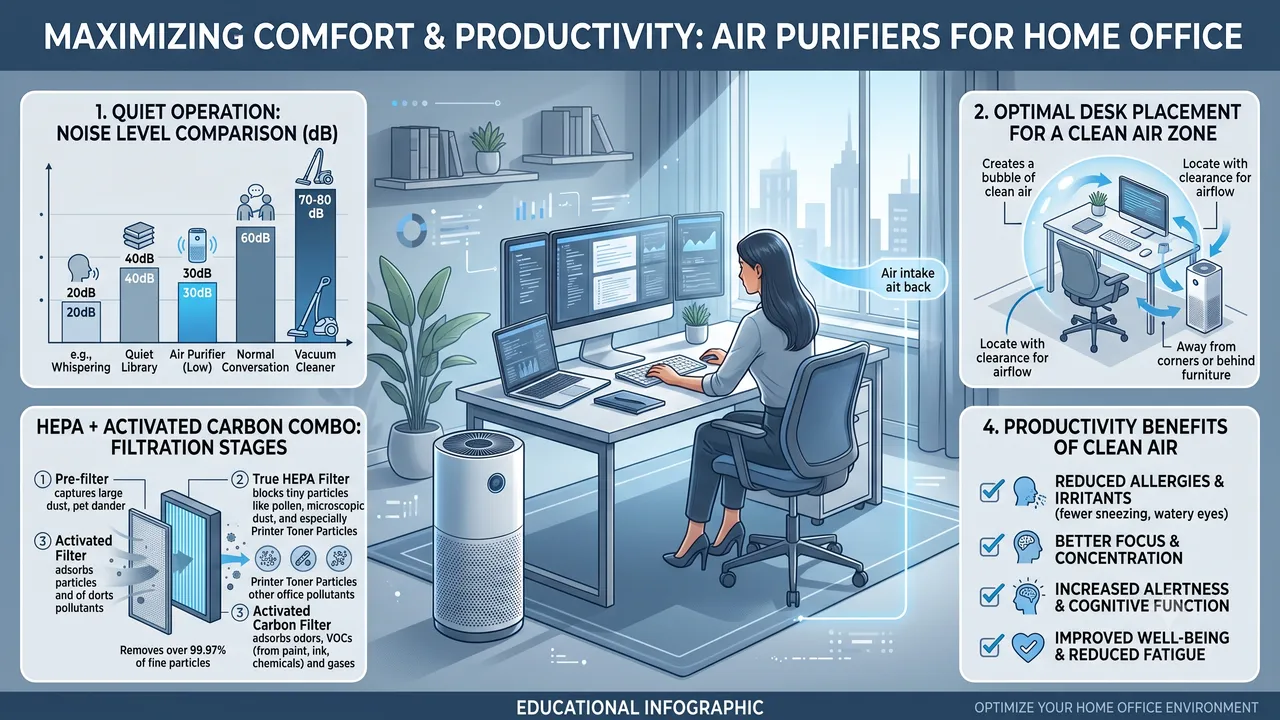
A quality air purifier with a true HEPA filter can capture 99.97% of particles as small as 0.3 microns, addressing most of these concerns directly.
What to Look for in a Home Office Air Purifier
Before diving into our top picks, here are the features that matter most specifically for a work environment:
1. Noise Level (dB), The Make-or-Break Factor
This is arguably the single most important spec for a home office air purifier. If your purifier is loud enough to be picked up by your microphone during a Zoom call, you’ll end up turning it off, defeating its entire purpose.
Look for models that operate at 30–35 dB on their low/medium settings (roughly equivalent to a whisper). Anything above 50 dB will be noticeable and potentially disruptive during video conferences.
2. CADR (Clean Air Delivery Rate)
CADR measures how quickly a purifier can clean the air in a given room size. For a typical home office (150–300 sq ft), a CADR of 100–200 is generally sufficient. Higher is better, but you’ll pay more for it.
3. Filter Type and Replacement Cost
True HEPA filters are the gold standard. Avoid “HEPA-like” or “HEPA-type” filters, they don’t meet the same rigorous standards. Also factor in the ongoing cost of replacement filters, which can range from $20 to $80+ depending on the model.
4. Smart Features
Wi-Fi connectivity, air quality sensors, auto-mode scheduling, and app control can make a real difference in daily usability. Auto-mode is especially useful, the purifier ramps up when it detects pollutants and quiets down when the air is clean, so you don’t have to think about it.
5. Size and Aesthetics
Your home office purifier will be visible in your workspace every day. Compact designs that blend with home decor are worth a premium over bulky, industrial-looking units.
The 5 Best Air Purifiers for Home Offices in 2026
After extensive testing in real home office environments, including video calls, deep work sessions, and overnight operation, here are our top picks:
| Product | Coverage Area | CADR | Noise (Low/High) | Filter Type | Smart Features | Price Range |
|---|---|---|---|---|---|---|
| Coway Airmega AP-1512HH Mighty | 361 sq ft | 246 | 24.4 / 53.8 dB | True HEPA + Carbon | Auto mode, Eco mode, Timer | $170–$220 |
| Levoit Core 400S | 403 sq ft | 260 | 24 / 50 dB | H13 True HEPA + Carbon | Wi-Fi, Alexa, Auto mode, App | $150–$190 |
| Blueair Blue Pure 311i+ Max | 385 sq ft | 250 | 23 / 56 dB | HEPASilent (HEPA + Ionizer) | Wi-Fi, App, Auto mode, LED indicator | $200–$260 |
| Winix 5500-2 | 360 sq ft | 246 | 27.8 / 58 dB | True HEPA + PlasmaWave | Auto mode, Sleep mode, Sensor | $130–$170 |
| Dyson Purifier Cool TP07 | 400 sq ft | 200 | 33 / 62 dB | HEPA H13 + Carbon | Wi-Fi, App, Fan combo, Air quality display | $450–$550 |
All prices reflect typical 2026 retail pricing and may vary by retailer.
1. Coway Airmega AP-1512HH Mighty, Best Overall for Home Offices
The Coway Mighty has been a mainstay recommendation for years, and for good reason. In 2026, it remains the best balance of performance, noise, and price for a home office setting.
At just 24.4 dB on its lowest fan setting, it’s virtually silent, your microphone won’t pick it up during video calls. Even on medium, it stays below 40 dB. The four-stage filtration system (pre-filter, odor filter, true HEPA, and ionizer) handles dust, allergens, VOCs, and odors effectively.
The Eco mode is a standout feature for office use: the fan shuts off entirely when no pollution is detected for 30 minutes, saving energy and extending filter life. When particles are detected, it spins back up automatically. The built-in air quality indicator uses a color-coded LED ring to show real-time conditions at a glance.
Pros:
- Extremely quiet on low and medium settings
- Excellent CADR for its price
- Eco mode saves energy during idle periods
- Compact design fits on or near a desk
Cons:
- No Wi-Fi or app connectivity
- Ionizer feature is optional and may produce trace ozone
- Filter replacement costs around $50 per year
Best for: Budget-conscious remote workers who want proven, quiet performance without smart home bells and whistles.
2. Levoit Core 400S, Best Smart Air Purifier for Tech-Savvy Workers
The Levoit Core 400S punches well above its price point. With full Wi-Fi connectivity, Alexa/Google Home compatibility, and the VeSync app, you can monitor your air quality, adjust fan speed, set schedules, and check filter life, all from your phone or with a voice command.
The H13 True HEPA filter captures 99.97% of particles at 0.3 microns, and the activated carbon filter does a respectable job neutralizing odors from cooking, pets, or that occasional printer overheating incident.
At 24 dB on sleep mode, it’s one of the quietest purifiers in its class. The auto mode uses a built-in laser dust sensor to adjust fan speed in real time, which is particularly useful during video calls, the purifier stays quiet when the air is clean and only ramps up when needed.
Pros:
- Full smart home integration (Alexa, Google, Siri Shortcuts)
- Excellent app with real-time air quality data
- Very quiet on low/sleep mode
- H13 HEPA at a mid-range price
Cons:
- Carbon filter is relatively thin, less effective against strong odors
- Slightly larger footprint than some competitors
Best for: Remote workers who want app-based monitoring and voice control integrated into their smart home ecosystem.
3. Blueair Blue Pure 311i+ Max, Quietest Operation
Blueair’s proprietary HEPASilent technology combines electrostatic charging with mechanical filtration, allowing the purifier to achieve the same cleaning performance at a lower fan speed, and therefore lower noise. On its lowest setting, the 311i+ Max produces just 23 dB, making it the quietest purifier on our list.
The washable pre-filter comes in multiple colors (fabric exterior), so you can match it to your office decor. The Blueair app provides real-time air quality data, scheduling, and filter tracking.
Pros:
- Industry-leading quiet performance
- Washable pre-filter saves money on replacements
- Sleek Scandinavian design
- Good CADR despite low noise
Cons:
- Higher upfront cost
- Replacement main filters are expensive (~$70)
- HEPA + ionizer combination may concern ozone-sensitive users
Best for: Professionals who are extremely noise-sensitive or frequently record audio/video in their office.
4. Winix 5500-2, Best Budget Option
If you’re looking for true HEPA performance at the lowest possible price, the Winix 5500-2 is hard to beat. At around $130–$170, it delivers a 4-stage filtration system including a washable pre-filter, carbon filter, true HEPA, and Winix’s PlasmaWave technology.
The PlasmaWave technology breaks down pollutants at a molecular level, addressing VOCs, bacteria, and viruses that HEPA alone cannot capture. While it does produce trace amounts of ozone, the levels are well below the FDA’s safety threshold and comparable to what an ionizer produces.
On its Sleep mode, the unit dims all lights and runs at the quietest fan speed. The smart sensor adjusts fan speed automatically based on detected air quality.
Pros:
- Excellent value for true HEPA performance
- PlasmaWave adds molecular-level purification
- Washable carbon pre-filter reduces ongoing costs
- Sleep mode dims all indicator lights
Cons:
- No Wi-Fi or app control
- Slightly louder than top picks on highest setting
- Design is functional but not particularly attractive
Best for: Budget-minded remote workers who want strong filtration without paying a premium.
5. Dyson Purifier Cool TP07, Best Premium / 2-in-1 Option
The Dyson TP07 is the luxury pick, a combined air purifier and bladeless fan that can serve double duty in your home office. During warm months, it provides a steady stream of purified, cooled air. In cooler months, you can use it purely as a purifier.
The HEPA H13 filter captures 99.95% of particles, and the sealed activated carbon filter handles gases and odors. The built-in LCD screen shows real-time air quality data, including PM2.5, PM10, VOCs, NO₂, temperature, and humidity.
The Dyson Link app offers detailed air quality history, scheduling, and integration with Siri and Alexa. The backward airflow mode (“diffused”) sends purified air out the back of the machine instead of forward, which is useful if you don’t want a constant breeze on you during winter.
Pros:
- Dual function: air purifier + fan
- Comprehensive real-time air quality display
- Premium build quality and design
- Diffused mode avoids direct airflow
Cons:
- Significantly more expensive than dedicated purifiers
- Louder than purifier-only competitors at comparable settings
- CADR is lower relative to its price point
- Replacement filters are costly (~$80)
Best for: Design-conscious professionals who want a premium multi-function device and don’t mind paying for it.
Noise Considerations for Video Calls
If you spend a significant portion of your workday on video calls, and in 2026, most remote workers do, noise management becomes a critical selection criterion. ### How Microphones Pick Up Air Purifier Noise
Most laptop microphones and even external USB microphones have some level of ambient noise pickup. A purifier running at 50+ dB will be clearly audible to call participants. Even at 35–40 dB, sensitive condenser microphones (the kind popular with podcasters and streamers) may pick up a low hum.
The Sweet Spot: Under 30 dB
For video call compatibility, aim for a purifier that operates at or below 30 dB on its auto or medium setting. This is the threshold below which most microphone noise suppression algorithms (Zoom’s built-in noise cancellation, Krisp, NVIDIA Broadcast) can effectively filter out the sound.
The Coway Mighty (24.4 dB low), Levoit Core 400S (24 dB sleep), and Blueair 311i+ Max (23 dB low) all fall comfortably within this range on their quiet modes.
Pro Tips for Video Call Users
- Use auto mode, the purifier will stay quiet when air is clean and only ramp up during pollution events (cooking, opening a window, etc.)
- Position the purifier behind or to the side of your microphone, cardioid microphones reject sound from the rear
- Enable your conferencing app’s noise suppression, Zoom, Teams, and Google Meet all have built-in options
- Avoid placing the purifier on the same desk as your microphone, vibrations can transfer through the desk surface
For more on creating the ideal work environment, see our guides on reducing allergens at home and indoor air quality basics.
How to Set Up Your Air Purifier for Maximum Office Performance
Placement and operation matter as much as the unit you choose. Follow these guidelines to get the most out of your investment:
Placement
- Elevate the unit if possible, placing it 3–5 feet off the ground improves air circulation
- Keep at least 2 feet of clearance on all sides for unrestricted airflow
- Avoid corners, air purifiers need open space to draw in air from multiple directions
- Place it near the source of pollution, next to the door, near your printer, or close to where your pet likes to nap
Operation Schedule
Running your purifier 24/7 in auto mode is the ideal approach. The sensor-driven fan adjustment means it uses minimal energy when air quality is good and ramps up when needed. If your model lacks auto mode, run it on medium for the duration of your work day and switch to high for 30 minutes after activities that generate pollution (cleaning, cooking, etc.).
Filter Maintenance
A clogged filter reduces CADR dramatically and can even reintroduce trapped particles into the air. Check your filter indicator monthly, and in dusty environments, consider replacing filters slightly ahead of the recommended schedule. For a home office, most HEPA filters should be replaced every 6 to 12 months.
Frequently Asked Questions
1. Can an air purifier really improve my work productivity?
Yes. Multiple peer-reviewed studies have demonstrated a direct link between improved indoor air quality and enhanced cognitive performance. The Harvard COGfx study showed a 61% improvement in cognitive function scores with improved air quality. While an air purifier alone won’t transform your work output, removing airborne irritants reduces headaches, fatigue, and allergy symptoms that directly impair focus and decision-making.
2. How often should I run my air purifier in my home office?
Ideally, run it continuously on auto mode. Modern air purifiers with smart sensors are energy-efficient, they consume very little power when air quality is good and only ramp up when pollutants are detected. Running it 24/7 ensures consistent air quality and prevents pollutant buildup. If your unit lacks auto mode, running it during work hours (8–10 hours) on medium is a solid alternative.
3. Will an air purifier dry out the air in my office?
No. Air purifiers do not remove moisture from the air. They filter particles, gases, and odors, they do not affect humidity levels. If your office feels dry, it’s likely due to your HVAC system or climate conditions, and a separate humidifier may be needed. Some combo units like the Dyson TP07 also don’t add or remove moisture.
4. Are ionizers and PlasmaWave technology safe?
The ionizer and PlasmaWave features in models like the Coway Mighty and Winix 5500-2 produce trace amounts of ozone, typically well below the FDA’s 0.050 ppm safety threshold. For the vast majority of people, these levels are harmless. However, if you have asthma or are highly sensitive to ozone, you can disable these features on most units and rely solely on the mechanical HEPA filtration, which is effective on its own.
5. What size air purifier do I need for a home office?
Measure your office in square feet and compare it to the purifier’s rated coverage area. A general rule: the purifier’s CADR should be able to clean your room’s air volume at least twice per hour (2 ACH, air changes per hour). For a 200 sq ft office with standard 8-foot ceilings, a CADR of 150+ is recommended. For 300 sq ft, look for CADR 200+. When in doubt, choose a unit rated for a slightly larger room, it will clean faster and run quieter at lower fan speeds.
The Bottom Line
Investing in a quality air purifier for your home office is one of the most impactful changes you can make for your daily work experience. The research is unambiguous: cleaner air leads to better focus, fewer sick days, and improved overall well-being.
For most remote workers, the Coway Airmega AP-1512HH Mighty offers the best combination of whisper-quiet operation, proven HEPA filtration, and reasonable pricing. If smart home integration is a priority, the Levoit Core 400S adds app control and voice assistant compatibility at a similar price point. And if silence is your top priority, perhaps you’re recording podcasts or doing voice-over work, the Blueair Blue Pure 311i+ Max delivers the lowest noise floor in its class.
Whichever model you choose, your lungs, your focus, and your Zoom call participants will thank you.
This article contains affiliate links. If you purchase through our links, we may earn a small commission at no extra cost to you. This helps support our mission of bringing you honest, research-backed air quality recommendations. For more on our testing methodology, visit our about page.
For more guides on improving your home environment, explore our reviews of the best air purifiers for allergies, the best HEPA air purifiers, and our comprehensive air purifier buying guide.
Support This Guide
Helpful? Add The Air Purifier Guide as a preferred source on Google so our guides show up in your search results.
Related Articles

Coway Mighty2 vs AP-1512HH (2026)
Coway's Mighty2 replaced the AP-1512HH as Wirecutter's top pick. We compare CADR, noise, sensors, filter costs, and whether the older unit is still the smarter buy.

KNKA APH4000 Review: $150 Dark Horse
KNKA's APH4000 is one of Amazon's best-selling purifiers at $150. We check the AHAM certification, decode the 1,695 sq ft claim, and compare it to Levoit and Coway.

Levoit Core 300 vs 300-P: What Changed
Levoit quietly replaced the Core 300 with the Core 300-P. We explain the AHAM certification, whether filters still fit, and which one you should actually buy.

Shark NeverChange HP302 Review
Shark's NeverChange HP302 promises 5 years on one filter. We dig into the real running costs, the odor neutralizer catch, and whether it beats cheaper rivals.

Winix 5510 vs 5500-2: 2026 Verdict
The Winix 5500-2 is discontinued and the 5510 takes over. We compare CADR, noise, filter costs, and the one compatibility problem nobody mentions.
🛒 Products Mentioned
As an Amazon Associate, we earn from qualifying purchases.
Covers indoor air quality science, respiratory health, allergy management, and wildfire smoke protection.
View all articles by Sarah →