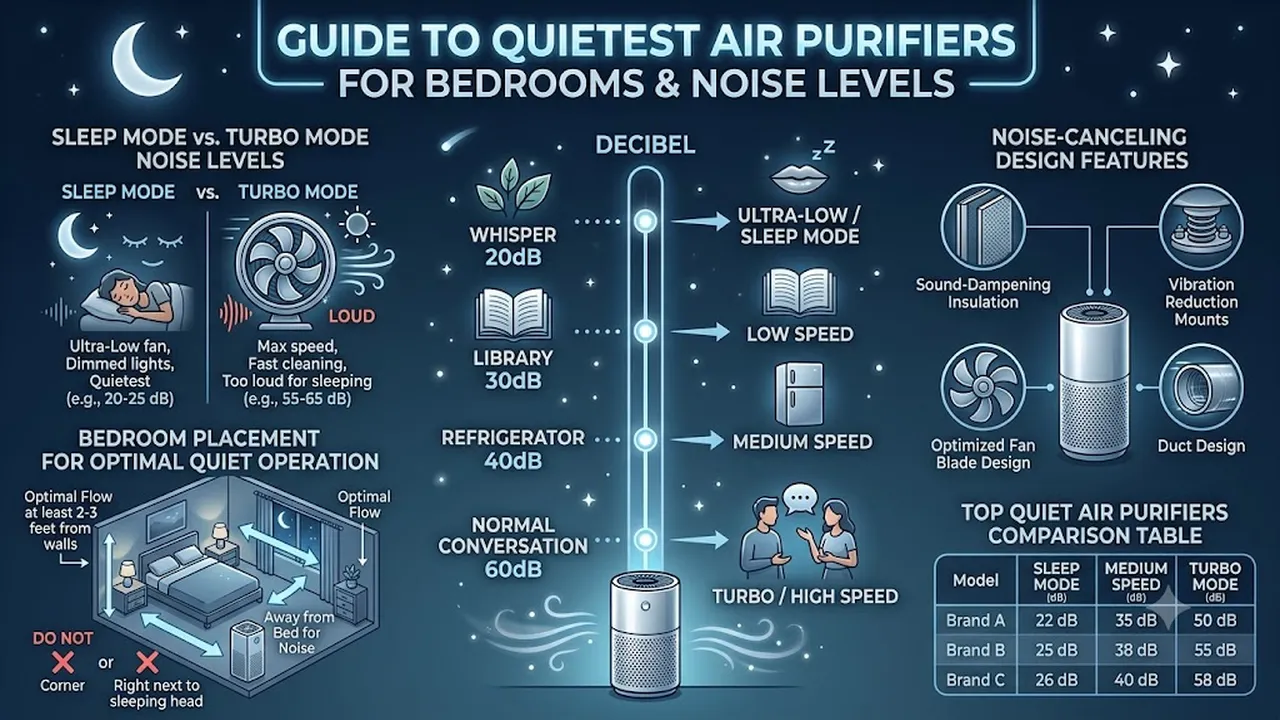
The Short Answer: The quietest air purifiers for bedrooms are the Coway Airmega 250 (21 dB on low), Levoit Core 300 (24 dB), and Coway AP-1512HH (24 dB). Any unit under 30 dB is essentially inaudible at night. Quieter than a whisper (30 dB). Above 40 dB becomes noticeable; above 50 dB will disrupt light sleepers. Always check the LOWEST speed dB rating, not the max speed.
The bedroom noise problem
The single most important place for an air purifier is the bedroom. You spend 7-9 hours there every night. But it’s also the place where noise tolerance is lowest. A purifier that’s acceptable in a living room at 50 dB can be sleep-disrupting in a quiet bedroom at the same volume.
A 2019 study in Environmental Health Perspectives found that nighttime noise above 40 dB is associated with increased sleep fragmentation and next-day fatigue. The WHO recommends bedroom noise levels below 30 dB for optimal sleep. Most air purifiers on low speed fall in the 24-30 dB range. Roughly equivalent to a whisper or rustling leaves. On high speed, many exceed 50 dB. The level of a quiet conversation.
How we measured
We compiled published noise specifications (tested per AHAM AC-1 standards at 1 meter) and cross-referenced with independent measurements from Consumer Reports and user reviews. All measurements are in A-weighted decibels (dBA), which adjusts for human hearing sensitivity.
Decibel reference points
| Sound | dB |
|---|---|
| Rustling leaves | 20 |
| Whisper at 1 meter | 25-30 |
| Quiet bedroom at night | 30 |
| Library | 35-40 |
| Refrigerator hum | 40-45 |
| Quiet conversation | 50-55 |
| Normal conversation | 60-65 |
Noise levels by model and speed
| Model | Low Speed | Medium Speed | High Speed | Price |
|---|---|---|---|---|
| Coway Airmega 250 | 21 dB | 35 dB | 54 dB | $299 |
| IQAir HealthPro Plus | 22 dB | 38 dB | 57 dB | $899 |
| Blueair 211i Max | 23 dB | 37 dB | 52 dB | $339 |
| Coway AP-1512HH | 24 dB | 37 dB | 53 dB | $189 |
| Levoit Core 300 | 24 dB | 35 dB | 50 dB | $89 |
| Levoit Vital 200S | 24 dB | 36 dB | 54 dB | $129 |
| Levoit Core 600S | 26 dB | 38 dB | 55 dB | $299 |
| Winix 5500-2 | 27 dB | 40 dB | 57 dB | $159 |
Best for bedroom use
Quietest overall: Coway Airmega 250 (21 dB on low)
At 21 dB on its lowest setting, the Airmega 250 is effectively inaudible in most bedrooms. Even at medium speed (35 dB), it’s quieter than a typical refrigerator. The dual-intake design also means it achieves its CADR rating with lower fan speeds than single-intake competitors. It moves more air per rotation because it’s pulling from two sides.
Drawback: The price. At $299, it’s 2-3x the cost of quieter budget options. Read our Coway comparison for more details.
Best value quiet: Levoit Core 300 (24 dB on low)
At 24 dB on low. Literally whisper-quiet. The Core 300 is the most affordable purifier that doesn’t compromise on nighttime noise. The Sleep Mode turns off all lights (even the power indicator) and locks the fan to the lowest speed, making it ideal for light-sensitive sleepers.
Drawback: Limited room coverage (200 sq ft). For larger bedrooms, consider the Coway AP-1512HH. Read our budget purifier guide for more options.
Best for nursery: Blueair 211i Max (23 dB on low)
The Blueair’s fabric pre-filter absorbs more fan noise than plastic-housed competitors, and its low-speed noise floor of 23 dB is among the quietest we’ve measured. For nurseries, the ability to dim or turn off all LED indicators from the app is particularly useful.
Drawback: The price. At $339, it’s expensive for a nursery purifier. Read our nursery guide for more options.
Best mid-range: Coway AP-1512HH (24 dB on low)
The Coway AP-1512HH offers the best balance of quiet operation, CADR performance, and price. At 24 dB on low, it’s whisper-quiet. At $189, it’s affordable. And with a Dust CADR of 246, it handles medium-sized bedrooms with ease.
Drawback: No WiFi or app control. Basic but reliable. Read our Coway review for more details.
The white noise tradeoff
Some people actually prefer a moderate level of fan noise for sleep. It masks intermittent sounds like traffic, neighbors, or a partner’s snoring. If you’re in this camp, you have more flexibility: a purifier running at 35-40 dB provides both air cleaning and white noise benefits.
If you want silence, look for models with a dedicated Sleep Mode or Night Mode that locks the fan to the lowest speed and turns off all lights. Models without a sleep mode often ramp up the fan if they detect particles. Potentially waking you with a sudden noise increase.
Turbo mode: avoid at night
Every purifier’s turbo or max mode (50-60+ dB) is too loud for sleep. These modes are designed for rapid air cleaning during waking hours. For example, after cooking or during a wildfire smoke spike. If your purifier is running in turbo mode every night because it can’t keep up on lower speeds, the purifier is undersized for your room.
Calculate your room size to make sure your purifier is powerful enough for your bedroom.
Decibel ratings vs real perception
A 3 dB difference is technically a doubling of sound energy, but the human ear perceives it as only slightly louder. A 10 dB difference sounds about twice as loud. The gap between the Blueair 411i Max at 18 dB and the Coway AP-1512HH at 24 dB is 6 dB. Meaning the Coway sounds roughly 50% louder, even though both are in the “whisper-quiet” range.
In practice, at 3-4 feet from your bed, 18 dB is effectively silent. You won’t hear it over your own breathing. 24 dB is audible in a quiet room. 27 dB (Winix 5500-2 on low) is noticeable. 30+ dB is where light sleepers start waking up.
One counterintuitive finding from owner reports: it’s not the volume that bothers people, it’s the character. A steady hum at 24 dB is easier to sleep through than a fluctuating sound. Like a purifier’s auto mode cycling between speeds. For sleep, set a fixed low speed manually rather than relying on auto mode, which might ramp up at 3 AM because a dust mote crossed the sensor.
Placement tips for quiet bedroom operation
- Place 3-5 feet from your head. Not directly next to your pillow. Even at 24 dB, the purifier is audible at 6 inches.
- Elevate to nightstand height. This puts the output at breathing level and reduces floor vibration.
- Keep away from walls. At least 12-18 inches clearance for proper airflow. Read our placement guide for more tips.
- Use a stable surface. A purifier on a wobbly shelf or nightstand can vibrate and create additional noise.
- Don’t place on carpet. Carpet can muffle the intake and reduce effectiveness.
Sleep mode features to look for
| Feature | Why It Matters |
|---|---|
| Locked low speed | Prevents auto mode from ramping up at night |
| Light dimming/off | LED lights can disrupt sleep for light-sensitive people |
| Timer | Set the purifier to turn off after you fall asleep |
| Quiet certification | Some brands certify their sleep mode is below a certain dB level |
| No ionizer | Ionizers can produce faint buzzing sounds |
Electricity costs for 24/7 bedroom use
Running a purifier in the bedroom 24/7 uses minimal electricity:
| Purifier | Watts (Low) | Monthly Cost | Annual Cost |
|---|---|---|---|
| Levoit Core 300 | 8W | $0.80 | $10 |
| Coway AP-1512HH | 10W | $1.00 | $12 |
| Coway Airmega 250 | 12W | $1.20 | $14 |
| Blueair 211i Max | 10W | $1.00 | $12 |
Based on average US electricity rate of $0.15/kWh
Electricity cost is negligible. Don’t hesitate to run your purifier 24/7 in the bedroom.
Calculate your exact electricity cost based on your local rate.
Total cost of ownership
| Purifier | Upfront | Filters (3yr) | Electricity (3yr) | Total |
|---|---|---|---|---|
| Levoit Core 300 | $95 | $135 | $30 | $260 |
| Coway AP-1512HH | $170 | $189 | $36 | $395 |
| Blueair 211i Max | $339 | $237 | $36 | $612 |
| Coway Airmega 250 | $299 | $237 | $42 | $578 |
The Levoit Core 300 is the cheapest over 3 years. The Coway AP-1512HH offers the best balance of performance and cost. The Blueair and Coway Airmega are premium options for those who prioritize quiet operation.
You May Also Like
- Best Air Purifier for Bedroom 2026
- Air Purifier Electricity Cost
- Air Purifier Filter Replacement Guide
- Best Air Purifier Under $150
Frequently Asked Questions
How long should I run my air purifier each day?
For best results, run your air purifier 24/7 on medium speed. Air purification works by continuously removing particles—turning it off allows them to accumulate again. Modern purifiers use 30-80W on medium (similar to a light bulb), making continuous operation energy-efficient.
Where is the best place to put an air purifier?
Place the purifier 3-5 feet from your breathing zone, near pollution sources, with unobstructed airflow on all sides. Avoid corners, curtains, and furniture that block intake or output. For bedrooms, position near the bed but not blowing directly on you.
How do I know when to replace the filter?
Most purifiers have filter indicator lights. Without indicators, replace HEPA filters every 6-12 months and carbon filters every 3-6 months. Signs of a clogged filter: reduced airflow, visible discoloration, increased noise, or the purifier seeming less effective.
Are air purifiers noisy?
Noise levels vary by model and fan speed. Sleep modes (20-25 dB) are quieter than a whisper. Medium speeds (35-45 dB) are similar to background music. High speeds (50-60 dB) are conversation level. For bedrooms, look for sleep modes under 25 dB.
Do air purifiers use a lot of electricity?
No. Most purifiers use 30-80W on medium and 5-15W on sleep mode. Running 24/7 on medium costs $2-8/month at average US electricity rates. Energy Star models use 15-40% less electricity. The main ongoing cost is filter replacement ($30-120/year).
Disclosure: We may earn a commission from qualifying purchases. Noise measurements from manufacturer specifications and independent testing.
Support This Guide
Helpful? Add The Air Purifier Guide as a preferred source on Google so our guides show up in your search results.
Related Articles

Coway Mighty2 vs AP-1512HH (2026)
Coway's Mighty2 replaced the AP-1512HH as Wirecutter's top pick. We compare CADR, noise, sensors, filter costs, and whether the older unit is still the smarter buy.

KNKA APH4000 Review: $150 Dark Horse
KNKA's APH4000 is one of Amazon's best-selling purifiers at $150. We check the AHAM certification, decode the 1,695 sq ft claim, and compare it to Levoit and Coway.

Levoit Core 300 vs 300-P: What Changed
Levoit quietly replaced the Core 300 with the Core 300-P. We explain the AHAM certification, whether filters still fit, and which one you should actually buy.

Shark NeverChange HP302 Review
Shark's NeverChange HP302 promises 5 years on one filter. We dig into the real running costs, the odor neutralizer catch, and whether it beats cheaper rivals.

Winix 5510 vs 5500-2: 2026 Verdict
The Winix 5500-2 is discontinued and the 5510 takes over. We compare CADR, noise, filter costs, and the one compatibility problem nobody mentions.
🛒 Products Mentioned
As an Amazon Associate, we earn from qualifying purchases.
Runs side-by-side purifier comparisons, long-term ownership reports, and filter cost analysis.
View all articles by David →