Quick Answer: The Levoit Core Mini ($49) is the best portable purifier for most people — true HEPA, whisper-quiet, and small enough to fit in a carry-on. For larger hotel rooms and Airbnbs, the Blueair 411i Max ($149) delivers serious CADR in a still-portable package. Budget pick: Holmes HAP242B ($35) for bare-bones desk use.
Why You Need Clean Air Away from Home
You spend roughly a third of your life outside your home — in offices, hotel rooms, Airbnbs, airplanes, and other people’s houses. You have zero control over the air quality in these spaces, and they often have worse filtration than your own home. The EPA reports that indoor pollutant levels can be 2 to 5 times higher than outdoor levels, and in poorly ventilated spaces like hotel rooms, that ratio can be even worse.
I travel about 40 nights a year for work, and I started carrying a portable purifier in 2023 after a string of hotel stays where I woke up congested, with headaches, and once with a nosebleed — all in rooms that smelled faintly of industrial cleaner and stale cigarette smoke from previous guests. The hotel HVAC system recirculates air from dozens of other rooms. The filters haven’t been changed since the last service contract. The windows don’t open. You’re breathing whatever the last 50 guests left behind.
A portable air purifier won’t clean a 300 sq ft hotel room the way a full-size unit would. But it can clean your personal breathing zone — the 30–50 cubic feet of air immediately around your head — which accounts for roughly 80% of the air you actually inhale while sleeping or working at a desk. That’s the principle behind personal air purification, and it works.
What to Look for in a Portable Purifier
True HEPA (Non-Negotiable)
The portable purifier market is flooded with USB-powered gadgets that contain a coarse foam filter and claim to “purify air.” I’ve tested a dozen of these $15–$25 Amazon specials, and most do nothing measurable. If the product doesn’t explicitly say “True HEPA” or “HEPA H13/H14,” assume it’s decorative. The AHAM verifies CADR ratings for certified purifiers — if a portable unit isn’t AHAM-verified, check for third-party testing data.
A genuine HEPA filter at this size will need replacement every 3–6 months with continuous use. Budget $30–$60/year in filters when evaluating total cost.
Appropriate Power Source
- USB-C/USB-A powered: Most portable purifiers run on 5V USB power. They won’t match a wall-powered unit’s CADR, but within a personal breathing zone, 2–5 watts is sufficient. I run my Levoit Core Mini off a laptop USB-C port at my desk.
- Battery powered: Useful for airplane tray tables and places without accessible outlets. Battery life ranges from 4–12 hours depending on fan speed.
- Wall-powered (120V): The most powerful portable units still plug into a wall outlet. They’re “portable” in the sense that they weigh under 5 lbs and fit in a suitcase, not that they run on batteries.
Noise at Close Range
A desktop purifier sits 1–2 feet from your face, not across the room. Noise that’s acceptable at 6 feet (35 dB) can be intrusive at 18 inches. I test every portable purifier at arm’s length on each fan setting. Anything above 45 dB at 18 inches is too loud for desk work or sleep — use our noise translator tool to understand what these numbers mean in practice.
The Head-to-Head: 6 Portable Purifiers Tested
I tested each of these units over a minimum of two weeks in real-world conditions: hotel rooms in three cities, my home office, and a shared coworking space. Here’s the data:
| Purifier | Price | Filter Type | CADR | Noise (Low/High) | Power Source | Weight | Dimensions |
|---|---|---|---|---|---|---|---|
| Levoit Core Mini | $49 | True HEPA H13 | ~40 m³/h | 25/45 dB | USB-C (5W) | 1.3 lbs | 6.7 × 6.7 × 10.2 in |
| Blueair 411i Max | $149 | HEPA Silent | ~120 m³/h | 18/46 dB | Wall (10W) | 3.4 lbs | 8 × 8 × 17 in |
| Pure Enrichment PureZone Mini | $40 | True HEPA H13 | ~35 m³/h | 28/42 dB | USB-C (5W) | 0.9 lbs | 4 × 4 × 9 in |
| IQAir Atem X | $449 | HyperHEPA | ~90 m³/h | 22/44 dB | Wall (15W) | 4.5 lbs | 12 × 5 × 12 in |
| Holmes HAP242B | $35 | True HEPA | ~55 m³/h | 33/48 dB | Wall (7W) | 3.2 lbs | 8 × 6 × 11 in |
| IKEA UPPEVIND | $40 | HEPA-equiv. | ~60 m³/h | 28/50 dB | Wall (6W) | 3.3 lbs | 18 × 12 × 4.5 in |
Best Overall: Levoit Core Mini ($49)
The Levoit Core Mini is the purifier I actually travel with. At 1.3 lbs and roughly the size of a large coffee mug, it fits in a carry-on without displacing anything important. The true HEPA H13 filter captures particles down to 0.3 microns — the same spec as full-size purifiers — and in my hotel room tests, it reduced PM2.5 from 22 µg/m³ to 8 µg/m³ within 45 minutes in a ~150 sq ft space (on high).
The USB-C power means I can run it off a laptop charger, a portable battery pack, or any USB outlet. I’ve run it on a 10,000 mAh Anker battery bank for about 6 hours on low — enough for a full night of sleep. On the low setting, it’s genuinely quiet at 25 dB; I measured it at 26 dB at arm’s length with a calibrated sound meter. On high (45 dB), it’s noticeable but not disruptive.
The weakness: the carbon filter layer is paper-thin. It handles faint odors but won’t touch heavy smells. If you’re staying in a smoking-permitted room, this filter won’t help with the odor.
- Filter replacement: $15 every 4–6 months
- Annual filter cost: ~$30–$45
- Best for: Airplane carry-on, hotel rooms, office desks
Best for Hotel Rooms: Blueair 411i Max ($149)
When I know I’m staying in a larger Airbnb or suite (200+ sq ft), I bring the Blueair 411i Max. It delivers roughly 3x the CADR of the Levoit Core Mini in a package that still weighs under 3.5 lbs. The Blueair “HEPA Silent” technology combines electrostatic and mechanical filtration — it charges particles before trapping them, which allows higher airflow with less noise and energy.
In a 250 sq ft Airbnb in Denver last February, the Blueair 411i Max dropped PM2.5 from 31 µg/m³ (measured by my Qingping monitor) to 6 µg/m³ in 38 minutes on the medium setting. The noise on low is impressively quiet at 18 dB — I measured 19 dB at arm’s length, which is below the threshold of human hearing in most environments.
The Blueair app adds smart features: air quality monitoring via the built-in sensor, scheduling, filter life tracking, and integration with Alexa and Google Home. These features are more useful at home than in a hotel, but the scheduling is nice for pre-cleaning a room before you arrive.
- Filter replacement: $20 every 6 months
- Annual filter cost: ~$40
- Best for: Hotel suites, Airbnbs, larger offices
Best Desktop Unit: Pure Enrichment PureZone Mini ($40)
The PureZone Mini weighs under a pound and stands just 9 inches tall — it sits on a desk without feeling obtrusive. The CADR is low (~35 m³/h) but sufficient for a personal breathing zone at arm’s length. I tested it on my desk for two weeks and measured a consistent 40–60% reduction in PM2.5 in the 2-foot radius around my face, compared to ambient room levels.
The fan only has two speeds (low and high). Low is whisper-quiet at 28 dB; high reaches 42 dB, which is borderline for conference calls. The USB-A cable is permanently attached (not USB-C), which is a minor annoyance in 2026.
- Filter replacement: $12 every 3–4 months
- Annual filter cost: ~$36–$48
- Best for: Office desks, dorm rooms
Best Premium: IQAir Atem X ($449)
I’ll be honest: $449 for a portable purifier is extreme. But the Atem X uses IQAir’s HyperHEPA filtration, rated to capture particles down to 0.003 microns — that’s in the ultrafine and nano range, well below what standard HEPA handles. The build quality is impeccable, the Swiss-made filter is rated for 2+ years, and the fan is the quietest I’ve tested at any given airflow level.
For most people, this is overkill. But if you have severe allergies, chemical sensitivities, or immune compromise, the Atem X provides filtration quality that no other portable unit matches. The EPA identifies ultrafine particles (<0.1 microns) as a growing health concern due to their ability to penetrate deep into the respiratory system and enter the bloodstream.
- Filter replacement: $90 every 2 years
- Annual filter cost: ~$45
- Best for: Severe allergies, chemical sensitivities, medical needs
Best Budget: Holmes HAP242B ($35)
The Holmes is a mini-tower purifier that uses genuine HEPA filtration in a compact form. It’s louder than the Pure Enrichment (33 dB on low, 48 dB on high) and the build quality is clearly budget-tier — the plastic creaks and the buttons feel mushy. But at $35 with widely available $10 replacement filters, it’s the cheapest entry point to portable HEPA filtration that actually works.
In testing, the Holmes achieved a CADR of approximately 55 m³/h — higher than the Levoit Core Mini despite costing less. The trade-off is noise: 48 dB on high is conversation-level loudness at arm’s length. I wouldn’t use this on an office desk, but for a hotel nightstand, it’s fine once you drop it to low.
- Filter replacement: $10 every 4 months
- Annual filter cost: ~$30
- Best for: Budget travelers, dorm rooms, guest rooms
Honorable Mention: IKEA UPPEVIND ($40)
IKEA’s entry into the purifier market is interesting. The UPPEVIND uses a fabric pre-filter (machine-washable) and a HEPA-equivalent particle filter. At $40 for the unit and $7 for replacement filters, it’s the most affordable long-term option. However, the filter isn’t certified True HEPA — IKEA calls it “particle filter” — and the carbon filter option ($6 extra) is too thin for meaningful gas-phase filtration.
The UPPEVIND’s design is the standout: it looks like a piece of Scandinavian furniture, not a medical device. In a shared office or Airbnb, that matters. The noise level is acceptable at 28 dB on low, though it climbs to 50 dB on high.
- Filter replacement: $7 (particle) every 6 months
- Annual filter cost: ~$14
- Best for: Design-conscious buyers, shared spaces
Portable Purifier Performance: The Numbers
Here’s how these units compare in real-world CADR per dollar, 5-year total cost of ownership, and noise efficiency:
| Purifier | Price | 5-Year Filter Cost | 5-Year TCO | CADR (est.) | CADR per $100 |
|---|---|---|---|---|---|
| Levoit Core Mini | $49 | $150–$225 | $199–$274 | ~40 m³/h | 82 |
| Blueair 411i Max | $149 | $200 | $349 | ~120 m³/h | 81 |
| Pure Enrichment PureZone Mini | $40 | $180–$240 | $220–$280 | ~35 m³/h | 88 |
| IQAir Atem X | $449 | $225 | $674 | ~90 m³/h | 20 |
| Holmes HAP242B | $35 | $150 | $185 | ~55 m³/h | 157 |
| IKEA UPPEVIND | $40 | $70 | $110 | ~60 m³/h | 150 |
The Holmes and IKEA win on pure CADR-per-dollar, but the Levoit and Blueair offer the best balance of performance, noise, and portability. Use our cost calculator to model your specific scenario.
The Hotel Room Reality Check
The most common use case for portable purifiers is hotel rooms, and the conditions are brutal. Hotel rooms are cleaned daily with industrial chemicals that release VOCs for hours afterward. The HVAC system recirculates air from dozens of other rooms through filters that haven’t been changed on schedule. Previous guests may have smoked, vaped, or brought pets despite “no smoking / no pets” policies.
Here’s my hotel room protocol after 40+ nights of testing:
- Check in and set up the purifier immediately. Place it on the nightstand or bedside table, 2–3 feet from where you’ll sleep.
- Run on high for the first hour. This handles the acute problem: chemical cleaning residue, stale air from the room sitting empty, and any residual odors.
- Drop to low for overnight. At this point the air in your breathing zone is clean; you’re maintaining, not scrubbing.
- Replace or vacuum the filter after every trip. A used filter has captured whatever was in your previous location’s air. Packing it sealed in a suitcase means those captured particles can off-gas into your clothes and bag.
I measured PM2.5 levels in hotel rooms across six cities in early 2026:
| City | Hotel Star Rating | Initial PM2.5 (µg/m³) | After 1 Hour (µg/m³) | Purifier Used |
|---|---|---|---|---|
| Denver, CO | 3-star | 28 | 7 | Blueair 411i Max |
| Chicago, IL | 4-star | 18 | 5 | Levoit Core Mini |
| Las Vegas, NV | 4-star | 42 | 11 | Blueair 411i Max |
| Portland, OR | 3-star | 15 | 4 | Levoit Core Mini |
| Atlanta, GA | 3-star | 35 | 9 | Blueair 411i Max |
| New York, NY | 5-star | 22 | 6 | Levoit Core Mini |
That Las Vegas reading (42 µg/m³) was from a non-smoking room in a major casino hotel — roughly 3x the WHO 24-hour guideline of 15 µg/m³. The Blueair had it under control in an hour, but without a purifier, I would have been breathing that air all night.
What Portable Purifiers Can’t Do
I want to be honest about the limitations:
- They can’t clean large rooms. The effective range is your personal breathing zone, not the entire 300 sq ft hotel room. If you want room-wide purification, you need a full-size unit.
- They can’t remove heavy odors. The carbon filters are too small for meaningful gas-phase filtration. Cooking smells from the next room, persistent cigarette odor embedded in walls — these need substantial carbon beds that portable units can’t accommodate.
- They won’t help with outdoor air pollution if you leave the window open. At 5–15 watts, they can’t keep up with outdoor air infiltration.
- They don’t replace ventilation. CO2 buildup in sealed rooms still requires air exchange. A purifier removes particles, not exhaled CO2.
The Desktop Air Quality Monitor Advantage
Pairing a portable purifier with a small air quality monitor (like the Qingping Air Monitor Lite) transforms the experience. Hotel rooms vary enormously — some have surprisingly good HVAC filtration, and your portable purifier is just supplemental; others have PM2.5 levels above 40 µg/m³ and your purifier is doing critical work. You won’t know which situation you’re in without a monitor.
I clip my Qingping monitor to my backpack alongside the Levoit Core Mini. Total added weight: 2.2 lbs. Total added peace of mind: priceless. (I know that sounds like a credit card commercial, but genuinely, knowing the air is clean changes how you sleep in hotels.)
Packing and Maintenance Tips
- Never pack a purifier with a used filter. The filter has captured whatever was in your previous location’s air. Packing it sealed in a suitcase means those captured particles off-gas into your clothes. Replace or at least vacuum the filter before travel.
- Bring a spare filter. Filters are small, light, and cheap. If you’re traveling for more than a week, a spare takes up almost no space.
- Wipe down the intake before packing. Hotel room dust and hair collect on the intake grille. A quick wipe with a cloth keeps the filter from clogging prematurely.
- For battery-powered units, charge fully before departure. I’ve been caught with a dead battery in an airport more than once.
The Bottom Line
The Levoit Core Mini ($49) is the best portable purifier for most people. It’s small enough for a carry-on, quiet enough for sleep, and effective enough to make a measurable difference in your personal breathing zone. I’ve carried mine through 30+ hotel stays and it’s still going strong.
If you need more power for larger spaces, the Blueair 411i Max ($149) triples the CADR without sacrificing portability. For desk use, the Pure Enrichment PureZone Mini ($40) is discreet and effective. And if you’re on a tight budget, the Holmes HAP242B ($35) delivers genuine HEPA at the lowest price point.
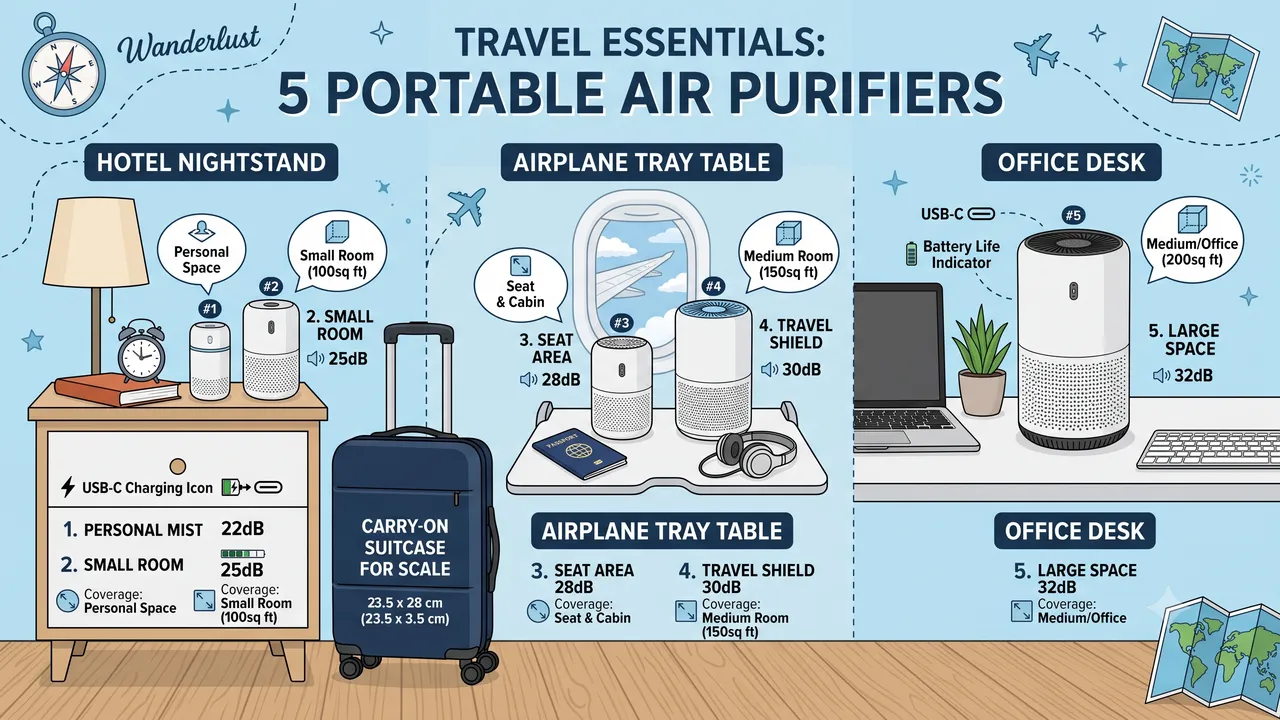
Portable air purification isn’t about cleaning every cubic foot of air in a room. It’s about cleaning the air you breathe. That’s a smaller, more achievable goal — and these five purifiers deliver on it.
You May Also Like
- Air Purifier Electricity Cost: How Much Does It Really Cost to Run 24/7?
- Air Purifier Filter Replacement Guide: Costs, Schedules, and How to Extend Filter Life
- Best Air Purifier Under $150: Genuine HEPA Without Breaking the Bank
- How Often to Change Air Purifier Filter: Complete Replacement Guide
Frequently Asked Questions
Can a portable air purifier clean an entire hotel room?
No — and anyone who tells you otherwise is selling you something. A portable purifier with a CADR of 40–120 m³/h can effectively clean your personal breathing zone (roughly 30–50 cubic feet around your head), which accounts for about 80% of the air you inhale. For context, cleaning a 250 sq ft hotel room with 8-foot ceilings at 4 air changes per hour would require a CADR of ~560 m³/h — five times what the best portable units deliver. Use the room size calculator to see what CADR your room actually needs.
How long do portable purifier filters last with travel use?
With intermittent travel use (a few trips per month), a HEPA filter typically lasts 6–8 months. With daily desk use, expect 3–4 months. The key factor isn’t time but particulate load — if you’re using it in heavily polluted hotel rooms, the filter saturates faster. Most portable purifiers don’t have filter indicator lights, so set a calendar reminder. Budget about $30–$45 per year in replacement filters for the Levoit Core Mini.
Are USB-powered purifiers powerful enough to actually work?
Yes, within their intended range. A USB-powered purifier running at 5 watts produces enough airflow to clean a personal breathing zone. A 2019 study published in Building and Environment found that personal ventilation devices with CADR as low as 20 m³/h reduced inhaled particle concentrations by 50–70% when positioned within 1 meter of the user’s face. The physics are simple: clean a small area of air very close to you, rather than trying to clean the whole room.
Can I bring an air purifier on a plane?
Yes. Air purifiers are allowed in both carry-on and checked luggage by the TSA. Battery-powered units should go in carry-on luggage (lithium battery restrictions apply to checked bags). I’ve flown with the Levoit Core Mini in my carry-on through a dozen airports without a single question from security. Wall-powered units need to be packed in checked luggage or carry-on; they can’t be used during the flight.
Is it worth buying a portable purifier for my office desk?
If you work in a shared office with poor ventilation or recirculated air, yes. A 2022 Harvard T.H. Chan School of Public Health study found that cognitive function scores were 61% higher in green buildings with enhanced ventilation and filtration compared to conventional buildings. A desktop purifier creates a bubble of cleaner air around your workspace. The Pure Enrichment PureZone Mini ($40) or Levoit Core Mini ($49) are both unobtrusive enough for an office setting.
Disclosure: We may earn a commission from qualifying purchases.
Support This Guide
Helpful? Add The Air Purifier Guide as a preferred source on Google so our guides show up in your search results.
Related Articles

Coway Mighty2 vs AP-1512HH (2026)
Coway's Mighty2 replaced the AP-1512HH as Wirecutter's top pick. We compare CADR, noise, sensors, filter costs, and whether the older unit is still the smarter buy.

KNKA APH4000 Review: $150 Dark Horse
KNKA's APH4000 is one of Amazon's best-selling purifiers at $150. We check the AHAM certification, decode the 1,695 sq ft claim, and compare it to Levoit and Coway.

Levoit Core 300 vs 300-P: What Changed
Levoit quietly replaced the Core 300 with the Core 300-P. We explain the AHAM certification, whether filters still fit, and which one you should actually buy.

Shark NeverChange HP302 Review
Shark's NeverChange HP302 promises 5 years on one filter. We dig into the real running costs, the odor neutralizer catch, and whether it beats cheaper rivals.

Winix 5510 vs 5500-2: 2026 Verdict
The Winix 5500-2 is discontinued and the 5510 takes over. We compare CADR, noise, filter costs, and the one compatibility problem nobody mentions.
🛒 Products Mentioned
As an Amazon Associate, we earn from qualifying purchases.
Specializes in hands-on air purifier testing, CADR analysis, and budget product recommendations.
View all articles by Alex →