The Short Answer: The best choice depends on your specific needs. True HEPA is essential for particles, activated carbon for gases and odors. Consider room size, noise tolerance, and budget when comparing models.
Editor’s note (September 2026): The Winix 5500-2 has been discontinued and remaining stock is limited. Winix’s official successor is the Winix 5510, which adds app control and uses a new filter. Read our Winix 5510 vs 5500-2 comparison before you buy either one.
The Coway AP-1512HH Mighty and the Winix 5500-2 have been locked in a head-to-head battle for the title of “best mid-range air purifier” for years. Both regularly appear on best-of lists from Wirecutter, Consumer Reports, and countless YouTube reviewers. Both use multi-stage HEPA filtration with activated carbon. Both are designed for rooms around 300–360 square feet. And both typically retail between $150 and $200, the sweet spot where you get genuinely effective air cleaning without paying premium prices.
So which one should you buy? The answer depends on your specific needs, allergies, pets, smoke sensitivity, noise tolerance, and budget for replacement filters all factor in. This comprehensive comparison breaks down every specification, every real-world performance difference, and every long-term cost consideration to help you make the right choice.
Affiliate Disclosure: As an Amazon Associate, The Air Purifier Guide earns from qualifying purchases. This comes at no extra cost to you and helps us keep producing honest, in-depth air purifier reviews.
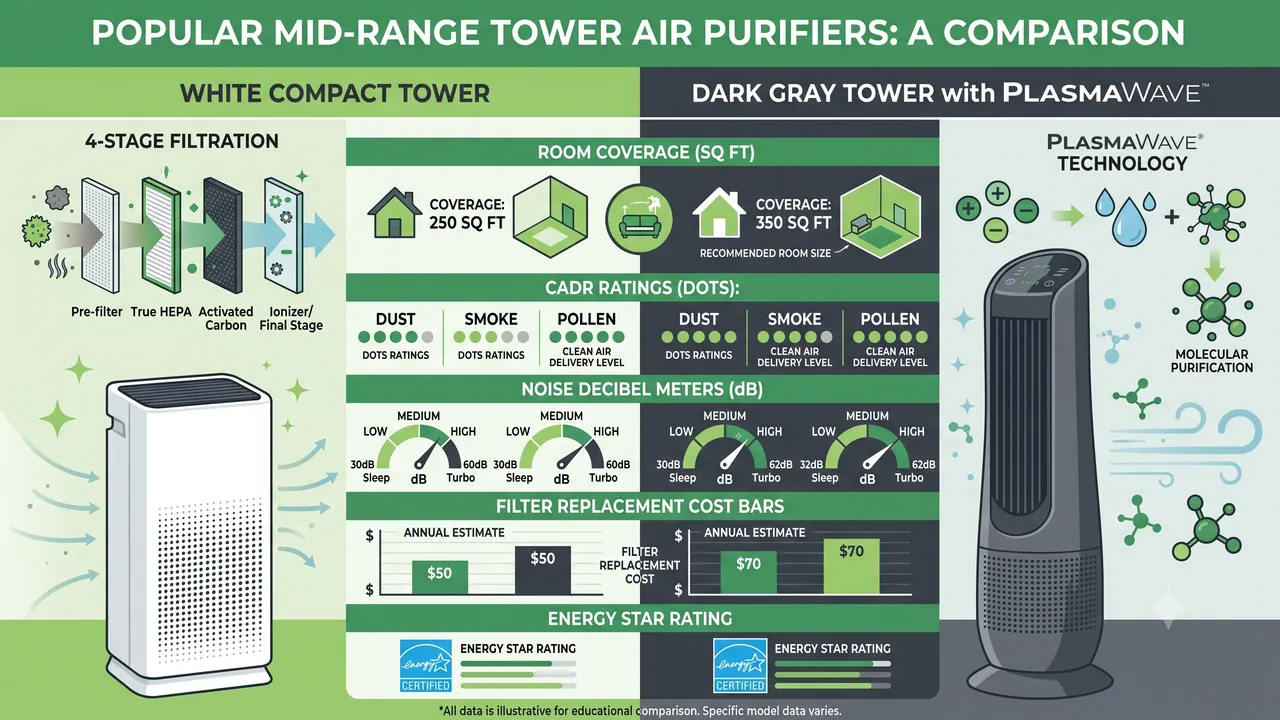
Head-to-Head Specification Comparison
Before diving into the nuances, let’s lay out the full spec sheet side by side.
| Specification | Coway AP-1512HH Mighty | Winix 5500-2 |
|---|---|---|
| Room Coverage (2 ACH) | 360 sq ft | 360 sq ft |
| Room Coverage (4 ACH) | 174 sq ft | 174 sq ft |
| CADR, Smoke | 122 CFM | 122 CFM |
| CADR, Dust | 134 CFM | 134 CFM |
| CADR, Pollen | 155 CFM | 155 CFM |
| Filtration Stages | 4 (Pre-filter, Odor, True HEPA, Ionizer) | 4 (Washable Pre-filter, AOC Carbon, True HEPA, PlasmaWave) |
| HEPA Class | H13 True HEPA (99.97% @ 0.3µm) | H13 True HEPA (99.97% @ 0.3µm) |
| Activated Carbon | Thin carbon sheet (~0.5 lbs) | Pelletized carbon (~1.0 lbs) |
| Noise Level, Low | 24.4 dB | 27.8 dB |
| Noise Level, High | 53.8 dB | 57.8 dB |
| Fan Speeds | 3 + Eco mode | 4 (Low, Medium, High, Turbo) |
| Air Quality Sensor | Yes (LED indicator: blue/amber/red) | Yes (LED indicator: blue/amber/red) |
| Auto Mode | Yes | Yes |
| Timer | 1 / 4 / 8 hour | 1 / 4 / 8 hour |
| Sleep Mode | No (uses Eco auto-off) | Yes (dims lights, runs on low) |
| Ionizer / Plasma | Optional ionizer (can be turned off) | PlasmaWave (can be turned off) |
| Remote Control | No | Yes (included) |
| Dimensions | 16.8 × 18.3 × 9.6 in | 14.9 × 23.6 × 8.2 in |
| Weight | 12.3 lbs | 14.8 lbs |
| Power, Low | 4.9 W | 7 W |
| Power, High | 77 W | 70 W |
| Filter Change Indicator | Yes (based on run time) | Yes (based on run time) |
| HEPA Filter Life | ~12 months | ~12 months |
| Carbon Filter Life | ~6 months (replace) | ~3 months (washable, then replace) |
| HEPA Filter Cost | $30–$45 (OEM) | $35–$50 (OEM) |
| Annual Filter Cost (est.) | $50–$70 | $55–$80 |
| Warranty | 3 years (1 year on motor) | 2 years |
| Price | ~$159–$189 | ~$130–$159 |
Note: CADR and coverage numbers are AHAM-verified. Noise measurements vary by source; figures above are representative based on multiple independent tests.
At a glance, these two purifiers look almost identical on paper, same CADR ratings, same coverage area, same HEPA class. The differences emerge in the details: carbon filtration, noise, design, features, and long-term operating costs.
Filtration Technology Deep Dive
Coway AP-1512HH: Four-Stage System
The Coway uses a straightforward four-stage filtration approach:
- Pre-filter, A washable mesh that captures large particles (hair, dust bunnies, pet fur). Should be vacuumed or rinsed every 2–4 weeks.
- Activated Carbon Sheet, A thin carbon-impregnated sheet for odor and VOC adsorption. This is the AP-1512HH’s weakest link, the carbon layer is relatively thin and fills up quickly. It handles light household odors (cooking smells, mild pet odor) but struggles with heavy smoke or strong chemical fumes.
- True HEPA Filter, H13-grade pleated HEPA media capturing 99.97% of particles down to 0.3 microns. This is the primary workhorse for allergens, dust, mold spores, and fine particulate matter.
- Ionizer, An optional bipolar ionizer that releases negative ions to help particles settle. Most users leave this off, it produces trace amounts of ozone (well below UL limits, but still worth noting for ozone-sensitive individuals). The unit works perfectly fine without it.
Winix 5500-2: Four-Stage System with PlasmaWave
The Winix uses a similar but slightly different approach:
- Washable Fine-Mesh Pre-filter, Similar to the Coway’s, captures large particles. Easy to remove and rinse.
- AOC (Advanced Odor Control) Carbon Filter, Here’s where Winix gains an edge. The 5500-2 uses a pelletized activated carbon filter rather than a thin sheet. The carbon pellets have significantly more surface area, meaning better adsorption of odors, VOCs, and gaseous pollutants. This is roughly twice the carbon volume of the Coway.
- True HEPA Filter, Same H13-grade HEPA as the Coway. Effective performance is essentially identical for particulate removal.
- PlasmaWave Technology, Winix’s version of an ionizer/plasma generator. It creates positive and negative ions that break down chemical vapors, allergens, and odors at a molecular level. Like the Coway’s ionizer, it can be turned off. Winix claims PlasmaWave does not produce harmful ozone levels, and independent testing has confirmed it stays well below the FDA’s 50 ppb limit, though ultra-cautious users may still prefer to disable it.
Bottom line on filtration: For pure particulate removal (dust, pollen, pet dander), these two are essentially tied, same CADR, same HEPA grade. For odor and gas-phase pollutants (cooking smells, pet odors, smoke, VOCs), the Winix 5500-2 has a clear advantage thanks to its pelletized carbon filter with roughly double the activated carbon volume.
Noise Performance
Noise is one of the most important real-world factors, especially for bedroom use. Both units are reasonably quiet on low, but neither is whisper-silent.
| Setting | Coway AP-1512HH | Winix 5500-2 |
|---|---|---|
| Low / Sleep | ~24 dB | ~28 dB |
| Medium | ~40 dB | ~44 dB |
| High / Turbo | ~54 dB | ~58 dB |
The Coway is consistently 3–4 dB quieter across all speeds. In practical terms, this is noticeable but not dramatic, on low, both are quiet enough for sleeping. On high, both produce a noticeable fan hum. The Coway’s quieter operation is one of the reasons it has been Wirecutter’s top pick for years.
The Winix does have a dedicated Sleep mode that dims the LED indicators and locks the fan on its lowest speed, a thoughtful touch for light-sensitive sleepers. The Coway’s Eco mode turns the fan off entirely when air quality is good, then restarts when sensors detect a decline, which some users find more disruptive than a constant quiet hum.
Design and Build Quality
Coway AP-1512HH
The Coway has a compact, somewhat retro-industrial design that’s become iconic in the air purifier world. At 16.8 × 18.3 × 9.6 inches and just 12.3 lbs, it’s notably lighter and more portable. The controls are simple and intuitive, a row of clearly labeled buttons on top. The air intake is 360° (from all sides), and the clean air outlet is on top, which helps with room circulation.
Winix 5500-2
The Winix is taller and slimmer (14.9 × 23.6 × 8.2 inches) with a more modern aesthetic. At 14.8 lbs, it’s heavier but still manageable. The front-panel air intake design means it needs some clearance behind it (not flush against a wall). The Winix includes a remote control, a small convenience that the Coway lacks entirely. Controls on the unit are touch-sensitive rather than physical buttons, which looks sleek but can be less responsive with wet or gloved hands.
Both units feel well-built for their price range. Neither feels cheap or flimsy, though neither approaches the premium feel of a Blueair or Dyson unit at two to three times the price.
Energy Consumption and Operating Costs
Running an air purifier 24/7 means energy costs matter over the long haul.
| Coway AP-1512HH | Winix 5500-2 | |
|---|---|---|
| Power, Low | 4.9 W | 7 W |
| Power, High | 77 W | 70 W |
| Est. Annual Energy (Auto/24-7) | $8–$15 | $10–$17 |
| Annual Filter Replacement | $50–$70 | $55–$80 |
| Total Annual Operating Cost | ~$60–$85 | ~$65–$97 |
The Coway is slightly cheaper to operate on low (its typical running mode) and has slightly cheaper replacement filters. Over a three-year period, you might save $15–$30 with the Coway on total operating costs. Not a huge difference, but worth noting.
One important note on filters: third-party and generic replacement filters are widely available for both models at roughly half the OEM price. We recommend OEM filters for the HEPA stage (the performance difference can be meaningful) but third-party pre-filters and carbon sheets are generally fine. See our filter replacement guide for more on this topic.
Pros and Cons
Coway AP-1512HH Mighty
Pros:
- Consistently quieter across all fan speeds
- More compact and lightweight (12.3 lbs vs 14.8 lbs)
- Longer warranty (3 years vs 2 years)
- Slightly lower long-term operating costs
- Proven reliability, the same model has been produced for over 10 years
- 360° air intake works well away from walls
- Simple, intuitive physical button controls
Cons:
- Weak activated carbon filtration (thin sheet)
- No remote control
- No dedicated Sleep mode (Eco auto-off can be disruptive)
- Design looks dated to some buyers
- Ionizer produces trace ozone (can be turned off)
Winix 5500-2
Pros:
- Superior carbon filtration (pelletized carbon, ~2× the volume)
- Remote control included
- Dedicated Sleep mode with dimmed LEDs
- PlasmaWave technology for VOC/odor reduction (can be turned off)
- More modern design aesthetic
- Similar CADR at a typically lower price point
Cons:
- Louder on every setting (3–4 dB difference)
- Heavier and taller (needs more vertical clearance)
- Shorter warranty (2 years)
- Slightly higher annual operating costs
- Front intake requires wall clearance
- Touch-sensitive controls less tactile than physical buttons
Which Is Better for Specific Use Cases?
Best for Allergies (Pollen, Dust Mites, Mold)
Winner: Tie, Both use identical H13 True HEPA filters with the same CADR ratings. For pure allergen removal, performance is essentially indistinguishable. Choose based on noise preference and budget.
For severe allergy sufferers, we recommend running either unit on high for 30 minutes before bed, then switching to low overnight. See our allergy season guide for more strategies.
Best for Pet Owners (Dander + Odor)
Winner: Winix 5500-2, The Winix’s superior carbon filtration handles pet odors (litter boxes, wet dog smell, general animal musk) noticeably better. The Coway’s thin carbon sheet becomes saturated quickly in a pet household, while the Winix’s pelletized carbon has more adsorption capacity. For pet dander specifically (particulate), they’re tied.
If pet odor is your primary concern, also check out our guide to the best air purifiers for pets.
Best for Smoke (Wildfire, Cigarette, Wildfire Season)
Winner: Winix 5500-2, Smoke is a mix of fine particulates (which both handle equally via HEPA) and gaseous pollutants (which the Winix handles better via its larger carbon bed). Neither purifier is a true smoke-eating powerhouse, for heavy smoke environments, you’d want something with 5+ lbs of activated carbon like the Austin Air HealthMate, but between these two, the Winix is meaningfully better.
See our dedicated air purifiers for smokers guide for stronger options if smoke is your primary concern.
Best for Bedroom Use
Winner: Coway AP-1512HH, The Coway’s lower noise on every setting makes it the better bedroom choice. At 24 dB on low, it’s below the threshold of most people’s awareness. The Winix at 28 dB is still quiet, but light sleepers may notice the difference. The Coway’s 360° intake also means more flexible placement relative to the bed.
That said, if you want a remote control to adjust settings without getting up, or want Sleep mode that dims all indicator lights, the Winix has those advantages.
Best for Large Rooms (300+ sq ft)
Winner: Tie, With identical CADR ratings and identical 2 ACH coverage at 360 sq ft, neither has an advantage. For rooms over 360 sq ft, consider stepping up to a larger unit like the Coway Airmega 250 or Winix 6300-2.
Price and Value Comparison
As of mid-2026, typical retail pricing is:
| Model | Typical Price | What You Get |
|---|---|---|
| Coway AP-1512HH | $159–$189 | Quieter operation, longer warranty, proven reliability |
| Winix 5500-2 | $130–$159 | Better carbon filtration, remote, Sleep mode, PlasmaWave |
The Winix typically costs $20–$30 less upfront. Over three years including filter replacements and energy, the total cost of ownership is:
- Coway: ~$350–$440
- Winix: ~$325–$430
They’re remarkably close in total cost. The Winix edges ahead on upfront value; the Coway edges ahead on long-term value thanks to cheaper filters and lower energy consumption on its most-used settings.
Final Verdict: Which Should You Buy?
Here’s our recommendation based on buyer profile:
Choose the Coway AP-1512HH if you:
- Prioritize quiet operation (bedroom, nursery, office)
- Want the longest warranty available
- Don’t have strong odor concerns
- Prefer simple physical button controls
- Want the most portable lightweight option
Choose the Winix 5500-2 if you:
- Need better odor and smoke filtration (pet owners, kitchens, wildfire areas)
- Want a remote control and Sleep mode
- Prefer a more modern design
- Want the lowest upfront price
- Have mild ozone concerns (PlasmaWave tested as ozone-safe)
Our overall pick: For most buyers, we give a slight edge to the Coway AP-1512HH. Its quieter operation, longer warranty, proven decade-long track record, and lower operating costs make it the safer all-around choice. But if odor removal is a priority, especially for pet owners or anyone in a smoke-prone area, the Winix 5500-2 is the better pick thanks to its significantly superior carbon filtration. You genuinely can’t go wrong with either one; both deliver excellent performance for the price.
Looking for more options? Check our complete 2026 air purifier guide or our budget picks under $100 if these two are above your price range.
Frequently Asked Questions
Is the Coway AP-1512HH being discontinued?
No. Despite being on the market since 2014, the Coway AP-1512HH remains in active production as of 2026. Coway has updated the design incrementally over the years (minor cosmetic changes, improved filter media), but the core model number and design remain unchanged. Replacement filters continue to be widely available from both OEM and third-party manufacturers.
Can the Winix PlasmaWave be turned off?
Yes. PlasmaWave can be toggled on or off by pressing and holding the PlasmaWave button on the control panel (or via the remote). When off, the Winix 5500-2 functions as a standard HEPA + carbon air purifier. Many users turn PlasmaWave off as a personal preference, the purifier works just fine without it for particulate and odor removal.
How often do I need to change the filters?
For both models, the True HEPA filter should be replaced every 12 months under normal use. Pre-filters should be washed every 2–4 weeks. For the Coway’s carbon sheet, replace every 6 months (or sooner if you notice odors returning). For the Winix’s carbon filter, it can be washed and reused once, then should be replaced. In heavy-use environments (smoke, pets, high pollution), filter life may be 50–75% of the rated duration.
Do either of these air purifiers produce ozone?
The Coway AP-1512HH’s optional ionizer produces trace amounts of ozone, but well within UL 2998 limits (0 ppm effectively). The Winix PlasmaWave produces no detectable ozone per Winix’s own UL-certified testing. In both cases, the ionizer/plasma features can be completely disabled, at which point neither unit produces any ozone, they operate as purely mechanical filtration devices.
Which is better for a 300 square foot room?
Both are rated for 360 sq ft at 2 ACH (Air Changes per Hour), which means they can clean the air in a 300 sq ft room approximately 2.4 times per hour, adequate for most situations. For allergy or asthma sufferers who need 4+ ACH, both are sized for rooms up to about 174 sq ft at that rate. If your room is 300 sq ft and you want high air change rates, you may want to step up to a larger unit, see our CADR and ACH guide for sizing help.
Last updated: June 9, 2026. Prices and availability are subject to change. All specifications sourced from manufacturer data and independent testing. The Air Purifier Guide is not affiliated with Coway or Winix.
You May Also Like
- Winix 5500-2 vs Blueair Blue Pure 211+: Which Air Purifier Is Right for You?
- Best Replacement Filters for Winix 5500-2: OEM vs Aftermarket Complete Guide
- Dyson Pure Cool vs Coway AP-1512HH: Which Air Purifier Deserves Your Money?
- Blueair vs Coway: Which Premium Air Purifier Brand Delivers Better Performance?
Support This Guide
Helpful? Add The Air Purifier Guide as a preferred source on Google so our guides show up in your search results.
Related Articles

Coway Mighty2 vs AP-1512HH (2026)
Coway's Mighty2 replaced the AP-1512HH as Wirecutter's top pick. We compare CADR, noise, sensors, filter costs, and whether the older unit is still the smarter buy.

KNKA APH4000 Review: $150 Dark Horse
KNKA's APH4000 is one of Amazon's best-selling purifiers at $150. We check the AHAM certification, decode the 1,695 sq ft claim, and compare it to Levoit and Coway.

Levoit Core 300 vs 300-P: What Changed
Levoit quietly replaced the Core 300 with the Core 300-P. We explain the AHAM certification, whether filters still fit, and which one you should actually buy.

Shark NeverChange HP302 Review
Shark's NeverChange HP302 promises 5 years on one filter. We dig into the real running costs, the odor neutralizer catch, and whether it beats cheaper rivals.

Winix 5510 vs 5500-2: 2026 Verdict
The Winix 5500-2 is discontinued and the 5510 takes over. We compare CADR, noise, filter costs, and the one compatibility problem nobody mentions.
🛒 Products Mentioned
As an Amazon Associate, we earn from qualifying purchases.
Runs side-by-side purifier comparisons, long-term ownership reports, and filter cost analysis.
View all articles by David →