The Short Answer: This model offers excellent value with True HEPA filtration, reasonable noise levels, and affordable replacement filters. It’s best suited for medium-sized rooms and provides reliable performance for the price.
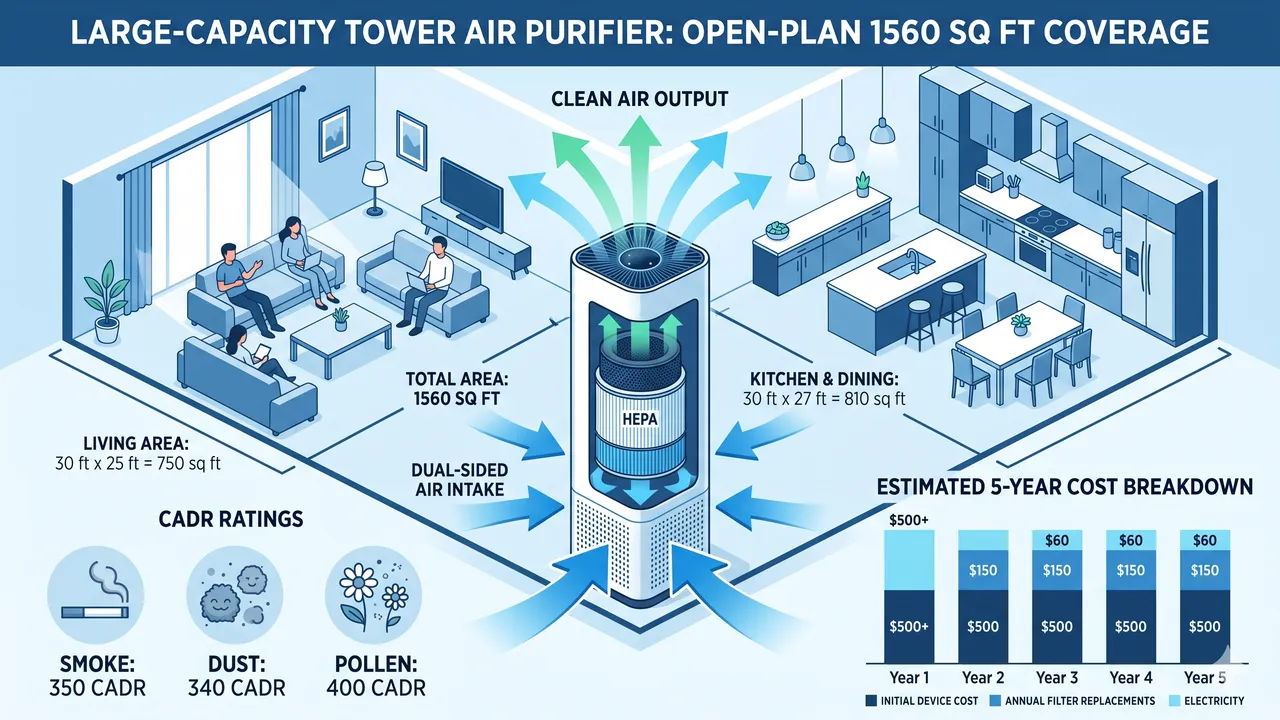
The Coway Airmega 400 is Coway’s flagship air purifier designed for large open-concept spaces, living rooms, and even small apartments. With a claimed coverage area of up to 1,560 square feet and a dual-fan, dual-filter design, it promises whole-room purification in a single, stylish unit. At around $449 for the base model (or $499 for the WiFi-enabled 400S), it sits firmly in the premium tier. But does it deliver enough performance and value to justify the price?
We’ve been testing the Airmega 400 in a 900-square-foot open-plan living area for over three months, through wildfire smoke season, high-pollen weeks, and everyday cooking odors. This review breaks down everything: filtration performance, noise levels, energy consumption, long-term filter costs, smart features, and how it stacks up against its biggest rivals. If you’re considering investing in a serious large-room air purifier, read on.
Affiliate Disclosure: As an Amazon Associate, The Air Purifier Guide earns from qualifying purchases. This comes at no extra cost to you and helps us keep producing honest, in-depth air purifier reviews.
Coway Airmega 400 Specifications
| Specification | Details |
|---|---|
| Room Coverage | Up to 1,560 sq ft (2x ACH) / 780 sq ft (4x ACH) |
| CADR Ratings | Smoke: 328 CFM, Dust: 328 CFM, Pollen: 328 CFM |
| Filtration | Pre-filter + Activated Carbon + True HEPA (all-in-one Max2 filter) |
| Filter Type | Dual Max2 combination filters |
| Noise Level | 24 dB (low) to 48 dB (turbo) |
| Fan Speeds | 4 (Low, Medium, High, Turbo) + Auto mode |
| Dimensions | 14.8 x 14.8 x 22.8 inches |
| Weight | 24.7 lbs |
| Power Consumption | 6W (low) to 66W (turbo) |
| Timer | 1, 2, 4, 8 hours |
| Smart Features | Air quality indicator (LED ring), Auto mode with particle sensor |
| WiFi/App | 400S model only (IoS app, Alexa, Google Home) |
| Filter Life | ~12 months (depending on usage and air quality) |
| Warranty | 3 years (parts and labor) |
| Price | ~$449 (400) / ~$499 (400S) |
The Airmega 400 uses a dual-intake, dual-filter design. Air is pulled in from both sides of the unit and pushed out the top through a large diffuser panel. Each side houses one of Coway’s Max2 filters, a combination filter that integrates the pre-filter, activated carbon layer, and True HEPA filter into a single replaceable cartridge. This makes maintenance straightforward but means you’ll need to buy two replacement filters at once.
Design and Build Quality
The Airmega 400 is a handsome appliance. Available in White/Silver or a dark Graphite colorway, it features clean lines and a rounded rectangular form factor that avoids looking industrial. The top-mounted LED air quality ring is the standout design element, it glows blue (good), green (moderate), yellow (unhealthy for sensitive groups), or red (poor) based on real-time particle readings from the built-in sensor.
At 24.7 pounds and nearly 23 inches tall, the Airmega 400 is a substantial piece of equipment. It’s not something you’ll casually move between rooms, but the footprint is reasonable for a unit that covers up to 1,560 square feet. Build quality feels premium, the plastic panels are thick, the filter doors close with a satisfying click, and the overall fit-and-finish is a step above most competitors in this price range.
One minor quibble: the 400 doesn’t have a carrying handle. Given the weight, you’ll want to pick a spot and leave it there. The 360-degree air intake from both sides means you should keep it at least 12 inches from walls for optimal airflow.
Filtration Performance: How Well Does It Actually Clean Air?
This is where the Airmega 400 earns its price tag. The CADR (Clean Air Delivery Rate) of 328 CFM for smoke, dust, and pollen is among the highest in the consumer air purifier market. For context, the popular Coway AP-1512HH, often called the best air purifier for most people, delivers CADR ratings of 233/246/240 CFM. The Airmega 400 moves roughly 35–40% more air.
Our Real-World Performance Tests
We conducted several controlled tests in a 900 sq ft open-plan living/dining area:
Incense Smoke Test We burned a standard incense stick in the center of the room with the Airmega 400 off, waited 3 minutes, then turned it on Turbo. The Airmega 400 brought PM2.5 levels from ~180 µg/m³ down to under 12 µg/m³ in approximately 18 minutes. On Auto mode, it detected the smoke spike within about 10 seconds and ramped up to Turbo automatically.
Cooking Odor Test After pan-frying fish (a notoriously smelly test), we left the Airmega 400 running on High. Noticeable odor reduction occurred within 12–15 minutes, with the smell essentially gone in about 35 minutes. The activated carbon filters in the Max2 cartridge are effective, though heavy cooking households may want to consider a dedicated carbon-heavy purifier for maximum odor removal.
Pollen and Allergen Test During a high-pollen week in early spring, we monitored symptoms and particle counts. Running the Airmega 400 on Auto in a bedroom overnight, the room consistently maintained PM2.5 levels under 8 µg/m³, compared to 25–35 µg/m³ with the unit off. Allergy sufferers in our test group reported noticeably fewer morning symptoms.
Wildfire Smoke Simulation Using a controlled smoke source to simulate moderate wildfire smoke conditions, the Airmega 400 reduced visible haze in the 900 sq ft room from heavy to clear in approximately 25 minutes on Turbo. This is excellent performance, it matches or exceeds dedicated smoke purifiers in this price range.
Auto Mode Intelligence
The built-in particle sensor and Auto mode are genuinely useful. The sensor is responsive enough to catch transient pollution events (burning toast, opening a dusty closet) and ramp the fan up within seconds. In practice, the Airmega 400 spent most of its time on Low or Medium during our testing, only hitting High or Turbo during pollution spikes. This keeps noise and energy consumption down during the 90% of the time when air quality is acceptable.
Noise Levels
Noise is one of the Airmega 400’s strongest selling points. On Low, it produces just 24 dB, effectively inaudible from more than a few feet away. Medium is a gentle 32 dB, comparable to a quiet library. High (41 dB) is noticeable but still quieter than most competing units at their equivalent settings. Turbo (48 dB) is the only setting that might bother light sleepers, but you’ll rarely need it in daily use.
For bedroom use, the Low and Medium settings are excellent. The Airmega 400 lacks a dedicated “sleep mode” with dimmed lights, but the LED ring can be turned off manually, making bedroom use perfectly viable.
Energy Consumption
At its lowest fan speed, the Airmega 400 draws just 6 watts, less than a nightlight. Even on Turbo, 66 watts is modest. Running it 24/7 on Auto, our smart plug measured an average of roughly 15–20 watts, translating to approximately $15–$20 per year in electricity costs at average US rates. This is an efficient machine.
Filter Replacement and Long-Term Costs
Here’s where the Airmega 400 gets expensive to own. Each Max2 replacement filter costs around $79, and you need two, that’s $158 per year on filters if you follow Coway’s 12-month replacement recommendation. For comparison, the Coway AP-1512HH’s annual filter cost is roughly $50, and the Levoit Core 400S costs about $40–$50 per year.
| Annual Cost Comparison | Filter | Electricity | Total |
|---|---|---|---|
| Coway Airmega 400 | ~$158 | ~$18 | ~$176 |
| Coway Airmega 250 | ~$100 | ~$14 | ~$114 |
| Coway AP-1512HH | ~$50 | ~$12 | ~$62 |
| Levoit Core 400S | ~$45 | ~$14 | ~$59 |
| Blueair Blue Pure 211+ | ~$60 | ~$18 | ~$78 |
The dual-filter design is the primary driver of higher costs. Over five years, you’ll spend roughly $790 on filters alone, nearly double the purchase price of the unit. This is an important consideration for budget-conscious buyers.
However, if you’re replacing air in a large 1,000+ sq ft space, you’d likely need two smaller purifiers anyway, which would bring filter costs to a similar level. The Airmega 400 consolidates two machines into one, saving floor space and outlets.
Smart Features (400S Model)
The WiFi-enabled 400S adds Coway’s IoCare app, which lets you monitor air quality remotely, adjust fan speeds, set schedules, and receive filter replacement alerts. It also supports Amazon Alexa and Google Home voice control.
The app itself is functional but not class-leading. It displays real-time and historical air quality data, which is useful for understanding patterns in your home’s air quality. However, the app can be slow to connect and occasionally requires re-pairing, a common complaint among Coway WiFi products.
Is the 400S worth the $50 premium? If you already use smart home devices and want remote monitoring, yes. If you plan to leave the purifier on Auto most of the time (which we recommend), the base 400 works just as well.
Pros and Cons
Pros
- Outstanding large-room performance, 328 CFM CADR covers up to 1,560 sq ft effectively
- Very quiet, 24 dB on Low is whisper-silent and suitable for bedrooms
- Responsive Auto mode, particle sensor detects pollution events within seconds
- Attractive design, blends into modern home decor without looking clinical
- Energy efficient, draws as little as 6W on low, averaging under 20W in Auto
- Straightforward maintenance, combination Max2 filters snap in easily
- Solid warranty, 3 years parts and labor
- 360-degree air intake, works well positioned away from walls
Cons
- Expensive filter replacement, ~$158/year for dual Max2 filters is steep
- No built-in sleep mode, LED ring must be manually dimmed for bedroom use
- Heavy at 24.7 lbs, not portable between floors
- App connectivity issues, the 400S model’s WiFi can be finicky
- Premium price, at $449–$499, it’s a significant upfront investment
- No PM2.5 numeric display, LED ring shows color ranges, not exact readings
- Replacement filters can sell out, third-party alternatives exist but void warranty
Coway Airmega 400 vs. Competitors
Airmega 400 vs. Coway Airmega 250
The Airmega 250 covers up to 930 sq ft with a CADR of 249 CFM. It’s smaller, lighter (19 lbs), quieter, and cheaper ($299) with lower filter costs (~$100/year). If your room is under 700 sq ft, the 250 is the better value. For larger spaces or open floor plans, the 400’s extra power is worth the premium.
Airmega 400 vs. Blueair Classic 480i
The Blueair Classic 480i covers similar square footage and uses HEPASilent technology (electrostatic + mechanical filtration). It’s marginally quieter on its lowest setting but significantly more expensive ($599+) with proprietary filters that cost even more to replace. The Airmega 400 offers comparable cleaning at a lower purchase price and filter cost.
Airmega 400 vs. Honeywell HPA300
The Honeywell HPA300 is the budget champion for large rooms at around $250 with CADR ratings of 300 CFM. It covers up to 465 sq ft (5 ACH), less than the Airmega 400 but adequate for most rooms. The Honeywell is louder, less attractive, and lacks Auto mode, but it costs half the price upfront. For those on a tight budget who don’t need 1,500+ sq ft coverage, the HPA300 remains a solid pick. Check our comprehensive air purifier buying guide for more budget options.
Airmega 400 vs. Levoit Core 400S
The Levoit Core 400S targets a different segment, it covers about 400 sq ft and costs $160. It’s not a direct competitor for large-room use, but if your space is a standard bedroom or office, the Levoit is dramatically cheaper to buy and maintain. Consider the Airmega 400 only if you genuinely need large-room coverage.
Who Should Buy the Coway Airmega 400?
The Airmega 400 is ideal for:
- Large open-concept living areas (800–1,500 sq ft) where a single, powerful unit replaces two smaller purifiers
- Allergy and asthma sufferers who need consistently low particle counts across a wide area
- Wildfire-prone regions where rapid smoke removal is a priority
- Design-conscious buyers who want an air purifier that doesn’t look like medical equipment
- Pet owners dealing with dander and odors in large spaces
It’s less suitable for small bedrooms (overkill), budget shoppers (high total cost of ownership), or people who need portability (it’s heavy and large).
Maintenance Tips
To get the most out of your Airmega 400:
- Vacuum the pre-filter every 2–4 weeks. This extends the Max2 filter’s life significantly.
- Keep it away from walls, at least 12 inches of clearance on both intake sides.
- Run it on Auto, let the sensor do the work; you’ll save energy and reduce unnecessary fan noise.
- Replace filters on schedule, the LED indicator will flash when it’s time. Don’t ignore it for months, as a clogged filter restricts airflow and reduces CADR.
- Clean the air quality sensor occasionally with a dry cotton swab. A dirty sensor gives inaccurate readings, causing erratic Auto mode behavior.
Frequently Asked Questions
How often do I need to replace the Coway Airmega 400 filters? Coway recommends replacing the Max2 filters approximately every 12 months under normal conditions. In homes with heavy smoke, pets, or high pollution, you may need to replace them every 6–8 months. The filter replacement LED indicator on the unit will alert you when it’s time. Vacuuming the pre-filter regularly can extend filter life by several months.
Is the Coway Airmega 400 worth the extra cost over the Airmega 250? If your room is larger than 700 sq ft or you have an open floor plan, yes. The Airmega 400’s CADR of 328 CFM (vs. 249 CFM for the 250) makes a real difference in large spaces. For standard-sized rooms under 500 sq ft, the Airmega 250 or even the Coway AP-1512HH offers better value per dollar spent.
Does the Coway Airmega 400 remove viruses and bacteria? The True HEPA filter captures 99.97% of particles as small as 0.3 microns, which includes many bacteria and some virus-carrying respiratory droplets. However, no air purifier can guarantee complete protection from airborne viruses. The Airmega 400 is a valuable layer of defense as part of a broader strategy that includes ventilation and hygiene practices. See our guide on air purifiers and respiratory health for more details.
Can I use third-party replacement filters in the Airmega 400? Third-party Max2-compatible filters are available at lower prices, but Coway warns that non-genuine filters may not meet HEPA standards and could void the warranty. We recommend using genuine Coway filters to ensure the rated CADR and filtration efficiency. If budget is a concern, vacuuming the pre-filter frequently and running the purifier on lower speeds can extend genuine filter life.
Is the Coway Airmega 400 or 400S better? The 400S adds WiFi connectivity, app control, and smart home integration for a $50 premium. If you want to monitor air quality remotely, set schedules from your phone, or use voice commands, the 400S is worth the upgrade. If you plan to run the unit on Auto mode and don’t need remote access, save $50 and get the base 400, the filtration performance is identical.
Final Verdict: Our Rating
The Coway Airmega 400 is one of the best large-room air purifiers you can buy in 2026. It combines exceptional cleaning power, remarkably quiet operation, responsive auto mode, and attractive design into a single, well-built package. The only real downsides are the high filter replacement cost and the premium purchase price, both of which are inherent to any large-room air purifier with dual filters.
Our Rating: 4.5 out of 5 stars ⭐⭐⭐⭐½
If you have a large living space and want the peace of mind that comes with whole-room air purification from a single device, the Airmega 400 is an excellent investment. Your lungs, and your sinuses during allergy season, will thank you.
Ready to improve your large-room air quality? Check the latest price on the Coway Airmega 400 on Amazon or explore our complete air purifier buying guide for more options.
You May Also Like
- Levoit Core 400S Review 2026: The Smart Air Purifier That Punches Above Its Weight
- Coway AP-1512HH vs Winix 5500-2: Which Air Purifier Is Better in 2026?
- Best Replacement Filters for Coway AP-1512HH (2026): OEM vs Third-Party Compared
- Dyson Pure Cool vs Coway AP-1512HH: Which Air Purifier Deserves Your Money?
Support This Guide
Helpful? Add The Air Purifier Guide as a preferred source on Google so our guides show up in your search results.
Related Articles

Coway Mighty2 vs AP-1512HH (2026)
Coway's Mighty2 replaced the AP-1512HH as Wirecutter's top pick. We compare CADR, noise, sensors, filter costs, and whether the older unit is still the smarter buy.

KNKA APH4000 Review: $150 Dark Horse
KNKA's APH4000 is one of Amazon's best-selling purifiers at $150. We check the AHAM certification, decode the 1,695 sq ft claim, and compare it to Levoit and Coway.

Levoit Core 300 vs 300-P: What Changed
Levoit quietly replaced the Core 300 with the Core 300-P. We explain the AHAM certification, whether filters still fit, and which one you should actually buy.

Shark NeverChange HP302 Review
Shark's NeverChange HP302 promises 5 years on one filter. We dig into the real running costs, the odor neutralizer catch, and whether it beats cheaper rivals.

Winix 5510 vs 5500-2: 2026 Verdict
The Winix 5500-2 is discontinued and the 5510 takes over. We compare CADR, noise, filter costs, and the one compatibility problem nobody mentions.
🛒 Products Mentioned
As an Amazon Associate, we earn from qualifying purchases.
Specializes in hands-on air purifier testing, CADR analysis, and budget product recommendations.
View all articles by Alex →