The Short Answer: The best choice depends on your specific needs. True HEPA is essential for particles, activated carbon for gases and odors. Consider room size, noise tolerance, and budget when comparing models.
The Dyson Pure Cool and the Coway AP-1512HH Mighty are two of the most frequently recommended air purifiers on the internet, and two of the most confusing to compare. One is a sleek, futuristic tower with bladeless fan technology and a premium price tag. The other is a compact, unassuming box that has quietly dominated “best air purifier” lists for nearly a decade. They target different buyers, solve the same core problem, and sit at very different price points.
This comparison breaks down every spec that matters, analyzes what you actually get for your money, and helps you decide which one fits your home and large-rooms. No brand loyalty, no hype, just the data and what it means for your air quality.
Affiliate Disclosure: This article contains affiliate links. If you purchase through our links, we may earn a commission at no extra cost to you. This helps us keep our content free and unbiased. We only recommend products we’ve thoroughly researched.
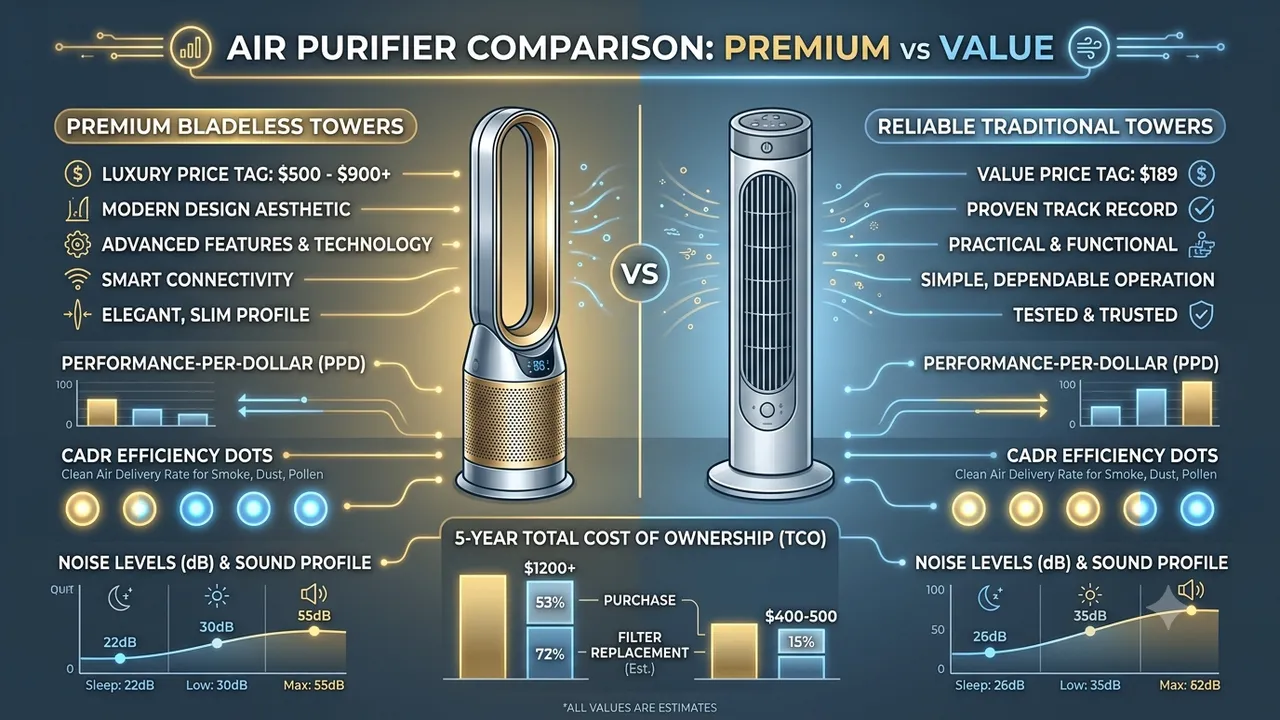
At a Glance: The Two Contenders
Dyson Pure Cool TP04 is a bladeless tower fan and air purifier hybrid. It uses a sealed HEPA H13 filter combined with an activated carbon layer, oscillates up to 350 degrees, connects to the Dyson Link app, and doubles as a cooling fan. It retails for roughly $449–$549 depending on the retailer and current promotions.
Coway AP-1512HH Mighty is a dedicated air purifier with a four-stage filtration system: pre-filter, odor filter (activated carbon), true HEPA filter, and an ionizer (optional). It has been a Wirecutter top pick for years, consistently ranks among the best-performing purifiers in its class, and sells for approximately $159–$229.
That price gap, roughly 3 to 4 times, is the central tension of this comparison. Is the Dyson worth the premium? Does the Coway punch above its weight? Let’s find out.
Head-to-Head Comparison Table
| Specification | Dyson Pure Cool TP04 | Coway AP-1512HH Mighty |
|---|---|---|
| Price (MSRP) | $499 | $189 |
| Filtration Type | Sealed HEPA H13 + Activated Carbon | 4-Stage: Pre-filter, Carbon, True HEPA, Ionizer |
| HEPA Grade | H13 (99.95% @ 0.1 microns) | True HEPA (99.97% @ 0.3 microns) |
| CADR (Smoke) | 130 cfm (estimated) | 233 cfm |
| CADR (Dust) | 150 cfm (estimated) | 246 cfm |
| CADR (Pollen) | 140 cfm (estimated) | 240 cfm |
| Room Coverage | ~350 sq ft (1 air change/hr) | 361 sq ft (4.8 air changes/hr) |
| Recommended Room Size | Up to 200 sq ft (for effective cleaning) | Up to 361 sq ft |
| Noise Level (Low) | ~40 dB | ~25 dB |
| Noise Level (High) | ~62 dB | ~54 dB |
| Fan Function | Yes, bladeless fan with oscillation | No |
| Oscillation | Up to 350° | No |
| Smart Features | Dyson Link app, Alexa, Siri, real-time AQ monitoring | None (basic LED air quality indicator) |
| Air Quality Sensor | Yes, PM2.5, PM10, VOC, NO2, temp, humidity | Yes, particle sensor with color LED |
| Filter Replacement Cost | ~$70/year | ~$50/year |
| Annual Energy Cost | ~$25–$40 | ~$15–$25 |
| Dimensions | 8.77” × 8.77” × 41.5” | 16.8” × 9.6” × 18.3” |
| Weight | 10.7 lbs | 12.3 lbs |
| Timer | Yes (app-controlled) | Yes (1, 4, 8 hours) |
| Auto Mode | Yes | Yes |
| Night Mode | Yes | Yes (dims LEDs, reduces fan speed) |
| Warranty | 2 years | 3 years (1 year on motor) |
Filtration Performance: What the Numbers Mean
This is where the comparison gets interesting, and where the Coway quietly dominates.
The Coway AP-1512HH has AHAM-verified CADR ratings of 233/246/240 cfm for smoke, dust, and pollen respectively. These are independently tested numbers that tell you exactly how much clean air the unit delivers per minute. In a 361-square-foot room, it can cycle all the air nearly 5 times per hour. That’s excellent.
Dyson does not publish AHAM-verified CADR ratings for the Pure Cool TP04. Instead, they reference their own internal testing and claim coverage of up to 350 square feet. Independent testing by organizations like Consumer Reports has estimated the Dyson’s CADR at roughly 130–150 cfm, significantly lower than the Coway. At that output, the Dyson achieves about 1 air change per hour in a 350-square-foot room, which is far below the recommended 4–5 air changes per hour for meaningful air purification.
In plain terms: In a typical 250-square-foot living room, the Coway will clean the air roughly 4 times while the Dyson cleans it once. The Coway moves substantially more air through its filters per minute.
Both units use high-quality HEPA filtration. The Dyson’s H13 filter captures 99.95% of particles down to 0.1 microns, while the Coway’s True HEPA captures 99.97% at 0.3 microns. In real-world use, the difference between H13 and True HEPA is negligible, both will trap pollen, dust, pet dander, mold spores, and most bacteria effectively.
Where Dyson fights back is in sensor sophistication. The TP04 monitors PM2.5, PM10, VOCs, and nitrogen dioxide in real time, displaying granular data on its screen and in the app. The Coway has a basic particle sensor with a color-coded LED (blue, purple, red). If you want to know exactly what’s in your air at any given moment, the Dyson provides more data.
Noise Levels: A Real-World Difference
The Coway is one of the quietest air purifiers in its class. On its lowest fan setting, it produces around 25 dB, essentially silent. Even on high, it tops out around 54 dB, which is roughly the volume of a quiet conversation.
The Dyson is noticeably louder. Its lowest setting hovers around 40 dB (audible but not disruptive), and on high it reaches approximately 62 dB (comparable to a normal conversation or a running air conditioner). If you plan to run the purifier in a bedroom while sleeping, the Coway has a clear advantage here.
The trade-off is that the Dyson doubles as a fan. The bladeless airflow can cool you directly, and the 350-degree oscillation distributes air across a room. If you’re comparing the Dyson against buying both an air purifier and a fan separately, the value proposition shifts somewhat.
Design and Smart Features
The Dyson Pure Cool TP04 is a design statement. Its bladeless tower looks like something from a sci-fi film, and it’s the kind of appliance guests notice and ask about. The LCD screen displays real-time air quality data, and the Dyson Link app gives you full control from your phone, scheduling, monitoring historical air quality data, adjusting oscillation angle, and integrating with voice assistants (Alexa and Siri).
The Coway AP-1512HH looks like… an air purifier. It’s compact, functional, and unobtrusive. There’s no app, no voice control, and no real-time air quality dashboard. The LED ring changes color to indicate air quality, and you get basic timer and fan speed controls on the top panel. It does its job quietly and without fanfare.
For tech enthusiasts who want smart home integration and data-driven air quality monitoring, the Dyson wins here. For people who want to plug in a unit and forget about it, the Coway’s simplicity is actually a feature.
Price and Value Analysis
This is the section that matters most for most buyers. Let’s break down the total cost of ownership over five years.
Dyson Pure Cool TP04
- Purchase price: $499
- Filter replacement: ~$70/year × 5 = $350
- Energy cost: ~$32/year × 5 = $160
- 5-year total: ~$1,009
Coway AP-1512HH Mighty
- Purchase price: $189
- Filter replacement: ~$50/year × 5 = $250
- Energy cost: ~$20/year × 5 = $100
- 5-year total: ~$539
Over five years, the Dyson costs nearly twice as much to own and operate as the Coway. And remember, the Coway delivers significantly higher CADR performance in that comparison.
You’re paying roughly $470 more for the Dyson over five years. What does that premium buy you?
- A bladeless fan function (saves you from buying a separate fan)
- Smart home integration and app control
- Real-time, multi-pollutant air quality monitoring
- Premium industrial design
- Brand cachet
What it does not buy you: better air purification. The Coway objectively cleans more air per minute, covers similar room sizes more effectively, and runs quieter while doing it.
When the Dyson Makes Sense
If you live in a studio or small apartment where the purifier will be in a room under 200 square feet, the Dyson’s CADR is adequate. If you’d otherwise spend $200+ on a Dyson fan anyway, bundling the purifier and fan into one device narrows the gap. If smart home integration and real-time air quality data are priorities you value highly, the Dyson delivers on that front.
When the Coway Makes Sense
If your primary goal is clean air, maximum particle removal per dollar, the Coway is the clear winner. It’s the better air purifier by the metric that matters most: how much clean air it delivers. It’s cheaper to buy, cheaper to run, cheaper to maintain, and quieter.
Pros and Cons
Dyson Pure Cool TP04
Pros:
- Doubles as a powerful bladeless fan with 350° oscillation
- Excellent real-time air quality monitoring (PM2.5, VOCs, NO2)
- Full app control with scheduling, history, and voice assistant support
- Sleek, modern design that complements contemporary interiors
- Sealed filtration system ensures no air bypasses the filter
Cons:
- Significantly lower CADR than competitors at the same or lower price
- 3–4× more expensive than the Coway upfront
- Louder on all settings
- Higher ongoing filter and energy costs
- Fan function adds bulk; tower design takes up vertical space
- Not AHAM-verified for CADR
Coway AP-1512HH Mighty
Pros:
- Exceptional CADR ratings (233/246/240 cfm), among the best in class
- Very quiet operation, especially on low settings (25 dB)
- Affordable purchase price and low maintenance costs
- Four-stage filtration with optional ionizer
- Compact footprint fits easily on shelves or in corners
- Proven track record with years of consistent positive reviews
- 3-year warranty
Cons:
- No smart features, app, or voice control
- Basic air quality indicator (color LED only, no data)
- Dated, utilitarian design
- Ionizer produces trace ozone (can be turned off)
- No fan or cooling function
Who Should Buy Which?
Buy the Dyson Pure Cool TP04 if:
- You want a combined air purifier and fan in one device
- You care about real-time air quality data and smart home integration
- Your room is small enough (under 200 sq ft) that the lower CADR is acceptable
- Design and aesthetics are important to you
- Budget is not your primary concern
Buy the Coway AP-1512HH Mighty if:
- Your top priority is maximum air purification performance per dollar
- You need to clean the air in a medium-sized room (200–360 sq ft) effectively
- You want a quiet unit for bedroom use
- You prefer simple, set-and-forget operation
- You’d rather spend the savings on a separate fan, better filters, or other priorities
Neither? Consider these alternatives:
If you want smart features and strong CADR, look at the Levoit Core 300S, it has app control and solid performance at a mid-range price. For larger rooms, the Blueair Blue Pure 211+ delivers exceptional CADR in a simple, quiet package.
For a broader overview of your options, see our Air Purifier Buying Guide for First-Time Buyers and our breakdown of common air purifier buying mistakes.
Frequently Asked Questions
Is the Dyson Pure Cool worth the extra cost over the Coway?
For most people, no. The Coway delivers substantially better air purification performance at a fraction of the price. The Dyson’s premium is justified only if you specifically value its fan function, smart features, and design. If clean air is your primary goal, the Coway is the better investment.
Can the Dyson Pure Cool actually cool a room?
The Dyson Pure Cool moves air like a fan, which creates a wind-chill effect on your skin. However, it does not lower the room’s temperature the way an air conditioner does. It’s effective for personal cooling in warm weather but won’t replace an AC unit. The oscillation and bladeless design make it pleasant to use at a desk or bedside.
How often do you need to replace the filters?
For the Coway AP-1512HH, the HEPA filter should be replaced every 12 months, and the pre-filter should be cleaned every 2–4 weeks (vacuumed or rinsed). The activated carbon filter should be replaced every 6 months. For the Dyson TP04, the combined HEPA and carbon filter should be replaced every 12 months. Filter replacement indicators on both units will alert you when it’s time.
Does the Coway AP-1512HH produce ozone?
The ionizer function on the Coway AP-1512HH can produce trace amounts of ozone, which is a concern for people with respiratory sensitivities. However, the ionizer is optional, you can turn it off and rely solely on the HEPA and carbon filtration stages, which produce no ozone. If you’re sensitive to ozone or have asthma, simply leave the ionizer off.
Which air purifier is better for allergies and asthma?
The Coway AP-1512HH is better for allergy and asthma sufferers because of its higher CADR, it removes more allergens from the air per hour. Effective allergen removal requires cycling the room’s air 4–5 times per hour, which the Coway can do in rooms up to 361 square feet. The Dyson’s lower CADR means it achieves this rate only in rooms under 150–200 square feet. For more on this topic, read our guide on choosing the right air purifier for your specific needs.
The Bottom Line
The Dyson Pure Cool TP04 is a beautiful, feature-rich device that does several things well, purifying, cooling, monitoring, and integrating with your smart home. But it is not the best air purifier you can buy for the money. That title belongs to the Coway AP-1512HH Mighty, which outperforms the Dyson in the metric that matters most: cleaning the air you breathe.
If you’re buying an air purifier because you want cleaner air, whether for allergies, asthma, pet dander, wildfire smoke, or general health, the Coway is the smarter purchase. Save the $300+ difference, or put it toward a good standalone fan and a year’s worth of replacement filters.
If you’re buying a lifestyle product that happens to purify air, looks notable in your living room, and gives you the satisfaction of real-time air quality dashboards on your phone, the Dyson delivers on that promise. Just know what you’re paying for.
Either way, both are solid products from reputable brands. You won’t regret owning either one. But if value and performance are your north stars, the Coway wins this comparison convincingly.
Ready to make a decision? Check the latest price on the Coway AP-1512HH or see the Dyson Pure Cool TP04 on Amazon. For more comparisons and buying advice, explore our complete air purifier guides.
You May Also Like
- Dyson Air Purifier Review: Beautiful Design, Premium Price, But Does It Actually Clean Air?
- Coway AP-1512HH vs Winix 5500-2: Which Air Purifier Is Better in 2026?
- Blueair vs Coway: Which Premium Air Purifier Brand Delivers Better Performance?
- Best Replacement Filters for Coway AP-1512HH (2026): OEM vs Third-Party Compared
Support This Guide
Helpful? Add The Air Purifier Guide as a preferred source on Google so our guides show up in your search results.
Related Articles

Coway Mighty2 vs AP-1512HH (2026)
Coway's Mighty2 replaced the AP-1512HH as Wirecutter's top pick. We compare CADR, noise, sensors, filter costs, and whether the older unit is still the smarter buy.

KNKA APH4000 Review: $150 Dark Horse
KNKA's APH4000 is one of Amazon's best-selling purifiers at $150. We check the AHAM certification, decode the 1,695 sq ft claim, and compare it to Levoit and Coway.

Levoit Core 300 vs 300-P: What Changed
Levoit quietly replaced the Core 300 with the Core 300-P. We explain the AHAM certification, whether filters still fit, and which one you should actually buy.

Shark NeverChange HP302 Review
Shark's NeverChange HP302 promises 5 years on one filter. We dig into the real running costs, the odor neutralizer catch, and whether it beats cheaper rivals.

Winix 5510 vs 5500-2: 2026 Verdict
The Winix 5500-2 is discontinued and the 5510 takes over. We compare CADR, noise, filter costs, and the one compatibility problem nobody mentions.
🛒 Products Mentioned
As an Amazon Associate, we earn from qualifying purchases.
Runs side-by-side purifier comparisons, long-term ownership reports, and filter cost analysis.
View all articles by David →