The Short Answer: The best choice depends on your specific needs. True HEPA is essential for particles, activated carbon for gases and odors. Consider room size, noise tolerance, and budget when comparing models.
Editor’s note (September 2026): The Winix 5500-2 has been discontinued and remaining stock is limited. Winix’s official successor is the Winix 5510, which adds app control and uses a new filter. Read our Winix 5510 vs 5500-2 comparison before you buy either one.
Shopping for an air purifier means wading through an alphabet soup of technology acronyms, HEPA, UV-C, PECO, PCO, bipolar ionization, each claiming to be the breakthrough your home needs. The reality, backed by decades of peer-reviewed research and independent laboratory testing, is far more nuanced. Some technologies have sterling scientific credentials. Others are marketing-heavy but evidence-light. And a few are actively harmful.
This guide breaks down every major air purification technology, compares them head-to-head, and helps you decide which approach, or combination of approaches, actually makes sense for your home, health, and budget. For a broader overview of choosing the right unit, see our complete air purifier buying guide.
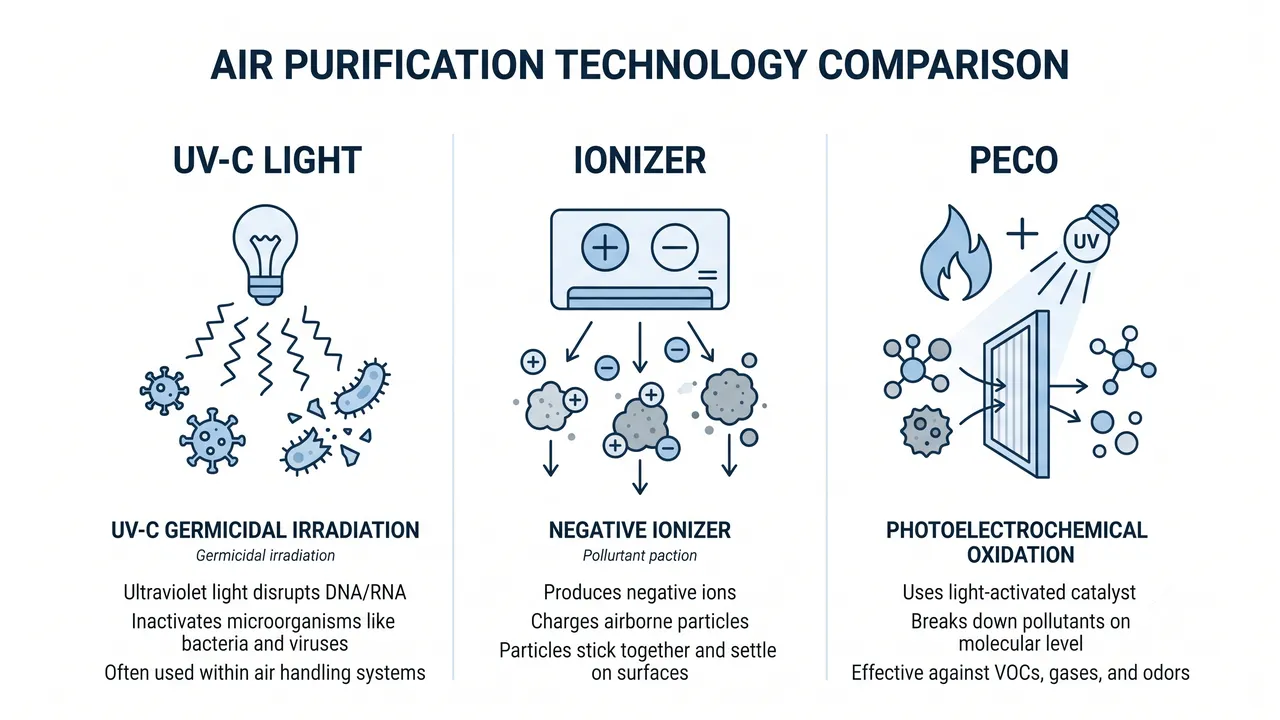
Air Purifier Technology Comparison
The table below summarizes the seven most common air purification technologies found in consumer products today. Use it as a quick reference, then read the detailed sections that follow for the science behind each method.
| Technology | How It Works | What It Captures | Ozone Risk | Effectiveness Rating | Typical Price Range |
|---|---|---|---|---|---|
| HEPA Filtration | Dense glass-fiber mat traps particles via interception, impaction, and diffusion | Particles ≥0.3 µm at 99.97% efficiency (dust, pollen, mold, bacteria, some viruses) | None | ★★★★★ | $50–$600 |
| Activated Carbon | Porous carbon adsorbs gas molecules through van der Waals forces | VOCs, odors, formaldehyde, benzene, some chemicals | None | ★★★★☆ (for gases) | $20–$400 (add-on or standalone) |
| UV-C Germicidal | 254 nm ultraviolet light damages microbial DNA/RNA | Bacteria, viruses, mold spores (requires prolonged exposure) | Low to moderate (some bulbs produce ozone) | ★★☆☆☆ (portable) / ★★★★☆ (HVAC) | $30–$300 |
| Ionizer | Emits charged ions that attach to particles, causing them to settle on surfaces | Fine particles, some smoke | High, ozone is a direct byproduct of ionization | ★★☆☆☆ | $30–$200 |
| Electrostatic Precipitator | Charges particles and collects them on oppositely charged metal plates | Fine particles, smoke, dust | Moderate to high, ozone generated during charging process | ★★★☆☆ | $100–$500 |
| PlasmaWave (Winix) | Generates positive and negative ions to break apart pollutants at a molecular level | Particles, some VOCs, odors | Low (produces trace amounts; within CARB limits on certified units) | ★★★☆☆ | $150–$350 |
| PECO (Molekule) | UV-A light on a catalyst-coated filter oxidizes pollutants | Claims VOCs, mold, bacteria, viruses, particles | Low | ★★☆☆☆ (unproven independently) | $400–$1,000 |
Key takeaway: HEPA filtration and activated carbon remain the only two technologies with decades of consistent, independently verified performance. Everything else ranges from situational usefulness (UV-C in HVAC systems) to unproven (PECO) to potentially harmful (ionizers). For more on why HEPA dominates, see our HEPA filter deep dive guide.
The Science Behind Each Technology
HEPA Filtration: Physics, Not Chemistry
HEPA (High-Efficiency Particulate Air) filtration works through three complementary physical mechanisms. Interception occurs when particles following an airstream come within one radius of a fiber and adhere to it. Impaction happens when larger particles can’t follow the air as it bends around fibers and crash into them directly. Diffusion captures the smallest particles, those below 0.1 microns, which move erratically due to Brownian motion (random collisions with air molecules) and eventually contact a fiber.
The result is the famous 99.97% efficiency at 0.3 microns, which is actually the hardest size to capture. Particles both larger and smaller are filtered at higher rates. This counterintuitive phenomenon, called the most penetrating particle size (MPPS), is well-established in aerosol science and is why HEPA filters perform better than their rating suggests in real-world conditions.
HEPA originated from the Manhattan Project, where scientists needed to filter radioactive particulates. Today it’s the standard for semiconductor cleanrooms (ISO Class 1–5), hospital isolation rooms, biosafety laboratories, and aircraft cabin air systems. No other consumer air cleaning technology has anything close to this pedigree.
Activated Carbon: Surface Area Is Everything
Activated carbon works through adsorption, gas molecules adhere to the carbon’s surface via weak van der Waals forces. A single gram of activated carbon has a surface area of roughly 3,000 square meters (about half a football field), created through an activation process that opens millions of microscopic pores.
The critical variable is carbon mass. A thin carbon mesh pad, the kind found in cheap combo filters, contains a few grams of carbon and saturates within days. A substantial carbon bed (several pounds) can adsorb VOCs, formaldehyde, and odors for months. For chemical sensitivities or post-renovation off-gassing, look for units with at least 5–15 pounds of granular activated carbon. Our guide to removing VOCs and formaldehyde from indoor air covers this in detail.
UV-C Germicidal Irradiation
UV-C light at 254 nanometers is genuinely germicidal, it’s been used in water treatment, hospital room disinfection, and HVAC coil sterilization for decades. The mechanism is photolytic: UV-C photons are absorbed by thymine dimers in DNA and uracil dimers in RNA, preventing microorganisms from replicating.
The catch is dose. Germicidal effectiveness is measured in µW·s/cm² (microwatt-seconds per square centimeter). Effective disinfection of common bacteria requires 2,000–10,000 µW·s/cm². In a portable air purifier, air passes the UV bulb in a fraction of a second, far too brief for meaningful microbial kill rates. In an HVAC air handler, where air circulates past UV-C lamps installed on cooling coils for extended periods, the technology works well for preventing biofilm buildup.
Some UV-C bulbs (particularly those using wavelengths below 240 nm) also produce ozone. Always check whether a UV-C purifier is CARB-certified as ozone-safe.
Ionizers and Electrostatic Precipitators
Ionizers emit clouds of negative ions (typically generated by corona discharge) that attach to airborne particles, giving them an electrical charge. These charged particles then either settle on nearby surfaces (walls, furniture, your lungs) or are attracted to a collection plate in electrostatic precipitators.
The fundamental problem is ozone generation. The corona discharge process that creates ions also splits O₂ molecules, which recombine into O₃ (ozone). Ozone is a powerful respiratory irritant, the EPA states that ozone can cause chest pain, coughing, shortness of breath, and worsened asthma. California’s Air Resources Board (CARB) sets an emission limit of 0.050 ppm for indoor air cleaners, and many ionizers exceed this.
Even setting ozone aside, ionizers are inefficient particle removers compared to HEPA. The charged particles that don’t hit a collection plate simply settle on your walls, ceiling, and furniture, they’re removed from the air but not eliminated. This creates a visible “black wall” effect near ionizer units used in smoky environments.
PlasmaWave Technology
PlasmaWave, found in Winix air purifiers, is a proprietary variant that generates both positive and negative ions to break apart pollutant molecules through oxidation. Winix claims this technology neutralizes viruses, bacteria, chemical vapors, and odors without producing harmful ozone levels.
CARB-certified Winix units do stay within ozone limits. However, independent testing of PlasmaWave’s standalone effectiveness (separate from the HEPA and carbon filters in the same unit) is limited. In practice, most of the particle removal in a Winix 5500-2 comes from its True HEPA filter and washable carbon filter, not PlasmaWave. Treat PlasmaWave as a minor supplement, not a primary purification mechanism. For a full breakdown of this model, see our Winix 5500-2 review.
PECO (Photo Electrochemical Oxidation)
Molekule’s PECO technology uses UV-A light shining on a nano-coated catalyst surface to generate hydroxyl radicals and other reactive oxygen species that allegedly oxidize pollutants, destroying VOCs, bacteria, viruses, and mold at a molecular level rather than merely trapping them.
The chemistry is sound in principle. Industrial photocatalytic oxidation (PCO) systems use similar reactions for VOC abatement in factories and water treatment plants. The question is scale. Industrial PCO systems use high-intensity UV sources and large catalyst areas with controlled contact times. A tabletop Molekule unit has a small catalyst area, a low-power UV-A LED, and air moving past at consumer-fan speeds.
Independent results have been disappointing. Consumer Reports rated the Molekule Air Pro at 55 out of 100, poor for particle removal at all fan speeds. A 2023 review in Building and Environment found PECO’s VOC removal inconsistent and often no better than a basic activated carbon filter. At $500–$1,000 per unit plus $100/year replacement filters, PECO remains an expensive experiment.
Which Technology Is Best for Your Situation
Use this decision guide to match your primary air quality concern with the right technology:
You have allergies or asthma (particles: pollen, dust, pet dander, mold spores) → True HEPA filtration. This is non-negotiable. No other technology matches HEPA’s proven particle removal. Look for units with a sealed system and high CADR ratings. The Coway AP-1512HH and Winix 5500-2 are consistently top-rated. See our guide to the best air purifiers for allergies.
You have chemical sensitivities or VOC concerns (new furniture, renovation, formaldehyde) → HEPA + substantial activated carbon. You need both particle and gas-phase filtration. Prioritize carbon mass, at least 5 lbs of granular activated carbon for meaningful VOC adsorption. Avoid combo filters with paper-thin carbon mesh. See how to remove VOCs from indoor air.
You want to reduce airborne germs (viruses, bacteria) → HEPA filtration captures virus-carrying respiratory droplets and aerosols. For supplemental disinfection in HVAC systems, UV-C is effective. Portable UV-C purifiers are largely ineffective due to insufficient exposure time. Focus on air changes per hour (ACH), the CDC recommends 5+ ACH for infection control.
You have odor problems (cooking, pets, smoke) → Activated carbon. Odor molecules are gases, and HEPA cannot capture them. Large carbon beds are the most effective odor solution. For wildfire smoke, combine HEPA (for particulate matter) with carbon (for gaseous compounds). Our wildfire smoke air purifier guide has specific recommendations.
You’re on a tight budget → HEPA-only unit. A $60–$100 HEPA purifier outperforms a $500 PECO unit for particle removal. Skip the bells and whistles, UV-C lights, ionizers, and PlasmaWave add-ons rarely improve real-world performance enough to justify their cost.
Technologies to Avoid
Not all air purification approaches deserve your money. Here’s what the evidence says to skip:
Ionic air purifiers (standalone ionizers without HEPA), These produce ozone as a byproduct, have inconsistent particle removal, and simply move pollutants onto your walls and furniture instead of capturing them. The Sharper Image Ionic Breeze, the most famous example, was banned from sale in California for ozone emissions.
Ozone generators marketed as “air purifiers”, Some products explicitly generate ozone and market it as a purifier. The EPA is unambiguous: ozone at concentrations safe enough to breathe does not effectively clean indoor air, and ozone at concentrations that could clean air is unsafe to breathe. Avoid any product that lists “ozone generation” as a feature.
Cheap UV-C “sanitizer” wands and gadgets, Handheld UV-C devices marketed for disinfecting surfaces, phones, or small spaces almost never deliver sufficient UV-C dose in the brief exposure time users provide. The FTC has taken action against several companies for unsubstantiated germ-killing claims.
PECO (at current prices and verification levels), The science is promising but the independent evidence doesn’t justify the premium pricing. At $500–$1,000, you can buy a top-tier HEPA purifier and a separate large carbon filter for superior performance at half the cost. If Molekule’s claims are eventually validated by large-scale independent studies, this assessment may change. For now, it’s a gamble, see our analysis of air purifier myths and mistakes.
“HEPA-like” or “HEPA-type” filters, These are not True HEPA. They may capture 85–95% of particles at their best size, but they lack the rigorous 99.97% at 0.3 µm standard. Always look for “True HEPA” or “HEPA H13” on the label.
Frequently Asked Questions
Do I really need a HEPA filter, or is a cheaper filter good enough? For allergy and asthma relief, True HEPA is worth the small price premium over “HEPA-type” filters. The difference between 95% and 99.97% particle removal compounds over hours of operation. In a sealed room running for 8 hours, a True HEPA unit delivers dramatically cleaner air than a 95%-efficient filter. For more detail on filter grades, see our HEPA filter guide.
Are ionizers safe if they’re CARB-certified? CARB certification means the unit emits below 0.050 ppm of ozone, it doesn’t mean it produces zero ozone. For healthy adults, this level is generally tolerable. For people with asthma, COPD, or other respiratory conditions, even low-level ozone exposure can trigger symptoms. Since HEPA achieves better particle removal with zero ozone, there’s no reason to accept the trade-off.
Can UV-C light in a portable purifier kill viruses like COVID-19? In theory, yes, UV-C at 254 nm inactivates SARS-CoV-2. In practice, a portable purifier’s airflow moves air past the UV bulb in fractions of a second, delivering far too little UV-C dose for meaningful viral inactivation. A HEPA filter, which physically captures virus-carrying aerosols, is far more reliable for portable air cleaning. UV-C is most effective as an HVAC installation aimed at cooling coils.
How often should I replace my HEPA filter? Most manufacturers recommend every 6–12 months, but actual lifespan depends on pollution levels, hours of operation, and pre-filter maintenance. A heavily used unit in a home with pets or wildfire smoke may need filter changes every 3–4 months. Always follow the manufacturer’s replacement schedule and monitor for reduced airflow, which indicates a clogged filter. See our air purifier maintenance guide for a complete schedule.
Is it worth paying extra for PECO or PlasmaWave technology? For most users, no. PECO’s independent testing results don’t justify its 2–5× price premium over proven HEPA units. PlasmaWave is typically bundled with Winix’s excellent HEPA and carbon filters, so you’re not paying a significant premium for it, but don’t choose a Winix unit for PlasmaWave. Choose it for the HEPA filter and carbon stage. The extra technologies are marketing differentiators, not performance differentiators.
The Bottom Line
After examining every major air purification technology against the available evidence, the conclusion is straightforward: HEPA filtration for particles, activated carbon for gases. This two-technology combination handles the vast majority of indoor air quality concerns, allergies, asthma, dust, pollen, mold, VOCs, odors, and wildfire smoke, with decades of independent scientific verification.
Everything else, UV-C in portable units, ionizers, PlasmaWave, PECO, ranges from situational usefulness to unproven to actively counterproductive. Before spending extra money on exotic technologies, invest in a well-sealed HEPA unit with strong CADR ratings and an adequate carbon stage. Your lungs and your wallet will thank you.
Disclosure: This article contains affiliate links. We may earn a commission from qualifying purchases at no additional cost to you. Our recommendations are based on independent research and testing, affiliate relationships do not influence our editorial conclusions. See our full disclosure policy for details.
See also: HEPA Filter Deep Dive Guide · Air Purifier Myths and Mistakes Debunked · Ozone Air Purifiers: Dangers and Safety Warnings · Best Air Purifiers for Allergies · How to Remove VOCs from Indoor Air
You May Also Like
- Air Purifier Placement Guide: Where to Put It for Maximum Effectiveness
- Air Purifier vs Opening Windows: Which Is Better for Indoor Air Quality?
- How Long Should You Run an Air Purifier? 24/7, Only When Home, or Somewhere in Between?
- How to Tell If Your Air Purifier Is Actually Working: 5 Simple Tests
Support This Guide
Helpful? Add The Air Purifier Guide as a preferred source on Google so our guides show up in your search results.
Related Articles

Coway Mighty2 vs AP-1512HH (2026)
Coway's Mighty2 replaced the AP-1512HH as Wirecutter's top pick. We compare CADR, noise, sensors, filter costs, and whether the older unit is still the smarter buy.

KNKA APH4000 Review: $150 Dark Horse
KNKA's APH4000 is one of Amazon's best-selling purifiers at $150. We check the AHAM certification, decode the 1,695 sq ft claim, and compare it to Levoit and Coway.

Levoit Core 300 vs 300-P: What Changed
Levoit quietly replaced the Core 300 with the Core 300-P. We explain the AHAM certification, whether filters still fit, and which one you should actually buy.

Shark NeverChange HP302 Review
Shark's NeverChange HP302 promises 5 years on one filter. We dig into the real running costs, the odor neutralizer catch, and whether it beats cheaper rivals.

Winix 5510 vs 5500-2: 2026 Verdict
The Winix 5500-2 is discontinued and the 5510 takes over. We compare CADR, noise, filter costs, and the one compatibility problem nobody mentions.
🛒 Products Mentioned
As an Amazon Associate, we earn from qualifying purchases.
Runs side-by-side purifier comparisons, long-term ownership reports, and filter cost analysis.
View all articles by David →