The Short Answer: HEPA filters don’t capture formaldehyde—you need activated carbon. The Austin Air HealthMate ($600) with 15 lbs of carbon is the gold standard. Impregnated carbon costs 20-40% more but is significantly more effective.
Editor’s note (September 2026): The Winix 5500-2 has been discontinued and remaining stock is limited. Winix’s official successor is the Winix 5510, which adds app control and uses a new filter. Read our Winix 5510 vs 5500-2 comparison before you buy either one.
Formaldehyde and volatile organic compounds (VOCs) are among the most overlooked threats to indoor air quality. Unlike dust or pollen, you can’t see them. Unlike mold, you often can’t smell them, at least not until concentrations reach levels that cause headaches, nausea, or worse. They seep into your home from new furniture, fresh paint, cleaning products, and even your clothing.
If you’ve recently moved into a new home, renovated a room, or purchased new furniture and noticed persistent headaches, eye irritation, or a chemical smell that won’t go away, VOCs are likely the culprit. A standard HEPA air purifier will do nothing for these gaseous pollutants. You need activated carbon, and a lot of it.
This guide breaks down exactly what VOCs and formaldehyde are, why they’re dangerous, and which air purifiers in 2026 actually have enough activated carbon to make a meaningful difference. We analyzed filtration capacity, carbon filter weight, room coverage, and real-world performance to identify the five best options.
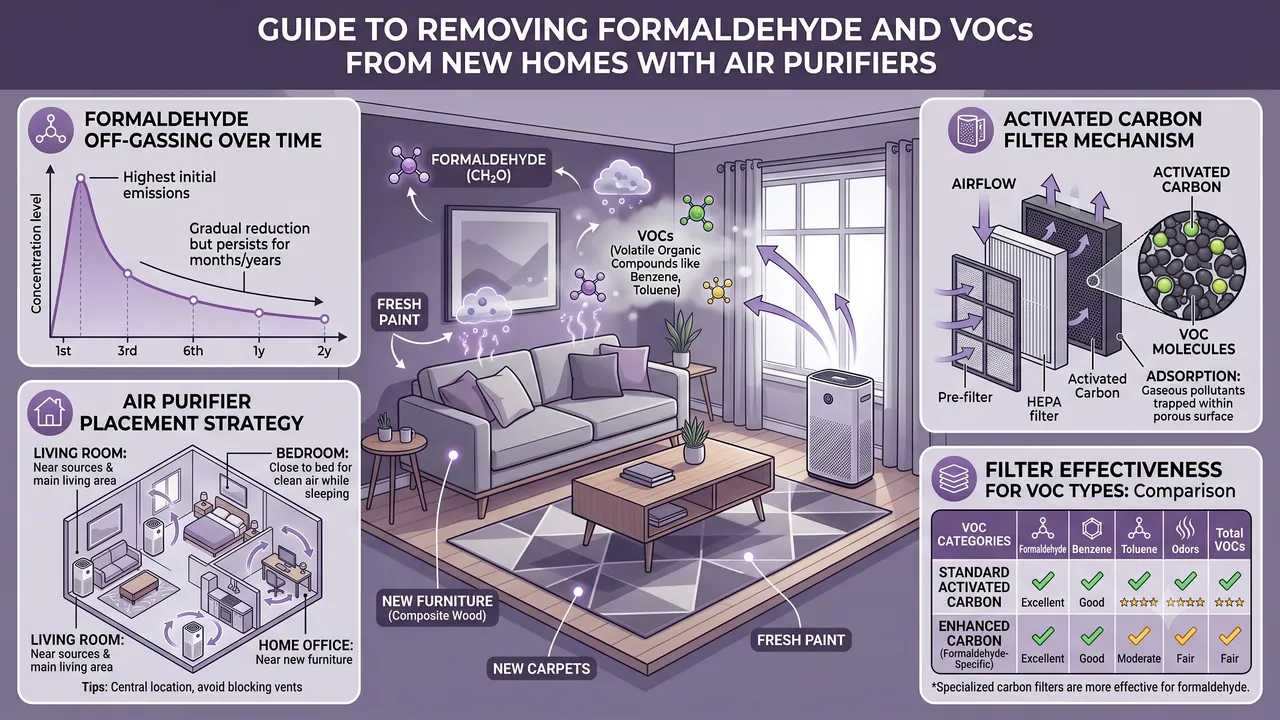
What Are VOCs and Where Do They Come From?
Volatile organic compounds are carbon-based chemicals that evaporate at room temperature. The “volatile” part means they transition easily from liquid or solid form into gas, which is exactly why they end up floating in the air you breathe.
Formaldehyde is technically a VOC, but it deserves special attention because of its ubiquity and potency. It’s classified as a Group 1 carcinogen by the International Agency for Research on Cancer (IARC), meaning there is sufficient evidence that it causes cancer in humans.
Here’s where these chemicals hide in your home:
Building Materials and Furniture
- Pressed-wood products (particleboard, MDF, plywood) use urea-formaldehyde resins as binders
- New carpet and carpet adhesives release formaldehyde and 4-phenylcyclohexene (4-PCH)
- Laminate flooring, especially cheaper varieties, off-gasses formaldehyde for months
- Paint, varnish, and polyurethane coatings release toluene, xylene, and ethyl acetate
Household Products
- Cleaning supplies (ammonia, chlorine, glycol ethers)
- Air fresheners and scented candles (limonene, linalool, which react with ozone to form secondary pollutants)
- Dry-cleaned clothing (perchloroethylene)
- Cosmetics, nail polish, and hair spray (formaldehyde, acetone, toluene)
Other Sources
- Cigarette smoke (over 7,000 chemicals, including formaldehyde, benzene, and acrolein)
- Gas stoves and ovens (formaldehyde, nitrogen dioxide, carbon monoxide)
- Office equipment like laser printers (styrene, ethylbenzene)
- Stored paints, solvents, and pesticides in garages
New homes and freshly renovated rooms are particularly problematic. A 2024 study published in Environmental Science & Technology found that formaldehyde concentrations in newly built homes averaged 89 parts per billion (ppb), nearly three times higher than older homes, and took 6 to 12 months to drop below the WHO guideline of 100 µg/m³ (approximately 82 ppb).
Health Risks of Formaldehyde and VOC Exposure
The health effects of VOC exposure range from mild annoyances to life-threatening conditions, depending on concentration, duration, and individual sensitivity.
Short-Term Exposure (Hours to Weeks)
- Eye, nose, and throat irritation
- Headaches and dizziness
- Nausea and vomiting
- Worsening of asthma symptoms
- Skin rashes and allergic reactions
- Difficulty concentrating and fatigue
Long-Term Exposure (Months to Years)
- Liver and kidney damage (from chronic exposure to certain VOCs like toluene and xylene)
- Central nervous system damage
- Increased cancer risk, formaldehyde is linked to nasopharyngeal cancer and leukemia; benzene is linked to blood cancers
- Reproductive and developmental problems
- Chronic respiratory conditions
Children, elderly individuals, and people with pre-existing respiratory conditions are especially vulnerable. The EPA estimates that indoor air can be 2 to 5 times more polluted than outdoor air, and in some cases, the VOC burden can be 1,000 times higher immediately after renovations.
Key Standard: California’s CARB (California Air Resources Board) sets a formaldehyde emission standard of 0.05 ppm for composite wood products, a benchmark that has become the de facto national standard since the formaldehyde regulations took effect under TSCA Title VI.
How Air Purifiers Remove VOCs and Formaldehyde
Not all air purifiers are created equal For gaseous pollutants. Here’s what matters:
HEPA Filters: Excellent for particles (dust, pollen, mold spores, bacteria) but completely ineffective against VOCs and formaldehyde. These gases pass right through the fiber mesh.
Activated Carbon Filters: The gold standard for VOC removal. Activated carbon works through adsorption, VOC molecules stick to the enormous surface area of carbon granules. One pound of activated carbon has a surface area equivalent to approximately 125 acres. The more carbon, the better.
Photocatalytic Oxidation (PCO): Uses UV light and a catalyst (usually titanium dioxide) to break down VOCs. Can be effective but may produce harmful byproducts like formaldehyde and ozone if not properly designed.
Plasma/Ionizer Technology: Some newer purifiers use bipolar ionization or cold plasma to decompose VOCs. Effectiveness varies widely, and some produce ozone as a byproduct, which is itself a respiratory irritant and a VOC that reacts with other indoor chemicals.
The Bottom Line: For reliable, safe VOC and formaldehyde removal, activated carbon in sufficient quantity is the most proven technology. We recommend a minimum of 5 pounds of carbon for meaningful whole-room treatment, and 15+ pounds for heavy contamination or larger spaces.
Comparison Table: Best Air Purifiers for Formaldehyde and VOCs (2026)
| Air Purifier | Carbon Filter Weight | HEPA Filter | Room Coverage (sq ft) | Price | Best For |
|---|---|---|---|---|---|
| Austin Air HealthMate Plus | 15 lbs activated carbon/zeolite blend | True HEPA | 750 | ~$715 | Heavy chemical contamination |
| IQAir GC MultiGas | 12 lbs activated carbon + alumina | HyperHEPA | 1,125 | ~$1,299 | Whole-home VOC removal |
| Austin Air HealthMate | 15 lbs activated carbon/zeolite | True HEPA | 1,500 | ~$615 | General VOC protection |
| Winix 5500-2 | Carbon pellet pre-filter (washable) | True HEPA | 360 | ~$159 | Budget-friendly VOC + particle combo |
| Coway AP-1512HH Mighty | Carbon deodorization filter | True HEPA | 361 | ~$189 | Best overall value |
Key Takeaway: The Austin Air units dominate this category because they contain 15 pounds of activated carbon and zeolite, roughly 10 to 30 times more carbon than budget competitors. The trade-off is weight (47 lbs) and price. For most homes, the Winix 5500-2 or Coway AP-1512HH offer a reasonable compromise between carbon filtration and everyday particle removal, though their carbon capacity is significantly lower.
Detailed Reviews: Top 5 Air Purifiers for VOCs and Formaldehyde
1. Austin Air HealthMate Plus, Best for Heavy Chemical Contamination
The Austin Air HealthMate Plus is purpose-built for chemical and gas removal. Its filter system includes a massive 15-pound blend of activated carbon and zeolite, along with potassium iodide (KI) impregnated carbon that specifically targets formaldehyde. The True HEPA inner filter handles particles down to 0.3 microns with 99.97% efficiency.
Why It Stands Out: The sheer amount of carbon is unmatched at this price point. Most consumer air purifiers contain less than 1 pound of carbon, sometimes just a thin sheet. The HealthMate Plus’s 15-pound carbon bed means it can adsorb VOCs continuously for 5 years before the filter needs replacement (at a cost of approximately $270).
Pros:
- Massive 15-lb carbon/zeolite/KI filter specifically targets formaldehyde
- 5-year filter life, lowest long-term cost of ownership
- Medical-grade steel housing (no plastic off-gassing)
- Covers 750 sq ft
- Made in the USA with a 5-year mechanical warranty
Cons:
- Heavy at 47 pounds
- Basic 3-speed fan (no smart features, no air quality sensor)
- Loud on highest setting (66 dB)
- No auto mode or app connectivity
- Expensive upfront ($715)
2. IQAir GC MultiGas, Premium VOC Specialist
The IQAir GC MultiGas is the gold standard for gas-phase air purification. It uses 12 pounds of activated carbon and alumina pellets, plus a post-filter sleeve of HyperHEPA media. The modular cartridge design lets you replace the gas phase and particle filters independently.
Why It Stands Out: IQAir’s engineering is exceptional. The sealed HyperHEPA filter captures particles down to 0.003 microns, 100 times smaller than what standard HEPA captures. The gas cartridges use a blend of activated carbon and aluminum oxide to target a broad spectrum of VOCs, including formaldehyde, benzene, toluene, and sulfur compounds.
Pros:
- 12-lb activated carbon + alumina cartridge
- HyperHEPA filtration to 0.003 microns
- 1,125 sq ft coverage
- Swiss-engineered quality
- Individual filter replacement scheduling
Cons:
- Very expensive (~$1,299)
- Replacement filter sets cost ~$398
- No smart features or app
- Heavy (35 lbs)
3. Winix 5500-2, Best Budget Option for VOCs and Particles
The Winix 5500-2 is a crowd favorite for good reason. While its carbon filter is dramatically smaller than the Austin Air’s, it uses a washable carbon pellet pre-filter rather than a deep carbon bed, it offers the best balance of particle and odor filtration at its price point. The PlasmaWave technology generates hydroxyl radicals that can break down some VOCs, though this feature is controversial due to trace ozone production.
Why It Stands Out: For under $160, you get a True HEPA filter, a carbon pre-filter (washable, saves money on replacements), PlasmaWave technology, and smart sensors that auto-adjust fan speed based on air quality. It’s an excellent entry point for someone dealing with mild VOC concerns from cooking odors, pet smells, or light off-gassing.
Pros:
- Excellent value at ~$159
- True HEPA + washable carbon pre-filter
- PlasmaWave technology for additional gas breakdown
- Auto mode with air quality sensor
- Quiet sleep mode (27.8 dB)
- Covers 360 sq ft
Cons:
- Carbon filter is thin, limited VOC removal capacity
- PlasmaWave produces trace amounts of ozone (optional, can be disabled)
- Won’t handle heavy formaldehyde contamination
- Carbon pre-filter needs washing every 3 months
4. Coway AP-1512HH Mighty, Best Overall Value
The Coway AP-1512HH has been a top recommendation across air purifier review sites for nearly a decade, and for good reason. It consistently delivers excellent particle filtration in a compact, energy-efficient package. For VOCs, it includes a carbon deodorization filter, again, much thinner than dedicated gas-phase units, but a meaningful addition for everyday odor and chemical control.
Why It Stands Out: The Coway Mighty is one of the most energy-efficient air purifiers on the market (77 watts on high). Its 4-stage filtration (pre-filter, carbon filter, True HEPA, and ionizer) covers 361 sq ft, and its auto mode intelligently adjusts fan speed. The real-time air quality indicator uses a color-coded LED ring, a surprisingly useful feature for monitoring when VOC levels spike (like when you open a fresh paint can or use cleaning products).
Pros:
- Excellent CADR ratings (smoke: 233, dust: 246, pollen: 240)
- 4-stage filtration with carbon deodorization
- Eco mode saves energy when no pollution detected
- Compact and lightweight (12.3 lbs)
- Real-time air quality LED indicator
- Timer and auto mode
- Covers 361 sq ft
Cons:
- Carbon filter is thin, limited formaldehyde removal
- Ionizer produces trace ozone (can be turned off)
- Filter replacement every 6–12 months (~$50)
- Not designed for heavy chemical contamination
5. Austin Air HealthMate, Best for General VOC Protection
The standard Austin Air HealthMate shares the same 15-pound carbon bed as the HealthMate Plus, but without the potassium iodide impregnation that specifically targets formaldehyde. For general VOC protection, toluene, benzene, xylene, ammonia, and sulfur compounds, it’s equally effective and slightly more affordable.
Why It Stands Out: Same massive carbon capacity, same 5-year filter life, same medical-grade construction, just without the KI additive for enhanced formaldehyde removal. If your primary concern is general VOCs rather than formaldehyde specifically, this is the better value.
Pros:
- 15-lb activated carbon/zeolite filter
- 5-year filter life
- Made in USA
- Covers 1,500 sq ft (larger than the Plus model)
- Same robust steel construction
Cons:
- Less effective against formaldehyde than the Plus model
- No smart features
- Loud on high
- Heavy (47 lbs)
How to Choose the Right Air Purifier for VOCs and Formaldehyde
For New Furniture or Renovations (Heavy Off-Gassing) Go with the Austin Air HealthMate Plus or IQAir GC MultiGas. These are the only consumer units with enough activated carbon to meaningfully reduce formaldehyde concentrations from new pressed-wood furniture, fresh flooring, or recent renovations. Air out rooms by opening windows whenever possible during the first few months, and run the purifier continuously.
For General Household VOCs (Cleaning Products, Cooking, Mild Odors) The Coway AP-1512HH or Winix 5500-2 will handle everyday VOC levels effectively. Their carbon filters are thin but sufficient for moderate chemical loads. For deeper guidance on matching a purifier to your specific needs, see our room-by-room air purifier guide.
For Whole-House Coverage The Austin Air HealthMate covers up to 1,500 sq ft with its full 15-lb carbon bed. For homes with central HVAC, you might also consider a whole-house air purification system installed directly in your ductwork.
On a Tight Budget The Winix 5500-2 offers the best carbon filtration under $160. While its carbon pre-filter is thin, you can supplement it by placing activated carbon bags near pollution sources (under new furniture, near fresh paint). This isn’t a substitute for a proper carbon filter, but it helps.
Tips for Reducing VOC Exposure Beyond Air Purifiers
Air purifiers are one part of the solution. Here are complementary strategies:
-
Ventilate aggressively during and after renovations. Open windows and use exhaust fans for at least 2 weeks after painting, installing new flooring, or bringing in new furniture. Cross-ventilation is most effective.
-
Choose low-VOC and no-VOC products. Look for GREENGUARD Gold, FloorScore, or SCS Indoor Advantage certifications. These products emit significantly fewer chemicals.
-
Let new furniture off-gas before bringing it inside. If possible, unpack new furniture in a garage or well-ventilated space for several days before moving it into bedrooms or living areas.
-
Maintain moderate temperature and humidity. Formaldehyde off-gassing increases with temperature and humidity. Keeping your home at 68–72°F and 40–50% relative humidity reduces emissions.
-
Remove unnecessary chemical sources. Store paints, solvents, and pesticides in detached garages or sheds, not in your home. Switch to fragrance-free cleaning products.
-
Test your air. Commercial formaldehyde test kits (like those from Home Air Check or Prism Analytical) can tell you whether your levels are elevated and help you decide if a heavy-duty carbon purifier is necessary.
For more strategies on maintaining healthy indoor air throughout the year, check our seasonal indoor air quality guide.
Frequently Asked Questions
Do HEPA air purifiers remove formaldehyde?
No. Standard HEPA filters are designed to capture solid particles, dust, pollen, mold spores, and bacteria, down to 0.3 microns. Formaldehyde is a gas molecule that passes right through HEPA media. To remove formaldehyde, you need a filter with activated carbon (ideally impregnated with potassium iodide or similar compounds). Some air purifiers combine HEPA and carbon filters, but the carbon portion is often too thin to be effective against heavy formaldehyde loads. Look for units with at least 5 pounds of activated carbon for meaningful gas-phase filtration.
How much activated carbon do I need for VOC removal?
For light VOC concerns (cooking odors, pet smells, general freshness), a carbon pre-filter of 0.5–1 pound may suffice. For moderate VOC loads (new furniture, cleaning products, home offices with printers), aim for 3–5 pounds of carbon. For heavy contamination (new construction, renovations, industrial proximity, formaldehyde-sensitive individuals), 10–15+ pounds is recommended. The Austin Air HealthMate Plus with its 15-pound carbon/zeolite blend represents the high end of consumer-grade carbon filtration and is effective for serious chemical contamination.
Can air purifiers cause ozone, and is that a concern for VOC removal?
Some air purifier technologies, including ionizers, electrostatic precipitators, and certain plasma generators, produce ozone as a byproduct. Ozone is a lung irritant and, ironically, reacts with indoor VOCs like limonene and linalool to form secondary pollutants including formaldehyde and ultrafine particles. If you’re buying an air purifier specifically for VOC removal, choose one with a sealed activated carbon filter and no ozone-producing technologies. Units like the Austin Air HealthMate Plus use no ionizers or ozone generators. If you choose a unit with PlasmaWave or ionizer features (like the Winix 5500-2 or Coway AP-1512HH), these features can typically be turned off.
How long does it take for an air purifier to reduce VOC levels?
This depends on the air purifier’s carbon capacity, the room size, the ventilation rate, and the source strength of the VOCs. In a typical 300 sq ft room with a strong carbon filter (Austin Air HealthMate Plus), you can expect noticeable reduction in odors and chemical smell within 1–3 hours of continuous operation. However, complete reduction to safe levels may take 24–72 hours if the source is ongoing (like new furniture). Formaldehyde off-gassing from new building materials can persist for months, which is why continuous operation is recommended. The key metric is the clean air delivery rate (CADR) for gases, higher is better.
Are cheap air purifiers with thin carbon filters worth it for VOCs?
It depends on what you’re trying to address. Thin carbon filters (under 1 pound) will help with cooking odors, pet smells, and light household chemical odors. They are essentially ineffective against formaldehyde from new furniture, flooring, or construction materials. If your primary concern is chemical off-gassing, spending more on a unit with a substantial carbon bed (5+ pounds) will deliver dramatically better results. A cheap purifier with a token carbon filter is better than nothing, but manage your expectations, it won’t solve a formaldehyde problem. For a comparison of the most popular budget options, see our Winix 5500-2 vs Blueair 211 comparison.
Final Verdict: Which Air Purifier Should You Buy?
If you have a formaldehyde or heavy VOC problem, new renovation, new furniture, chemical sensitivity, the Austin Air HealthMate Plus is the clear winner. Its 15-pound carbon/zeolite blend with potassium iodide impregnation provides genuine, sustained chemical filtration that thin-filter purifiers simply cannot match. Yes, it’s expensive. Yes, it’s heavy. But it works, and its 5-year filter life makes the long-term cost reasonable.
If you want the best balance of performance, features, and price, the Coway AP-1512HH Mighty remains the best all-around air purifier in 2026. It won’t solve a serious formaldehyde problem, but its carbon filter handles everyday odors and light chemical loads while delivering excellent particle filtration and smart has at a reasonable price.
If you’re on a budget but want VOC capability, the Winix 5500-2 gives you the most carbon filtration under $160, plus the added benefit of PlasmaWave technology that can break down some gaseous pollutants.
Whatever you choose, remember that an air purifier is a tool, not a complete solution. Ventilate when you can, choose low-emission products when possible, and test your air if you suspect elevated formaldehyde levels.
Affiliate Disclosure: The Air Purifier Guide is a participant in the Amazon Services LLC Associates Program, an affiliate advertising program designed to provide a means for sites to earn advertising fees by advertising and linking to Amazon.com. When you purchase through our links, we may earn a commission at no additional cost to you. This helps us continue testing and reviewing air purifiers to bring you honest, data-driven recommendations. See our full disclosure for more details.
You May Also Like
- Air Purifiers for VOCs and Formaldehyde: What Actually Works (and What’s Just Marketing)
- Air Purifier Electricity Cost: How Much Does It Really Cost to Run 24/7?
- Air Purifier Filter Replacement Guide: Costs, Schedules, and How to Extend Filter Life
- Best Air Purifier Under $150: Genuine HEPA Without Breaking the Bank
Support This Guide
Helpful? Add The Air Purifier Guide as a preferred source on Google so our guides show up in your search results.
Related Articles

Coway Mighty2 vs AP-1512HH (2026)
Coway's Mighty2 replaced the AP-1512HH as Wirecutter's top pick. We compare CADR, noise, sensors, filter costs, and whether the older unit is still the smarter buy.

KNKA APH4000 Review: $150 Dark Horse
KNKA's APH4000 is one of Amazon's best-selling purifiers at $150. We check the AHAM certification, decode the 1,695 sq ft claim, and compare it to Levoit and Coway.

Levoit Core 300 vs 300-P: What Changed
Levoit quietly replaced the Core 300 with the Core 300-P. We explain the AHAM certification, whether filters still fit, and which one you should actually buy.

Shark NeverChange HP302 Review
Shark's NeverChange HP302 promises 5 years on one filter. We dig into the real running costs, the odor neutralizer catch, and whether it beats cheaper rivals.

Winix 5510 vs 5500-2: 2026 Verdict
The Winix 5500-2 is discontinued and the 5510 takes over. We compare CADR, noise, filter costs, and the one compatibility problem nobody mentions.
🛒 Products Mentioned
As an Amazon Associate, we earn from qualifying purchases.
Covers indoor air quality science, respiratory health, allergy management, and wildfire smoke protection.
View all articles by Sarah →