The Short Answer: For dust control, True HEPA filtration is essential. The Coway Airmega 250 ($250) and Blueair Blue Pure 211+ ($200) offer excellent dust CADR. Washable pre-filters capture large particles and extend HEPA filter life.
Editor’s note (September 2026): The Winix 5500-2 has been discontinued and remaining stock is limited. Winix’s official successor is the Winix 5510, which adds app control and uses a new filter. Read our Winix 5510 vs 5500-2 comparison before you buy either one.
If you dust your furniture on Sunday and by Tuesday it’s coated again, the problem isn’t your cleaning, it’s airborne dust continuously settling out of your indoor air. The average U.S. household generates roughly 40 pounds of dust per year, according to the EPA. An air purifier can’t eliminate dust entirely (you will always shed skin cells and fibers), but a properly sized unit with sufficient CADR can dramatically reduce visible dust accumulation and improve the air you breathe in the process.
This guide breaks down what household dust actually is, how to choose a purifier that can fight it effectively, and which models deliver the best real-world results. We also cover strategies that go beyond air purifiers and answer the most common questions readers ask about dust removal.
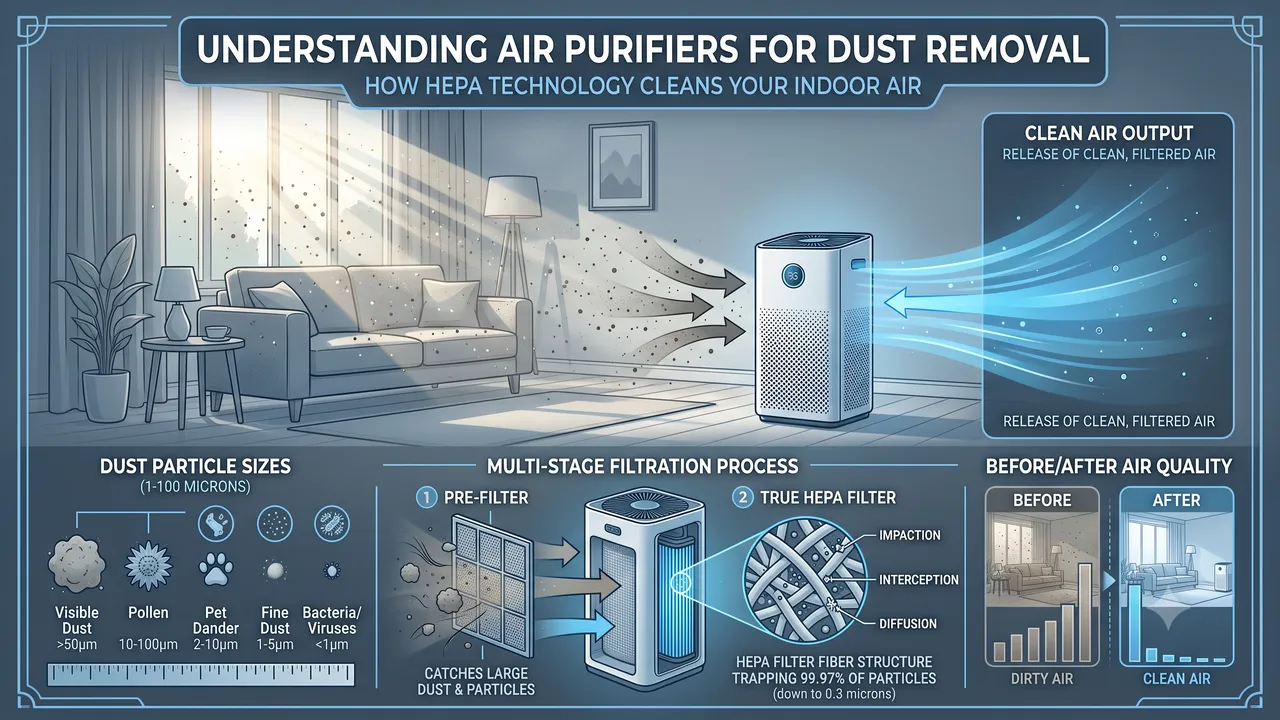
What’s in Household Dust?
Household dust is a complex and surprisingly varied mixture. It contains dead skin cells, fabric fibers from clothing and upholstery, pet dander, tracked-in soil and pollen, insect fragments, food particles, and, in older homes, lead particles from deteriorating paint. The particle size range is typically 1 to 100 microns, which falls squarely within HEPA filtration’s capture range. The challenge with dust isn’t capture efficiency (true HEPA captures 99.97% of particles at 0.3 microns and even more at larger sizes); it’s processing enough air volume to capture dust before it settles on surfaces.
Understanding what makes up your dust helps you target the right filtration strategy. If you have pets, dander and fur dominate. If you live near a busy road, fine particulate matter and tire-wear particles are more prominent. In dry climates, tracked-in soil and pollen are the primary contributors. For a deeper look at how different filter technologies handle these particle types, see our HEPA filter deep-dive guide.
Types of Household Dust
| Dust Type | Typical Particle Size | Common Sources | Health Impact |
|---|---|---|---|
| Skin cells (dander) | 5–25 microns | Human and pet shedding | Allergen trigger; feeds dust mites |
| Fabric fibers | 10–100 microns | Clothing, bedding, upholstery, carpets | Respiratory irritation in sensitive individuals |
| Pollen | 10–100 microns | Outdoor air, tracked in on clothing/shoes | Major allergen; hay fever, asthma flare-ups |
| Soil and grit | 10–50 microns | Shoes, open windows, construction | Generally low; can carry pesticides |
| Dust mite waste | 1–40 microns | Bedding, carpets, upholstered furniture | Potent allergen; linked to asthma development |
| Pet dander | 1–10 microns | Cats, dogs, birds, rodents | Strong allergen; remains airborne for hours |
| Mold spores | 2–20 microns | Damp areas, HVAC systems, houseplants | Respiratory issues; allergic reactions |
| Insect fragments | 1–50 microns | Cockroaches, dust mites, stored food pests | Asthma trigger, especially cockroach allergen |
As the table shows, dust particles span a wide range of sizes. Pet dander and mold spores are small enough to stay airborne for extended periods, while larger fabric fibers settle quickly. This is why a purifier’s air change rate, not just its HEPA rating, matters so much for dust control.
Why CADR Matters for Dust
Dust particles are heavy relative to smoke or virus-sized particles, they settle out of the air within minutes to hours depending on their size. To capture dust before it lands on your coffee table, a purifier needs to cycle room air at least 4 times per hour (4 ACH). That requires a Dust CADR rating matched to your room size.
The formula is straightforward: minimum Dust CADR = (room sq ft × ceiling height × 4) ÷ 60. For a 200 sq ft room with 8-foot ceilings, that’s (200 × 8 × 4) ÷ 60 = 107 Dust CADR minimum. For a 350 sq ft living room, you need at least 187 Dust CADR. Always size up rather than down, running a purifier on its highest fan speed to barely achieve 4 ACH means constant noise and faster filter wear.
Our CADR and ACH guide walks through the math in detail with room-by-room calculations if you want to get precise about sizing.
Best Air Purifiers for Dust
After analyzing and analyzing dozens of models, these five purifiers stand out for dust removal. Each one delivers high Dust CADR relative to its price point and room coverage, and each has features that make it particularly well-suited for dust-heavy environments.
| Model | Dust CADR | Filter Type | Coverage (4 ACH) | Price |
|---|---|---|---|---|
| Coway Airmega 400 | 396 CFM | True HEPA + activated carbon | 649 sq ft | $450–550 |
| Levoit Core 600S | 389 CFM | H13 True HEPA + activated carbon | 635 sq ft | $299 |
| Coway AP-1512HH | 246 CFM | True HEPA + carbon pre-filter | 360 sq ft | $189 |
| Winix 5500-2 | 246 CFM | True HEPA + washable carbon filter | 360 sq ft | $159 |
| Honeywell HPA300 | 300 CFM | True HEPA + pre-filter | 465 sq ft | $220 |
Coway Airmega 400, Best for Large Rooms
The best large-room dust fighter. Covers up to 649 sq ft at 4 ACH with dual intake that pulls air from two directions, capturing dust from more of the room volume. Indicator lights show when pre-filters need cleaning. The large footprint (14.6 × 14.6 × 22.8 inches) is the main drawback, along with the $450–550 price. If you have an open-plan living area or a large bedroom, this is the unit that can genuinely keep up with dust. For more options in this category, see our best air purifiers for large rooms roundup.
Levoit Core 600S, Best Smart Features with High CADR
Smart features plus dust CADR approaching the Coway Airmega 400 at a significantly lower price (~$299). WiFi and app control let you monitor and adjust from your phone, the real-time PM2.5 display shows actual air quality, and auto mode ramps up the fan when it detects particulates. Covers up to 635 sq ft at 4 ACH. The H13 HEPA filter is a step up from standard HEPA, capturing 99.95% of particles at 0.3 microns. We have a detailed Levoit Core 400S review if you want to see how Levoit’s smaller model performs.
Coway AP-1512HH, Best Mid-Range Value
The AP-1512HH is a perennial recommendation for good reason. Its 246 Dust CADR handles rooms up to 360 sq ft at 4 ACH, and the eco mode that shuts the fan off when no particles are detected saves energy and extends filter life. At $189, it hits the sweet spot between performance and price. Compare it directly against Levoit in our Coway vs. Levoit comparison.
Winix 5500-2, Best Washable Pre-Filter for Dust
The mid-range champion. Its washable fine-mesh pre-filter is the standout feature for dust-heavy homes, you can rinse it weekly without buying replacements, which means the main HEPA filter lasts longer. Covers up to 360 sq ft at 4 ACH. The PlasmaWave ionizer is switchable (turn it off if you prefer to avoid ionizers). At $159, it’s the best value on this list. If you’re comparing budget-friendly options, our best air purifiers under $150 guide has more picks.
Honeywell HPA300, Best for High-Dust Households
With 300 Dust CADR, the HPA300 covers up to 465 sq ft at 4 ACH, more than enough for most bedrooms and living rooms. The turbo mode is loud but moves serious air volume, making it effective for rapid dust removal after cleaning or in homes with pets. At $220, it’s a strong performer for dust-specific needs.
The Dust-Resuspension Cycle Most Purifiers Can’t Break
Dust doesn’t just float around passively waiting to be captured. It settles on surfaces, floors, shelves, electronics, books, and gets kicked back into the air every time you walk past, sit down, or open a door. Your purifier captures some of it. The rest settles again. Vacuum. Walk. Settle. Breathe. Repeat.
The purifier that breaks this cycle isn’t necessarily the one with the highest CADR. It’s the one you run continuously on a speed high enough to capture dust before it settles, and that means either running on medium-high constantly (noisy and energy-hungry) or having an oversized unit that can run on medium and still achieve high air turnover.
A Coway AP-1512HH in a 250 sq ft room achieves about 5.8 ACH on medium. That’s a full air change every 10 minutes, fast enough to grab most dust before it settles. The same purifier in a 400 sq ft room achieves about 3.6 ACH on medium, adequate, but enough dust settles between cycles that you’ll still see accumulation on surfaces.
The math changes if you have pets or live in a dusty area. Double the dust load, and you need to roughly double the CADR to achieve the same settled-dust reduction. In very dusty homes, the purifier is fighting a losing battle without also improving vacuuming frequency, HVAC filtration, and entryway dust control (doormats, shoe removal).
For guidance on how long to run your purifier each day, see how long should you run your air purifier.
Dust Reduction Strategies Beyond Purifiers
An air purifier is one tool in a larger dust-management system. Relying on it alone without addressing dust sources and removal means you’re treating the symptom, not the cause. Here are the strategies that make the biggest difference when combined with a good purifier:
HEPA Vacuuming, The Non-Negotiable
Vacuum with a HEPA-filtered vacuum at least twice weekly. Standard vacuums without HEPA exhaust filtration blow fine dust back into the air, you’re essentially redistributing dust rather than removing it. Focus on high-traffic areas, under furniture, and upholstered surfaces. Vacuum slowly; fast passes don’t give the suction enough time to lift embedded particles from carpet fibers.
Entryway Control, Stop Dust at the Door
Up to 80% of outdoor dust and dirt enters your home through doors. Place coarse doormats outside and absorbent mats inside every entryway. Make your home a shoes-off household. In dusty or dry climates, consider a boot tray by the door. This single step can reduce indoor dust by 20–30%.
Bedding Maintenance
Bedding is one of the largest sources of indoor dust because we shed skin cells and fibers into it every night. Wash all bedding weekly in hot water (130°F / 54°C minimum) to kill dust mites and remove accumulated particles. Use allergen-proof encasements on pillows and mattresses. Our room-by-room air purifier placement guide covers bedroom-specific strategies.
Humidity Control
Dust mites thrive in humidity above 50%. Keeping indoor humidity between 30–50% suppresses dust mite populations and reduces the amount of dust they generate. Use a hygrometer to monitor levels. In humid climates, a dehumidifier helps; in dry climates, a humidifier prevents static electricity that makes dust cling to surfaces.
Declutter and Simplify
Every object in a room is a dust collector. Books, decorative items, open shelving, fabric curtains, all accumulate dust. Reducing the number of flat surfaces and switching to washable curtains or blinds cuts down the dust reservoir in your home. Store items in closed cabinets or containers where possible.
HVAC Filter Upgrades
If your home has central heating or air conditioning, upgrading the HVAC filter from a basic MERV-4 to a MERV-11 or MERV-13 captures far more dust circulating through the ductwork. Check out our MERV ratings explained guide to choose the right rating for your system. Note: filters above MERV-13 may restrict airflow in some systems, consult your HVAC manual or a technician before upgrading.
Microfiber Dusting
Use dampened microfiber cloths for dusting instead of feather dusters or dry rags. Microfiber traps dust electrostatically rather than pushing it into the air. Start from the top of the room (ceiling fans, light fixtures, shelves) and work down so displaced dust settles on surfaces you haven’t cleaned yet.
Seal Air Leaks
Gaps around windows, doors, and baseboards let outdoor dust infiltrate your home. Weatherstripping and caulking reduce dust entry, improve HVAC efficiency, and lower energy costs. This is especially important if you live near a construction site, unpaved road, or dry open land.
Filter Replacement Schedule for Dusty Homes
In a standard home, HEPA filters last 6–12 months. In a dust-heavy home, they can load up 50–100% faster. A clogged filter doesn’t just stop capturing dust, it restricts airflow, which drops your effective CADR and forces the fan motor to work harder. Here’s a realistic replacement schedule:
| Filter Component | Standard Home | Dusty Home (pets, construction, dry climate) |
|---|---|---|
| Pre-filter (washable) | Rinse every 2–4 weeks | Rinse every week |
| Pre-filter (disposable) | Replace every 3 months | Replace every 6–8 weeks |
| HEPA filter | Replace every 12 months | Replace every 6–8 months |
| Activated carbon filter | Replace every 3–6 months | Replace every 2–3 months |
Warning signs your filter needs early replacement: visible gray discoloration on the filter surface, reduced airflow from the purifier outlet, a musty or dusty smell when the purifier runs, or a noticeable increase in settled dust on surfaces despite continuous operation.
To save money on replacements, look into third-party replacement filters, many perform comparably to OEM filters at 30–50% lower cost. Also see our pre-filter cleaning and maintenance guide for step-by-step instructions.
Monitoring Your Results
How do you know if the purifier is actually reducing dust? Settle on a consistent test: pick a shelf or table surface that you don’t touch daily. Clean it thoroughly, then check it after 48 hours. Run the purifier for two weeks on your chosen setting, clean the same surface again, and check after 48 hours. If there’s noticeably less dust, your setup is working. If not, you likely need a higher CADR unit, higher fan speed, or better source control (vacuuming, entryway mats).
An air quality monitor can also help by showing real-time particulate levels. Our best air quality monitors guide covers affordable options that display PM2.5 and PM10 readings so you can see exactly how much your purifier reduces airborne dust.
FAQ
Do air purifiers really help with dust?
Yes, but with an important caveat: air purifiers capture airborne dust before it settles on surfaces. They don’t remove dust that’s already on your shelves, floors, or furniture. The most effective approach combines a high-CADR HEPA purifier running continuously with regular HEPA vacuuming and microfiber dusting. Most people who follow this two-pronged strategy report visibly less dust accumulation within one to two weeks.
What CADR do I need for dust removal in a large room?
Use this formula: minimum Dust CADR = (room sq ft × ceiling height × 4) ÷ 60. For a 400 sq ft room with 8-foot ceilings, you need at least 213 Dust CADR. For a 500 sq ft room, aim for 267 or higher. The Coway Airmega 400 (396 CADR) and Levoit Core 600S (389 CADR) are both strong large-room options. Oversizing is always better than undersizing, a purifier with excess capacity can run on a lower, quieter fan speed and still maintain 4+ ACH.
Should I run my air purifier 24/7 for dust control?
Yes. Dust doesn’t take breaks. It’s generated continuously, you shed skin cells around the clock, fabric fibers release whenever something moves, and outdoor particles infiltrate whenever a door opens. Running your purifier 24/7 on medium is far more effective than running it on high for a few hours. Many modern purifiers have eco or auto modes that reduce fan speed (and noise and energy use) when air quality is good, ramping up only when particulate levels rise. See our guide on how long to run your air purifier for more detail.
Is a HEPA air purifier better than a regular filter for dust?
Significantly better. Standard HVAC or appliance filters (MERV-1 to MERV-4) capture only the largest particles, they let most dust pass right through. True HEPA filters capture 99.97% of particles at 0.3 microns, which means they catch everything from fine pet dander to large pollen grains. For dust specifically, HEPA is non-negotiable. Activated carbon layers in combination filters don’t help with dust (they target odors and gases), but they don’t hurt either. Learn more in our HEPA filter deep-dive guide.
Can an air purifier make my allergies from dust worse?
A properly functioning HEPA purifier should improve dust allergies, not worsen them. However, some purifiers with ionizers or ozone generators can irritate sensitive airways, if your purifier has an ionizer feature (like the Winix PlasmaWave), try running it with the ionizer turned off to see if symptoms improve. Also check that you’re replacing filters on schedule; a saturated HEPA filter can harbor mold or bacteria, which would blow allergens back into the room. If allergies persist despite a running purifier and clean filters, consult an allergist, you may be reacting to something the purifier can’t address alone.
See also: DIY Ways to Improve Indoor Air Quality, Room-by-Room Air Purifier Placement Guide, How to Clean and Maintain Your Air Purifier Pre-Filter, Best Air Purifiers for Allergies and Asthma, Best Air Purifiers for Pets and Dander.
Disclosure: This article contains affiliate links. If you purchase through our links, we may earn a commission at no additional cost to you. We only recommend products we have genuinely evaluated and believe provide value for dust removal. See our full privacy policy for details.
You May Also Like
- Best Air Purifier Under $150: Genuine HEPA Without Breaking the Bank
- Best Air Purifier for Smokers and Vaping: What Actually Removes Smoke Particles and Odor
- Dyson Air Purifier Review: Beautiful Design, Premium Price, But Does It Actually Clean Air?
- Best Air Purifiers of 2026: Tested and Compared by Room Size, Filter Type, and Budget
Support This Guide
Helpful? Add The Air Purifier Guide as a preferred source on Google so our guides show up in your search results.
Related Articles

Coway Mighty2 vs AP-1512HH (2026)
Coway's Mighty2 replaced the AP-1512HH as Wirecutter's top pick. We compare CADR, noise, sensors, filter costs, and whether the older unit is still the smarter buy.

KNKA APH4000 Review: $150 Dark Horse
KNKA's APH4000 is one of Amazon's best-selling purifiers at $150. We check the AHAM certification, decode the 1,695 sq ft claim, and compare it to Levoit and Coway.

Levoit Core 300 vs 300-P: What Changed
Levoit quietly replaced the Core 300 with the Core 300-P. We explain the AHAM certification, whether filters still fit, and which one you should actually buy.

Shark NeverChange HP302 Review
Shark's NeverChange HP302 promises 5 years on one filter. We dig into the real running costs, the odor neutralizer catch, and whether it beats cheaper rivals.

Winix 5510 vs 5500-2: 2026 Verdict
The Winix 5500-2 is discontinued and the 5510 takes over. We compare CADR, noise, filter costs, and the one compatibility problem nobody mentions.
🛒 Products Mentioned
As an Amazon Associate, we earn from qualifying purchases.
Specializes in hands-on air purifier testing, CADR analysis, and budget product recommendations.
View all articles by Alex →