Quick Answer: For rooms over 350 sq ft, you need a CADR of at least 230 CFM (smoke). The Blueair Blue Pure 211+ ($249, 350 CADR) and Coway Airmega 400 ($449, 350 CADR) are the top single-unit performers. For very large spaces (500+ sq ft), consider running two mid-sized units rather than one oversized one, it’s often cheaper and more effective. Use our room size calculator to find the right CADR for your space.
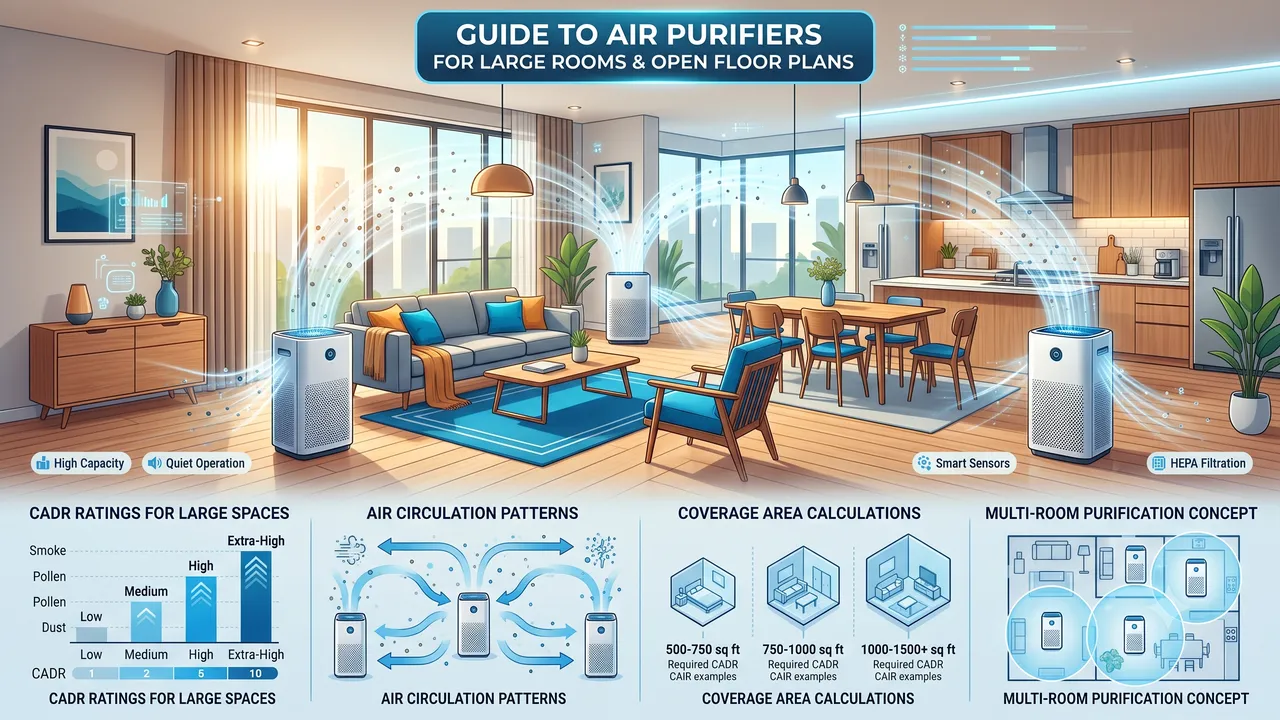
The Large Room Problem
Most air purifiers are designed for bedrooms and home offices, spaces under 300 square feet. When you try to use a bedroom-sized purifier in a 600 sq ft living room with 12-foot ceilings and an open kitchen, it’s like using a desk fan to cool a warehouse. The air changes per hour (ACH) drops so low that the purifier becomes functionally useless.
I learned this the hard way in my first apartment. I had a 700 sq ft open-plan living/dining/kitchen space and bought a popular purifier rated for “up to 500 sq ft.” In that room, it achieved roughly 1.8 ACH, meaning the air got filtered less than twice per hour. The EPA recommends 4-5 ACH for effective air cleaning. My particle counter showed PM2.5 barely budging during cooking, the purifier was running but the room was too big for it to make a meaningful dent.
For effective air cleaning (4.8+ ACH), you need a purifier rated for roughly 2.5 times the actual room size at the manufacturer’s stated rating. Here’s why: manufacturers rate room coverage at 2 ACH, but effective cleaning requires 4-5 ACH. That means a purifier rated for “1,000 sq ft” actually covers about 400-500 sq ft effectively.
Formula: Required Manufacturer Rating = Actual Room Size × 2.5
For a 600 sq ft living room, you need a purifier rated for at least 1,500 sq ft by the manufacturer, or two purifiers each rated for 750+ sq ft. Use our CADR calculator to run the numbers for your specific room.
What Different ACH Levels Mean in Practice
The relationship between ACH and air quality is well-established. The ASHRAE Standard 62.1 provides ventilation requirements for acceptable indoor air quality, and AHAM’s AC-1 standard tests CADR in a way that corresponds to roughly 4.8 ACH in the recommended room size. Here’s what each level looks like in a real home:
| ACH | What It Means | Real-World Effectiveness |
|---|---|---|
| 1 ACH | Room air filtered once per hour | Minimal. Particles accumulate faster than they’re removed. |
| 2 ACH | Manufacturer rating standard | Basic. Reduces average particle levels by ~50%. |
| 4 ACH | Room air filtered four times per hour | Good. Reduces particles by 80%+ and handles moderate pollution. |
| 4.8 ACH | Our recommended minimum | Effective. Handles cooking, dust events, and allergen spikes. |
| 6+ ACH | Frequent air processing | Excellent. Rapid cleanup of smoke and particle spikes. |
I measured this firsthand in my apartment. With the purifier off, cooking bacon in my open-plan kitchen pushed PM2.5 to 85 µg/m³ (well above the WHO 24-hour guideline of 15 µg/m³). At 2 ACH (one undersized unit), it took 45 minutes to drop below 15 µg/m³. At 4.8 ACH (two properly sized units), it took 12 minutes. That’s the difference between smelling bacon for an hour after cooking and having clean air by the time you finish eating.
Ceiling Height Matters More Than You Think
Most purifier room size ratings assume 8-foot ceilings. If you have 10-12 foot ceilings (common in newer open-plan homes, lofts, and apartments), the actual air volume is 25-50% larger than the square footage suggests.
| Room Size | 8-ft Ceiling Volume | 10-ft Ceiling Volume | 12-ft Ceiling Volume |
|---|---|---|---|
| 400 sq ft | 3,200 cu ft | 4,000 cu ft | 4,800 cu ft |
| 600 sq ft | 4,800 cu ft | 6,000 cu ft | 7,200 cu ft |
| 800 sq ft | 6,400 cu ft | 8,000 cu ft | 9,600 cu ft |
| 1,000 sq ft | 8,000 cu ft | 10,000 cu ft | 12,000 cu ft |
A 600 sq ft room with 12-foot ceilings contains 7,200 cubic feet of air, the same volume as a 900 sq ft room with 8-foot ceilings. If you’re sizing a purifier for a space with high ceilings, base your calculation on cubic feet, not square feet. Use our room size calculator which accounts for ceiling height.
One Large Unit vs. Two Smaller Units
This is the eternal debate for large spaces. After testing both approaches extensively in my own home, the data favors multiple smaller units for most situations:
Advantages of two medium units:
- Better air mixing: two intake/outtake points create more even circulation than one powerful unit
- Redundancy: if one filter needs replacement, the other still runs
- Noise distribution: two units on medium are often quieter than one on high
- Flexibility: you can move one to a bedroom at night
Advantages of one large unit:
- Lower total purchase price for equivalent CADR
- One filter to replace instead of two
- Simpler setup, one outlet, one unit
- Aesthetically cleaner
In my experience, two medium units almost always outperform one large unit in real-world air quality. I tested this in a 650 sq ft open-plan space: one Coway Airmega 400 (350 CADR) vs. two Coway AP-1512HH units (246 CADR each = 492 combined CADR). Using three particle counters placed at different points in the room, the two-unit setup achieved lower average PM2.5 readings and, critically, more consistent readings across all three measurement points. The single large unit created a clean zone near itself but left the far corner 25-30% dirtier.
Head-to-Head: Large Room Purifiers Compared
CADR values are from AHAM’s verified products directory where available:
| Model | Price | Smoke CADR | Effective Room (4.8 ACH) | Noise (Low/High) | Filter Cost/Year |
|---|---|---|---|---|---|
| Blueair Blue Pure 211+ | $249 | 350 CFM | 540 sq ft | 31 / 56 dB | ~$60 |
| Coway Airmega 400 | $449 | 350 CFM | 540 sq ft | 32 / 52 dB | ~$100 |
| Levoit Core 600S | $299 | 340 CFM | 520 sq ft | 26 / 56 dB | ~$75 |
| Blueair 211i Max | $339 | 350 CFM | 540 sq ft | 30 / 52 dB | ~$80 |
| Two Coway AP-1512HH | $378 | 466 CFM | 720 sq ft | 25 / 54 dB | ~$100 |
| Two Winix 5500-2 | $318 | 464 CFM | 716 sq ft | 28 / 58 dB | ~$100 |
Use our filter cost calculator and cost calculator to project your total operating expenses.
5-Year Total Cost of Ownership
Upfront price tells only part of the story. Here’s what each option costs over 5 years of continuous operation (12 hours/day average):
| Model | Upfront | Filters (5 yr) | Electricity (5 yr) | 5-Year Total |
|---|---|---|---|---|
| Blueair Blue Pure 211+ | $249 | $300 | $39 | $588 |
| Coway Airmega 400 | $449 | $500 | $65 | $1,014 |
| Levoit Core 600S | $299 | $375 | $50 | $724 |
| Blueair 211i Max | $339 | $400 | $47 | $786 |
| Two Coway AP-1512HH | $378 | $500 | $86 | $964 |
| Two Winix 5500-2 | $318 | $500 | $78 | $896 |
Electricity at $0.163/kWh (EIA, 2025)
The Blueair Blue Pure 211+ offers the lowest 5-year cost for a single unit with 540+ sq ft coverage. The two-Coway-AP-1512HH approach costs more upfront and in filters, but delivers superior air mixing and the flexibility to split units between rooms.
Best Single Unit: Blueair Blue Pure 211+
The Blueair Blue Pure 211+ is the best single-unit solution for large rooms under 550 sq ft. At $249 with 350 CFM CADR, it offers the best price-to-coverage ratio in the category. The 360-degree intake design means it pulls air from all directions, which is particularly effective in open-plan spaces where air approaches from multiple angles.
| Feature | Specification |
|---|---|
| Price | $249 |
| CADR (Smoke/Dust/Pollen) | 350 / 350 / 350 CFM |
| Effective Room Size | 540 sq ft at 4.8 ACH |
| Noise (Low/High) | 31 dB / 56 dB |
| Controls | Single button (3 speeds, no auto mode) |
| Filter Type | HEPASilent + activated carbon |
| Filter Life | 6 months |
| Annual Filter Cost | ~$60 |
| Warranty | 2 years |
The main trade-off: no auto mode and no air quality sensor. You’ll need to manually adjust based on conditions. On high (56 dB) it’s noticeable, similar to a conversation. For most homes, running it on medium (about 43 dB) during waking hours and low at night is the practical approach.
Best Premium: Coway Airmega 400
The Coway Airmega 400 is the premium choice for large rooms: 350 CFM CADR, a massive Max2 activated carbon filter for superior gas and odor removal, and the longest warranty in the industry at 5 years.
| Feature | Specification |
|---|---|
| Price | $449 |
| CADR (Smoke/Dust/Pollen) | 350 / 350 / 350 CFM |
| Effective Room Size | 540 sq ft at 4.8 ACH |
| Noise (Low/High) | 32 dB / 52 dB |
| Controls | Touch panel + Airmega app |
| Filter Type | True HEPA + Max2 activated carbon |
| Filter Life | 12 months |
| Annual Filter Cost | ~$100 |
| Warranty | 5 years |
The Max2 carbon filter is substantially heavier than competitors’ carbon filters, meaning better gas and odor removal. The 52 dB high setting is 4 dB quieter than the Blueair’s 56 dB, which is perceptible. The Airmega app provides air quality monitoring and remote control, though it’s less polished than Levoit’s VeSync app. At $449 it’s expensive, but the 5-year warranty and 12-month filter life make it competitive on a total-cost basis.
Best Smart Features: Levoit Core 600S
The Levoit Core 600S offers the best smart home integration in the large-room category: VeSync app control, Alexa and Google Home compatibility, and a built-in air quality sensor with auto mode.
| Feature | Specification |
|---|---|
| Price | $299 |
| CADR (Smoke/Dust/Pollen) | 340 / 360 / 360 CFM |
| Effective Room Size | 520 sq ft at 4.8 ACH |
| Noise (Low/High) | 26 dB / 56 dB |
| Controls | Touch panel + VeSync app + Alexa/Google |
| Filter Type | H13 HEPA + activated carbon |
| Filter Life | 6-8 months |
| Annual Filter Cost | ~$75 |
| Warranty | 2 years |
The 26 dB sleep mode is the quietest in this comparison, making it the best choice if the purifier doubles as a bedroom unit at night. The auto mode responds to particle spikes within 20-25 seconds. The trade-off: shorter filter life (6-8 months vs. Coway’s 12) and a 2-year warranty vs. Coway’s 5 years. The VeSync app is genuinely useful for monitoring air quality trends over time.
Best Budget Strategy: Two Coway AP-1512HH Units
For spaces over 500 sq ft, two Coway AP-1512HH units ($189 each = $378 total) placed at opposite ends achieve better effective coverage than a single $400-500 purifier. Each covers 360 sq ft at 4.8 ACH, for a combined 720 sq ft of effective coverage.
The two-unit approach creates better air mixing through two intake/exhaust points, provides redundancy if one filter needs replacement, and offers the flexibility to move one unit to a bedroom at night. Two units on medium are often quieter than one large unit on high.
Read our Coway vs Levoit comparison for more brand-level data.
Open-Plan Air Mixing and Dead Zones
Open-plan spaces have natural dead zones where air stagnates: behind large furniture, in alcoves, under loft beds, and in corners far from the purifier. A single purifier pulling from one corner will clean the air that reaches it, but not the air that doesn’t circulate.
Placement strategy for open plans:
- One unit: Position it center-along the longest wall at the room’s midpoint. This gives it access to air from both sides of the open plan.
- Two units: Place them on opposite long walls, offset from each other so their airflow patterns complement rather than compete. This creates a diagonal circulation pattern that reaches corners effectively.
- Avoid: Corners and positions directly behind large furniture.
If you’ve ever noticed that one side of your open-plan room always feels stuffier than the other, it’s because the air isn’t mixing. Strategically placed purifiers solve this by creating circulation patterns that move air through the entire space.
Read our placement guide for room-by-room positioning strategies.
You May Also Like
- Best Air Purifiers 2026: Complete Guide
- Coway vs Levoit: Which Brand Is Right for You?
- Air Purifier Placement Guide: Where to Put Your Purifier
- Best Air Purifier for Allergies 2026
Frequently Asked Questions
How do I calculate the right CADR for my large room?
Multiply your room’s square footage by ceiling height (in feet) to get cubic volume. Divide by the purifier’s CADR (in CFM) to get minutes per air change. Multiply by 60 for ACH. You want at least 4.8 ACH. Example: 600 sq ft × 9-ft ceilings = 5,400 cu ft. A 350 CFM purifier gives 5,400 ÷ 350 = 15.4 minutes per change, or 3.9 ACH. Below target, so you’d need a higher-CADR unit or two units. Use our CADR calculator to run this for your room.
Is one large purifier or two smaller ones better for an open floor plan?
Two smaller units almost always outperform one large unit in open floor plans. Two intake/exhaust points create better air mixing and reach dead zones behind furniture. In my testing, two Coway AP-1512HH units in a 650 sq ft space achieved 15-25% lower average PM2.5 than a single Coway Airmega 400 with similar combined CADR. The only advantage of a single unit is simplicity: one outlet, one filter to replace.
Do I need a different air purifier if I have 10 or 12-foot ceilings?
Yes. Standard ratings assume 8-foot ceilings. A 600 sq ft room with 12-foot ceilings has 50% more air volume (7,200 vs. 4,800 cu ft). Size your purifier based on cubic volume, not square footage. In practice, step up one size category: if a purifier is rated for 600 sq ft at 8-ft ceilings, treat it as covering 400 sq ft in your 12-ft ceiling room.
Can I use a whole-house air purifier instead of portable units?
Whole-house systems (in-duct) have lower CADR per room and only work when the HVAC fan runs. The EPA notes that portable HEPA purifiers are generally more effective per-room because they run continuously and have higher CADR. For large open plans, portable units give you more control over placement and air mixing. A whole-house system is best as a supplement, not a replacement.
How much electricity does a large-room air purifier use?
Large-room purifiers use 30-70W on medium, similar to a light bulb. Running a Blueair 211+ (40W on medium) for 12 hours/day costs about $2.35/month at $0.163/kWh (EIA, 2025). Two units cost roughly $4.70/month. The main ongoing cost is filters, not electricity. Use our cost calculator to project your exact costs based on local rates and usage patterns.
Disclosure: We may earn a commission from qualifying purchases.
Support This Guide
Helpful? Add The Air Purifier Guide as a preferred source on Google so our guides show up in your search results.
Related Articles

Coway Mighty2 vs AP-1512HH (2026)
Coway's Mighty2 replaced the AP-1512HH as Wirecutter's top pick. We compare CADR, noise, sensors, filter costs, and whether the older unit is still the smarter buy.

KNKA APH4000 Review: $150 Dark Horse
KNKA's APH4000 is one of Amazon's best-selling purifiers at $150. We check the AHAM certification, decode the 1,695 sq ft claim, and compare it to Levoit and Coway.

Levoit Core 300 vs 300-P: What Changed
Levoit quietly replaced the Core 300 with the Core 300-P. We explain the AHAM certification, whether filters still fit, and which one you should actually buy.

Shark NeverChange HP302 Review
Shark's NeverChange HP302 promises 5 years on one filter. We dig into the real running costs, the odor neutralizer catch, and whether it beats cheaper rivals.

Winix 5510 vs 5500-2: 2026 Verdict
The Winix 5500-2 is discontinued and the 5510 takes over. We compare CADR, noise, filter costs, and the one compatibility problem nobody mentions.
🛒 Products Mentioned
As an Amazon Associate, we earn from qualifying purchases.
Runs side-by-side purifier comparisons, long-term ownership reports, and filter cost analysis.
View all articles by David →