The Short Answer: Open offices concentrate people, equipment, and airborne irritants in shared air. One personal purifier at your desk can make a measurable difference in your immediate breathing…
Editor’s note (September 2026): The Winix 5500-2 has been discontinued and remaining stock is limited. Winix’s official successor is the Winix 5510, which adds app control and uses a new filter. Read our Winix 5510 vs 5500-2 comparison before you buy either one.
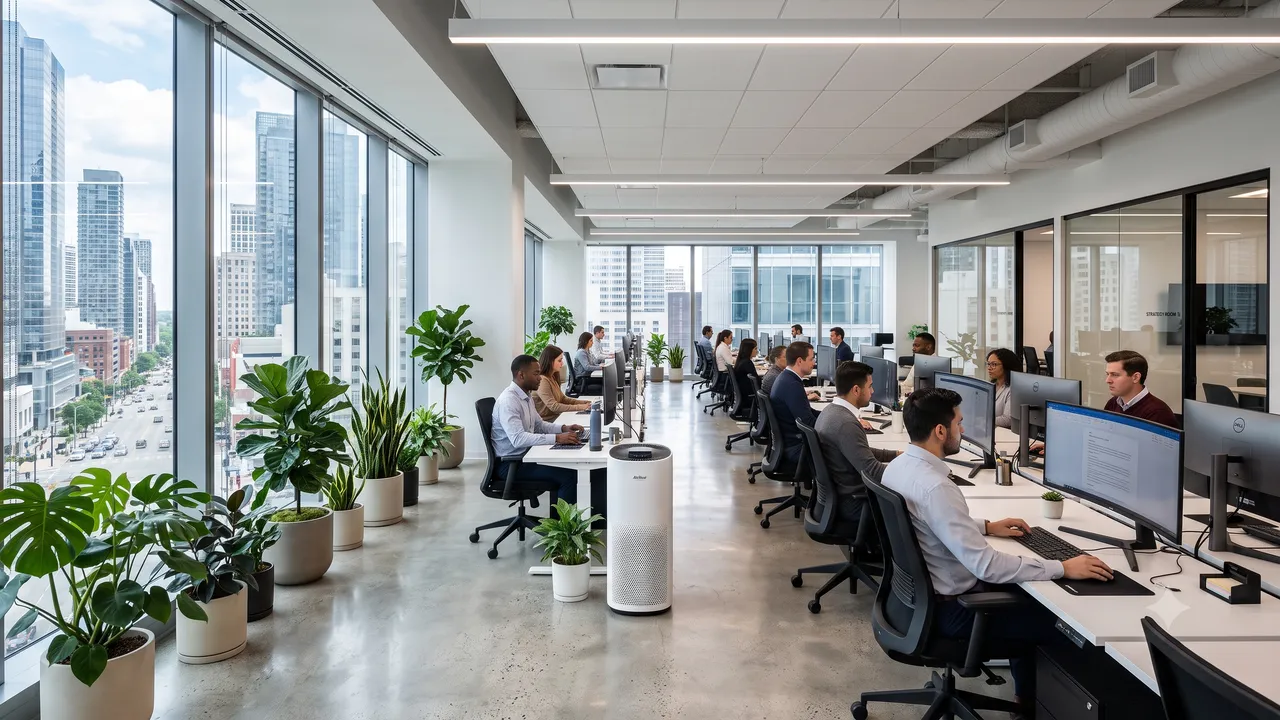
Open-plan offices concentrate multiple air quality challenges in one shared space: high occupant density drives CO2 buildup, office equipment emits toner and ultrafine particles, and furniture and carpet off-gas VOCs long after installation. If you’ve ever felt foggy-headed by 3 PM in an open office, air quality may be a contributing factor, a 2015 Harvard study found that CO2 levels above 1,000 ppm (common in meeting rooms) reduced cognitive function scores by 15-50%.
The problem isn’t just comfort. Poor office air quality correlates with increased sick days, reduced productivity, and higher rates of respiratory complaints. A landmark study published in Environmental Health Perspectives estimated that improving indoor air quality in offices could save $30 billion annually in lost productivity across the U.S. alone. Whether you’re an employee looking to protect your personal breathing zone or a facilities manager evaluating building-wide solutions, this guide covers everything you need to know about air purifiers for open-plan offices.
Why Open Offices Are Particularly Challenging
Most office HVAC systems are designed for thermal comfort, not air quality. They recirculate a high percentage of indoor air (to save energy) and use MERV 8 filters that capture only large particles. CO2, fine particles, and VOCs accumulate over the workday with no effective removal. You can’t open windows in most commercial buildings, and you have limited control over your immediate environment.
The open-plan layout compounds the problem. With dozens of people sharing one air volume, you’re breathing in everyone’s exhaled breath, personal care product fumes, and the byproducts of communal equipment. Laser printers and copiers emit ultrafine particles (UFPs) smaller than 0.1 microns, particles that MERV 8 filters pass right through. These UFPs penetrate deep into the lungs and enter the bloodstream, which is why printer proximity has been linked to respiratory irritation in multiple occupational health studies.
Carpet, particleboard desks, acoustic panels, and even the adhesive in ceiling tiles continuously off-gas volatile organic compounds (VOCs) including formaldehyde, benzene, and toluene. New or recently renovated offices can have VOC levels several times higher than older buildings. Combined with the fact that most commercial buildings maintain 20-30% outdoor air intake (barely above the minimum code requirement), indoor pollutant concentrations can reach levels that would trigger alerts if they occurred outdoors.
Temperature stratification is another hidden issue. In open offices with high ceilings, warm air rises and creates layers of uneven air quality. Workers near the floor may breathe different air than those on a mezzanine. And since most commercial HVAC supply vents are in the ceiling, the fresh conditioned air doesn’t always reach the breathing zone of seated occupants before being pulled back to the return duct.
Office Air Quality Standards: ASHRAE and EPA Guidelines
Understanding the standards that govern office air quality helps you advocate for better conditions, and choose the right purifier.
ASHRAE Standard 62.1 (Ventilation for Acceptable Indoor Air Quality) is the benchmark for commercial buildings. It specifies minimum ventilation rates based on occupant density and floor area. For typical office space, ASHRAE requires 17 CFM (cubic feet per minute) of outdoor air per person plus 0.06 CFM per square foot of floor area. However, “acceptable” is a low bar, it’s defined as air that 80% of occupants find non-complaint-inducing, which still allows significant pollutant presence.
ASHRAE Standard 52.2 defines filter efficiency ratings via the MERV scale. Most offices use MERV 8 filters, which capture 70-85% of particles 3-10 microns but less than 20% of particles in the 0.3-1 micron range (the most respirable fraction). Upgrading to MERV 13 filters, which capture 90% of particles 1-3 microns, is one of the most cost-effective improvements a building can make, though many HVAC systems lack the fan power to handle the increased resistance.
The EPA identifies indoor air quality as one of the top five environmental risks to public health. Their guidance recommends maintaining CO2 levels below 1,000 ppm (roughly 600 ppm above outdoor baseline) and ensuring adequate air exchange. The EPA does not set enforceable indoor air standards for offices the way it does for outdoor air under the Clean Air Act, which means office air quality is largely unregulated, and largely in the hands of building operators.
OSHA provides Permissible Exposure Limits (PELs) for specific workplace chemicals, but these are set for industrial settings and are far less protective than what most people would consider acceptable for a modern office. For example, OSHA’s PEL for formaldehyde is 0.75 ppm over an 8-hour TWA, a level well above what causes irritation and health concerns for sensitive individuals.
The practical takeaway: you cannot rely on codes and standards alone to ensure healthy air at your desk. Supplemental air purification, whether personal or building-wide, is the most direct way to improve what you breathe in an open office.
Best Air Purifiers for Open Plan Offices
Choosing the right purifier for an office environment means balancing filtration performance, noise, size, and aesthetics. Here are five top options across different use cases:
| Purifier | CADR | Room Size | Noise (Low) | Best For | Price |
|---|---|---|---|---|---|
| Coway AP-1512HH | 246/240/233 (smoke/dust/pollen) | Up to 361 sq ft | 25 dB | Shared office zones, break rooms | $189 |
| Winix 5500-2 | 243/246/232 | Up to 360 sq ft | 27.8 dB | Cost-effective open-plan coverage | $159 |
| Blueair 211i Max | 350/350/350 | Up to 522 sq ft | 32 dB | Large open offices, lobby areas | $339 |
| Levoit Core Mini | 30 | Up to 50 sq ft | 25 dB | Personal desktop use | $49 |
| Coway Airmega 400 | 350/350/350 | Up to 1,560 sq ft | 22 dB | Whole-floor open plan coverage | $499 |
The Coway AP-1512HH remains our top recommendation for most open-office scenarios. Its three-stage filtration (pre-filter, activated carbon, True HEPA) handles particles, odors, and VOCs effectively. The auto mode adjusts fan speed based on real-time particulate sensing, so it runs quietly when air is clean and ramps up during peak activity, useful in offices where traffic patterns create pollution spikes throughout the day.
For personal desktop use, the Levoit Core Mini is hard to beat. At $49, USB-powered, and 25 dB on low, it creates a clean air bubble around your immediate workspace without drawing attention or requiring a dedicated outlet. If you sit near a printer or in a high-traffic area, this small investment pays for itself in reduced irritation.
If you’re a facilities manager deploying multiple units across a floor, the Coway Airmega 400 offers the best CADR-per-dollar for large coverage areas. Placing one unit per 600-900 sq ft of open space provides meaningful air cleaning. Pair it with a purifier placement strategy to maximize effectiveness.
Personal Desktop Purifiers: Your Breathing Zone Solution
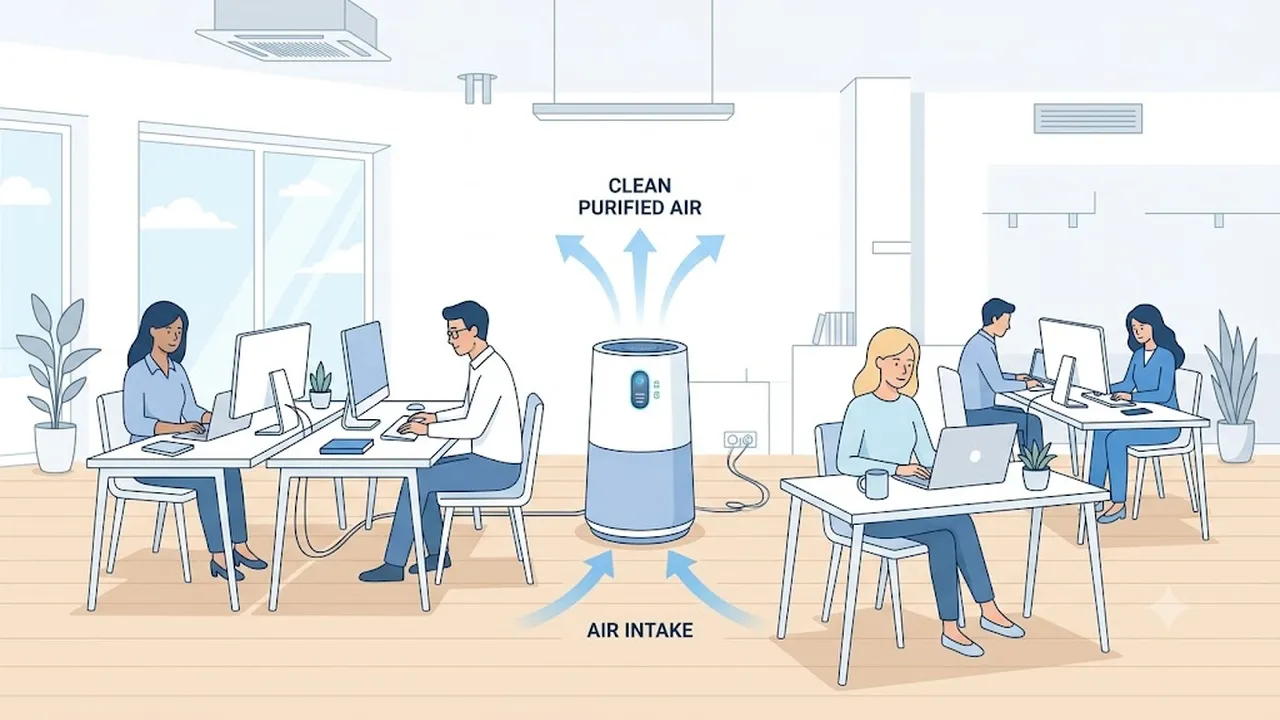
A small desktop purifier creates a 30-50 cubic foot clean air bubble around your workstation, your personal breathing zone. While it won’t clean the entire office, it ensures the air you’re actually inhaling at your desk is filtered.
Levoit Core Mini ($49): The best office option. USB-powered (no need to hunt for an outlet), 25 dB on low (quieter than typical office HVAC hum), and genuinely effective for the 50 sq ft personal zone. Small enough to sit behind a monitor. The white noise from the fan at low speed can actually help mask distracting office conversations.
For a private office up to 150 sq ft with a door you can close, step up to the Levoit Core 300 ($89) or Blueair 411i Max ($140) for room-level filtration. Both offer True HEPA filtration with quiet operation modes suitable for phone calls and focused work. The Levoit Core 300’s sleep mode drops to 24 dB, effectively silent in a typical office environment, while still moving enough air to cycle the room’s volume multiple times per hour.
Position your desktop purifier to your side rather than directly in front of or behind you. Air flows best when it can reach your breathing zone from a perpendicular angle. Avoid placing it behind your monitor where warm exhaust air from the monitor’s vents could create unpredictable airflow patterns. For more detailed guidance, see our air purifier placement guide.
How Air Quality Affects Office Productivity
The link between air quality and cognitive performance is one of the strongest findings in environmental health research. Beyond the Harvard CO2 study mentioned above, research from the Lawrence Berkeley National Laboratory found that workers in well-ventilated offices with low VOC levels scored 61% higher on cognitive function tests compared to those in conventional offices.
Even modest improvements matter. A 2021 study in Indoor Air found that reducing PM2.5 concentrations by just 10 µg/m³ in office environments improved typing speed by 2.5% and reduced error rates by 4%. Extrapolated across a workforce, that productivity gain far exceeds the cost of air purification equipment. If you’re interested in monitoring your office’s actual air quality, our guide on how to read air quality index (AQI) explains what the numbers mean.
Sick building syndrome, a cluster of symptoms including headaches, fatigue, and respiratory irritation that improve when leaving the building, affects an estimated 30% of office workers according to the World Health Organization. While air purifiers alone don’t solve every contributing factor (humidity, lighting, ergonomics all play a role), addressing particulate and VOC levels is one of the highest-impact interventions available.
How Many Purifiers Do You Need? (Calculation Guide)
Sizing air purifiers for an office space involves more than matching the manufacturer’s stated room coverage. Here’s a practical calculation:
Step 1: Calculate room volume. Multiply the floor area (sq ft) by the ceiling height (ft). A 2,000 sq ft office with 9-ft ceilings has 18,000 cubic feet of air volume.
Step 2: Determine target ACH. For an occupied office, aim for 4-6 Air Changes per Hour (ACH) of filtered air. Five ACH is a good target for offices with moderate pollution sources.
Step 3: Calculate required CADR. Required CADR (in CFM) = (Room volume × Target ACH) / 60. For our 18,000 cubic foot office at 5 ACH: (18,000 × 5) / 60 = 1,500 CFM total CADR needed.
Step 4: Select units. A Coway Airmega 400 delivers about 350 CFM. You’d need roughly 4-5 units distributed across the space to reach the target CADR. Alternatively, six Coway AP-1512HH units (each ~240 CFM) would provide 1,440 CFM total, close enough with favorable placement.
Key principles for multi-unit deployment:
- Distribute, don’t centralize. Three units spread across a floor outperform one unit with triple the CADR, because distributed units create better air mixing and shorter particle travel distances.
- Account for pollution sources. Place extra capacity near printers, kitchens, and high-traffic entrances. A strategic placement approach significantly improves effectiveness.
- Consider your air purifier’s energy cost. Multiple units running 24/7 add up, choose Energy Star-rated models and use auto modes to reduce runtime when air quality is good.
For personal desktop purifiers, sizing is simpler. Any unit that can cycle the 30-50 cubic feet of your immediate breathing zone 6+ times per hour is sufficient. The Levoit Core Mini handles this easily.
Noise Considerations for Shared Workspaces
In an open-plan office, every sound source is a potential distraction for dozens of people. Air purifier noise requires careful consideration in this context.
Understanding decibel levels in an office context:
- 20-25 dB: Whisper-quiet. Comparable to a quiet library. Barely perceptible in a typical office.
- 30-35 dB: Similar to normal office HVAC background noise. Most people won’t notice this level.
- 40-45 dB: Noticeable hum. May bother colleagues in adjacent cubicles during quiet tasks.
- 50+ dB: Conversation-level noise. Too loud for a shared office environment.
Most quality air purifiers offer a low-speed mode in the 25-30 dB range, perfectly acceptable for office use. The noise characteristics vary significantly between technologies, with HEPA units generally quieter than ionizer or UV-based systems on equivalent settings.
Practical noise management tips:
- Run the purifier on low or auto mode during business hours. Auto mode is ideal, it keeps the fan at minimum speed when air is clean and only ramps up when sensors detect pollution spikes (e.g., after someone uses the printer).
- Avoid turbo/high modes in shared spaces. The performance gain rarely justifies the noise disruption in an office with moderate air quality.
- Test during a trial period. If your office allows a one-week trial, gauge colleague reactions before committing. Most people adjust to consistent low-level white noise quickly.
- Frequency matters more than volume. Purifiers with DC motors tend to produce a more consistent, less annoying sound profile than AC-motor units that can create pulsating or cycling noise.
- Consider the tonal quality of the noise. Some purifiers produce a smooth broadband white noise that many workers find helpful for focus, masking conversations and keyboard sounds. Others produce a higher-pitched whine that can be irritating. Read reviews and, if possible, test in-store before purchasing.
The white noise effect is a genuine benefit in open offices. Several studies have shown that consistent low-level background sound (around 40-50 dB of broadband noise) improves concentration in open-plan environments by masking speech, the single most distracting sound source in offices. A purifier running on low can provide this masking effect while simultaneously cleaning the air.
Office Etiquette
- Verify the purifier is allowed. Some offices prohibit personal appliances for fire safety or energy policy reasons. Check with facilities management before purchasing. Frame it as a health and productivity investment, citing the studies mentioned above can help your case.
- Position the output away from papers. Fan output can blow documents off your desk. Angle toward a wall or upward.
- Use low or auto speed. Medium and high speeds may disturb nearby colleagues.
- Maintain your unit. A purifier with a clogged filter not only stops working effectively but can become noisier and may circulate captured pollutants. Set calendar reminders for filter replacement based on the manufacturer’s schedule, typically every 6-12 months in office environments.
- Offer to share data. Some purifiers’ app-connected air quality readings can demonstrate the need for better office-wide air quality management. Showing your PM2.5 readings during peak afternoon hours can be a powerful advocacy tool.
- Clean the pre-filter monthly. Office environments are dustier than you’d think, especially with carpet and paper. A quick pre-filter cleaning every few weeks keeps performance optimal.
For Employers: Office-Wide Solutions
If you’re an employer or facilities manager considering office-wide purification, the investment case is strong. At an average fully-loaded cost of $50-75 per employee per hour, even a 2% productivity improvement from better air quality generates substantial returns.
Recommended multi-unit strategies:
- Coway Airmega 400: One unit per 600-900 sq ft of open space. Excellent CADR per dollar for commercial deployment. The auto mode reduces energy costs and filter wear during low-occupancy periods.
- Multiple distributed Blueair units: Provide more even air mixing than a single large unit. Three Blueair 211i Max units spread across a 1,500 sq ft office are more effective than one purifier with triple the CADR centralized in one spot.
- Layered approach: Combine building-level HVAC upgrades (MERV 13 filters if the system can handle it) with distributed room-level purifiers and optional personal desktop units for employees who want extra protection. This defense-in-depth strategy addresses the broadest range of particle sizes.
For school or classroom settings with similar high-density challenges, see our classroom air purifier guide.
Budget for ongoing filter replacement costs, typically $30-60 per unit every 6-12 months. Some commercial units offer subscription filter programs that reduce per-unit costs. Check warranty terms carefully, as commercial use sometimes voids residential warranties.
Office Politics and the Shared Purifier
Introducing a purifier to an open-plan office involves navigating co-worker preferences. Some people love the white noise; others find any mechanical sound distracting. Some want the purifier right next to their desk; others worry about drafts. The purifier becomes an office politics object.
The diplomatic approach: position the unit in a neutral zone, near the kitchen or copy area, not directly adjacent to anyone’s primary workspace. Let it run on medium during business hours and auto overnight. If someone complains about noise, offer to move it further from their desk rather than turning it down. A purifier turned too low to be audible is a purifier not meaningfully cleaning the air.
If you’re the one bringing a personal purifier to your desk, frame it proactively: “I’ve been having allergy issues and got this for my desk, it’s quieter than my computer fan.” Most colleagues won’t give it a second thought, and some will ask where to get one for themselves.
For common air quality myths and misconceptions that may come up in office discussions, see our guide on air purifier myths debunked.
FAQ
Can an air purifier reduce the spread of illness in an open office? Yes, to a meaningful degree. HEPA air purifiers capture airborne respiratory droplets and aerosols that carry viruses and bacteria. A purifier with a True HEPA filter running near your desk continuously filters the air in your breathing zone, reducing your exposure to pathogens exhaled by nearby colleagues. During flu season or a respiratory illness outbreak, running your purifier on a higher setting increases the number of air changes and particle capture. However, air purifiers are a supplement to, not a substitute for, other measures like vaccination, hand hygiene, and staying home when sick.
Will my employer pay for an air purifier for my desk? Many employers will, especially if you frame it as a health accommodation. Start by asking your HR or facilities team, citing your specific symptoms (allergies, headaches, dry eyes) and the published research linking air quality to productivity. Some employees have successfully claimed personal air purifiers through workplace wellness programs or ergonomic/health accommodation budgets. At $49-89 for a desktop unit, it’s a minimal investment that many companies will approve without hesitation.
Do office air purifiers help with allergies? Absolutely. Open offices with carpet, fabric partitions, and shared HVAC systems harbor dust mites, mold spores, pet dander (brought in on clothing), and pollen (through ventilation intakes and open doors). A True HEPA purifier captures 99.97% of particles 0.3 microns and larger, which includes all major allergen particles. Place the purifier on your desk and run it consistently for the best results, see our detailed allergy season air purifier guide for more.
How often should I replace the filter in an office air purifier? In a typical office environment, replace the HEPA filter every 8-12 months and the activated carbon filter every 3-6 months, depending on VOC levels and odor concerns. The pre-filter should be vacuumed or washed every 2-4 weeks. Office air often contains more fine dust (from paper handling, toner, and carpet) than residential air, so filters may clog faster. Monitor your purifier’s filter indicator light, and check our filter replacement cost guide for budgeting.
Can I use an air purifier instead of opening windows in my office? In most commercial buildings, opening windows isn’t an option, they’re sealed by design. Even where operable windows exist, outdoor air quality may be worse than indoor (near highways, in urban areas, or during wildfire season). An air purifier handles particles, VOCs, and odors that open windows cannot address reliably. For a detailed comparison, see our article on air purifiers vs. opening windows.
See also: DIY Ways to Improve Indoor Air Quality, How to Read Air Quality Index (AQI), Air Purifier vs Opening Windows for Ventilation, Air Purifier Placement Guide, Air Purifier Energy Cost Guide.
Disclosure: This article contains affiliate links. If you purchase a product through one of our links, we may earn a commission at no additional cost to you. We only recommend products we have thoroughly evaluated and believe provide genuine value. Our recommendations are based on independent research, published studies, and independent analysis, affiliate relationships do not influence our editorial opinions. See our full disclosure policy for details.
You May Also Like
Support This Guide
Helpful? Add The Air Purifier Guide as a preferred source on Google so our guides show up in your search results.
Related Articles

Coway Mighty2 vs AP-1512HH (2026)
Coway's Mighty2 replaced the AP-1512HH as Wirecutter's top pick. We compare CADR, noise, sensors, filter costs, and whether the older unit is still the smarter buy.

KNKA APH4000 Review: $150 Dark Horse
KNKA's APH4000 is one of Amazon's best-selling purifiers at $150. We check the AHAM certification, decode the 1,695 sq ft claim, and compare it to Levoit and Coway.

Levoit Core 300 vs 300-P: What Changed
Levoit quietly replaced the Core 300 with the Core 300-P. We explain the AHAM certification, whether filters still fit, and which one you should actually buy.

Shark NeverChange HP302 Review
Shark's NeverChange HP302 promises 5 years on one filter. We dig into the real running costs, the odor neutralizer catch, and whether it beats cheaper rivals.

Winix 5510 vs 5500-2: 2026 Verdict
The Winix 5500-2 is discontinued and the 5510 takes over. We compare CADR, noise, filter costs, and the one compatibility problem nobody mentions.
🛒 Products Mentioned
As an Amazon Associate, we earn from qualifying purchases.
Covers indoor air quality science, respiratory health, allergy management, and wildfire smoke protection.
View all articles by Sarah →