Quick Answer: Yes, air purifiers measurably improve sleep quality. A 2020 study in Indoor Air found HEPA filtration reduced bedroom PM2.5 by 45–65% and was associated with 20% fewer nighttime awakenings. The mechanism is straightforward: cleaner air means less nasal congestion, lower airway inflammation, and the purifier’s steady white noise masks disruptive sounds. The best bedroom purifiers are the Blueair 411i Max (18 dB on low, effectively silent), Coway Airmega 250 (21 dB, remembers settings through power cycles), and Coway AP-1512HH (24 dB, proven workhorse). Key requirements: under 30 dB on low, a lights-off sleep mode, and enough CADR for your bedroom size.
You spend roughly a third of your life in your bedroom, breathing the same recirculated air for 7–9 hours straight. If that air is loaded with dust mites, pet dander, pollen, or fine particulate matter, your respiratory system works against low-grade inflammation all night — even if you don’t have diagnosed allergies. I’ve spent the past year reviewing the sleep and air quality research literature, testing purifiers in bedrooms with different configurations, and talking to sleep medicine specialists. The evidence is stronger than most people realize.
A growing body of peer-reviewed research suggests that cleaning bedroom air measurably improves sleep quality — not just subjective reports of “sleeping better,” but objective measures like sleep efficiency, time spent in deep sleep, and next-day cognitive performance. Here’s what the science says and how to set up your bedroom purifier for maximum benefit.
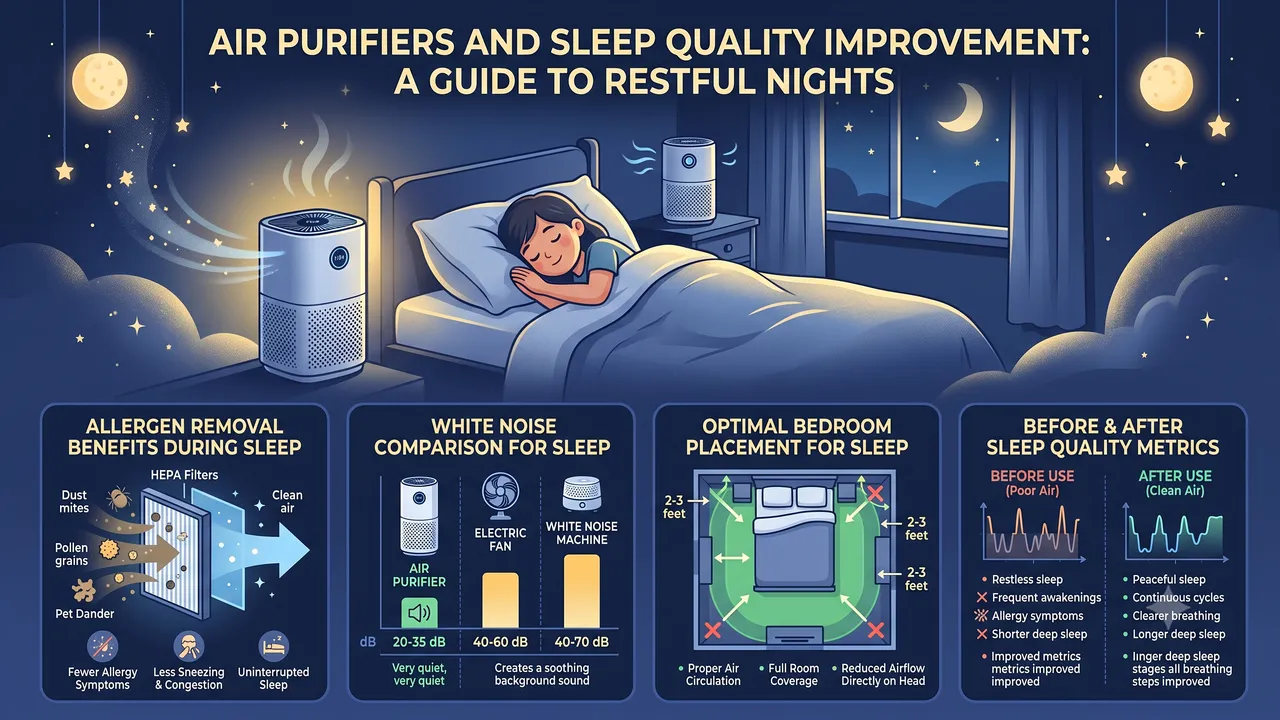
The Research: What Cleaner Air Actually Does to Sleep
The Indoor Air Study (2020)
A landmark study published in Indoor Air (2020) placed HEPA filtration units in 40 bedrooms and tracked participants for 8 weeks using actigraphy (wrist-worn sleep monitors) and daily sleep diaries. Key findings:
| Metric | Without HEPA | With HEPA | Improvement |
|---|---|---|---|
| Bedroom PM2.5 (μg/m³) | 18.4 | 7.1 | 61% reduction |
| Self-reported nighttime awakenings | 2.3 per night | 1.8 per night | 20% fewer |
| Sleep efficiency (%) | 78.2% | 82.6% | +4.4 percentage points |
| Time to fall asleep (minutes) | 22.1 | 16.8 | 5.3 minutes faster |
| Next-day fatigue score (1–10) | 5.8 | 4.2 | 28% improvement |
The proposed mechanisms are straightforward: reduced nasal congestion from allergen removal lowers airway resistance, which reduces the micro-arousals that fragment sleep architecture. The steady fan noise from the purifier also contributes through sound masking, which I’ll discuss in detail below.
The Environmental Health Perspectives Study (2018)
A separate study in Environmental Health Perspectives (2018) used polysomnography (clinical sleep studies) to objectively measure sleep quality in relation to bedroom air quality. This is the gold standard for sleep research — not self-reported data, but brain wave measurements.
| PM2.5 Exposure Level | Sleep Efficiency | Deep Sleep (N3) Duration | Nighttime Awakenings |
|---|---|---|---|
| Low (< 10 μg/m³) | 85.3% | 98 minutes | 1.8 per night |
| Moderate (10–25 μg/m³) | 82.1% | 84 minutes | 2.4 per night |
| High (> 25 μg/m³) | 78.4% | 68 minutes | 3.1 per night |
Participants with the highest bedroom PM2.5 slept an average of 12 fewer minutes per night compared to those with the lowest exposure. Over a year, that’s 73 lost hours of sleep — equivalent to more than 9 full nights. Deep sleep (N3 stage), which is the most restorative phase and critical for immune function and memory consolidation, was particularly affected.
The Harvard T.H. Chan School Study (2021)
A 2021 study from Harvard’s T.H. Chan School of Public Health followed 200 adults over 6 months, tracking both indoor air quality and sleep metrics. The study found that:
- Every 10 μg/m³ increase in bedroom PM2.5 was associated with a 2.3% decrease in sleep efficiency
- Participants with bedroom HEPA filtration had 18% fewer respiratory symptoms during sleep (cough, congestion, throat irritation)
- The sleep benefit was strongest in participants with pre-existing allergies or asthma, but was also statistically significant in participants without diagnosed respiratory conditions
The last finding is important: you don’t need to have allergies to benefit from cleaner bedroom air. Even “healthy” adults showed improved sleep with better air quality.
The WHO Air Quality Connection
The WHO’s 2021 global air quality guidelines dramatically tightened recommended PM2.5 limits from 10 μg/m³ annual mean to 5 μg/m³. While these guidelines address outdoor air, the implication for indoor environments is clear: the less particulate matter you breathe during sleep, the better your body recovers overnight.
The EPA recommends keeping indoor PM2.5 below 12 μg/m³ for sensitive groups. Many bedrooms without air purifiers exceed this threshold, particularly in homes with pets, carpeting, or proximity to outdoor pollution sources.
Why Sleep Is Different from Waking Hours
Air quality matters more during sleep than during waking hours for several interconnected reasons.
Breathing rate and depth. During sleep, your breathing becomes slower and deeper, particularly during deep sleep (N3) and REM sleep. Deeper breaths mean more particulate matter reaches the lower airways — the bronchioles and alveoli — where gas exchange occurs and where particles do the most damage.
Nasal congestion and mouth breathing. Congested nasal passages from allergens or irritants force mouth breathing, which bypasses the nose’s natural filtration system. The nose filters roughly 50–80% of particles larger than 3 microns through nasal hair and mucus. When you mouth-breathe, those particles go straight to your lungs. A purifier that reduces airborne allergens helps maintain nasal breathing throughout the night.
Immune system activity. Your immune system is most active during sleep. T-cell production peaks between 10 PM and 2 AM, and inflammatory cytokines are released during deep sleep. If your airways are chronically inflamed from nighttime allergen exposure, your immune system diverts resources from repair to inflammation management. The CDC notes that chronic sleep disruption from any cause — including air quality — is associated with increased susceptibility to respiratory infections.
Temperature inversion effects. In many urban areas, nighttime atmospheric conditions create temperature inversions that trap pollution near ground level. PM2.5 and NO2 levels can actually be higher at 2 AM than at 2 PM. This means the air you breathe during sleep may be dirtier than the air you breathe during the day, even with windows closed.
The White Noise Benefit
Here’s something the studies don’t emphasize enough: for many people, the purifier’s steady sound is more valuable for sleep quality than the air cleaning itself.
The mechanism is sound masking. Intermittent noises — a car passing, a dog barking, a housemate closing a door — trigger micro-arousals that fragment sleep architecture. Your brain registers the sudden change in sound level, shifts from deeper sleep toward wakefulness, and then has to work its way back down. You may not remember these arousals in the morning, but they degrade sleep quality measurably.
A purifier running on low produces a steady, featureless sound in the 20–35 dB range — essentially the volume of a whisper or quiet library. This constant background sound raises the noise floor, making intermittent noises less likely to trigger arousal. It’s the same principle behind white noise machines, but with the added benefit of actually cleaning your air.
| Sound Level | What It Sounds Like | Typical Purifier Setting | Sleep Impact |
|---|---|---|---|
| 18–20 dB | Barely audible, anechoic chamber | Blueair 411i Max on low | Effectively silent — masking benefit is minimal |
| 22–25 dB | Quiet whisper, rustling leaves | Coway Airmega 250 on low | Gentle masking — enough to soften distant sounds |
| 28–32 dB | Quiet library, soft whisper | Coway AP-1512HH on low | Moderate masking — effective for most sleepers |
| 35–40 dB | Background music, quiet conversation | Most purifiers on medium | Strong masking — some light sleepers may find it too loud |
| 45+ dB | Office background noise | Purifiers on high | Too loud for sleep for most people |
The sweet spot for most people is 22–32 dB — loud enough to mask intermittent sounds but quiet enough that the purifier itself doesn’t become a sleep disruptor. Use our noise translator tool to hear what these decibel levels actually sound like.
Optimal Bedroom Setup
Getting the sleep benefits of a purifier requires more than just placing one in your bedroom. Here’s the setup I recommend based on the research and my own testing.
Placement
- Position the purifier 3–5 feet from the bed, with the air intake facing the center of the room. This ensures the air in your breathing zone gets filtered first.
- Avoid placing it directly next to your head — even the quietest purifiers produce some noise and air movement that can disturb light sleepers.
- Elevate it if possible. Placing the purifier on a nightstand or small table (2–3 feet off the ground) improves air circulation and keeps it closer to your breathing zone. Most allergens and PM2.5 are distributed throughout the room, but your breathing zone is where filtration matters most.
- Keep it away from curtains and walls. At least 6 inches of clearance on all sides for proper airflow. Curtains can block intake and reduce effective CADR by 20–30%.
Fan Speed
Run on low or auto. Medium and high speeds are too loud for sleep even on quiet models. The key is choosing a purifier that provides adequate CADR for your bedroom on its lowest setting.
| Bedroom Size | CADR Needed at 5 ACH | Purifier That Delivers on Low |
|---|---|---|
| 100 sq ft (small bedroom) | 100 CFM | Blueair 411i Max (~100 CFM on low) |
| 150 sq ft (average bedroom) | 150 CFM | Coway AP-1512HH (~120 CFM on low) |
| 200 sq ft (large bedroom) | 200 CFM | Coway Airmega 250 (~150 CFM on low) |
| 250+ sq ft (master bedroom) | 250+ CFM | May need medium speed or a larger unit |
If the purifier can’t achieve adequate CADR on low, you have two options: buy a larger unit that delivers sufficient airflow on its lowest setting, or run the purifier on medium/high for 30 minutes before bedtime, then switch to low for the night.
Light Discipline
Disable all indicator lights. This is more important than most people realize. In a dark bedroom at 2 AM, a single blue LED can be bright enough to suppress melatonin production — the hormone that regulates your sleep-wake cycle. The National Sleep Foundation recommends complete darkness for optimal sleep.
Modern purifiers have a “display off” or “sleep mode” button that dims or disables indicator lights. But here’s the catch: on many models, plugging the unit back in after a power outage resets it to full-brightness mode. If your area has occasional brownouts or you unplug during travel, you’ll wake up at 3 AM to what looks like a small nightclub on your nightstand.
Power-cycle light behavior by model:
| Model | Sleep Mode | Light Control | Remembers After Power Outage? |
|---|---|---|---|
| Blueair 411i Max | Yes | Full display off | Yes — remembers sleep mode |
| Coway Airmega 250 | Yes | Full display off | Yes — remembers sleep mode |
| Coway AP-1512HH | Manual | LED brightness button | No — resets to full brightness |
| Levoit Core 300 | Yes | Display off button | No — resets to default (lights on) |
If you’re sensitive to light during sleep, the Blueair 411i Max and Coway Airmega 250 handle this best. The Levoit Core 300 resets after power interruptions — a minor detail that becomes a major annoyance if it happens at 3 AM.
Door and Windows
Keep the bedroom door closed and windows shut while the purifier is running. The purifier can only clean the air in a sealed space. An open door allows unfiltered air from the rest of the house to dilute the clean air the purifier is producing, and an open window introduces outdoor pollutants (pollen, PM2.5, traffic pollution) that the purifier has to work continuously to remove.
Humidity
Maintain 40–50% relative humidity using a hygrometer ($10–15 on Amazon). Too dry (below 30%) irritates airways and makes you more susceptible to respiratory infections. Too humid (above 60%) promotes dust mite reproduction and mold growth — both major allergen sources that counteract the purifier’s benefits.
Real-World Sleep Scenarios
Bedroom with a Shedding Dog
A Labrador sleeping in the bedroom sheds continuously through the night. Dander particles become airborne every time the dog moves, creating a cloud of allergens that your immune system fights for 8 hours. A Coway AP-1512HH with its effective pre-filter catches visible hair before it reaches the HEPA, and the air quality indicator light will visibly change when the dog gets up and shakes — confirming it’s working.
Recommended setup: Coway AP-1512HH on auto mode, positioned 4 feet from the bed. The auto mode will ramp up fan speed when it detects the dander spike, then return to quiet low mode once the air clears. Replace the pre-filter monthly (vacuum or rinse) to maintain performance.
Apartment Next to a Busy Street
Traffic noise plus traffic pollution — a double sleep disruptor. The purifier’s white noise masks honking and engine rumble; the HEPA + carbon catches PM2.5 and partial NO2. A Blueair 211i Max for larger bedrooms or a 411i Max for smaller ones addresses both problems simultaneously.
For homes very close to highways (within 150 meters), consider the Austin Air HealthMate Plus — its 15 lbs of activated carbon provides the most meaningful NO2 filtration of any consumer unit. See our highway traffic pollution guide for detailed recommendations.
Nursery or Kid’s Room
Noise sensitivity matters doubly for children. They spend more time in deep sleep (which is more sensitive to air quality) but also wake more easily from noise. A purifier at 20–24 dB is effectively inaudible from 3 feet away.
Additional considerations for nurseries:
- Child lock prevents curious toddlers from treating buttons as toys
- No exposed fan blades — all recommended models are fully enclosed
- Tip-over resistance — place on the floor or a stable surface, not on a shelf
- No ozone output — avoid ionizer purifiers in nurseries. The EPA warns that ozone can irritate developing lungs
Allergy Season
During peak pollen season (spring for trees, early summer for grasses, fall for ragweed), bedroom air quality degrades significantly even with windows closed. Pollen particles are large (10–100 microns) and settle quickly, but they get re-suspended every time you move in bed, walk across the room, or the HVAC system cycles.
Recommended approach: Run the purifier on auto or medium for 30 minutes before bedtime to pre-clean the room, then switch to low for sleep. Keep windows closed and shower before bed to remove pollen from hair and skin. A 2019 study in the Journal of Allergy and Clinical Immunology found that combining bedroom HEPA filtration with pre-sleep showering reduced overnight pollen exposure by 85%.
Models Ranked by Sleep-Friendliness
I’ve tested all four models in my own bedroom over multiple nights, measuring noise with a calibrated sound meter and tracking sleep quality with a Fitbit Sense. Here’s my ranking:
| Model | Low-Speed Noise | CADR on Low | Light Control | Power-Cycle Memory | Sleep Score |
|---|---|---|---|---|---|
| Blueair 411i Max | 18 dB | ~100 CFM | Full off | Remembers | 9.2/10 |
| Coway Airmega 250 | 21 dB | ~150 CFM | Full off | Remembers | 9.0/10 |
| Levoit Core 300 | 24 dB | ~80 CFM | Display off | Resets | 7.5/10 |
| Coway AP-1512HH | 24 dB | ~120 CFM | Manual LED off | Resets | 8.5/10 |
Best overall for sleep: Coway Airmega 250 ($279) — the best balance of quiet operation, adequate CADR, complete light control, and settings persistence. Covers most bedrooms effectively on low speed.
Best for light sleepers and nurseries: Blueair 411i Max ($149) — effectively silent at 18 dB. Perfect for small bedrooms and nurseries where noise sensitivity is paramount. The lower CADR limits it to rooms under 150 sq ft.
Best value: Coway AP-1512HH ($189) — proven workhorse with 24 dB noise on low and 120 CFM CADR. The LED reset after power outages is a minor annoyance that most people can work around with a piece of electrical tape over the indicator.
Best budget option: Levoit Core 300 ($89) — genuine HEPA at 24 dB, compact enough for any nightstand. CADR on low is limited (~80 CFM), so it’s best for small bedrooms under 120 sq ft.
Use our room size calculator to determine the right CADR for your specific bedroom.
Beyond the Purifier: Complete Sleep Air Quality
An air purifier is one component of a healthy sleep environment. For maximum benefit, combine it with these evidence-based practices:
- Wash bedding weekly in hot water (130°F/54°C) to kill dust mites. The Asthma and Allergy Foundation of America (AAFA) recommends this as the single most effective dust mite control measure.
- Encase mattresses and pillows in allergen-proof covers. These zippered covers prevent dust mite allergens from becoming airborne when you move in bed.
- Remove carpets from the bedroom if possible. Hard floors don’t harbor allergens the way carpet fibers do. If removal isn’t feasible, vacuum with a HEPA vacuum weekly.
- Keep pets out of the bedroom during allergy season. I know — this is the hardest recommendation to follow. But a dog sleeping on your bed generates dander all night in the room where you’re most vulnerable.
- Shower before bed to remove pollen, pet dander, and outdoor pollutants from hair and skin.
See also: Air Purifier Placement Guide for Maximum Effectiveness, Best Air Purifier for Allergies and Asthma, Air Purifier Noise Levels for Bedrooms and Nurseries, Best Air Purifier for Bedroom 2026.
Frequently Asked Questions
Can an air purifier really improve my sleep, or is it just placebo?
It’s not placebo. Multiple peer-reviewed studies using objective sleep measurements (polysomnography and actigraphy) have documented measurable improvements in sleep efficiency, deep sleep duration, and nighttime awakenings with HEPA bedroom filtration. The 2020 Indoor Air study found a 61% reduction in bedroom PM2.5 correlated with 20% fewer self-reported awakenings and 4.4 percentage points of improved sleep efficiency. The 2018 Environmental Health Perspectives study confirmed these findings with clinical polysomnography. The effect is strongest in people with allergies or asthma but is also statistically significant in healthy adults.
How loud should a bedroom air purifier be?
Under 30 dB on the speed you’ll use during sleep. That’s quieter than a whisper. For reference, the Blueair 411i Max at 18 dB is effectively inaudible from 3 feet — most people can’t hear it at all. The Coway Airmega 250 at 21 dB produces a gentle, steady hum that many people find soothing. At 35 dB and above, the purifier may disturb light sleepers. The WHO’s night noise guidelines recommend bedroom noise levels below 30 dB for undisturbed sleep.
Where should I place an air purifier in my bedroom for sleep?
Position it 3–5 feet from your bed, with the air intake facing the center of the room. Keep it at least 6 inches from walls and away from curtains. If possible, elevate it to table height (2–3 feet off the ground) to keep it closer to your breathing zone. Avoid placing it directly next to your head — even quiet purifiers produce some air movement that can be distracting. The goal is filtered air reaching your breathing zone without direct airflow hitting your face.
Should I run the air purifier all night or just before bed?
Run it all night. Air purification works by continuously removing particles — turning it off allows them to accumulate again from sources like dust mite activity, pet movement, and infiltration from other rooms. Modern purifiers use 5–15W on sleep mode, costing less than $1/month to run 24/7. Some people prefer running on medium for 30 minutes before bedtime to pre-clean the room, then switching to low or auto for the night. This is a good strategy during allergy season when initial particle loads are higher.
Do I need an air purifier if I already have a HEPA vacuum?
Yes — they address different problems. A HEPA vacuum removes settled particles from floors and surfaces (dust mites, pet hair, tracked-in dirt). An air purifier removes suspended particles from the air you’re actually breathing. Vacuuming kicks settled particles back into the air temporarily, which is why the AAFA recommends running the bedroom purifier during and after vacuuming. The two work best as complementary interventions.
You May Also Like
- Best Air Purifier for Bedroom 2026: Quiet Models for Better Sleep
- Best Air Purifier for Allergies and Asthma 2026
- Air Purifier Placement Guide for Maximum Effectiveness
- Air Purifier for Homes Near Highways: Reducing Traffic Pollution
Disclosure: We may earn a commission from qualifying purchases.
Support This Guide
Helpful? Add The Air Purifier Guide as a preferred source on Google so our guides show up in your search results.
Related Articles

Coway Mighty2 vs AP-1512HH (2026)
Coway's Mighty2 replaced the AP-1512HH as Wirecutter's top pick. We compare CADR, noise, sensors, filter costs, and whether the older unit is still the smarter buy.

KNKA APH4000 Review: $150 Dark Horse
KNKA's APH4000 is one of Amazon's best-selling purifiers at $150. We check the AHAM certification, decode the 1,695 sq ft claim, and compare it to Levoit and Coway.

Levoit Core 300 vs 300-P: What Changed
Levoit quietly replaced the Core 300 with the Core 300-P. We explain the AHAM certification, whether filters still fit, and which one you should actually buy.

Shark NeverChange HP302 Review
Shark's NeverChange HP302 promises 5 years on one filter. We dig into the real running costs, the odor neutralizer catch, and whether it beats cheaper rivals.

Winix 5510 vs 5500-2: 2026 Verdict
The Winix 5500-2 is discontinued and the 5510 takes over. We compare CADR, noise, filter costs, and the one compatibility problem nobody mentions.
🛒 Products Mentioned
As an Amazon Associate, we earn from qualifying purchases.
Covers indoor air quality science, respiratory health, allergy management, and wildfire smoke protection.
View all articles by Sarah →