The Short Answer: For dust control, True HEPA filtration is essential. The Coway Airmega 250 ($250) and Blueair Blue Pure 211+ ($200) offer excellent dust CADR. Washable pre-filters capture large particles and extend HEPA filter life.
Editor’s note (September 2026): The Winix 5500-2 has been discontinued and remaining stock is limited. Winix’s official successor is the Winix 5510, which adds app control and uses a new filter. Read our Winix 5510 vs 5500-2 comparison before you buy either one.
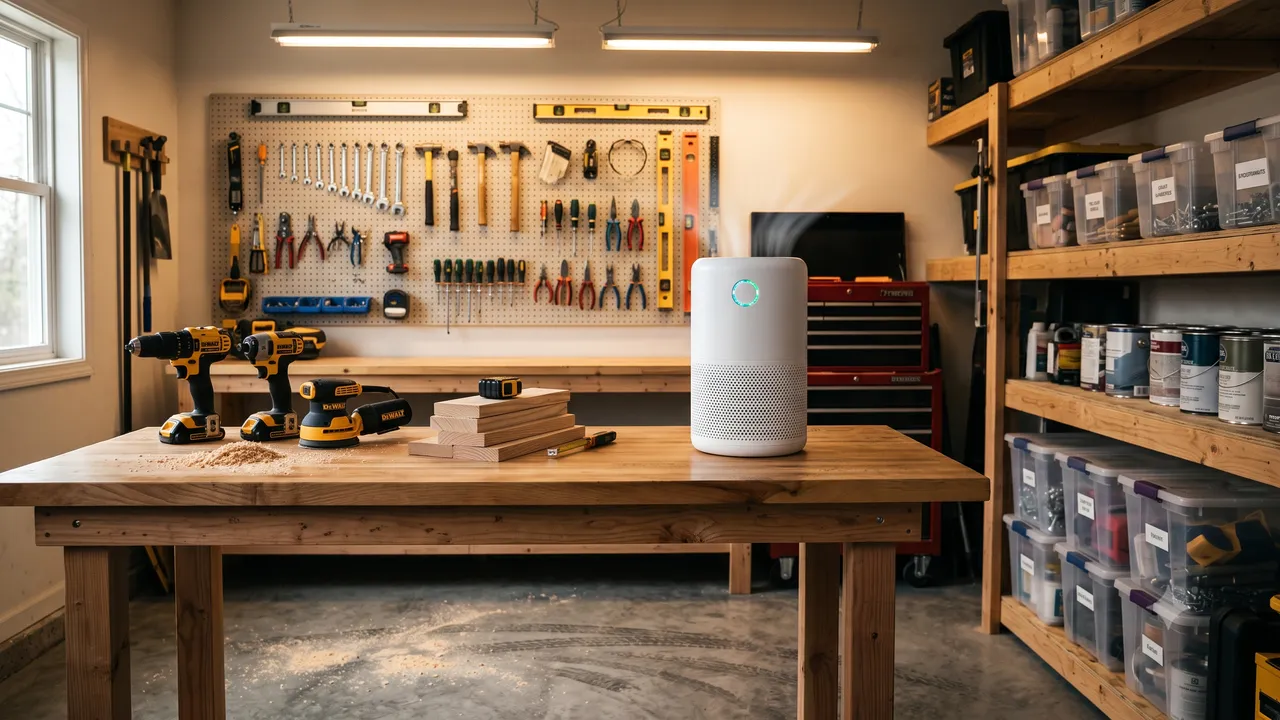
Garages and workshops present air quality challenges that no standard residential air purifier was designed to handle. The pollutant loads, coarse sawdust, fine sanding dust, welding fumes, paint solvents, and gasoline vapors, are closer to an industrial environment than a living room. A standard HEPA purifier can help, but only if you understand its limitations and pair it with appropriate source controls.
In this guide, we’ll break down exactly what you need to know to breathe safely in your garage or workshop, from understanding pollutant types to choosing the right purifier and setting it up correctly.
Why Garage Air Quality Is Worse Than You Think
Most people underestimate the air quality hazards in their garage or workshop. Consider this: a single hour of belt sanding can release over 100 grams of fine wood dust into the air. A session of spray painting with oil-based enamel can push VOC levels above 1,000 parts per billion, ten times what you’d find in a newly renovated living room.
Unlike your home’s interior, a typical garage has minimal air sealing, no dedicated HVAC filtration, and often poor natural ventilation. Pollutants linger for hours after the activity ends. Fine particulates from sanding can remain suspended in still air for 30 minutes or more. VOCs from paint and solvents off-gas for days.
According to the EPA, indoor air quality can be two to five times worse than outdoor air, and a garage workshop, with its concentrated pollutant sources and limited ventilation, easily exceeds that range.
Three Categories of Garage Pollutants
Understanding what you’re dealing with is the first step to choosing the right solution. Garage and workshop pollutants fall into three distinct categories, each requiring different filtration technology.
Coarse Particulates (10–100+ Microns)
Examples: Sawdust, metal grinding dust, drywall dust, drywall compound particles, concrete dust.
These are the particles you can see floating in a sunbeam. They load pre-filters within hours and will clog a HEPA filter rapidly if not caught first. The key requirement for handling coarse particulates is a heavy-duty washable pre-filter that can be cleaned daily during active projects, not a flimsy mesh that tears after three washes.
While these particles don’t penetrate deep into the lungs, they still cause irritation to the eyes, nose, and throat, and they carry a serious secondary risk: combustible dust explosions (more on that below).
Fine Particulates (0.1–10 Microns)
Examples: Sanding dust, welding fumes, smoke from cutting or grinding, laser cutter emissions.
These are respirable particles, they reach deep into the lungs and can cause long-term respiratory damage with chronic exposure. HEPA filtration captures them efficiently at 99.97% of particles at 0.3 microns, but standard residential purifiers aren’t designed for the concentration produced by an hour of sanding or welding. You need a unit with a high CADR (Clean Air Delivery Rate) and a filter designed for heavy particulate loads.
For reference, NIOSH recommends that wood dust exposure not exceed 1 mg/m³ for hardwoods and 5 mg/m³ for softwoods. A single hand-sanding session in an enclosed garage can easily push concentrations ten to fifty times above these limits without proper filtration.
VOCs and Chemical Vapors (Individual Molecules)
Examples: Paint solvents, mineral spirits, gasoline vapors, adhesives, wood stains, lacquer thinner, formaldehyde from certain wood products.
Activated carbon is the only consumer technology that addresses VOCs effectively. Carbon works through adsorption, VOC molecules chemically bond to the vast surface area of activated carbon granules. But here’s the critical issue: the thin carbon sheets found in most residential purifiers contain only a few ounces of carbon and saturate almost immediately in a garage environment. You need pounds of carbon, ideally 5+ lbs, for meaningful VOC removal in a workshop setting.
If you’re working with specific chemicals, check our guide on air purifiers for VOCs and formaldehyde for more detailed recommendations.
Best Air Purifiers for Garage Use Compared
Not all purifiers are created equal For workshop demands. Here are the top five options we’ve evaluated, each excelling in a different use case:
| Product | CADR (Dust) | Filter Type | Carbon Weight | Price | Best For |
|---|---|---|---|---|---|
| WEN 3410 | 400 CFM | 1-micron filter + 5-micron outer | None | ~$130 | High-volume wood dust |
| Austin Air HealthMate Plus | 400 CFM (combined) | True HEPA + carbon/zeolite | 15 lbs | ~$715 | Heavy VOC + dust combined |
| Coway AP-1512HH | 246 CFM | True HEPA + carbon pre-filter | 0.5 lbs | ~$189 | Light workshop use / finishing area |
| Winix 5500-2 | 243 CFM | True HEPA + carbon pellet filter | 1.4 lbs | ~$159 | Budget dust + light fumes |
| Blueair 211+ | 350 CFM | HEPASilent + particle filter | None | ~$299 | Large garage, particulate focus |
Our pick for most workshops: The WEN 3410 handles the sheer volume of dust that woodworking generates without burning through expensive HEPA filters. Pair it with a shop vacuum at the tool for source capture and you’ll cover 90% of workshop air quality needs. If you also work with solvents and paints, add the Austin Air HealthMate Plus as a dedicated VOC removal unit.
For a broader look at how these brands stack up, see our Coway vs. Levoit comparison and our best air purifiers for dust removal guide.
How to Set Up Air Filtration in Your Workshop
Getting the right purifier is only half the battle. Proper placement and setup can double or triple the effective air cleaning in your garage. Follow these steps:
Step 1: Assess Your Space
Measure your garage’s square footage and ceiling height. A standard two-car garage is roughly 400–500 square feet with 8–9 foot ceilings, giving you 3,200–4,500 cubic feet of volume. Write this number down, you’ll need it to calculate the air changes per hour (ACH) your purifier can deliver.
Step 2: Identify Your Primary Pollutants
Are you mostly woodworking? Metalworking? Automotive work? Painting? Your dominant activity determines whether you need to prioritize particulate filtration (woodworking, grinding) or chemical filtration (painting, solvent use) or both.
Step 3: Choose Your Primary and Secondary Filtration
For most workshops, the optimal setup is a two-unit system:
- Primary: A high-CFM unit (like the WEN 3410) mounted at ceiling level to capture the bulk of airborne dust
- Secondary: A HEPA + activated carbon unit placed at breathing height near your primary work zone for fine particulate and VOC removal
Step 4: Position for Airflow
Mount ceiling units centrally in your workshop, not against a wall. Position floor or tabletop units so they pull air from the dusty side of the room and exhaust clean air toward your breathing zone. Avoid placing units directly behind you where they’d blow settled dust back into your face.
Step 5: Create a Filtration Cycle
For a 400-square-foot garage (3,200 cubic feet), a unit with 400 CFM delivers roughly 7.5 air changes per hour, good for general maintenance but not enough during active sanding. During heavy dust-generating work, run all units simultaneously and consider cracking a garage door 6–12 inches on the opposite side from your work to create a cross-ventilation path.
Step 6: Time Your Filtration
Don’t run your main air purifier during active dust generation (see the combustible dust section below). Instead, run source capture (shop vacuum) during work, and switch to room air purification 15–20 minutes after you stop the dust-generating activity. Run the purifier for at least 2 hours after heavy sessions.
Step 7: Seal What You Can
Close windows on the side of the garage facing prevailing winds to reduce uncontrolled airflow. If you have living space above or adjacent to the garage, weather-strip the connecting door to prevent pollutant migration into your home. This is especially important if you’re also concerned about improving your overall indoor air quality.
Dust Collection vs Air Purification: What’s the Difference?
These two systems are often confused, but they serve fundamentally different purposes, and a well-equipped workshop needs both.
Dust Collection: Capture at the Source
A dust collection system connects directly to your tools via hoses and captures dust at the point of generation, before it enters the room air. Typical systems use a blower motor and a large collection bag or drum, filtering particles down to 1–5 microns.
Advantages:
- Prevents dust from spreading in the first place
- Handles the heaviest dust loads at the tool
- Reduces cleanup time dramatically
- Most effective for coarse and medium particles
Limitations:
- Only works when connected to a running tool
- Doesn’t capture dust from hand sanding, sweeping, or general activities
- Doesn’t address VOCs or chemical fumes at all
- Requires hose connections to each tool
Air Purification: Room-Level Cleaning
An air purifier operates independently of your tools, continuously filtering room air through HEPA and/or activated carbon filters. It captures whatever is suspended in the air, regardless of how it got there.
Advantages:
- Works 24/7, including after you’ve left the workshop
- Captures fugitive dust that escapes dust collection
- Addresses VOCs with activated carbon
- No tool connections needed
Limitations:
- Cannot keep up with heavy dust generation on its own
- Consumable filters add ongoing cost
- Slower to clear air than source capture
The Bottom Line
Think of dust collection as your first line of defense, capturing 80–90% of heavy dust at the source, and air purification as your cleanup crew, handling the remaining 10–20% of airborne particles plus all the VOCs and odors that dust collection can’t touch. Using air purification alone for workshop dust is like mopping a floor while someone keeps dumping sand on it.
For more on filter technologies and how they compare, check our HEPA filter deep dive and our air purifier technology comparison.
Combustible Dust: A Risk Most Garage Users Ignore
Wood dust from sanding is classified as combustible dust by OSHA. In a confined garage with a running purifier, fine wood dust suspended in the air creates an explosion risk if concentrations reach the lower explosive limit, which requires roughly a visible cloud of dust, a condition that can develop quickly during heavy sanding or planing.
According to the Chemical Safety Board, combustible dust incidents injure dozens of workers each year. While garage-scale explosions are rare, the risk is real, especially in enclosed spaces with ignition sources like pilot lights, electrical motors, or water heaters.
The practical safety protocol:
- During active dust-generating work: Turn off all air purifiers. Use source capture (dust collection or shop vacuum) only. The air purifier’s motor and circulating airflow can keep fine particles suspended at dangerous concentrations.
- Wait 15–20 minutes after stopping work to let heavier particles settle onto surfaces.
- Then turn on your air purifier to capture remaining suspended fine particles.
- Clean thoroughly, vacuum settled dust with a shop vacuum, don’t sweep. Sweeping re-aerosolizes settled particles.
Better yet, use dedicated dust collection at the tool source and treat the purifier as secondary air cleaning, not primary dust control.
Critical Safety Note: Purifiers Don’t Replace Respirators
A respirator with appropriate cartridges, P100 for particulates, organic vapor cartridges for solvents, is more important than any air purifier. The purifier cleans the room over hours; the respirator protects your lungs in real time. Never substitute a room purifier for proper respiratory protection during activities that generate high-concentration airborne hazards.
A quality half-face respirator with P100/OV cartridges costs $25–$40 and provides immediate protection. Consider it a non-negotiable part of your workshop setup, alongside safety glasses and hearing protection.
Maintenance Schedule for Workshop Purifiers
Workshop purifiers work far harder than residential units, and they need more frequent maintenance to stay effective. Here’s a practical schedule:
Every Work Session
- Check the pre-filter visually. If it’s loaded with dust, clean it before the next session.
- Empty dust collection bags/bins when they reach 50% capacity, overfilled bags reduce suction and filtration efficiency.
Weekly (If You Use Your Workshop Regularly)
- Wash or vacuum pre-filters. Foam and mesh pre-filters can be washed with mild soap and water. Let them dry completely before reinstalling.
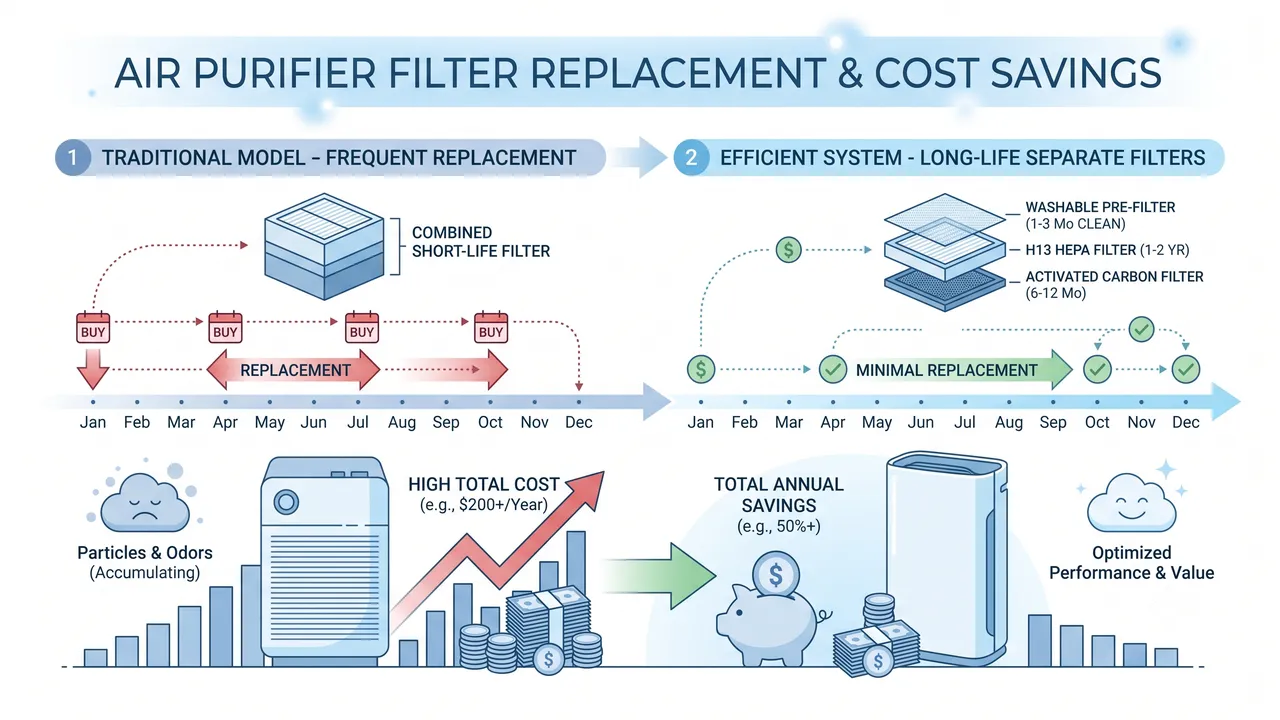
- Inspect HEPA filters for visible dust loading. In a workshop, HEPA filters may need replacement every 6–12 months instead of the typical 12–18 months for residential use.
- Wipe down the purifier exterior and air intake grilles with a damp cloth.
Monthly
- Check activated carbon filters. In a workshop with regular VOC exposure, carbon filters saturate faster, often in 3–6 months instead of the typical 6–12 months.
- Test airflow. Hold a tissue near the intake; it should pull firmly toward the unit. Reduced airflow indicates a clogged filter.
- Inspect hoses and connections on dust collection systems for cracks or blockages.
Every 3–6 Months
- Replace HEPA filters as needed based on visual inspection and airflow performance. In heavy-use workshops, quarterly replacement is common.
- Replace activated carbon filters if you notice returning odors, a sign the carbon is saturated.
- Deep clean the dust collection system, including the blower impeller and all ductwork.
Annually
- Audit your entire air quality setup. Check that your purifier’s CADR still meets your needs, especially if your workshop activities have changed.
- Calibrate or replace any air quality monitors you’re using. Consider investing in one if you don’t have one, our guide to the best air quality monitors covers affordable options.
Pro tip: Keep a log of filter replacement dates. Workshop filters don’t last as long as manufacturer estimates, which are based on residential use. Tracking actual replacement intervals will help you budget and plan.
Choosing the Right Purifier for Your Workshop Activities
Different workshop activities demand different filtration priorities:
If you primarily do woodworking: Prioritize high CFM and a robust pre-filter system. The WEN 3410 or a similar ceiling-mounted unit is your best investment. HEPA is a bonus but secondary to handling volume.
If you do finishing work (painting, staining, lacquering): Activated carbon is non-negotiable. The Austin Air HealthMate Plus with its 15 lbs of carbon/zeolite is the gold standard. Pair it with good ventilation, open the garage door and set up a box fan to push fumes out while painting.
If you do metalworking (grinding, welding): Fine metal particulates and welding fumes require true HEPA. A fume extractor with an articulated arm positioned at the weld point is far more effective than room-level filtration for welding activities.
If you do mixed work: A two-unit system, one high-CFM unit for dust and one HEPA + carbon unit for fines and fumes, is the most versatile setup.
For broader guidance on choosing the right purifier capacity, see our CADR and ACH guide.
FAQ
Can a regular home air purifier work in a garage?
A standard home air purifier can help with light workshop use, but it won’t hold up under heavy dust loads. Residential purifiers typically have small pre-filters that clog within hours of woodworking, and their carbon filters are too thin to handle solvent fumes effectively. For regular workshop use, you need a unit specifically suited to high-particle environments, either a workshop air filtration system or a commercial-grade purifier.
Do I need a HEPA filter for wood dust?
For coarse sawdust (10+ microns), a 1-micron filter like the one in the WEN 3410 is sufficient and more practical, since HEPA filters would clog rapidly from heavy wood dust loads. For fine sanding dust and finishing work, true HEPA filtration is recommended. A two-stage approach, coarse pre-filter for volume, HEPA for fines, is ideal.
How many air changes per hour do I need in a workshop?
For general workshop air quality maintenance, aim for 6–8 air changes per hour (ACH). During active dust-generating work, 10+ ACH is better. Calculate your target by multiplying your garage’s cubic footage by your desired ACH, then divide by 60 to get the minimum CFM your purifier needs. For example, a 400 sq ft garage with 8 ft ceilings (3,200 cubic feet) at 8 ACH needs roughly 427 CFM.
Will an air purifier remove paint fumes from my garage?
Only if it contains a substantial amount of activated carbon. Most residential purifiers have less than 1 lb of carbon, which saturates within minutes of heavy paint fume exposure. Look for units with 5+ lbs of carbon, the Austin Air HealthMate Plus (15 lbs) is the best consumer option. For heavy painting sessions, ventilation (open door + fan) is more effective than any purifier.
Is it safe to run an air purifier while woodworking?
During active dust generation (sanding, planing, routing), turn off air purifiers due to combustible dust risk. Use source capture (dust collection, shop vacuum) during work. Turn the purifier back on 15–20 minutes after stopping to capture remaining suspended particles. This protocol reduces both explosion risk and filter wear.
How often should I replace filters in a workshop air purifier?
Much more frequently than in home use. Pre-filters may need cleaning every session and replacement every 3–6 months. HEPA filters typically last 3–6 months in a workshop (vs. 12–18 months at home). Carbon filters can saturate in 1–3 months with regular VOC exposure. Always inspect monthly and replace when airflow noticeably decreases or odors return.
See also: DIY Ways to Improve Indoor Air Quality, Air Purifier VOCs and Formaldehyde Guide, How to Clean Your Air Purifier Pre-Filter, Best Air Purifiers for Dust Removal.
Disclosure: This article contains affiliate links. We may earn a commission from qualifying purchases made through these links at no additional cost to you. All product recommendations are based on independent research and testing.
You May Also Like
- How to Improve Indoor Air Quality Without an Air Purifier: 10 Science-Backed Methods
- Air Purifier Electricity Cost: How Much Does It Really Cost to Run 24/7?
- Air Purifier Filter Replacement Guide: Costs, Schedules, and How to Extend Filter Life
- Best Air Purifier Under $150: Genuine HEPA Without Breaking the Bank
Support This Guide
Helpful? Add The Air Purifier Guide as a preferred source on Google so our guides show up in your search results.
Related Articles

Coway Mighty2 vs AP-1512HH (2026)
Coway's Mighty2 replaced the AP-1512HH as Wirecutter's top pick. We compare CADR, noise, sensors, filter costs, and whether the older unit is still the smarter buy.

KNKA APH4000 Review: $150 Dark Horse
KNKA's APH4000 is one of Amazon's best-selling purifiers at $150. We check the AHAM certification, decode the 1,695 sq ft claim, and compare it to Levoit and Coway.

Levoit Core 300 vs 300-P: What Changed
Levoit quietly replaced the Core 300 with the Core 300-P. We explain the AHAM certification, whether filters still fit, and which one you should actually buy.

Shark NeverChange HP302 Review
Shark's NeverChange HP302 promises 5 years on one filter. We dig into the real running costs, the odor neutralizer catch, and whether it beats cheaper rivals.

Winix 5510 vs 5500-2: 2026 Verdict
The Winix 5500-2 is discontinued and the 5510 takes over. We compare CADR, noise, filter costs, and the one compatibility problem nobody mentions.
🛒 Products Mentioned
As an Amazon Associate, we earn from qualifying purchases.
Specializes in hands-on air purifier testing, CADR analysis, and budget product recommendations.
View all articles by Alex →