The Short Answer: Yes, 3D printers need air purification. FDM and resin printers both emit ultrafine particles (UFPs) and VOCs that HEPA-only filters cannot fully handle. The practical minimum is a purifier with True HEPA plus 2+ pounds of activated carbon. For resin printers, step up to 3-6 lbs of carbon. The Rabbit Air MinusA2 is the strongest consumer option; the Winix 5500-2 is the best budget pick.
Editor’s note (September 2026): The Winix 5500-2 has been discontinued and remaining stock is limited. Winix’s official successor is the Winix 5510, which adds app control and uses a new filter. Read our Winix 5510 vs 5500-2 comparison before you buy either one.
Why 3D Printing Pollutes the Air
The smell you notice when a printer runs is not the whole story. The invisible part matters more.
When filament melts at 190-260C, it releases two classes of pollutants. The first is ultrafine particles (UFPs): microscopic plastic droplets and partially decomposed polymer fragments, mostly under 100 nanometers. The second is volatile organic compounds (VOCs): the gases that carry the classic “burning plastic” smell, including styrene, formaldehyde, acetaldehyde, and caprolactam.
The numbers are worth taking seriously. A 2020 study published in Aerosol and Air Quality Research measured emissions during PLA printing and found 2 to 200 billion particles per minute, depending on filament brand and nozzle temperature. The same research group at California Polytechnic State University reported that a single 3D printer in an office produced UFP concentrations comparable to a busy street intersection within an hour of operation.
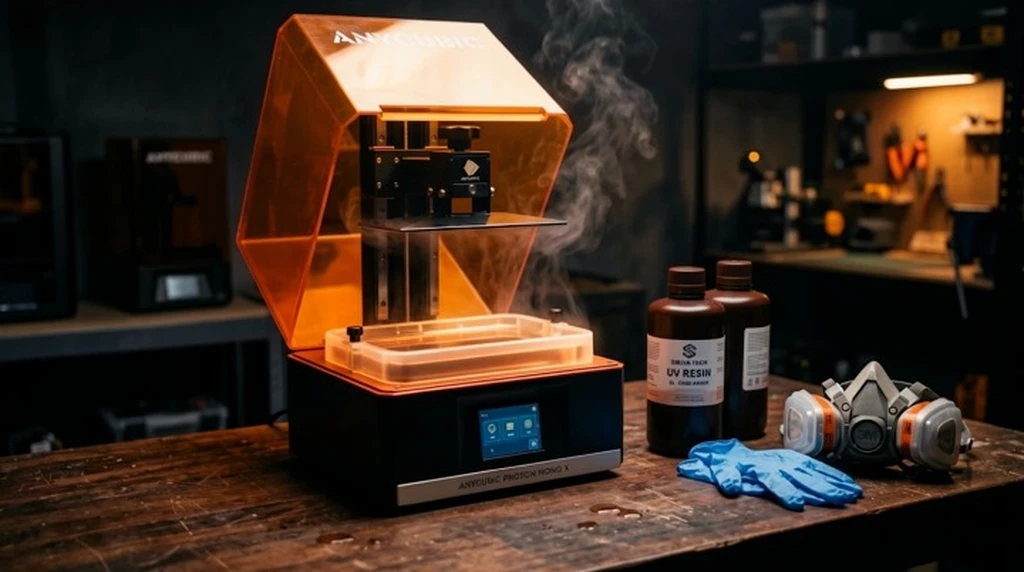
Resin printers are a separate, more serious category. Photopolymer resins contain acrylates and methacrylates that off-gas continuously, not just during printing. Uncured resin in the vat keeps releasing VOCs for hours after a print finishes. This is why resin printers are the ones that trigger headaches and respiratory irritation in enclosed spaces.
HEPA Alone Is Not Enough
This is the mistake most makers make on the first purchase.
A True HEPA filter captures 99.97% of particles at 0.3 microns. That handles the UFPs, the melted plastic droplets, and the dust that settles on your bench. But gases pass straight through HEPA media. A HEPA-only purifier next to an FDM printer will leave the room smelling exactly the same after an hour of printing, because styrene and acetaldehyde molecules (0.0004 to 0.001 microns) are far smaller than the 0.3-micron test particle HEPA is rated against.
The EPA’s guide to indoor air quality is explicit on this point: particle filters do not remove gaseous pollutants. Gas-phase filtration requires activated carbon or a similar adsorbent material.
This is why the recommendation throughout this guide is always the same pairing: True HEPA for particles, activated carbon for gases. A purifier with only one of the two is half a solution for a 3D printing workspace.
How Much Carbon Is Actually Enough?
Carbon weight is the number that separates “technically has carbon” from “actually removes VOCs.”
Most budget purifiers ship with a thin carbon sheet of 0.2-0.5 pounds. That is enough for cooking odors and light household smells, and essentially useless for a room where a printer runs three hours a day. Saturation happens fast, and a saturated carbon filter stops adsorbing and can even re-release captured VOCs.
Here is the practical scale:
| Printer type | Carbon needed | Why |
|---|---|---|
| FDM, occasional (PLA) | 1-2 lbs | PLA is the mildest filament; moderate VOC load |
| FDM, daily or multiple | 2-3 lbs | ABS/ASA release much more styrene |
| Resin, any regular use | 3-6 lbs | Acrylates off-gas continuously, even between prints |
| Multiple printers | 4+ lbs | Linear scaling with print volume |
Among the products we track, the Rabbit Air MinusA2 is the outlier here: its carbon-zeolite matrix weighs in around 6.5 pounds, which is in a different class from the sub-1-pound carbon sheets found in most consumer purifiers. That is why it appears at the top of the recommendations below.
The Four Best Air Purifiers for 3D Printer VOCs
1. Rabbit Air MinusA2 ($549) — Best Overall for Print Rooms
The MinusA2 is the rare consumer purifier designed with gas filtration as a first-class feature. Its customizable filter packs let you swap in the “Toxin Absorber” filter, which combines activated carbon with zeolite, and the company’s published carbon weight is roughly 6.5 pounds in that configuration.
Specs that matter for a print room:
| Specification | Value |
|---|---|
| CADR (smoke) | 290 CFM |
| Room coverage (4 ACH) | 450 sq ft |
| Carbon weight | ~6.5 lbs (Toxin Absorber pack) |
| Noise (low / high) | 22 / 49 dB |
| Filter cost / year | ~$70 |
| WiFi / app | Yes |
The dual-sided intake pulls air from both directions, and the wall-mount option lets you position it at breathing height near the printer. For resin printers, this is the purifier to buy.
The tradeoff: at $549 plus ~$70/year in filters, it is the most expensive option here. If you print PLA occasionally and can vent the room, the budget picks below cover you.
2. Coway Airmega 400 ($449) — Best High-CADR Option
The Airmega 400 brings the highest smoke CADR in this group at 350 CFM, which matters if your printer lives in a larger room or open basement. Its dual-intake design moves a lot of air quietly on medium, and the pelletized carbon filter is replaceable separately from the HEPA.
Specs:
| Specification | Value |
|---|---|
| CADR (smoke) | 350 CFM |
| Room coverage (4 ACH) | 710 sq ft |
| Carbon | Pelletized, moderate weight |
| Noise (low / high) | 24 / 52 dB |
| Filter cost / year | ~$90 |
The Airmega 400 is the choice when the print room is also the living room and you need the air turned over fast. Its carbon bed is not in the Rabbit Air class, so for resin work we would still take the MinusA2.
3. Winix 5500-2 ($199) — Best Budget Pick
The Winix 5500-2 has been the value benchmark for years, and it earns its place here for one specific reason: its AOC (Advanced Odor Control) carbon filter uses pelletized carbon rather than a thin sheet, which gives it noticeably better VOC adsorption than most purifiers at the price.
Specs:
| Specification | Value |
|---|---|
| CADR (smoke) | 232 CFM |
| Room coverage (4 ACH) | 360 sq ft |
| Carbon | Pelletized AOC filter |
| Noise (low / high) | 28 / 58 dB |
| Filter cost / year | ~$70 |
For a single FDM printer in a bedroom or small office, the 5500-2 covers you at a third of the MinusA2’s price. The tradeoff is noise on high (58 dB) and a smaller carbon bed, so it is not the pick for resin printers or heavy ABS schedules.
4. Levoit Core 400S ($219) — Best Smart Budget Option
The Core 400S is the only option here with built-in WiFi and app control at a budget price. The VeSync app gives you a PM2.5 reading, schedule controls, and filter-life tracking. For a hobbyist who wants to check air quality from the couch while a print runs, that convenience is real.
Specs:
| Specification | Value |
|---|---|
| CADR (smoke) | 250 CFM |
| Room coverage (4 ACH) | 403 sq ft |
| Carbon | H13 HEPA + carbon layer |
| Noise (low / high) | 24 / 50 dB |
| Filter cost / year | ~$60 |
The Core 400S sits between the Winix and the Coway in both price and performance. Its carbon layer is lighter than the Winix’s pelletized filter, so odor control is adequate for PLA but not exceptional for ABS or resin.
Where to Put the Purifier
Position matters as much as the machine. Place the purifier within 3-6 feet of the printer, on the same side as the printer’s cooling fan. That places it in the plume path, where particle concentrations are highest. Elevated placement (on a shelf or the MinusA2’s wall mount) puts the intake in the breathing zone rather than floor level.
Do not aim a desk fan at the printer across the room. That just spreads the plume wider before filtration has a chance to catch it. Keep the room’s natural air path simple: printer and purifier together on one side, and if a window is available, an exhaust fan on the opposite side.
For the full picture on matching purifier strength to room size, use our CADR calculator for VOCs and formaldehyde to confirm the number your print room needs.
Practical Habits That Cut Exposure
A purifier is the safety net, not the whole plan. These habits reduce the load it has to handle:
- Print with the lid or enclosure on. An enclosed printer traps a large fraction of the emissions at the source. A 2017 study in Journal of Occupational and Environmental Hygiene found enclosures reduced UFP concentrations by roughly 70-90% depending on seal quality.
- Vent during and after resin work. Resin vats keep off-gassing after prints finish. Move the printer to a room you can vent, or run the purifier for 2-3 hours after the last print.
- Change the carbon filter on schedule. A saturated carbon filter stops working silently. Mark the replacement date when you install it. For daily printing, plan on every 3-4 months for the carbon element, not the 6-12 months the box may claim.
- Print PLA at the lowest temperature that works. Hotter nozzles mean more thermal decomposition and more emissions. Dropping from 220C to 200C on a spool that prints clean at the lower temp measurably reduces particle output.
- Keep the room sealed during long prints. Air from a print room that circulates into the rest of the house spreads the load everywhere. Close the door and rely on the purifier.
Our guide to removing VOCs and formaldehyde from the air covers the filtration science in more depth, and the best purifiers for new-home formaldehyde article lists additional carbon-heavy options if you are shopping across categories.
Frequently Asked Questions
How fast does a purifier clear 3D printer fumes?
On high speed, a properly sized purifier (250+ smoke CADR for a small room) will clear visible haze and most particulate within 20-30 minutes. VOC gases take longer because carbon adsorption is slower than mechanical filtration. Expect noticeable odor reduction in 30-60 minutes, with full clearance in 2-3 hours depending on carbon weight.
Is ABS or PLA worse for indoor air?
ABS emits more styrene and produces more UFPs at comparable temperatures, making it the worse offender of the two. PLA is the mildest common filament, but it is not emission-free. If you print ABS indoors, prioritize a purifier with 2+ lbs of carbon and keep the room vented.
Do I need a purifier if I use an enclosure?
An enclosure reduces emissions substantially but does not eliminate them. Sealed enclosures with their own filter (like the Bambu Lab X1 series) capture most particles at the source; open enclosures simply delay the release. Even with an enclosure, a room-level purifier is a sensible second layer, particularly for resin printers which off-gas between prints.
Can a small $50 purifier handle 3D printer fumes?
No. Purifiers in the $40-60 range (like the Levoit Core Mini, 60-65 CFM CADR) move too little air and carry too little carbon to keep up with an active printer. They handle a desktop in a tiny room at best. For a printer, budget at least $150-200, or expect the room to keep smelling.
What is the difference between the Rabbit Air MinusA2 and cheaper carbon purifiers?
Carbon weight, mostly. The MinusA2’s Toxin Absorber filter holds roughly 6.5 pounds of carbon-zeolite matrix; most sub-$300 purifiers hold 0.3-1 pound. That difference shows up directly in how long the filter keeps adsorbing VOCs before saturating, and in whether the room stops smelling after an hour or after a week.
Final Verdict
If you print resin, or print FDM daily in an enclosed room, the Rabbit Air MinusA2 is the right tool: 6.5 pounds of carbon is the difference between a room that smells like a print shop and one that does not. If you print PLA occasionally and want value, the Winix 5500-2 covers a single printer at $199. For larger rooms or smart-home integration, the Coway Airmega 400 and Levoit Core 400S fill those niches respectively.
Whatever you choose, pair the purifier with an enclosure and good habits. Filtration at the room level is the last line of defense, not the first.
Disclosure: As an Amazon Associate, The Air Purifier Guide earns from qualifying purchases made through links in this article. This does not affect our recommendations. We only recommend products we have researched and analyzed independently.
You May Also Like
Support This Guide
Helpful? Add The Air Purifier Guide as a preferred source on Google so our guides show up in your search results.
Related Articles

Coway Mighty2 vs AP-1512HH (2026)
Coway's Mighty2 replaced the AP-1512HH as Wirecutter's top pick. We compare CADR, noise, sensors, filter costs, and whether the older unit is still the smarter buy.

KNKA APH4000 Review: $150 Dark Horse
KNKA's APH4000 is one of Amazon's best-selling purifiers at $150. We check the AHAM certification, decode the 1,695 sq ft claim, and compare it to Levoit and Coway.

Levoit Core 300 vs 300-P: What Changed
Levoit quietly replaced the Core 300 with the Core 300-P. We explain the AHAM certification, whether filters still fit, and which one you should actually buy.

Shark NeverChange HP302 Review
Shark's NeverChange HP302 promises 5 years on one filter. We dig into the real running costs, the odor neutralizer catch, and whether it beats cheaper rivals.

Winix 5510 vs 5500-2: 2026 Verdict
The Winix 5500-2 is discontinued and the 5510 takes over. We compare CADR, noise, filter costs, and the one compatibility problem nobody mentions.
🛒 Products Mentioned
As an Amazon Associate, we earn from qualifying purchases.
Covers indoor air quality science, respiratory health, allergy management, and wildfire smoke protection.
View all articles by Sarah →