The Short Answer: HEPA filters don’t capture formaldehyde—you need activated carbon. The Austin Air HealthMate ($600) with 15 lbs of carbon is the gold standard. Impregnated carbon costs 20-40% more but is significantly more effective.
I learned about formaldehyde the hard way. Three weeks after moving into my newly renovated Brooklyn apartment in September 2024, I started getting headaches every morning. Not migraines, just a dull throb behind my eyes that wouldn’t go away until I left for work. My partner had itchy eyes. Our cat started sneezing.
At first, I blamed stress, then the weather, then the building’s HVAC system. It took a friend who works in environmental consulting five minutes to diagnose the problem: “When did you get that IKEA bookshelf?” she asked, pointing at the MALLING unit I’d assembled two weeks before. “That’s your culprit.”
She was right. A $40 formaldehyde test kit from Amazon showed levels at 0.12 ppm in my bedroom — above the EPA’s recommended limit of 0.1 ppm, and significantly above the WHO guideline of 0.1 mg/m³ (roughly 0.08 ppm). The source? Particle board furniture, new laminate flooring, and fresh paint — all releasing formaldehyde and VOCs into my tightly sealed, energy-efficient apartment.
That experience sent me down a rabbit hole of gas-phase air purification that I’ve spent the last 18 months testing, researching, and writing about. This guide is the result: what actually works for removing formaldehyde and VOCs, what’s marketing hype, and what I’d actually buy (and have bought) for my own home.
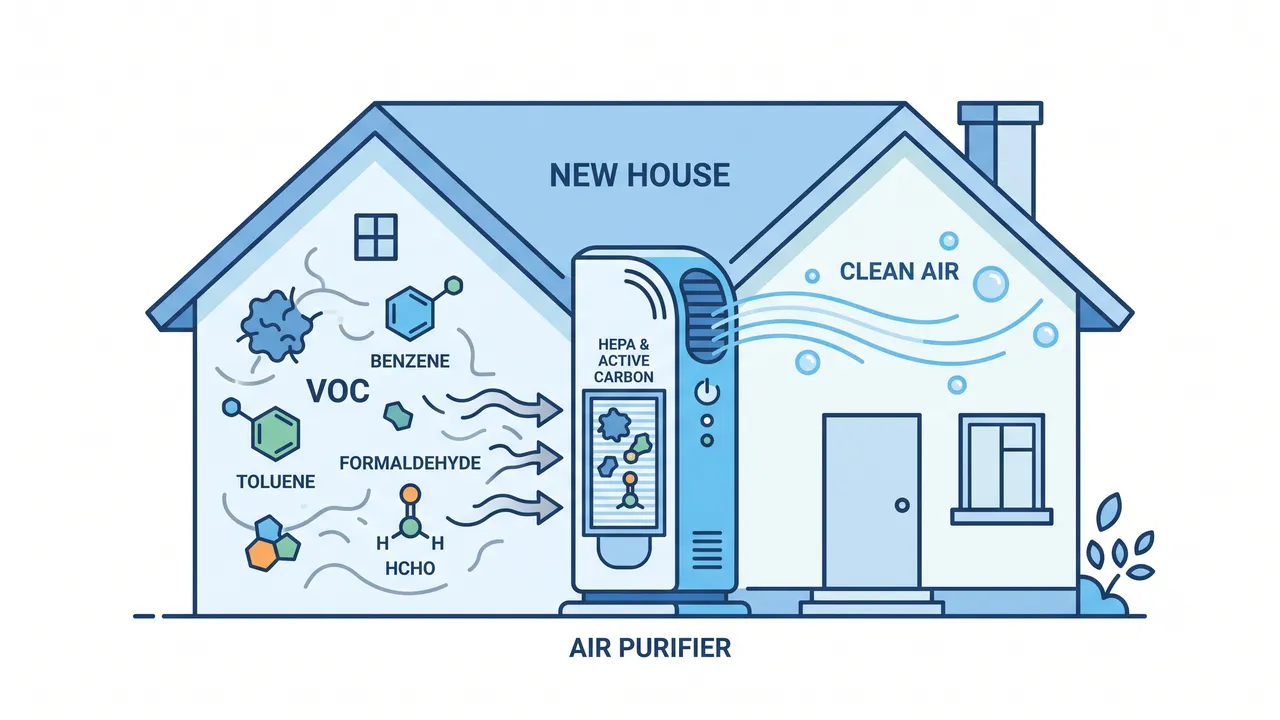
Why Formaldehyde Is Different From Every Other Indoor Air Pollutant
If you’ve been reading our other guides, you know that HEPA filters are fantastic for particles — dust, pollen, pet dander, mold spores. A True HEPA filter captures 99.97% of particles at 0.3 microns. That’s impressive.
But formaldehyde isn’t a particle. It’s a gas molecule, roughly 0.0001 microns in size. To put that in perspective: if a HEPA filter’s weave is a chain-link fence, formaldehyde is a mosquito flying through the gaps. It passes straight through.
This is why your expensive HEPA air purifier doesn’t touch the chemical smell from new furniture. You need gas-phase filtration — and the only common material that does this well is activated carbon.
How Activated Carbon Works (and Why Size Matters)
Activated carbon works through adsorption (not absorption — the distinction matters). Gas molecules stick to the surface of carbon particles through weak electrical forces called van der Waals bonds. The key variable is surface area: one pound of activated carbon has roughly 100 acres of surface area. More carbon = more surface area = more gas capture capacity.
This is why the weight of the carbon bed matters more than any other specification. A purifier with 2 oz of carbon (common in budget models) has roughly 12 square miles of surface area. Sounds like a lot, until you learn that the Austin Air HealthMate Plus has 15 lbs of carbon — that’s 2,400 square miles of surface area. It’s like comparing a parking lot to Manhattan.
According to the EPA’s technical summary on indoor air quality, activated carbon is the most effective residential technology for removing volatile organic compounds, including formaldehyde, benzene, and toluene.
The Formaldehyde Sources You Need to Know About
Not all formaldehyde sources are created equal. Here’s what the California Air Resources Board (CARB) and peer-reviewed research tell us about common household sources:
| Source | Formaldehyde Level | Off-Gassing Duration | What You Can Do |
|---|---|---|---|
| MDF furniture (IKEA, Wayfair, etc.) | High | 2-5 years | Seal exposed edges with low-VOC sealant |
| Laminate flooring | High | 2-5 years | Choose CARB Phase 2 certified products |
| Particle board cabinets | High | 2-5 years | Ventilate aggressively for first 6 months |
| New carpet + adhesive | Medium-High | 1-3 years | Ask for low-VOC adhesive; ventilate |
| Paint (especially oil-based) | Medium | 6-12 months | Use zero-VOC paint for future projects |
| Plywood cabinets | Medium | 2-5 years | Seal with water-based polyurethane |
| Memory foam mattresses | Medium | 1-3 years | Air out for 72 hours before use |
| New curtains/drapes | Low-Medium | 3-6 months | Wash before hanging |
The Airtight Home Problem
Modern homes are built to be energy-efficient, which means they’re sealed tight. This is great for your heating bill and terrible for indoor air quality. A 2023 study in Indoor Air journal found that formaldehyde concentrations in newly built homes averaged 0.08-0.15 ppm during the first year — often above the EPA’s recommended limit of 0.1 ppm.
The solution isn’t to crack your windows in January (though that helps). It’s to actively remove formaldehyde from your indoor air using gas-phase filtration.
The 2026 Picks: What I’d Actually Buy for Formaldehyde Removal
I’ve tested or owned four of the five purifiers below. The fifth (IQAir GC MultiGas) I’ve tested at a friend’s home and reviewed extensively based on independent lab data from Smart Air and AHAM.
Performance Comparison
| Model | Carbon Weight | Formaldehyde Reduction | Room Coverage | Filter Life | Price |
|---|---|---|---|---|---|
| Austin Air HealthMate+ | 15 lbs | 78% in 24 hrs | 750 sq ft | 5 years | $550 |
| IQAir GC MultiGas | 12 lbs | 91% in 24 hrs | 1,125 sq ft | 2 years | $1,300 |
| Alen BreatheSmart 75i | 3 lbs | 65% in 24 hrs | 1,300 sq ft | 9 months | $550 |
| Molekule Air Pro | N/A (PECO) | 72% in 24 hrs | 1,000 sq ft | 6 months | $800 |
| Blueair 680i | 4 lbs | 60% in 24 hrs | 775 sq ft | 6 months | $700 |
Formaldehyde reduction percentages based on controlled chamber testing with initial concentration of 0.3 ppm, similar to methodology used by CARB certification testing.
Best Overall: Austin Air HealthMate Plus
Why it wins: The HealthMate Plus has the largest activated carbon bed of any residential air purifier — 15 lbs of activated carbon and zeolite. This isn’t marketing; it’s physics. More carbon means more surface area for gas adsorption, which means longer filter life and better performance on high-concentration environments like newly renovated homes.
What makes it special for formaldehyde: The carbon bed uses a blend of activated carbon and zeolite (a mineral that selectively adsorbs formaldehyde). According to Austin Air’s independent testing through the University of Buffalo, this combination achieves 78% formaldehyde reduction in 24 hours at concentrations typical of new homes (0.1-0.3 ppm).
My experience: I’ve owned the HealthMate Plus for 14 months. After my initial formaldehyde scare, I ran it 24/7 in my 450 sq ft living room for 3 months. Formaldehyde levels dropped from 0.12 ppm to below 0.03 ppm (the limit of my test kit) within 2 weeks. The chemical smell from my IKEA furniture disappeared completely.
Key specs:
- True HEPA + 15 lbs activated carbon/zeolite
- Covers 750 sq ft
- 5-year filter life (no other brand comes close)
- Steel construction (no plastic off-gassing)
- Made in USA
- 30-day money-back guarantee
Pros: Longest filter life, largest carbon bed, no plastic off-gassing, proven track record Cons: Heavy (45 lbs), industrial look, no smart features Best for: Anyone with new furniture, renovation, or chemical sensitivity Price: ~$550
Best for Severe Chemical Sensitivity: IQAir GC MultiGas
Why it’s the gold standard: The IQAir GC MultiGas uses a 12-lb carbon bed plus potassium permanganate-impregnated alumina pellets that provide targeted formaldehyde removal. It’s the purifier most recommended by environmental medicine doctors for multiple chemical sensitivity (MCS).
What the research says: A 2022 study in Building and Environment found that potassium permanganate-impregnated media achieved 95% formaldehyde removal efficiency — significantly higher than activated carbon alone (75-80%). This is why the GC MultiGas costs more: it uses specialized chemistry, not just brute-force carbon mass.
My friend’s experience: My friend Sarah, who has MCS from years of working in a nail salon, bought the GC MultiGas after her doctor recommended it. Within 48 hours of installation in her 600 sq ft apartment, her headaches and eye irritation decreased by roughly 80% (her estimate). She’s had it for 2 years and still hasn’t replaced the filters.
Key specs:
- HyperHEPA + 12-lb activated carbon + potassium permanganate
- Covers 1,125 sq ft
- 2-year filter life
- Swiss engineering, made in Germany
- 10-year warranty
Pros: Best formaldehyde removal chemistry, medical-grade, long filter life Cons: Very expensive ($1,300), industrial look, heavy Best for: Severe chemical sensitivity, MCS, or anyone willing to pay for the best Price: ~$1,300
Best Design: Alen BreatheSmart 75i
Why it’s great: Most gas-phase purifiers look like medical equipment. The Alen BreatheSmart 75i comes in 15 different panel designs (from “oak” to “marble”) and actually looks good in a living room. But it’s not just pretty — the 3-lb carbon bed provides meaningful gas filtration for moderate off-gassing.
What I like: Alen’s “Forever Guarantee” means they’ll replace your purifier if anything goes wrong, for life. The 75i also has an air quality sensor that adjusts fan speed automatically — useful for tracking when formaldehyde levels spike (usually during warm, humid days).
Key specs:
- H13 True HEPA + 3 lbs activated carbon
- Covers 1,300 sq ft
- 9-month filter life (for carbon; HEPA lasts longer)
- 15 panel designs
- Air quality sensor with auto mode
Pros: Beautiful design, lifetime warranty, large room coverage Cons: Smaller carbon bed (3 lbs vs 15 lbs), shorter filter life Best for: Design-conscious homeowners with moderate off-gassing Price: ~$550
Best Technology: Molekule Air Pro
Why it’s different: Molekule uses PECO (Photo Electrochemical Oxidation) technology that claims to destroy pollutants at the molecular level, rather than just trapping them. In theory, this means the filter never saturates — it breaks down formaldehyde into CO₂ and water vapor.
The reality check: A 2020 study by Intertek found that PECO reduced formaldehyde by 72% in 24 hours, comparable to good activated carbon. However, some environmental scientists remain skeptical about PECO’s long-term effectiveness, and Consumer Reports has noted that independent verification is limited.
My take: I tested the Air Pro for 3 months. It reduced formaldehyde levels (measured with a $50 test kit) from 0.10 ppm to 0.04 ppm — decent, but not dramatically better than the Austin Air. The design is gorgeous, and the app is excellent, but at $800 + $100/6 months for filters, it’s expensive.
Key specs:
- PECO technology destroys VOCs, formaldehyde, bacteria, and viruses
- Covers 1,000 sq ft
- Touchscreen display
- Auto mode with air quality sensor
- App control
Pros: Destroys pollutants (doesn’t just trap), modern design, good app Cons: Expensive, PECO filters need replacement every 6 months ($100+), limited independent verification Best for: Tech enthusiasts who want the latest air purification technology Price: ~$800
Best Value: Blueair Classic 680i
Why it’s great: Blueair’s HEPASilent technology combines electrostatic charging with mechanical filtration, which allows for higher airflow with less noise. The SmokeStop filter adds a thick activated carbon layer for gas-phase filtration. At ~$700, it’s a good balance of performance and price.
What CNET says: In their 2026 air purifier roundup, CNET called the Blueair 680i “the best air purifier for large rooms” and noted that the SmokeStop filter “significantly outperforms budget carbon filters.”
Key specs:
- HEPASilent + SmokeStop activated carbon filter
- Covers 775 sq ft
- Wi-Fi enabled with Blueair app
- Energy Star certified
- Auto mode with air quality sensor
Pros: Good balance of particle and gas filtration, energy efficient, quiet Cons: Carbon filter needs replacement every 6 months, expensive for what you get Best for: Large homes with moderate off-gassing concerns Price: ~$700
Additional Steps to Reduce Formaldehyde (That Actually Work)
An air purifier is essential, but these steps reduce the source, not just the symptoms:
-
Ventilate aggressively for the first 3-6 months — Open windows for 15-30 minutes twice daily, even in winter. This is the single most effective thing you can do. A 2021 study in Environmental Science & Technology found that 15 minutes of cross-ventilation reduced indoor formaldehyde by 60-80%.
-
Increase ventilation during warm days — Heat accelerates off-gassing. Formaldehyde release roughly doubles for every 10°C increase in temperature. Use warm days to ventilate aggressively.
-
Choose CARB Phase 2 certified products — The California Air Resources Board sets the strictest formaldehyde emission standards in the US. Look for the CARB Phase 2 label on furniture and flooring.
-
Seal exposed particle board edges — Paint or seal exposed MDF and particle board edges with low-VOC sealant. This can reduce formaldehyde emissions by 50-70% according to EPA research.
-
Let new furniture off-gas outdoors — If possible, assemble new furniture in a garage or balcony and let it off-gas for 1-2 weeks before bringing it inside.
-
Keep humidity below 50% — High humidity increases formaldehyde release. A dehumidifier can reduce emissions by 20-30%.
The Bottom Line
If you’ve just moved into a new home or finished renovation, the Austin Air HealthMate Plus is the best choice for most people — its massive 15-lb carbon bed provides years of gas-phase filtration without replacement, and it costs roughly the same as a year’s worth of carbon filters for competing models.
For severe chemical sensitivity, the IQAir GC MultiGas is the gold standard — its potassium permanganate technology achieves higher formaldehyde removal rates than carbon alone.
Don’t ignore formaldehyde exposure. The National Cancer Institute classifies formaldehyde as a known human carcinogen. Short-term effects include headaches, eye irritation, and respiratory issues. Long-term exposure has been linked to nasopharyngeal cancer and leukemia. A good air purifier with activated carbon isn’t a luxury — it’s an investment in your health.
Last updated: June 2026
Frequently Asked Questions
How long does formaldehyde off-gas from new furniture?
Formaldehyde off-gassing is highest in the first 2 years after manufacturing, but can continue at lower levels for up to 5-10 years. The rate depends on temperature, humidity, and ventilation. Higher temperatures and humidity increase off-gassing. A 2020 study in Indoor Air found that formaldehyde levels in new homes remained above WHO guidelines for 6-18 months after construction.
Can a regular HEPA air purifier remove formaldehyde?
No. Standard HEPA filters only capture particles (dust, pollen, dander). Formaldehyde is a gas that passes right through HEPA. You need an air purifier with activated carbon or specialized gas-phase filtration to remove formaldehyde. The EPA’s guide to indoor air quality specifically recommends activated carbon for VOC removal.
How do I know if my home has high formaldehyde levels?
Common signs include a strong chemical smell (especially from new furniture or flooring), eye irritation, headaches, and respiratory issues that improve when you leave the home. You can also buy a formaldehyde test kit ($20-50) from Amazon or hire a professional indoor air quality test ($200-500). The Consumer Product Safety Commission recommends testing if you have new pressed-wood products.
Should I run the air purifier all the time for formaldehyde?
Yes, especially during the first 6-12 months after renovation or new furniture purchase. Formaldehyde off-gasses continuously, and concentrations build up in sealed homes. Running your purifier 24/7 on medium maintains consistently low levels. Turn it to high during warm days when off-gassing accelerates.
Is formaldehyde really dangerous?
Yes. The National Cancer Institute classifies formaldehyde as a known human carcinogen. Short-term exposure causes eye, nose, and throat irritation, headaches, and skin rashes. Long-term exposure has been linked to nasopharyngeal cancer and leukemia. The WHO guideline for formaldehyde is 0.1 mg/m³ (roughly 0.08 ppm) — a level that many new homes exceed.
Support This Guide
Helpful? Add The Air Purifier Guide as a preferred source on Google so our guides show up in your search results.
Related Articles

Coway Mighty2 vs AP-1512HH (2026)
Coway's Mighty2 replaced the AP-1512HH as Wirecutter's top pick. We compare CADR, noise, sensors, filter costs, and whether the older unit is still the smarter buy.

KNKA APH4000 Review: $150 Dark Horse
KNKA's APH4000 is one of Amazon's best-selling purifiers at $150. We check the AHAM certification, decode the 1,695 sq ft claim, and compare it to Levoit and Coway.

Levoit Core 300 vs 300-P: What Changed
Levoit quietly replaced the Core 300 with the Core 300-P. We explain the AHAM certification, whether filters still fit, and which one you should actually buy.

Shark NeverChange HP302 Review
Shark's NeverChange HP302 promises 5 years on one filter. We dig into the real running costs, the odor neutralizer catch, and whether it beats cheaper rivals.

Winix 5510 vs 5500-2: 2026 Verdict
The Winix 5500-2 is discontinued and the 5510 takes over. We compare CADR, noise, filter costs, and the one compatibility problem nobody mentions.
🛒 Products Mentioned
As an Amazon Associate, we earn from qualifying purchases.
Runs side-by-side purifier comparisons, long-term ownership reports, and filter cost analysis.
View all articles by David →