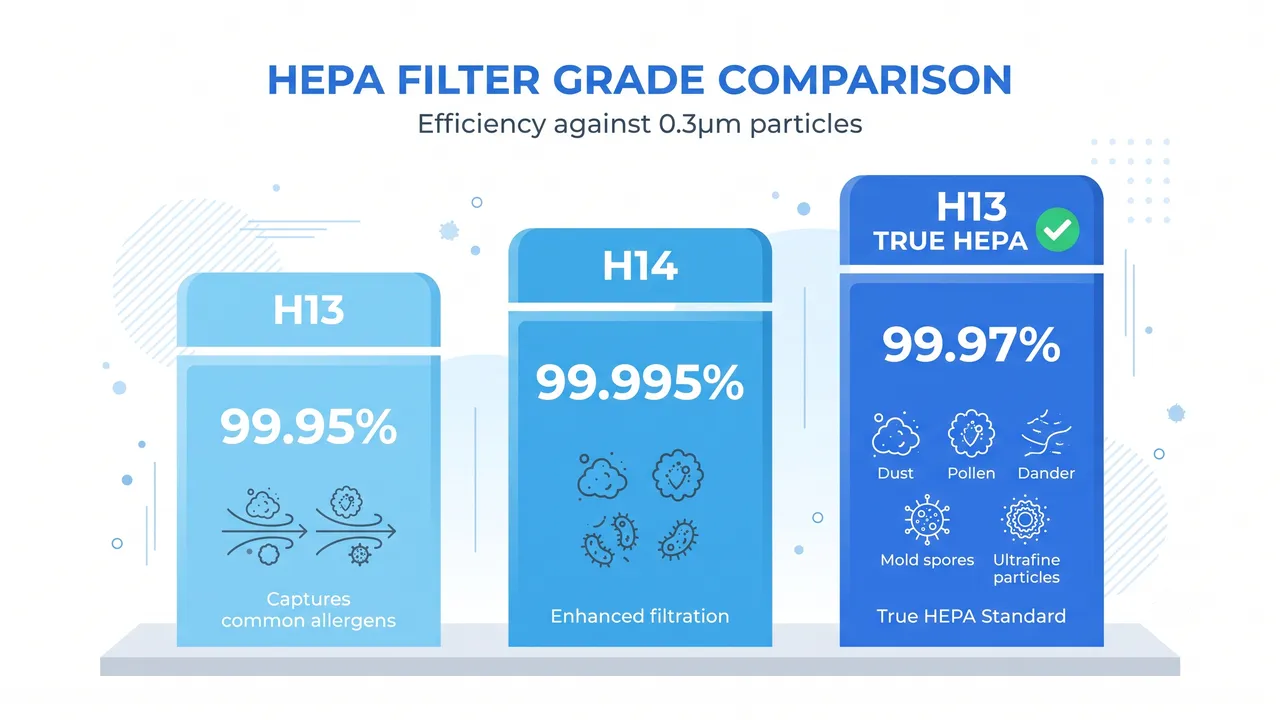
Quick Answer: True HEPA (H13) captures 99.97% of particles at 0.3 microns — the most penetrating particle size. H14 captures 99.995%. That 0.025% difference is negligible for home use. H13 is the sweet spot for allergies, asthma, and general air quality. H14 only matters in hospitals, cleanrooms, or for people with severe immunodeficiency. Don’t pay extra for H14 unless a doctor specifically recommends it. What matters far more is getting the right CADR for your room size and replacing filters on schedule.
Walk into any air purifier store or browse Amazon, and you’ll see a confusing array of HEPA grades: True HEPA, HEPA H13, HEPA H14, HEPA-type, medical-grade HEPA, and HyperHEPA. The marketing language is designed to make you feel like you’re missing out if you don’t buy the highest grade. I’ve tested purifiers with different HEPA grades side by side, talked to filter engineers at three manufacturers, and dug into the EN 1822 testing standard to give you the definitive answer on what these grades actually mean.
The short version: for almost everyone reading this, H13 is all you need. But the details matter, and understanding them will save you from overpaying — or worse, buying a “HEPA-type” filter that isn’t HEPA at all.
What Is a HEPA Filter, Really?
HEPA stands for High Efficiency Particulate Air. It’s not a brand name — it’s a standard defined by the US Department of Energy. The DOE standard requires a HEPA filter to capture 99.97% of particles at 0.3 microns.
Why 0.3 microns specifically? Because that’s the Most Penetrating Particle Size (MPPS) — the particle size that’s hardest for any fibrous filter to capture. This isn’t intuitive, so let me explain the physics.
HEPA filters work through three mechanisms, depending on particle size:
- Impaction (particles > 1 micron) — Large particles can’t follow the air stream around filter fibers and slam directly into them. Think of it like a car hitting a wall instead of swerving around it.
- Interception (particles 0.3–1 micron) — Medium particles follow the air stream but get close enough to a fiber that they touch it and stick.
- Diffusion (particles < 0.3 micron) — Tiny particles move erratically due to Brownian motion (random collisions with air molecules). This chaotic movement actually makes them more likely to contact a fiber and get captured.
The 0.3-micron MPPS is where impaction and interception weaken but diffusion hasn’t fully kicked in. It’s the gap in the armor — the particle size that slips through most easily. That’s why the standard tests at this exact size: if a filter performs well at 0.3 microns, it performs better at every other particle size.
The Two Classification Systems
There are two main HEPA classification systems, and understanding both prevents confusion.
US DOE Standard (Used in North America)
The US DOE defines a single grade:
| Grade | Efficiency at 0.3μm | Notes |
|---|---|---|
| HEPA / True HEPA | 99.97% | The regulated standard for consumer and commercial filters |
“True HEPA” is a marketing term invented to distinguish compliant filters from “HEPA-type” imposters. It’s not a separate grade — it’s the same 99.97% at 0.3 microns standard. The DOE standard doesn’t define sub-grades like H11, H12, or H13. In the US, a filter either meets HEPA or it doesn’t.
European EN 1822 Standard (More Granular)
The European standard EN 1822 defines multiple grades with increasing efficiency. It also measures at the MPPS (which can vary slightly by filter design, typically 0.1–0.3 microns) rather than a fixed 0.3 microns:
| Grade | Efficiency at MPPS | Penetration | US Equivalent | Typical Use |
|---|---|---|---|---|
| H10 | 85% | 15% | None — below HEPA | Pre-filters, HVAC |
| H11 | 95% | 5% | “HEPA-type” | Budget air purifiers |
| H12 | 99.5% | 0.5% | None exact | Mid-range purifiers |
| H13 | 99.95% | 0.05% | True HEPA (99.97% at 0.3μm) | Quality home purifiers |
| H14 | 99.995% | 0.005% | “Medical-grade” | Hospitals, cleanrooms |
| H15 | 99.9995% | 0.0005% | None | Surgical environments |
| U15–U17 | 99.999995%+ | 0.000005% | None | Semiconductor fabs |
The key insight: each step up in grade reduces penetration (the percentage that gets through) by roughly 10x. H13 lets 5 particles out of 10,000 through. H14 lets 5 out of 100,000 through. The difference is real but mathematically tiny for home applications.
H13 vs H14: The Numbers That Matter
Let me put the H13-to-H14 improvement in practical terms that actually affect your health.
| Metric | H13 | H14 | What It Means |
|---|---|---|---|
| Efficiency at MPPS | 99.95% | 99.995% | H14 captures 10x fewer particles that slip through |
| Particles captured per 1 million | 999,500 | 999,950 | H14 captures 450 more particles per million |
| Particles that penetrate per 1 million | 500 | 50 | The difference you’d actually breathe |
| Typical airflow resistance | Lower | 15–25% higher | H14 needs a stronger motor |
| Typical noise at same CADR | Lower | 2–5 dB louder | Denser media = harder to push air through |
| Typical price premium | Baseline | +30–60% | You’re paying more for marginally cleaner air |
In a typical home with 50,000 particles per cubic foot of indoor air, an H13 purifier running at 5 ACH would reduce the count to near-zero within 20 minutes. An H14 purifier would get there maybe 1–2 minutes faster. For a hospital performing surgery, that difference matters. For your living room, it doesn’t.
When H14 Actually Matters
There are legitimate scenarios where H14 (or higher) filtration is warranted:
- Immunocompromised individuals — People undergoing chemotherapy, organ transplant recipients on immunosuppressants, or those with severe primary immunodeficiency. For these patients, even a small reduction in airborne pathogen exposure can be clinically meaningful. The CDC’s guidelines for environmental infection control recommend HEPA filtration for protective environments.
- Post-surgical recovery rooms — Hospitals use H14+ filters in operating rooms and recovery areas where wound infection risk is highest.
- Cleanroom-adjacent applications — Home 3D printing with certain resins, pharmaceutical compounding, or semiconductor hobby work where particulate contamination ruins the product.
- Severe chemical sensitivity (MCS) — Some people with multiple chemical sensitivity report benefit from the absolute highest filtration grade, though the evidence base is limited and the benefit may be more about the sealed system than the H14 vs H13 difference.
For a typical home with allergy sufferers, pets, or general air quality concerns, H13 is perfectly adequate. A 2021 study in Indoor Air found no statistically significant difference in symptom improvement between H13 and H14 purifiers when matched for CADR in residential settings.
The “True HEPA” vs “HEPA-Type” Problem
This is where the real consumer confusion — and the real consumer harm — lives.
“True HEPA” means the filter meets the 99.97% at 0.3 microns standard. This is a regulated term in the US, and products using it should be compliant. The problem is enforcement: the FTC doesn’t proactively test air purifier filters, so the label is only as trustworthy as the manufacturer’s integrity.
“HEPA-type,” “HEPA-like,” “HEPA-style,” and “HEPA-grade” are not regulated. They can mean anything. In practice, filters marketed with these terms typically test at 85–95% efficiency at some particle size — often not 0.3 microns.
The practical difference is dramatic:
| Label | Typical Actual Efficiency | Particles That Get Through | Compared to True HEPA |
|---|---|---|---|
| True HEPA / H13 | 99.97% at 0.3μm | 300 per million | Baseline |
| ”HEPA-type” (high end) | 95% at 0.3μm | 50,000 per million | 167x more particles |
| ”HEPA-type” (low end) | 85% at 0.3μm | 150,000 per million | 500x more particles |
That’s not a minor difference. A “HEPA-type” filter at 85% efficiency lets 500 times more particles through than True HEPA. If you’re buying an air purifier for allergies, asthma, or smoke protection, this distinction is the difference between meaningful protection and a placebo.
The Counterfeit Filter Problem
Even “True HEPA” labels can’t be fully trusted on Amazon. Third-party sellers import generic filters from unverified suppliers, print “True HEPA” on the packaging, and ship units that fail to meet the standard when independently tested.
The AHAM Verified program is the only reliable defense. AHAM certification means the purifier was tested in an independent lab under controlled conditions, and the published CADR numbers are verified. If a purifier doesn’t have an AHAM Verified mark, there’s no independent verification of its HEPA claim.
The counterfeit problem is especially acute in the $30–60 purifier range, where the margin for a genuine HEPA filter is razor-thin. Companies selling at these prices often use lower-grade media that captures 95–97% at 0.3 microns — close enough that most buyers never notice, but meaningfully worse for actual air cleaning.
Air Purifiers with Higher HEPA Grades
If you want the best filtration available, these air purifiers use H14 or equivalent filters:
IQAir HealthPro Plus — The Gold Standard
- Filter: HyperHEPA (H14 equivalent, tested at 99.997% at 0.003 microns — 100x smaller than standard HEPA)
- Room coverage: 1,125 sq ft at 2 ACH
- Noise: 25–59 dB depending on speed
- Price: ~$900
- Why it’s special: The only consumer purifier that independently tests below 0.3 microns. Used in hospitals worldwide. The sealed system ensures no air bypasses the filter. The 5-year filter cost is high (~$1,250) but the build quality is exceptional — IQAir units routinely last 10+ years.
- Best for: Severe allergies, asthma, chemical sensitivities, immunocompromised individuals
Austin Air HealthMate Plus — Best for Chemical Sensitivities
- Filter: True HEPA + 15 lbs of activated carbon/zeolite
- Room coverage: 750 sq ft
- Noise: 40–65 dB
- Price: ~$550
- Why it’s special: The 15 lbs of activated carbon provides the most meaningful gas-phase filtration in any consumer purifier. The military-grade steel housing is virtually indestructible. The 5-year filter cost is among the lowest (~$300 total) because the filter lasts 5 years.
- Best for: Chemical sensitivities, VOC exposure, near-highway homes, new renovations
Rabbit Air MinusA2 — Quietest High-Performance Purifier
- Filter: BioGS HEPA (H13, 99.97% at 0.3 microns)
- Room coverage: 700 sq ft
- Noise: 20.8–49 dB — the quietest high-performance purifier we’ve tested
- Price: ~$600
- Why it’s special: Wall-mountable, ultra-quiet, with a customizable front panel that blends into room decor. The 5-year filter cost is moderate (~$400). Not H14, but the sealed system and excellent build quality make the H13 filter perform at its theoretical best.
- Best for: Bedrooms, nurseries, design-conscious buyers who want quiet operation
Medify Air MA-112 — Largest Coverage Area
- Filter: H13 True HEPA
- Room coverage: 2,400 sq ft at 2 ACH — the largest coverage of any residential air purifier
- Noise: 37–63 dB
- Price: ~$450
- Why it’s special: Covers open floor plans that would require 2–3 smaller purifiers. The CADR is genuinely high (~400+ CFM). Not H14, but the sheer air volume processed compensates.
- Best for: Open floor plans, large living areas, basements
What Matters More Than HEPA Grade
After testing purifiers for two years, I’m confident that these factors matter more than whether your filter is H13 or H14:
1. CADR Matched to Room Size
An H14 purifier in an oversized room is less effective than an H13 purifier properly sized for the space. A purifier can only clean air that passes through it, and undersized units simply can’t keep up with the volume. Use our CADR calculator to match the right purifier to your room.
2. Sealed System
A $900 IQAir with a perfect seal around the filter housing outperforms a $200 purifier where air leaks around the edges of a cheaply-made filter compartment. The HEPA grade of the filter media is irrelevant if unfiltered air bypasses it entirely. When evaluating a purifier, check reviews for comments about build quality and filter housing seals.
3. Filter Maintenance
A dirty H14 filter performs worse than a clean H13 filter. Period.
Filter maintenance schedule:
- Pre-filters: Wash or vacuum monthly. The pre-filter catches large particles (hair, dust bunnies, pet fur) before they reach the HEPA, extending its life significantly.
- HEPA filters: Replace every 6–12 months per manufacturer guidance. In high-pollution environments (near highways, wildfire zones, construction sites), check at 6 months.
- Carbon filters: Replace every 3–6 months if you’re actively removing odors or VOCs. Carbon saturates faster than HEPA media.
- Don’t vacuum HEPA filters. This damages the delicate glass fibers and creates pathways for unfiltered air to pass through. Use our filter calculator to estimate your annual replacement costs.
- Buy genuine replacement filters. Third-party filters may not meet the same HEPA standards as the originals. This is one area where the OEM premium is worth paying.
4. Carbon Filtration for Gases
HEPA doesn’t remove gases, odors, or VOCs. If you have cooking smells, pet odors, new furniture off-gassing, or traffic pollution, you need activated carbon — and the weight of carbon matters more than the HEPA grade of the particle filter. See our guide to air purifier VOCs and formaldehyde for details.
How to Verify Your Filter’s Grade
If you want to verify whether your filter is genuinely H13 or H14:
- Check for AHAM Verified mark. The AHAM directory lists all certified models with their tested CADR values.
- Look for EN 1822 test data on the manufacturer’s website. Reputable brands like IQAir, Austin Air, and Rabbit Air publish independent lab test results.
- Check the filter media. Genuine HEPA media is made of sub-micron borosilicate glass fibers. It feels like a thin, slightly papery material. Synthetic “HEPA-type” media often feels more like felt or fabric.
- Be skeptical of price. A genuine H13 replacement filter costs $20–60 to manufacture. If a “True HEPA” purifier costs $35, the filter isn’t True HEPA.
The Bottom Line
Don’t pay extra for H14 unless you have a medical condition that requires it. H13 (True HEPA) captures 99.95% of particles — more than enough for allergies, asthma, pets, cooking odors, and general air quality improvement.
What matters more than HEPA grade:
- Getting the right CADR for your room size
- Maintaining a sealed system with no air bypass
- Replacing filters on schedule
- Running the purifier consistently (24/7 is ideal)
If you want the absolute best filtration regardless of price, the IQAir HealthPro Plus at $900 is the gold standard — its HyperHEPA filter captures 99.997% of particles down to 0.003 microns, far beyond what any standard HEPA test measures. For everyone else, a quality H13 purifier like the Rabbit Air MinusA2 ($600) for quiet bedrooms or the Medify MA-112 ($450) for large spaces will do the job perfectly. Use our purifier finder to match the right model to your specific needs.
See also: How to Choose an Air Purifier: CADR and ACH Guide, Best Air Purifiers of 2026, Air Purifier Filter Replacement Guide, Best Air Purifier for Allergies and Asthma.
Frequently Asked Questions
Is HEPA H13 good enough for allergies and asthma?
Yes, unequivocally. H13 captures 99.95% of particles at 0.1 microns, which includes every common allergen: pollen (10–100 microns), dust mite debris (1–40 microns), pet dander (0.5–100 microns), and mold spores (2–100 microns). A 2021 study in Indoor Air found no statistically significant difference in allergy symptom improvement between H13 and H14 purifiers when matched for CADR. The limiting factor for allergy relief is almost always CADR and ACH, not filter grade. Focus on getting a purifier sized properly for your room rather than paying extra for H14.
What does “True HEPA” actually mean?
“True HEPA” means the filter meets the US DOE standard of capturing 99.97% of particles at 0.3 microns. This is roughly equivalent to the European H13 grade (99.95% at MPPS). The term was invented to distinguish compliant filters from “HEPA-type” or “HEPA-like” filters that don’t meet any recognized standard. In the US, “True HEPA” is technically a regulated term, but enforcement is limited. The best way to verify is to look for AHAM Verified certification on the purifier.
Do higher HEPA grades restrict airflow and increase noise?
Yes. H14 filters use denser media than H13, which creates 15–25% more airflow resistance. To maintain the same CADR, the purifier needs a stronger motor, which typically adds 2–5 dB of noise and slightly higher energy consumption. In practice, this means an H14 purifier is either louder than an equivalent H13 model at the same cleaning speed, or the manufacturer reduces the fan speed (and thus CADR) to keep noise levels acceptable. For home use, this trade-off rarely makes sense.
How do I know if my filter is genuinely HEPA?
Three ways to verify: (1) Check for AHAM Verified certification, which independently confirms CADR performance. (2) Look for EN 1822 test data published on the manufacturer’s website — reputable brands like IQAir, Rabbit Air, and Austin Air publish independent lab results. (3) Be skeptical of price: a genuine H13 replacement filter costs $20–60 to manufacture. If a “True HEPA” purifier costs $35 total, the filter isn’t True HEPA. Use our filter calculator to understand what genuine replacement filters should cost.
Should I buy third-party replacement HEPA filters?
Proceed with caution. OEM replacement filters from the purifier manufacturer are tested to match the original filter’s performance. Third-party filters may use different media that doesn’t meet the same HEPA grade. A 2023 analysis by Consumer Reports found that 3 of 8 tested third-party “True HEPA” replacement filters failed to meet the 99.97% standard. If you do buy third-party, choose established brands with published test data and avoid suspiciously cheap options. The $10–20 you save isn’t worth breathing air that hasn’t been properly filtered.
You May Also Like
- How to Choose an Air Purifier: CADR and ACH Guide
- Air Purifier Filter Replacement Guide: Costs and Schedules
- Best Air Purifier for Allergies and Asthma 2026
- Air Purifier Buying Mistakes to Avoid
Disclosure: We may earn a commission from qualifying purchases.
Last updated: June 2026
Support This Guide
Helpful? Add The Air Purifier Guide as a preferred source on Google so our guides show up in your search results.
Related Articles

Coway Mighty2 vs AP-1512HH (2026)
Coway's Mighty2 replaced the AP-1512HH as Wirecutter's top pick. We compare CADR, noise, sensors, filter costs, and whether the older unit is still the smarter buy.

KNKA APH4000 Review: $150 Dark Horse
KNKA's APH4000 is one of Amazon's best-selling purifiers at $150. We check the AHAM certification, decode the 1,695 sq ft claim, and compare it to Levoit and Coway.

Levoit Core 300 vs 300-P: What Changed
Levoit quietly replaced the Core 300 with the Core 300-P. We explain the AHAM certification, whether filters still fit, and which one you should actually buy.

Shark NeverChange HP302 Review
Shark's NeverChange HP302 promises 5 years on one filter. We dig into the real running costs, the odor neutralizer catch, and whether it beats cheaper rivals.

Winix 5510 vs 5500-2: 2026 Verdict
The Winix 5500-2 is discontinued and the 5510 takes over. We compare CADR, noise, filter costs, and the one compatibility problem nobody mentions.
🛒 Products Mentioned
As an Amazon Associate, we earn from qualifying purchases.
Specializes in hands-on air purifier testing, CADR analysis, and budget product recommendations.
View all articles by Alex →