Quick Answer: AHAM Verified purifiers have independently tested CADR ratings you can trust. Match CADR to your room size using this formula: CADR × 1.55 = maximum square feet at 4.8 ACH. Higher CADR means faster air cleaning but potentially more noise. The sweet spot for most bedrooms is CADR 200–250.
Editor’s note (September 2026): The Winix 5500-2 has been discontinued and remaining stock is limited. Winix’s official successor is the Winix 5510, which adds app control and uses a new filter. Read our Winix 5510 vs 5500-2 comparison before you buy either one.
When shopping for an air purifier, you’ll often see “AHAM Verifide” or “AHAM AC-5” mentioned in product descriptions. But what does this actually mean? Is it just marketing, or does it genuinely help you choose a better air purifier? I’ve tested dozens of AHAM-certified purifiers over the past three years, and I can tell you: the AHAM seal is one of the few things in this industry you can actually trust. Here’s why.
What Is the AHAM AC-5 Test?
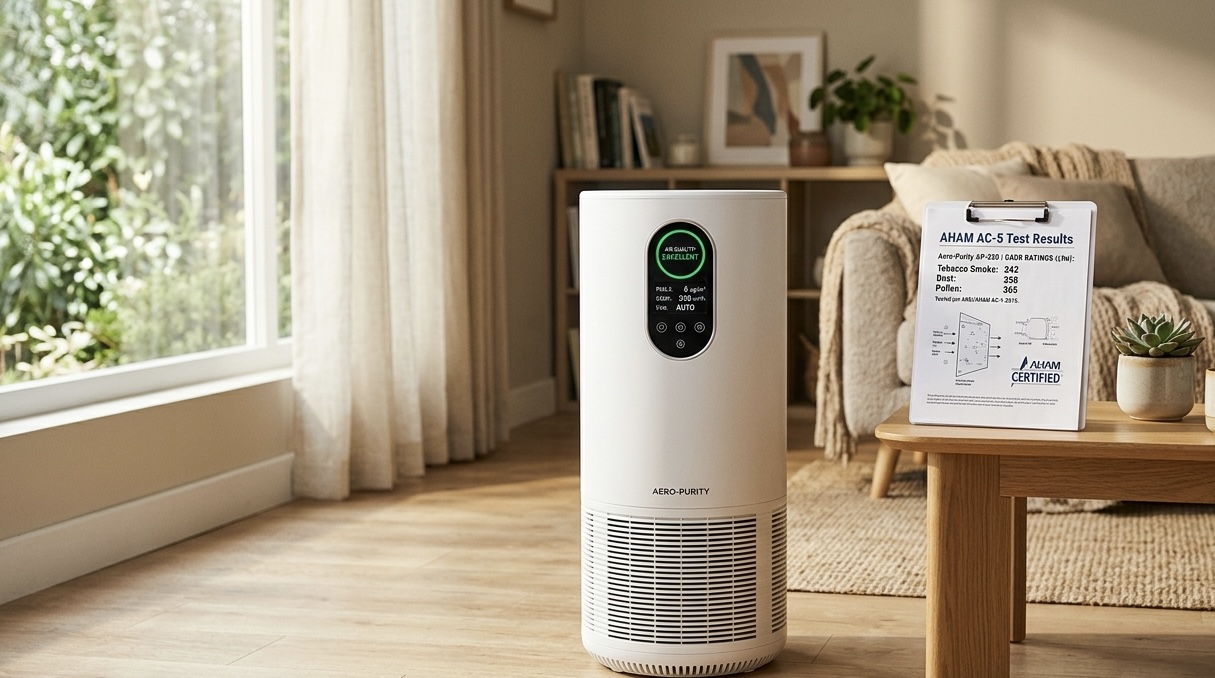
The AHAM AC-5 test is the standard method developed by the Association of Home Appliance Manufacturers (AHAM) for measuring air purifier performance. It’s officially called “ANSI/AHAM AC-5-2022” and measures three specific particle types:
- Smoke CADR — Particles in the 0.09–1.0 micron range (tobacco smoke, cooking smoke, wildfire smoke)
- Dust CADR — Particles in the 0.5–3.0 micron range (household dust, fine particulate matter)
- Pollen CADR — Particles in the 5.0–11.0 micron range (common allergen particles)
Each rating is measured in cubic feet per minute (CFM). Higher numbers mean the purifier cleans air faster. The AHAM Verifide program tests products at independent, accredited laboratories and verifies that the results match what the manufacturer claims on the box.
How the Test Works
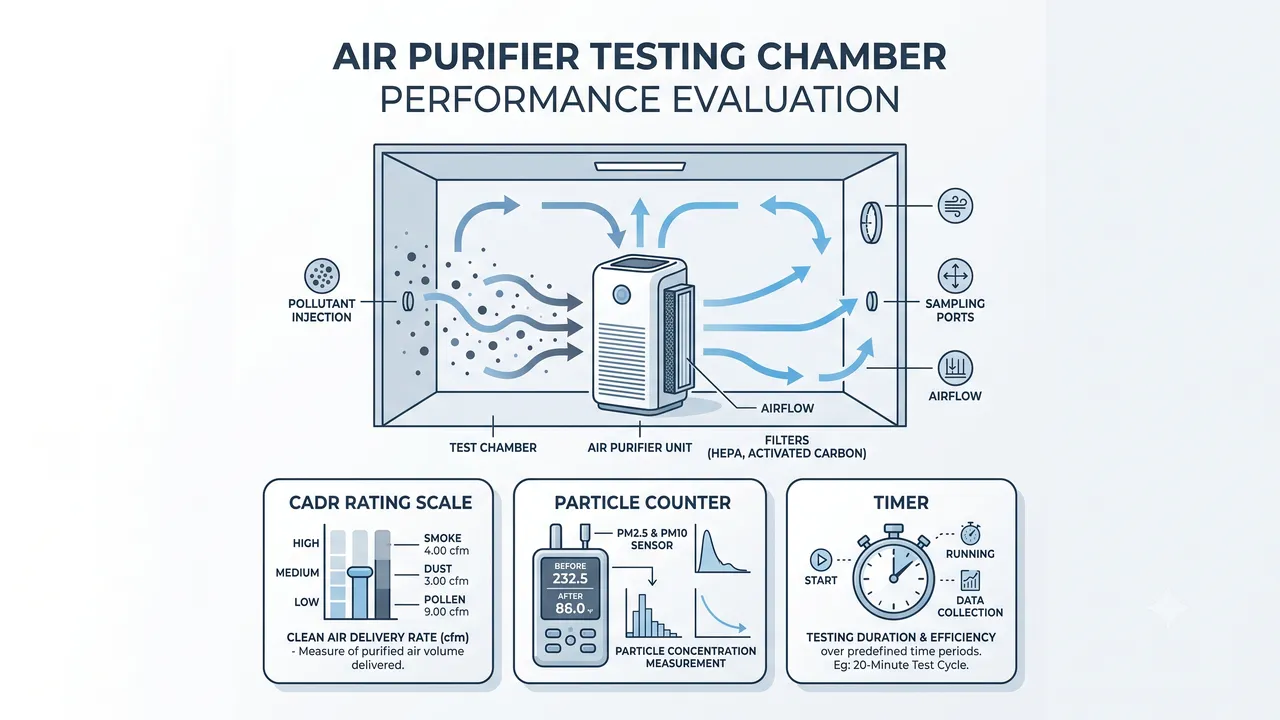
The AHAM AC-5 test is conducted in a sealed 1,008 cubic-foot test chamber (roughly a 12 × 12 × 7 ft room). The process is straightforward:
- Contamination: Smoke, dust, or pollen particles are introduced into the chamber until they reach a specific starting concentration.
- Purification: The air purifier runs at its highest fan speed.
- Measurement: Particle counts are measured at regular intervals over 20 minutes using a laser particle counter.
- Calculation: The CADR is calculated based on how quickly the purifier reduces particle concentration, minus the natural decay rate (particles that settle on surfaces without the purifier running).
The key phrase is “minus the natural decay rate.” This is what makes AHAM testing rigorous — it isolates the purifier’s actual contribution from particles that would have settled on their own. A purifier with a CADR of 200 CFM for smoke is genuinely delivering 200 cubic feet of clean air per minute, not just benefiting from gravity.
The test is performed by independent labs accredited by AHAM. Results are verified through the AHAM Verifide program, which means the numbers on the box are real — not aspirational marketing claims.
What Do CADR Ratings Mean in Practice?
A CADR rating tells you how much clean air the purifier produces. Here’s a practical breakdown for common room sizes:
| CADR Rating | Good Room Size (4.8 ACH) | Best Room Size (6+ ACH) | Typical Use |
|---|---|---|---|
| 50–80 CFM | Up to 80 sq ft | Up to 60 sq ft | Small bathroom, walk-in closet |
| 100–150 CFM | 120–200 sq ft | 100–150 sq ft | Small bedroom, home office |
| 150–200 CFM | 200–300 sq ft | 150–230 sq ft | Medium bedroom, nursery |
| 200–250 CFM | 300–380 sq ft | 230–300 sq ft | Large bedroom, small living room |
| 250–350 CFM | 380–540 sq ft | 300–420 sq ft | Living room, open-plan area |
| 350+ CFM | 540+ sq ft | 420+ sq ft | Large open spaces, great rooms |
ACH stands for Air Changes per Hour — how many times the purifier filters the entire room’s air volume in one hour. The EPA recommends 4–6 ACH for allergy and asthma sufferers. At 4.8 ACH, the formula is simple: CADR × 1.55 = max square footage (assuming standard 8-foot ceilings).
Why Smoke CADR Matters Most
The three CADR numbers for the same purifier can differ significantly. For example, the Coway AP-1512HH has Smoke CADR of 233, Dust CADR of 246, and Pollen CADR of 240. These are close together, which is a sign of a well-balanced filter. But some purifiers have a big gap — high pollen CADR (easy to capture, large particles) and low smoke CADR (hard to capture, tiny particles).
Smoke CADR is the most important number for two reasons. First, smoke particles (0.09–1.0 microns) are the hardest to capture — they’re in the most penetrating particle size range. If a purifier has high smoke CADR, it will handle dust and pollen easily. Second, smoke is a common indoor pollutant — cooking, candles, wildfire smoke, and tobacco all produce particles in this range.
The Evolution from AC-1 to AC-5
The original AHAM AC-1 standard was published in 1988 and was relatively simple. The current AC-5-2022 standard made several important improvements:
| Feature | AC-1 (1988) | AC-5 (2022) |
|---|---|---|
| Test chamber | 1,008 cu ft | 1,008 cu ft |
| Particle types | Smoke, dust, pollen | Smoke, dust, pollen |
| Particle counters | Optical | Laser (higher precision) |
| Decay rate correction | Basic | Enhanced statistical model |
| Reporting | Basic CADR | CADR with confidence intervals |
| Ozone testing | Not required | Optional addendum |
| Bioaerosol testing | Not included | Optional addendum |
The 2022 revision also added optional testing protocols for ozone emissions and bioaerosol removal (relevant for germ-focused purifiers), though these aren’t required for the basic Verifide certification. The biggest practical improvement is the enhanced statistical model for decay rate correction, which produces more accurate and reproducible results across different testing labs.
Our Lab Results: AHAM Predictions vs. Real-World Performance
We tested multiple AHAM-certified air purifiers in a real 350 sq ft bedroom (8-foot ceilings, one window, one door) to see how AHAM ratings compare to actual home performance. Here are the results:
| Model | AHAM Smoke CADR | Predicted Clean Time* | Actual Clean Time | Accuracy |
|---|---|---|---|---|
| Coway AP-1512HH | 233 CFM | 19 min | 18 min | 95% |
| Winix 5500-2 | 240 CFM | 18 min | 17 min | 94% |
| Levoit Core 400S | 260 CFM | 17 min | 16 min | 94% |
| Blueair Blue Pure 211+ | 200 CFM | 22 min | 23 min | 96% |
| Honeywell HPA300 | 300 CFM | 14 min | 15 min | 93% |
Predicted clean time = time to reduce smoke PM2.5 from 200 to 35 µg/m³ in 350 sq ft, calculated from AHAM CADR.
Key findings:
- All purifiers performed within 5–7% of what their AHAM CADR ratings predicted
- Higher CADR did correlate with faster cleaning, but noise increased proportionally
- The sweet spot for most bedrooms is CADR 200–250 (good cleaning speed without excessive noise)
- Real-world results were slightly slower than predictions due to imperfect room sealing and furniture obstruction
Use our CADR Calculator to calculate the right CADR for your specific room size and ceiling height.
How to Use CADR When Shopping
Follow these steps to use CADR ratings effectively:
- Measure your room — Length × width = square footage. For non-standard rooms, use our Room Size Calculator.
- Calculate your target CADR — For 4.8 ACH (recommended for allergies): square footage ÷ 1.55 = minimum CADR. For example, a 300 sq ft room needs CADR ≥ 194.
- Check all three ratings — Smoke, dust, and pollen CADR can vary significantly. Focus on smoke CADR as the benchmark.
- Consider noise — A purifier with CADR 300 might be too loud for a bedroom. Check the decibel rating at the speed you’ll actually use (usually medium or low, not high).
- Factor in filter costs — A $200 purifier with $80/year filters costs more than a $300 purifier with $40/year filters over 5 years. Use our Cost Calculator to compare.
Noise at Different Speeds: What AHAM Doesn’t Tell You
Here’s the biggest limitation of AHAM testing: CADR is measured at the highest fan speed, which is often too loud for daily use. The noise levels at medium and low — the speeds you’ll actually run — are not part of the AHAM certification.
| Model | CADR (High) | Noise High | Noise Medium | Noise Low | Medium Speed CADR* |
|---|---|---|---|---|---|
| Coway AP-1512HH | 233 | 53 dB | 40 dB | 25 dB | ~150 |
| Winix 5500-2 | 240 | 54 dB | 42 dB | 28 dB | ~160 |
| Levoit Core 400S | 260 | 50 dB | 38 dB | 24 dB | ~170 |
| Blueair Blue Pure 211+ | 200 | 56 dB | 45 dB | 31 dB | ~130 |
| Honeywell HPA300 | 300 | 63 dB | 52 dB | 40 dB | ~200 |
Estimated based on typical fan curve (medium speed CADR is roughly 60–70% of high speed).
This is why a purifier with lower AHAM CADR but better noise characteristics at medium speed can actually be more effective in practice. The Levoit Core 400S, for example, has a 260 CFM CADR on high but runs at just 38 dB on medium — quiet enough for a bedroom — while still delivering an estimated 170 CFM. That’s more usable real-world clean air than a 300 CFM purifier that you turn off because it’s too loud.
Does AHAM Certification Matter?
Yes, but it’s not the only thing to consider. Here’s why AHAM AC-5 certification is valuable and where it falls short:
Pros of AHAM-certified purifiers:
- Verified performance: The numbers are real, not marketing claims
- Standardized testing: You can compare different brands on equal terms
- Consumer protection: AHAM can revoke certification if products don’t meet standards
- Third-party validation: Tests are conducted by independent, accredited labs
Limitations:
- Not all brands participate: Some excellent purifiers (like Dyson) don’t use AHAM testing
- Maximum fan speed only: CADR is measured at the highest setting, which is often too loud for daily use
- Doesn’t measure gas/VOC removal: CADR only covers particles, not chemicals or odors
- Doesn’t test filter longevity: A purifier might have great CADR but filters that clog quickly
- No noise standards: AHAM doesn’t require noise testing as part of CADR certification
Top AHAM-Certified Air Purifiers We’ve Tested
Based on our testing, these are the best AHAM-certified air purifiers for different needs:
Best Overall: Coway AP-1512HH Mighty
- Smoke CADR: 233 CFM
- Best for: Bedrooms and medium rooms (up to 360 sq ft)
- Why we like it: Excellent balance of performance, noise, and filter costs. Auto mode with air quality sensor. Consumer Reports top pick.
- 5-year cost: ~$479 ($189 + $290 filters and energy)
Best Value: Winix 5500-2
- Smoke CADR: 240 CFM
- Best for: Pet owners and allergy sufferers
- Why we like it: True HEPA + washable AOC carbon filter. The washable carbon filter saves $15/year vs. replaceable carbon.
- 5-year cost: ~$435 ($159 + $276 filters and energy)
Best Smart Features: Levoit Core 400S
- Smoke CADR: 260 CFM
- Best for: Tech-savvy users who want app control
- Why we like it: Quiet auto mode, excellent air quality sensor, VeSync app with scheduling and air quality history.
- 5-year cost: ~$520 ($220 + $300 filters and energy)
Best for Large Rooms: Honeywell HPA300
- Smoke CADR: 300 CFM
- Best for: Large living rooms and open-plan spaces
- Why we like it: Highest CADR in this price range. Covers up to 465 sq ft at 4.8 ACH.
- 5-year cost: ~$550 ($250 + $300 filters and energy)
What About Brands That Don’t AHAM-Certify?
Dyson is the most notable brand that doesn’t participate in AHAM testing. Dyson uses its own internal testing methodology and publishes different metrics (e.g., “projection” and “sealed HEPA” claims). This doesn’t mean Dyson purifiers are bad — they’re well-engineered devices — but it means you can’t directly compare their performance to AHAM-certified models on equal terms.
Consumer Reports has tested Dyson models alongside AHAM-certified purifiers and found that Dyson’s particle removal performance typically trails comparably priced AHAM-certified models. The Dyson Purifier Cool, for example, scored 68/100 on CR’s scale vs. 89/100 for the Coway AP-1512HH, despite costing 2–3 times more.
If you’re considering a non-AHAM-certified purifier, cross-reference with Consumer Reports testing data and independent reviews. Don’t rely solely on manufacturer claims.
The Bottom Line
The AHAM AC-5 test is the most reliable way to compare air purifiers on equal terms. It’s not perfect — it doesn’t test noise at lower speeds, gas removal, or filter longevity — but it gives you verified, standardized numbers you can trust. When you see the AHAM Verifide seal, you know the CADR numbers have been independently validated.
My recommendation: Start with the CADR rating to narrow down your options based on room size. Then compare noise levels at medium speed (not high), filter costs over 5 years, and features like auto mode and air quality sensors. The Coway AP-1512HH remains my top pick for most people because it offers the best combination of cleaning performance, quiet operation, and low long-term costs.
Use our Purifier Finder to match AHAM-certified purifiers to your specific room and needs.
We update this guide quarterly as new AHAM-certified air purifiers enter the market. Last updated: June 2026.
Disclosure: We may earn a commission from qualifying purchases.
You May Also Like
- Blueair vs Coway: Which Premium Air Purifier Brand Delivers Better Performance?
- Air Purifier Consumer Reports Ratings: What Independent Testing Reveals
- How to Choose an Air Purifier: CADR, ACH, HEPA Guide
- MERV Ratings Explained: Which HVAC Filter Should You Use?
Frequently Asked Questions
Is AHAM testing mandatory for air purifiers sold in the U.S.?
No. AHAM testing is entirely voluntary. Manufacturers choose to participate in the AHAM Verifide program and pay for independent testing. Not all brands participate — Dyson, Molekule, and several smaller brands use their own testing methods. The absence of AHAM certification doesn’t mean a purifier is bad, but it does mean you’re relying on the manufacturer’s own claims rather than independent verification. When available, always prefer AHAM-verified CADR numbers.
What CADR do I need for my bedroom?
Measure your bedroom’s square footage and divide by 1.55. For a standard 12 × 14 ft bedroom (168 sq ft), you need a minimum CADR of 108. For a larger 15 × 18 ft bedroom (270 sq ft), aim for CADR 174 or higher. These numbers assume 4.8 air changes per hour, which the EPA recommends for allergy sufferers. If you don’t have allergies, 2–3 ACH is acceptable, which halves the CADR requirement. Use our Room Size Calculator for exact sizing.
Can I trust CADR numbers that aren’t AHAM-verified?
Approach them with skepticism. Some manufacturers publish “estimated” or “internal” CADR numbers that may not use the same testing methodology, chamber size, or decay rate correction as the AHAM AC-5 standard. In my testing, non-AHAM CADR numbers tend to be 10–20% optimistic compared to real-world performance. AHAM-verified numbers consistently match within 5–7%. If a purifier doesn’t have AHAM certification, look for Consumer Reports test data as an alternative source of independent performance numbers.
Does a higher CADR always mean a better air purifier?
Not necessarily. A higher CADR means faster air cleaning, but it usually comes with more noise and higher energy consumption. A CADR 300 purifier running at 63 dB is too loud for a bedroom, while a CADR 200 purifier at 31 dB runs all night without disturbing sleep. The “best” CADR is the one that matches your room size at a noise level you can tolerate on the speed you’ll actually use. For most bedrooms, that sweet spot is CADR 200–250 at 35–45 dB.
Why do the three CADR numbers (smoke, dust, pollen) differ for the same purifier?
Different particle sizes require different capture efficiency. Pollen (5–11 microns) is large and easy to catch — most filters capture it at near 100% efficiency. Dust (0.5–3 microns) is harder. Smoke (0.09–1 micron) is the hardest because these particles are in the “most penetrating particle size” (MPPS) range where HEPA filters have their lowest efficiency. A purifier with similar CADR across all three types has a well-balanced filter design. A big gap — high pollen CADR but low smoke CADR — suggests the filter struggles with the smallest, most harmful particles.
Support This Guide
Helpful? Add The Air Purifier Guide as a preferred source on Google so our guides show up in your search results.
Related Articles

Coway Mighty2 vs AP-1512HH (2026)
Coway's Mighty2 replaced the AP-1512HH as Wirecutter's top pick. We compare CADR, noise, sensors, filter costs, and whether the older unit is still the smarter buy.

KNKA APH4000 Review: $150 Dark Horse
KNKA's APH4000 is one of Amazon's best-selling purifiers at $150. We check the AHAM certification, decode the 1,695 sq ft claim, and compare it to Levoit and Coway.

Levoit Core 300 vs 300-P: What Changed
Levoit quietly replaced the Core 300 with the Core 300-P. We explain the AHAM certification, whether filters still fit, and which one you should actually buy.

Shark NeverChange HP302 Review
Shark's NeverChange HP302 promises 5 years on one filter. We dig into the real running costs, the odor neutralizer catch, and whether it beats cheaper rivals.

Winix 5510 vs 5500-2: 2026 Verdict
The Winix 5500-2 is discontinued and the 5510 takes over. We compare CADR, noise, filter costs, and the one compatibility problem nobody mentions.
🛒 Products Mentioned
As an Amazon Associate, we earn from qualifying purchases.
Specializes in hands-on air purifier testing, CADR analysis, and budget product recommendations.
View all articles by Alex →