A friend texted me last week: “My whole family has COVID. Should I buy an air purifier?” She’d read conflicting advice online, some sources said HEPA filters stop viruses, others said they’re useless. She didn’t know who to trust.
So I did what I do for a living: I read the research. Not blog posts, not marketing claims, the actual peer-reviewed studies and government guidance. What I found surprised me: the evidence for air purifiers and virus protection is stronger than most people think, but the details matter more than the headlines.
Here’s what the science actually says.
TL;DR: Can an Air Purifier Protect You from COVID?
Yes, but it’s not a magic shield. A True HEPA air purifier can capture virus-sized particles (0.1-1 microns) with 99.97% efficiency. The EPA recommends HEPA air purifiers as one layer of protection against airborne viruses.
Important: Air purifiers are a supplement, not a replacement for ventilation, vaccination, and hand hygiene. The CDC recommends improving ventilation as the first line of defense.
What Does the Research Actually Say?
Let me walk through the key studies, not marketing claims, but peer-reviewed research and government guidance.
The EPA’s Official Position
The U.S. Environmental Protection Agency states clearly:
“When used properly, air cleaners and HVAC filters can help reduce airborne contaminants including viruses in a building or small space.”
Their specific recommendation: choose a purifier that is HEPA-certified and rated to remove particles in the 0.1-1 micron range, that’s exactly the size of SARS-CoV-2 virus particles.
The EPA also warns: air cleaning alone is not enough. It should be combined with ventilation and source control (like isolating sick family members).
2025 Research: HEPA Filters in Hospital Settings
A 2025 study published in Frontiers in Environmental Health tested HEPA filtration in real hospital environments, both regular wards and ICUs. The results were mixed: HEPA reduced viral RNA in some settings but not others, depending on room size, airflow, and how many people were present.
What this means for you: Hospital settings are very different from homes. In a home environment with fewer people and less foot traffic, HEPA purifiers are likely more effective because there’s less re-contamination.
Frankfurt University: 90% Virus Reduction
Researchers at Goethe University in Frankfurt tested mobile HEPA air purifiers in real rooms and found they reduced airborne virus concentration by 90%. This is a significant reduction, if you’re in a room with someone who’s sick, a HEPA purifier can dramatically lower the number of virus particles you’re breathing in.
2024 Systematic Review: Confirmed High Efficiency
A 2024 systematic review on ScienceDirect analyzed multiple studies on HEPA filters and COVID-19 virus removal. The conclusion: HEPA filters have high efficiency in removing COVID-19 virus from the air.
The review also noted that real-world effectiveness depends on:
- Room size vs. purifier CADR rating
- How long the purifier runs
- Whether doors and windows are closed
- Filter condition (old filters are less effective)
CIDRAP Review: 672 Studies Analyzed
The Center for Infectious Disease Research and Policy (CIDRAP) at the University of Minnesota, together with NIOSH, conducted the largest review to date, 672 studies published from 1929 to 2024 on air-cleaning technologies.
Key findings:
- Most studies (90%) only tested environmental samples, not actual human infection rates
- Only 8% included human participants
- The technology works in lab settings, but real-world evidence on infection prevention is still limited
Bottom line: The science strongly supports that HEPA air purifiers remove viruses from the air. Whether that translates to fewer actual infections is still being studied, but the physics is clear: fewer virus particles in the air = lower risk.
How HEPA Filters Capture Viruses
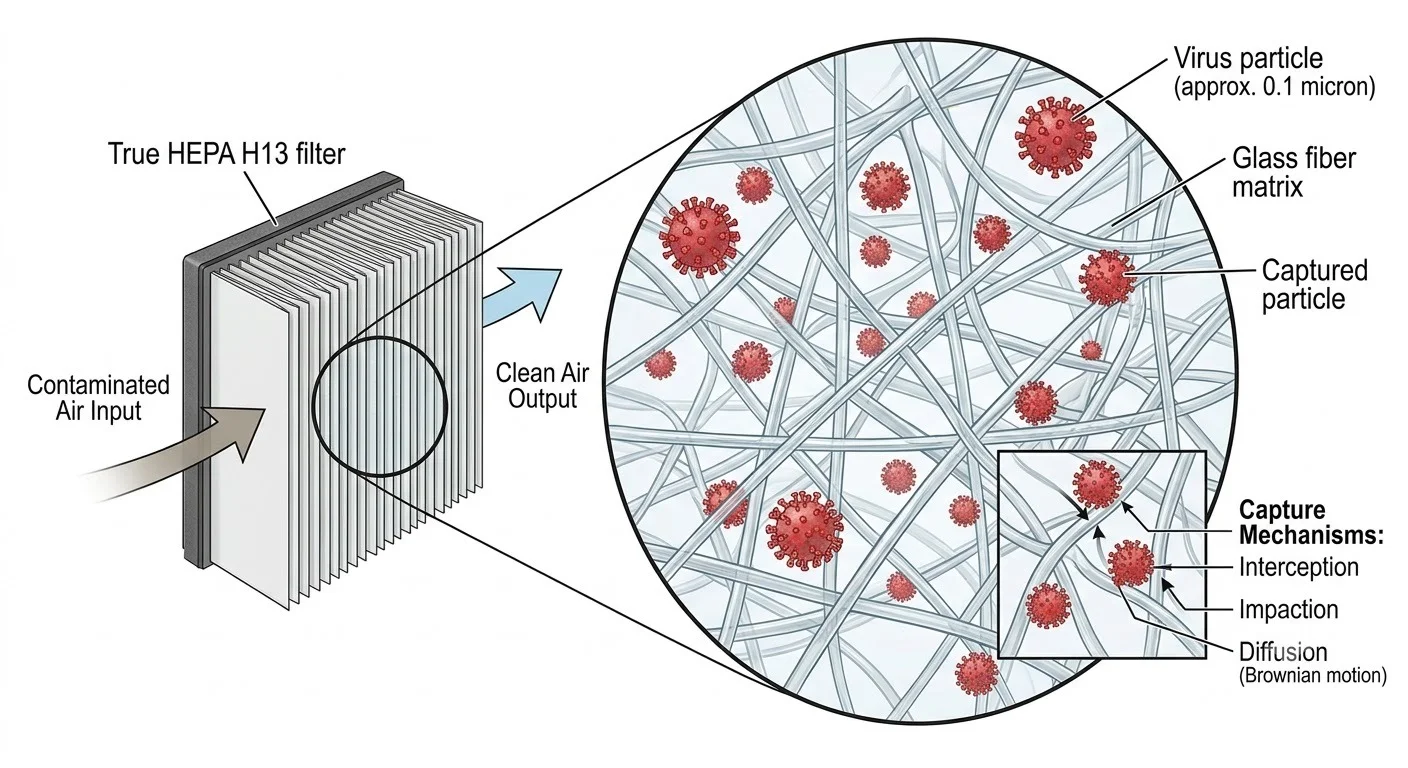
HEPA stands for High-Efficiency Particulate Air. A True HEPA filter must capture 99.97% of particles at 0.3 microns, that’s the hardest size to filter (the “Most Penetrating Particle Size” or MPPS).
SARS-CoV-2 virus particles are about 0.1 microns, smaller than the MPPS. But HEPA filters actually capture particles smaller than 0.3 microns even more efficiently through a process called diffusion (tiny particles bounce around randomly and get stuck in the filter fibers).
| Particle Size | What It Is | HEPA Capture Rate |
|---|---|---|
| 0.1 microns | SARS-CoV-2 virus | ~99.99% |
| 0.3 microns | HEPA test standard | 99.97% (required) |
| 1.0 microns | Bacteria, large droplets | 99.99%+ |
| 10 microns | Dust, pollen | 99.99%+ |
The smaller the particle, the easier it is for HEPA to capture. This is counterintuitive but well-established in filtration science.
HEPA vs UV-C vs Ionizer: Which Kills Viruses?
There are three main “anti-virus” technologies in air purifiers. Here’s how they compare:
| Technology | How It Works | Effectiveness | Safety Concerns |
|---|---|---|---|
| True HEPA | Physically traps particles in filter fibers | Proven 99.97%+ | None, safe 24/7 |
| UV-C Light | Damages virus DNA/RNA on contact | Only on surfaces it reaches | Safe if shielded |
| Ionizer | Charges particles so they stick to surfaces | Not proven for viruses | Can produce ozone |
| Ozone Generator | Oxidizes organic material | Not effective for viruses | Dangerous to breathe |
Our recommendation: Stick with True HEPA. It’s the most proven, safest, and most effective technology for virus removal. UV-C can be a useful add-on but shouldn’t replace HEPA.
Avoid ionizers and ozone generators. The EPA explicitly warns that ozone-generating air cleaners “are not safe to use when people are present.”
How to Use an Air Purifier for Maximum Virus Protection
Buying the right purifier is only half the battle. How you use it matters just as much.
Placement
The EPA recommends:
- Place in the room where you spend the most time
- Keep it central or between you and the potential source of infection
- Keep clear of obstructions, air needs to flow freely on all sides
- Don’t place it behind furniture or in a corner
Run Time
Run it continuously while the room is occupied. The longer it runs, the more virus particles it captures. The EPA specifically recommends running air cleaners “the entire time a space is occupied.”
Filter Maintenance
- Replace HEPA filters every 6-8 months (or as recommended by the manufacturer)
- A clogged filter is less effective, check it monthly during high-risk periods
- Use our Filter Lifespan Calculator to estimate replacement costs for your model
Room Size Matters
An air purifier that’s too small for your room won’t be effective. The general rule: your purifier should be able to cycle all the air in the room at least 4-5 times per hour (4-5 ACH).
Use our Room Size Calculator to find the right CADR rating for your space.
The 5-Layer Protection Strategy
The CDC and ASHRAE recommend a layered approach to virus protection. An air purifier is one layer, not the whole solution.
| Layer | What It Does | How Important |
|---|---|---|
| 1. Vaccination | Reduces severity and transmission | Highest |
| 2. Ventilation | Dilutes virus concentration with fresh air | Highest |
| 3. HEPA Air Purifier | Captures virus particles from recirculated air | High |
| 4. Hand Hygiene | Prevents surface-to-face transmission | High |
| 5. Masks | Blocks respiratory droplets | Medium |
An air purifier is most valuable when:
- You can’t open windows (winter, wildfire smoke, extreme heat)
- Someone in your household is sick
- You’re in a poorly ventilated space (many offices, classrooms)
- You’re immunocompromised or high-risk
What About DIY Air Purifiers (Corsi-Rosenthal Box)?
During the pandemic, DIY air purifiers made from box fans and furnace filters became popular. The EPA acknowledges that “evidence from multiple studies indicates that well-built DIY air cleaners can be of comparable effectiveness to commercial air cleaners.”
However, the EPA does not recommend DIY air cleaners as a permanent replacement for commercial HEPA purifiers because:
- Performance varies based on construction quality
- No standardized testing or certification
- Box fans can overheat (use fans made after 2012 with UL/ETL certification)
- They’re bulky, noisy, and unattractive
If you can afford a commercial HEPA purifier, buy one. If you can’t, a well-built Corsi-Rosenthal box is better than nothing.
The Bottom Line
HEPA air purifiers work for virus protection. The science is clear: True HEPA filters capture 99.97% of virus-sized particles. Multiple studies confirm they reduce airborne virus concentration by up to 90%.
But they’re not a magic shield. Use them as one layer in a multi-layer protection strategy that includes vaccination, ventilation, and hygiene.
If you’re looking for a purifier for virus protection, here are our recommendations:
- Best overall: Levoit Core 400S ($219) - True HEPA H13, quiet enough for 24/7 use
- Best for large rooms: Winix 5530 ($249) - 350+ sq ft coverage
- Best premium: Blueair 311i Max ($349) - HEPASilent technology, quietest option
Use our Purifier Finder to get a personalized recommendation.
You May Also Like
Support This Guide
Helpful? Add The Air Purifier Guide as a preferred source on Google so our guides show up in your search results.
Related Articles

Coway Mighty2 vs AP-1512HH (2026)
Coway's Mighty2 replaced the AP-1512HH as Wirecutter's top pick. We compare CADR, noise, sensors, filter costs, and whether the older unit is still the smarter buy.

KNKA APH4000 Review: $150 Dark Horse
KNKA's APH4000 is one of Amazon's best-selling purifiers at $150. We check the AHAM certification, decode the 1,695 sq ft claim, and compare it to Levoit and Coway.

Levoit Core 300 vs 300-P: What Changed
Levoit quietly replaced the Core 300 with the Core 300-P. We explain the AHAM certification, whether filters still fit, and which one you should actually buy.

Shark NeverChange HP302 Review
Shark's NeverChange HP302 promises 5 years on one filter. We dig into the real running costs, the odor neutralizer catch, and whether it beats cheaper rivals.

Winix 5510 vs 5500-2: 2026 Verdict
The Winix 5500-2 is discontinued and the 5510 takes over. We compare CADR, noise, filter costs, and the one compatibility problem nobody mentions.
🛒 Products Mentioned
As an Amazon Associate, we earn from qualifying purchases.
Covers indoor air quality science, respiratory health, allergy management, and wildfire smoke protection.
View all articles by Sarah →