You know that “new furniture smell”? The one that hits you when you walk into a room with a freshly assembled crib or dresser? That’s formaldehyde and VOCs (volatile organic compounds) off-gassing from particleboard, paint, and fabric treatments. And most parents have no idea it’s happening.
I didn’t either, until a pediatrician friend mentioned that she sees more respiratory issues in babies whose nurseries were furnished with new particleboard furniture. She said the first three months are the worst, when off-gassing is at its peak. That got me digging into the research.
What I found changed how I think about nursery setup. It’s not just about crib safety and outlet covers, the air your baby breathes matters just as much.
TL;DR: Should You Worry About VOCs in the Nursery?
Yes, especially if you have new particleboard or MDF furniture. New cribs, dressers, and changing tables off-gas VOCs and formaldehyde for months. The EPA identifies indoor air quality as one of the top five environmental risks to public health.
What helps:
- Ventilation (open windows when possible)
- An air purifier with activated carbon (not just HEPA)
- Choosing low-VOC or GREENGUARD Gold certified furniture
- Letting new furniture off-gas in a separate room before moving it to the nursery
What doesn’t help:
- Air fresheners (they add more VOCs, just mask the smell)
- HEPA-only purifiers (they capture particles, not gas molecules)
- Ignoring it because “everyone uses particleboard furniture”
What’s Actually in Your Baby’s Nursery Air?
New nursery furniture releases a cocktail of chemicals into the air. Here’s what you’re dealing with:
Formaldehyde is the biggest concern. It’s used in the adhesives that hold particleboard, MDF, and plywood together. The EPA classifies formaldehyde as a known human carcinogen. New furniture releases the most formaldehyde in the first 3 months, but can continue off-gassing for up to 5 years.
VOCs (Volatile Organic Compounds) are a broader category that includes formaldehyde plus chemicals like benzene, toluene, and xylene. These come from paint, varnish, fabric treatments, and carpet. VOCs cause eye, nose, and throat irritation, headaches, and nausea.
Dust and allergens accumulate quickly in nurseries. Pet dander, dust mites, and pollen all settle on soft surfaces like crib bedding and stuffed animals.
A 2025 study published in REHVA Journal tested portable air purifiers in real nurseries and found they significantly reduced PM2.5 levels both in winter and summer. The study confirmed that air purifiers are effective at improving air quality in baby rooms.
Why Children Are More Vulnerable
Children are not just small adults. Their bodies process air pollutants differently, and the consequences are more severe.
They breathe faster. A newborn takes 30-60 breaths per minute, compared to 12-20 for adults. This means they inhale proportionally more pollutants per unit of body weight.
They’re closer to the source. Babies spend most of their time on the floor or in a crib, where heavier-than-air VOCs concentrate. Formaldehyde is heavier than air and settles near the ground.
Their organs are still developing. A 2025 study found that ambient formaldehyde exposure increased hospital admission risks for respiratory diseases in children, especially during high-temperature periods.
Long-term exposure matters. Moms Clean Air Force reports that children chronically exposed to elevated formaldehyde face increased risks of developing allergies and asthma.
HEPA vs Carbon: What You Actually Need
This is where most parents get confused. There are two types of filtration, and you need both:
| Filter Type | What It Captures | Do You Need It? |
|---|---|---|
| True HEPA | Particles: dust, pollen, pet dander, mold spores (99.97% at 0.3 microns) | Yes |
| Activated Carbon | Gases: VOCs, formaldehyde, odors, chemical fumes | Yes, for VOCs |
| HEPA only | Particles only | Not enough for nursery |
| Carbon only | Gases only | Not enough for nursery |
The problem: Most cheap air purifiers only have HEPA. They do nothing for VOCs and formaldehyde, which are the primary concern in a nursery with new furniture.
The solution: Buy a purifier with both True HEPA and a substantial activated carbon filter. The bigger the carbon filter, the better it performs against VOCs.
Carbon Filter Size Matters
Not all carbon filters are equal:
| Model | Carbon Filter | Effectiveness |
|---|---|---|
| Levoit Core 400S | ~1 lb carbon pellet blend | Good for small rooms |
| Winix 5530 | ~0.5 lb carbon pellet blend | Moderate |
| Blueair 311i Max | Carbon sheet (thin) | Basic odor only |
For a nursery with new furniture, you want at least 1 lb of activated carbon. If you’re dealing with strong off-gassing (new particleboard dresser, fresh paint), consider a model with more carbon.
How to Set Up the Nursery Air Purifier
Buying the right purifier is only half the battle. How you set it up matters just as much.
Before the Baby Arrives
Start 2-4 weeks early. New furniture off-gasses the most in the first few weeks. Run the purifier continuously with the nursery door closed to reduce VOC levels before the baby uses the room.
Pre-off-gas new furniture. If possible, assemble new furniture in a garage or spare room first. Let it air out for 2-4 weeks before moving it to the nursery. The BabyCenter community recommends keeping the room warm and ventilating occasionally to speed up off-gassing.
Placement
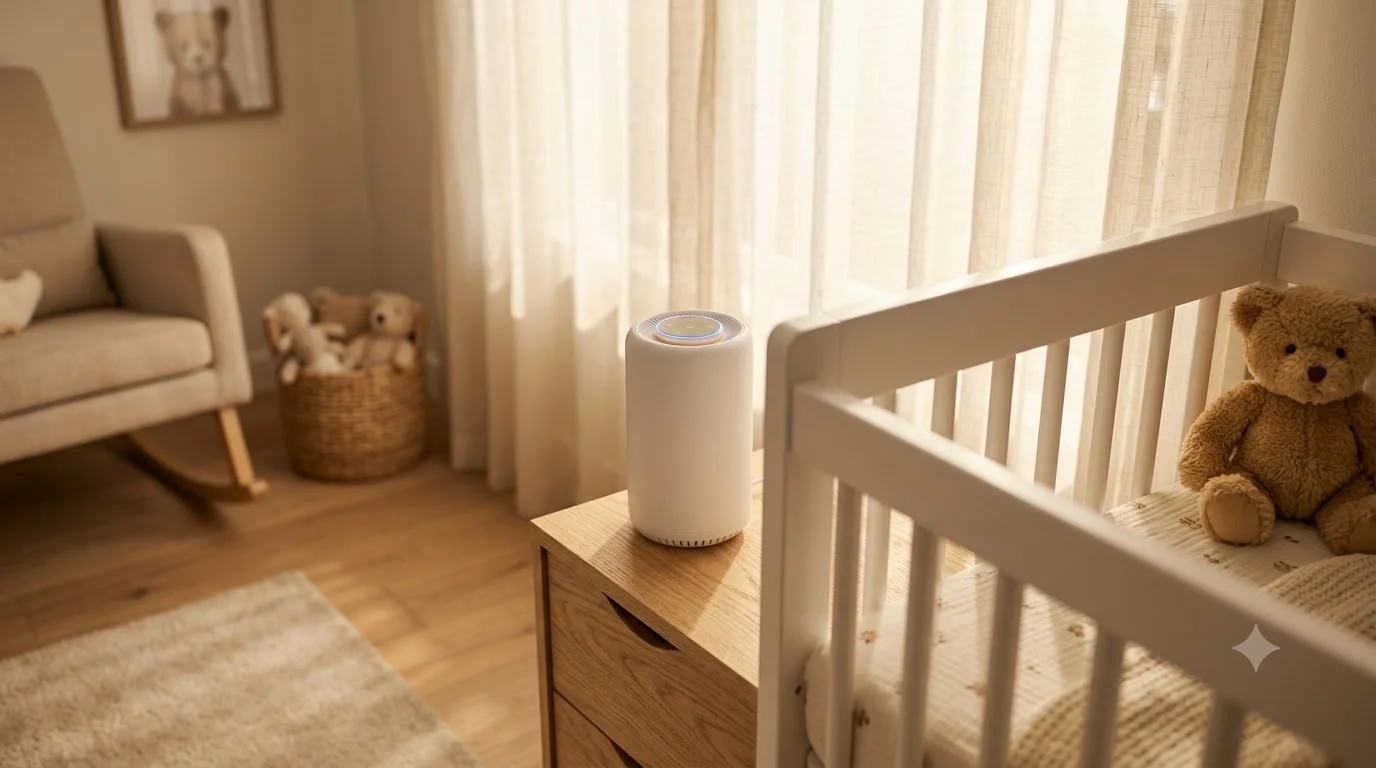
- Place the purifier near the source of VOCs (next to the new dresser or crib)
- Keep it at least 3 feet from the crib so the baby can’t reach it
- Keep it clear of obstructions on all sides
- Don’t place it behind furniture or in a corner
Run Time
Run it 24/7. VOCs off-gas continuously, not just when you can smell them. The purifier needs to run constantly to keep levels low. On low speed, the Levoit Core 400S uses only about 15W (less than a light bulb).
Filter Maintenance
- Replace the HEPA filter every 6-8 months
- Replace the carbon filter every 3-6 months (carbon saturates faster when absorbing VOCs)
- Use our Filter Lifespan Calculator to track replacement dates and costs
- Check the filter monthly during the first year (when off-gassing is highest)
Other Ways to Reduce VOCs in the Nursery
An air purifier is one layer of protection. Here are others:
Choose low-VOC furniture. Look for GREENGUARD Gold certified products, which meet strict chemical emission limits. Solid wood furniture releases far fewer VOCs than particleboard. It costs more, but for a nursery, it’s worth considering.
Use low-VOC or zero-VOC paint. Standard paint releases VOCs for months after application. Low-VOC paints dry with minimal off-gassing. Most major paint brands now offer low-VOC options.
Ventilate regularly. Open windows when weather permits, especially during the first few months after new furniture arrives. Cross-ventilation (windows on opposite sides of the room) is most effective.
Keep the room warm. Higher temperatures increase off-gassing speed. If you can, keep the nursery warm (72-75°F) with windows open for the first 2-4 weeks to accelerate the initial off-gassing period.
Avoid synthetic fragrances. Air fresheners, scented candles, and plug-in diffusers add more VOCs to the air. They mask odors but make the problem worse.
Common Mistakes Parents Make
Buying a HEPA-only purifier. HEPA filters capture particles, not gases. If your main concern is VOCs from new furniture, a HEPA-only purifier won’t help.
Placing the purifier in the wrong spot. Don’t put it in a corner or behind furniture. Air needs to flow freely on all sides.
Turning it off during the day. VOCs off-gas 24/7, not just at night. Run the purifier continuously.
Forgetting to replace the carbon filter. Carbon filters saturate faster than HEPA filters. If you only replace the HEPA filter, the carbon stops working and VOCs pass through.
Relying only on the purifier. Ventilation is still important. Open windows when you can, especially during the first few months.
The Bottom Line
New nursery furniture releases VOCs and formaldehyde that can harm your baby. The research is clear: children are more vulnerable to these chemicals, and the first few months after furniture purchase are the most dangerous.
An air purifier with True HEPA + activated carbon is the most effective way to reduce these pollutants. But it’s not the only thing you should do: ventilate, choose low-VOC furniture, and avoid synthetic fragrances.
If you’re buying a purifier for the nursery, the Levoit Core 400S ($219) is a good choice. It has both HEPA and carbon filtration, runs quietly at 24 dB, and the WiFi app lets you check air quality without entering the room.
Start running it 2-4 weeks before the baby arrives. VOC levels are highest when furniture is new. Give the purifier time to clean the air before your baby uses the room.
Use our Purifier Finder to get a personalized recommendation based on your nursery size and furniture type.
You May Also Like
Support This Guide
Helpful? Add The Air Purifier Guide as a preferred source on Google so our guides show up in your search results.
Related Articles

Coway Mighty2 vs AP-1512HH (2026)
Coway's Mighty2 replaced the AP-1512HH as Wirecutter's top pick. We compare CADR, noise, sensors, filter costs, and whether the older unit is still the smarter buy.

KNKA APH4000 Review: $150 Dark Horse
KNKA's APH4000 is one of Amazon's best-selling purifiers at $150. We check the AHAM certification, decode the 1,695 sq ft claim, and compare it to Levoit and Coway.

Levoit Core 300 vs 300-P: What Changed
Levoit quietly replaced the Core 300 with the Core 300-P. We explain the AHAM certification, whether filters still fit, and which one you should actually buy.

Shark NeverChange HP302 Review
Shark's NeverChange HP302 promises 5 years on one filter. We dig into the real running costs, the odor neutralizer catch, and whether it beats cheaper rivals.

Winix 5510 vs 5500-2: 2026 Verdict
The Winix 5500-2 is discontinued and the 5510 takes over. We compare CADR, noise, filter costs, and the one compatibility problem nobody mentions.
🛒 Products Mentioned
As an Amazon Associate, we earn from qualifying purchases.
Covers indoor air quality science, respiratory health, allergy management, and wildfire smoke protection.
View all articles by Sarah →